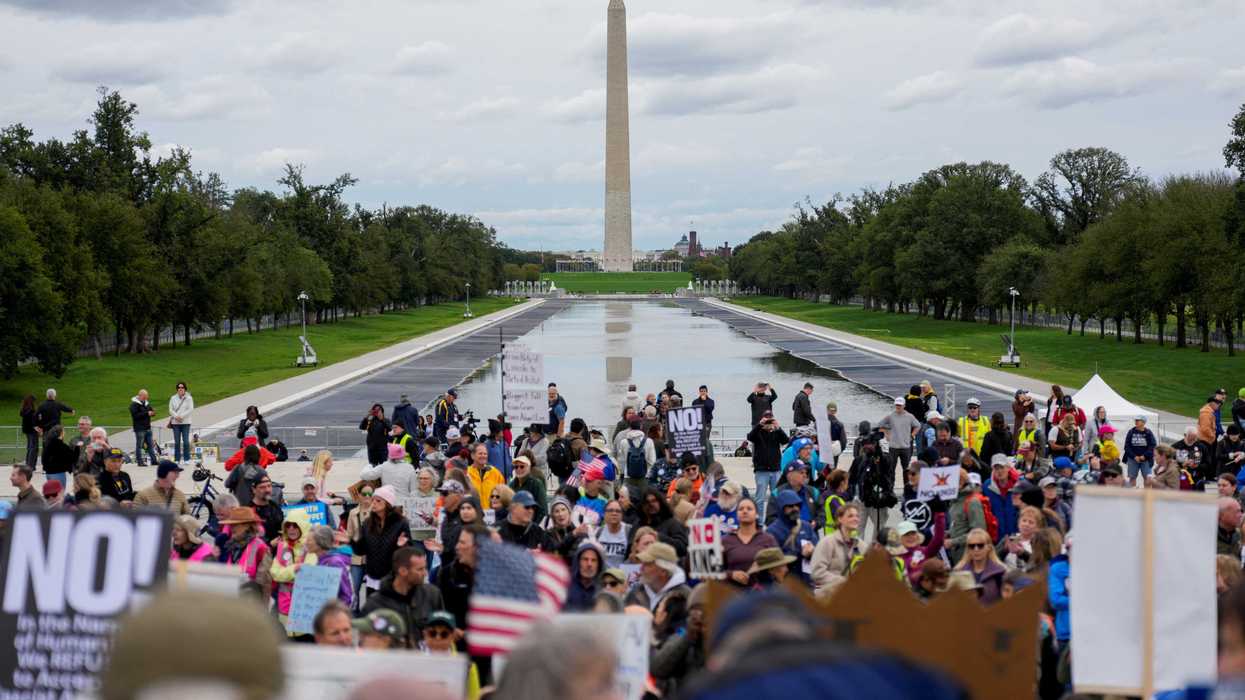
As President Donald Trump vows to redesign D.C. despite his historic 2026 midterm defeat, Congress is pushing back. Residents have also opposed Trump’s construction projects, including a monument and statue in his honor and the rebranding of the iconic Kimmel Center. Democrats promise to do what they can to stop and reverse Trump’s changes, calling them mere vanity projects.
Trump’s administration boasts that his construction projects have added value to the District. One White House spokesperson, Davis Ingle, told NPR in an email that "no other president has done more to beautify our Nation's interior than President Trump." Ingle pointed to park cleanups, the Reflecting Pool, and the White House helipad and ballroom as examples, and said Democrats "should work with President Trump to make our nation's capital beautiful again." But Democrats and residents say Trump’s projects jeopardize and erase the cultural landscape of the District.
Rep. Jared Huffman of California told NPR that the Trump administration has "played this game of Catch Me If You Can, where they roll ahead with the bulldozers and the tree cutters … and they wait for courts to shut them down." He says Democrats will use their congressional majority to challenge the administration. "There's no way that we could look away while these sacred, iconic places are being permanently changed in ways that violate the law and could have really terrible lasting impacts," Huffman added. He is the top Democrat on the House Natural Resources Committee, which has a legislative purview over public lands and national parks.
Earlier this week, Huffman sent notices ordering administration officials and private companies to preserve their records for a future investigation, vowing to hold everyone accountable. "Whether it is the arch or … or the East Potomac golf course or any number of other examples around the United States capital, that is federal land, and we have a direct statutory responsibility to either authorize those changes or to stop them if they're proceeding without the proper authorization," Huffman said.
There are several ways Democrats can enact the changes. They can pass laws to block specific projects. But with Trump vowing to “veto everything,” challenges may persist. However, there are other ways.
"Legislation in principle is the cleanest way of doing it, but it's also not achievable," said David Super, who teaches administrative and constitutional law at Georgetown. "So what they're likely to do is cut off funds."
The Constitution requires Congress to approve federal spending. However, Trump has not sought or received approval for projects such as the triumphal arch and White House ballroom, arguing that he does not need it.
Rep. Chellie Pingree of Maine is the top Democrat on the House committee that oversees funding for the Interior Department. "Certainly Congress should have been involved, because we have the power of the purse," Pingree told NPR. "That is our ultimate tool. And Republicans have refused to use that. But we can use that in very many ways to block him or to use it for leverage."
Pingree says Democrats could use their majority to draft spending bills that explicitly outline how federal funds can be used, while leaving open the possibility of suing the president if he ignores those restrictions.
She also says Trump is igniting the fire further by not prioritizing what Americans are most concerned about, such as economic relief. That gives Democrats the upper hand.
"They want the president to be focused on the issues they're dealing with: the cost of health care, the cost of food, the cost of gasoline," she said. "And if every time the president gives a speech, he's either standing in front of the Reflecting Pool, which he spent millions of dollars on, or showing you the new marble choices he's putting into the ballroom, it just makes a lot of people mad….After the first of the year, we will use every tool in our toolbox."