

Trump's loss of white bros sends the GOP into a death spiral
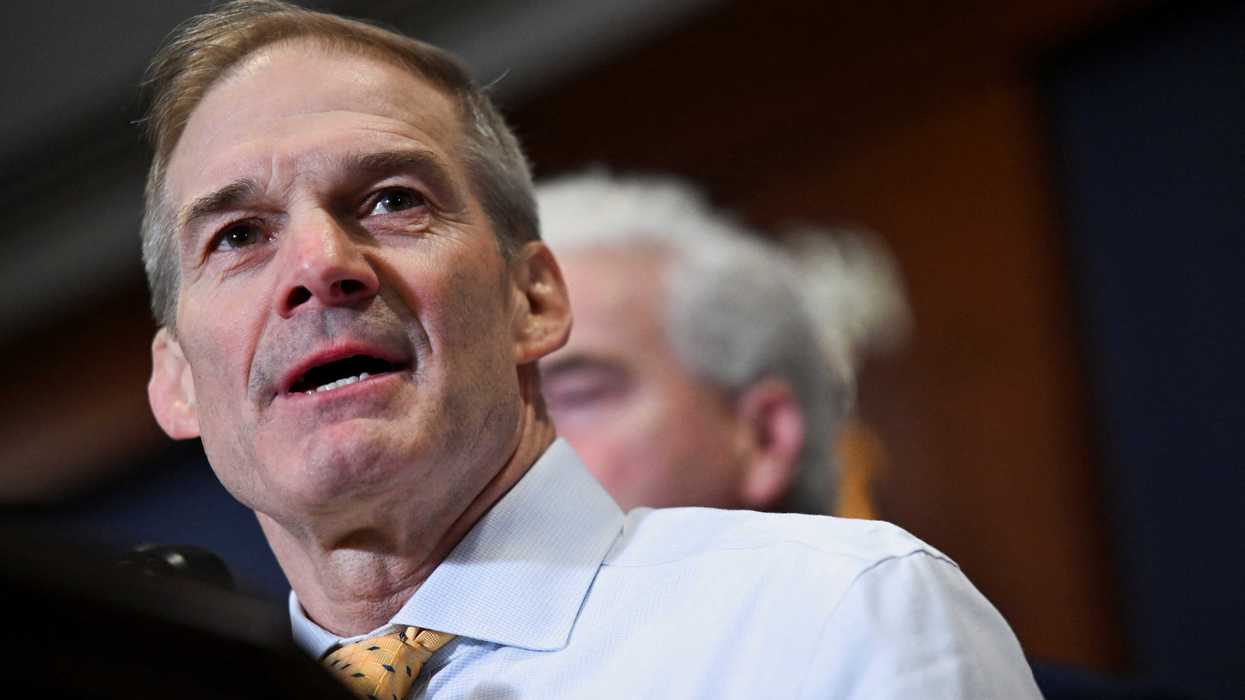
US Rep. Jim Jordan (R-OH) speaks during a press conference after Republicans in the US House of Representatives elected him to lead the chamber's incoming Republican minority during the final two years of President Donald Trump's presidency, at the US Capitol in Washington, DC, US, November 10, 2026.
Can MAGA survive the loss of the manosphere?
President Donald Trump never would have been elected, and then reelected, without the avid support of so-called "manosphere" influencers from podcaster Joe Rogan and former child star Jake Paul to right-wing activist Laura Loomer and self-proclaimed "pimp" Andrew Tate. As the group's informal name indicates, they cater overwhelmingly to men by dispensing — in varying degrees — a mix of right-wing political ideology, fitness advice, spiritual preachings and pop culture hot takes.
These are the same people who attempted a coup when Trump lost the 2020 presidential election. They made it cool to support Trump (and uncool to back his successor/predecessor, former President Joe Biden), and command audiences of millions to spread that message through both social and traditional media. Yet after catapulting Trump back to power in 2024, some people in the manosphere have cooled on Trump (see Rogan) while others are literally in jail (see Tate).
What's happening?
To learn more, AlterNet reached out to Ross Morales Rocketto. Rocketto's career in advocacy and electoral politics spans more than 20 years, including state and local campaigns in Texas (such as Julián Castro's first run for mayor of San Antonio in 2005), presidential organizing for John Edwards and Bill Richardson, serving as a political consultant and co-founding Run for Something, which recruits progressive young candidates for down ballot races. Now he is chief advocacy and culture change officer at Equimundo.
When AlterNet asked President Trump about Rocketto's observations, White House spokesman Davis Ingle said that “no other President in history has accomplished more for young men than President Trump, who is working tirelessly to create jobs, cool inflation, increase housing affordability, and more. The President has already made historic progress not only in America but around the world, and this is just the beginning as his agenda continues taking effect."
The following interview has been lightly edited for clarity, context and length.
What is the manosphere?
ROZSA: Would you agree with me that as a good working definition of manosphere, the term refers to political content aimed at men that is far right in its ideological thrust and which tends to play on the economic, gendered, and social vulnerabilities of the men themselves? Would you agree with that as a basic description?
ROCKETTO: Yeah. The only thing I would add to it is that I don't think it's just political. I think it's often not only political content. I think it actually becomes broader than political. But yes, I agree generally with that.
ROZSA: It includes fitness, spirituality, pop culture analysis. Absolutely. It is quite broad ranged.
ROCKETTO: Yep.
ROZSA: I have created for this interview four categories of manosphere influencers, and each category has four people in it. If you will give me just 30 seconds, I will go through these categories and then ask for your analysis on what defines the type of person that lands in said group. Does that make sense?
ROCKETTO: Sure.
ROZSA: Excellent. So you have:
- The jailed manosphere influencers, and by that I mean those who are literally incarcerated right now, such as Andrew and Tristan Tate, who are held in Miami pending UK extradition. They have not been convicted. Wes Watson, who pleaded guilty to aggravated battery in Miami-Dade and has separate charges pending in Broward for allegedly beating a woman. And Russell Brand, who was convicted of rape and sexual assault recently and is in custody pending his being transferred for the ten-and-a-half-year sentence.
- You have the Rogansphere, which includes people like Joe Rogan, Theo Von, Andrew Schulz, and Tony Hinchcliffe.
- You have the Rumblesphere, which includes people like Tim Pool, Fresh and Fit, and Steven Crowder.
- And you have the Trumpsphere, those who are directly aligned with the president, which includes people like Elon Musk, Logan and Jake Paul, and Laura Loomer.
What do you think of my groupings there?
ROCKETTO: Oh, wow. Okay. So the first one, the ones in jail — I think that's a really interesting framing for them. At some point you could include the fitness influencer who just got accused of rape, Clavicular. At some point you'll probably be able to include him in there. I don't know if they have a ton in common beyond the fact that they're charged with things and they're a part of the manosphere, but I think that's a really interesting thing. I just had not given it a ton of thought. I think the Rogan grouping is pretty good. Those folks are pick-and-choose-your-own-ideology, and sometimes they're political and often they're apolitical, but they have a political lens to them. People often talk about a Joe Rogan of the left. Joe Rogan endorsed Bernie Sanders in whatever year that was, 2016. And so I think those folks are ideologically flexible, and what they actually care about is making as much money as possible, and they will ride whatever vibes are out there. That doesn't mean that they aren't platforming or saying harmful things. I think you could put the Pauls in a bunch of different categories.
ROZSA: I put them as aligned with Trump because, much like Loomer and Musk, they have direct access to the president.
ROCKETTO: Yes. I think they're less political than — Laura Loomer is a political animal — they're less political than the Musks and the Laura Loomers of the world. But yes, they went to the fight night. They've aligned themselves directly with the administration. I actually think the Paul brothers are starting to try to distance themselves a tad bit from the administration now, because I think they're starting to realize it's not great for their brand. And again, a lot of these guys care much more about making money than they do ideology. But yeah, I think that's a really interesting grouping of folks. Some of them I'm like, "Oh yeah, that makes sense." And the other ones I'm like, "Oh, I hadn't thought about it like that before."
ROZSA: The one that you didn't get to was the Rumble sphere, the ones that are on Rumble, like Fresh and Fit, Crowder and Pool.
ROCKETTO: Yeah, that one does make sense to me. I didn't say it because that one also makes intuitive sense. That grouping checks out to me.
ROZSA: Here's why I grouped them as I did. And as I'm sure you can tell, I've done my research on the subject.
ROCKETTO: Yes.
ROZSA: It is because it represents different ways in which they influence people or can be stripped of said influence, because the Tate brothers, Watson and Brand have minimal, if any, influence left as a result of being in prison. I know they still have diehard followers who cling to every crumb that they toss from social media accounts, but generally speaking, their influence has been significantly curtailed because they are in prison. That's one group of manosphere influencer, and as you pointed out, Clavicular is making it a growing group of manosphere influencer. Then you have the ones like Joe Rogan, who, I agree with you again, have more mainstream appeal because they are flexible, because they aren't rigidly motivated by ideology, but are rather opportunistic. Then you have the Rumble sphere, who I believe are firmly political, people who can never scrub politics from their brands. People like, again, Pool, Fresh and Fit and Crowder. And then you have the Trump sphere, which is the people who have direct access to the president. The only possible revision I would have made to this list was putting Joe Rogan in the Trump sphere, but if I did that, I would have had to take him out of the Rogan sphere.
ROCKETTO: [laughs]
ROZSA: So the bottom line is this. I think I have covered most of the ways that young men are indoctrinated into the manosphere. It is either through direct political contact with the president and those who boost him, it is through far-right platforms such as Rumble or Kick or Truth Social or OAN or Newsmax or even countless YouTube channels, or it's through mainstream podcasters like the people in Joe Rogan's orbit. Would you agree with that analysis, or did I leave anyone out?
ROCKETTO: Yeah. And then I think there are folks who are a little bit further up. There are a lot of science podcasts that are not political at all. I think Andrew Huberman is in this group. He's not political, but he becomes a top of funnel for Joe Rogan and some of these other folks. And then I think they work up a chain, if that makes sense. It's not linear necessarily, but people get worked up a chain. You start by listening to things that are super mainstream and are maybe science or sports or some other niche, and then you end up going to another podcaster who has something similar, but is a little bit more political. And then you get into far-right stuff. So I think there are also folks that are even further up the pipeline on some of that, who are not intentionally doing that work, but because they exist on the internet, they are a top of funnel. If you talk to Andrew Huberman about it, he would be like, "That's not what I'm doing." But you can do mapping and see how you get from point A to point B.
Will President Trump be able to rely on the manosphere going forward?
ROZSA: How will this impact President Trump in terms of this ecosystem of influencers? How will the fact that a quarter of them are in jail and another quarter are abandoning them — and I'm referring to the jailed and Rogansphere groups respectively — how will Trump's political movement thrive or collapse as a result of where he stands with them now?
ROCKETTO: I mean, I think his political movement has collapsed. And I don't know that there's a ton of rebuilding of it that he can do. What I start to think about is, how do these movements reconstitute, and do they reconstitute around somebody else? One of the things that Trump did that was unique in the Republican Party is he united the cultural and political right in a way that previous candidates — you go back to Reagan, to be honest. Bush did a little bit, but it was really Reagan that coalesced the cultural and political right for the first time, really. Because those folks don't really like each other, and they don't trust one another either. So some of me is like, can somebody else unite these groups and rebuild this coalition with a slightly different flavor to it, because it won't feel the same as it did with Trump? Or do these groups break apart and the Republican Party is split in two? I think we don't know the answer to that question yet. I think the [2028] presidential election cycle is gonna show us what it becomes. I'd be real scared of Tucker Carlson, because he's the kind of person that could unite those two groups of people again. I think a traditional politician like JD Vance, Marco Rubio, et cetera, probably can't. Maybe one of the Trump kids. But I think it really depends on how the 2028 cycle plays out. To me, Trump's ability to move power that isn't institutional within the government — I think his large-scale influence on culture is nearing its end. And I think this election cycle showed that people's pocketbook issues matter more than one person, or even good vibes that they might appreciate in one elected.
ROZSA: I appreciate you being so thorough. However, I do need to know what you plan on doing to influence said 2028 narrative. You're the founder of White Dudes for Harris, after all. My sense is that you are not going to remain on the sidelines.
ROCKETTO: Well, now my full-time work is — I'm the chief advocacy and culture change officer at Equimundo. And we're a 501(c)(3) organization. But we do a lot of online work with young men, and that's the space that I'm largely gonna fill as we go into the 2028 cycle. I think one of the things that is important is that we're entering an era in U.S. politics where the electorate has gotten more flimsy than it's ever been. And by that, I mean less adherence to parties or structures than we've probably seen — for sure in my lifetime. We saw a 40-point movement from Republicans to Democrats for young men between 2024 and 2026 for this midterm election. I think those numbers are going to continue to swing until two things happen. One is one political party delivers for them. And the second is until we address some of the underlying issues that make men really prey for the politics of grievance. And I think that's the side of the work that I'm spending my time and energy on: How do we actually inoculate men, and especially young men, from grievance politics?
ROZSA: I think one of the clues is to help them see through manosphere lies, to help them see through the opportunism of the Rogansphere, or the extremism of the Rumblesphere, or the political maneuverings of the Trumpsphere, or the fact that people like Watson, the Tates, and Brand deserve to be in jail. When you show these things to young men and have them understand it, that makes a difference. But the question is, how do you get them to understand?
ROCKETTO: I think there's a couple of ways that you have to approach it. First, you gotta meet people where they're at, right? And I think that means without judgment, and I think it means from a place of empathy and compassion. I wrote a piece around the Cornell Seven, and I think this idea applies, which is that most people are not born monsters. Our society and the structures that exist in our society tell people how they can and should act. And I think we have to create different representations of what masculinity and what being a man can mean for folks. We need to create the permission structures for folks to actually act differently. And I think you do that by working with the folks who are directly talking to young men, and men more generally. And I think those are largely non-political actors. I think they're largely folks who are making content about gaming, sports, fitness — wherever people are on the internet, that's where we also need to be. And I think we need to do that not through an ideological prism. I think we need to do it through the prism of, how are we helping make these men's lives better in some way, shape or form? Whether that's helping them form in-person community and social connections and all that stuff. To me, the policy work and the political work obviously has to happen. It has to be done. I'm personally the most interested in the work that goes way further upstream and meets men where they're at.

