
Trump’s WH business deals expose a dark truth about Americans: analysis
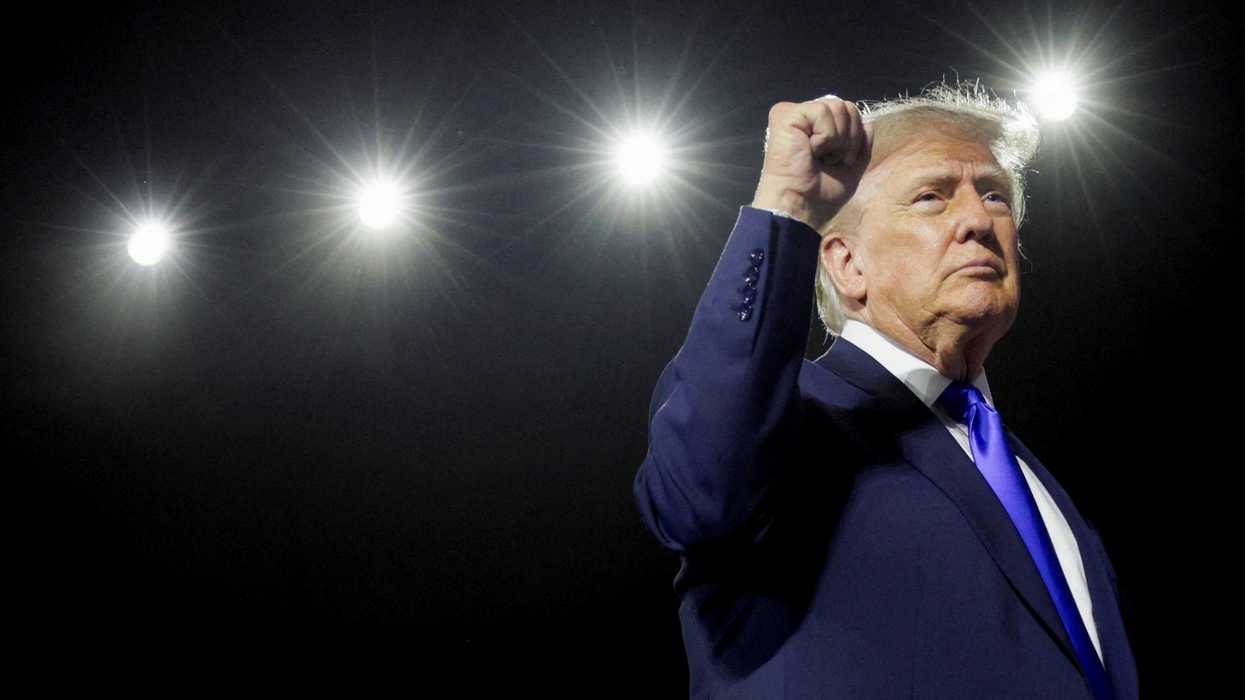
U.S. President Donald Trump in Dallas, Texas, U.S., September 9, 2026.
President Donald Trump is so fixated on making money, he is the first American president to openly pursue lucrative business interests while in office, earning more than $2 billion in the process. He has not only failed to conceal this, but actively boasted about it. As he has said over and over again, he believes the American public does not care if he is on the make while ostensibly serving them.
One scholar is able to put Trump's brazen attitude in its proper perspective.
In his 2021 book "Stuck Nation," radio host and journalist Bob Hennelly — who is currently general manager and national news executive producer at New York City's WBAI (99.5 FM), which is owned by Pacifica — explains that late-stage capitalist America prioritizes profits over people. Studying American history in depth, Hennelly demonstrates this point by unpacking the racism, sexism, xenophobia, anti-LGBTQ prejudice, antisemitism and other forms of prejudice that have shaped our past and present. Amidst all of this, however, Hennelly kept one point in focus:
American political culture values earning money over every other consideration.
Yet even within this broader sweep in American history, Trump represents an anomaly, a manifestation of this pre-existing phenomenon so egregious that he requires special attention. To provide those insights, AlterNet spoke exclusively with Hennelly.
The following interview has been lightly edited for clarity, context and length.
Trump personifies America's obsession with profit.
Matthew Rozsa: Now I want to talk about a theme in your book, Stuck Nation, which you also alluded to in your answer to my previous question: how America prioritizes profits over people. Trump did not by any means begin this trend. In fact, he is the product of that trend. But I still want your insights into how his second presidency has displayed the egregiousness of this problem in American political life.
Bob Hennelly: Well, I guess what happened was, in Trump 1.0, there was some residual level of Republican old heads that were hanging around the periphery of what he was doing, right? But then you saw that in the second term, the ideologues were very much in charge. You had Russell Vought at OMB, a return performance, and at that point, they knew where the restrooms were. And so they directly went after the inspectors general, which have always been the safeguard within the government, coming out of the Watergate-era reforms, understanding that the government needed a check. And then they also went after the federal civil service, and this, I think, is where they overreached. The federal civil service is kind of a bipartisan creation, in the sense that it came out of the 19th century.
People need to understand that President Garfield was assassinated by someone who was seeking a civil service position and felt that he deserved a job. And up to that time, federal employment had very much been part of the spoils system. And so the idea, and this is something that was championed by Republicans and Democrats, was that federal government service should be based on merit and not on who you knew. And so over more than a century, the tradition was that in certain positions, whether it be agriculture at the USDA or public health, we needed to have experts who would be insulated from the partisan battle. And so this really gives you a sense of the authoritarian nature of this regime. They went straight for that independent body of the workforce. It's historically been the balancing force.
And it also meant that they could, at that point, begin to turn this into a bit of a racket, and you've seen that. I think that's the thing that's happened: Trump has personally been linked to profiting off of these decisions he's made. For instance, he has gone and supported data centers. Whenever there's a conflict between multinational capital and consumer interests, he always sides with the corporation. And I think in the second term, they got even greedier, and you saw his sons, and by extension the wider circle in the cabinet, actually turn this into a self-dealing enterprise on a scale that we haven't seen before. And that's along with the violent takedowns of working people who are just doing things like — I remember one incident; well, there have been so many — but in Rochester, there were three undocumented individuals putting a roof on someone's home, and ICE came to take them away, and spontaneously a hundred people from the neighborhood pushed ICE out of the neighborhood.
And so that was the point at which Trump crossed over, because he had promised he was only going to go after the violent criminals. And once people saw in their own community that it was working people of color that he was going after — well, the reality is, and you won't see a headline that says this, the truth is, Matt, Americans love their neighbors.
Matthew Rozsa: I just moved to my area of Long Island, so I don't know my neighbors personally, but in theory, I love them, sure.
How Trump benefits from Americans being disconnected from each other.
Bob Hennelly: Well, right. The other thing about this is that Trump benefited from the disconnect, and we covered this in the first interview. Trump benefited from the fact that there was a bipartisan disconnect that goes back to when they changed the tax code. At one point, in the Eisenhower era, the top tax rate was 90 percent, and there were still rich people. Then you had this period of time where, increasingly, the tax burden and the obligation of paying for the country was shifted to working people, and you had a situation where both parties, because of the corruption of the Beltway and politics, outdid each other with the tax code, figuring out ways that multinationals could actually benefit by dismantling American industry. And so we had this notion, the neoliberal model, that said that if we export capitalism, well, democracy's got to be its younger brother.
That's not the truth. You see it now in China: you don't have to assume that if you bring capitalism along, democracy is automatically going to follow, because when you get to late-stage predator capitalism, like we see now, you see this concentration of wealth at the top. And that's the other thing that's happened here: Trump is presiding over an acceleration of this. Let's go back to the regulatory failure of President Obama to hold Wall Street accountable when we had the greatest heist in history, in 2008 and 2009, where Wall Street just went in, whether it be Main Street or MLK Boulevard. The reality is that African Americans won the pride of an African American in the White House, but hundreds of thousands lost their homes, and they lost them as a consequence of predatory policies on Wall Street.
And so we can't just look at the Nvidia scandal right now in isolation, or the whole tech bro phenomenon. We have to go back and look at all the steps that have happened to create this disconnect between the Beltway and the rest of America. Similarly, the folks that look at the economy, whether it be Steven Rattner on Morning Joe, look at the health of the economy in aggregate. In 2024, you had Vice President Harris running on the Biden economy, and the analysis there was, well, look at Wall Street, look at the gross national product. Those are all aggregate data points, and nobody lives in the aggregate. The reality is that America has been struggling for a long time, if you're going back to where we started, to the experience of people who can only support their families by what they do with their hands and their minds and their hearts every day.
And if you have to work for a living, if you're a wage slave, then you've been struggling pretty much, unless you're part of that 0.01 percent for whom the game has been rigged for quite a while now, because they've managed to buy our politics.
Matthew Rozsa: I have one last question for you. Based on your on-the-ground reporting, what was Trump able to do to build a populist coalition behind him, albeit one based on the false premise that he is actually a populist, and what can Democrats learn from him? I keep in mind, while asking this question, that you have interviewed Trump personally, and I'm curious for your insights into his political gifts and weaknesses based on that conversation.
Bob Hennelly: So he has cunning, and that's the ability to act in real time, like if you've ever been involved in the natural world with a fox or something that has teeth that bites, and you're dealing with it, okay? So there's that aspect. But I think we give Trump too much bandwidth, in the sense that he's a creation of a media culture. And so you have to look back at the combination of the loss of local, authenticated news and the demise of journalism in general. As I told you before, I started at 17 — I'm 71 — working for the Ramsey Mall Reporter, a local newspaper. When I went to cover town hall meetings, there were several other people there who supported themselves — imagine that, paying a mortgage, putting kids through college — as local news reporters. That architecture existed throughout the United States, from coast to coast, and there was a whole relay of local radio stations, where local radio reporters went out, and local TV.
Under the Clinton era, there was this push for deregulation and aggregation, and the ability for media companies to own an ungodly percentage of the media. And as a result, you lost local voices and authenticated reporting. What supplanted it is the petri dish that gave us Donald Trump. And right now, in a period of time where being well-informed is so important, access to information and quality reporting is so often behind a paywall, right? So how well can a democracy do if the information that voters need to make decisions is behind an ever-growing paywall, where the ability to be well-informed becomes a function of your wealth? Are we really surprised we can't agree on the last election, or collectively agree on whether vaccination is a good thing for our kids? And so that is public enemy number one.
That's what gave Donald Trump the ability to mobilize. And labor also has to take a hit here, because there came to be a growing disconnect. The same thing we talked about in terms of the national government happened in the labor movement, where you saw labor endorse an increasingly disconnected, corporatist Democratic Party. Meanwhile, their local people, the rank and file, were feeling the inability of labor to make up for what happened during the Reagan era. And what ended up happening was you had an era of givebacks. You had an era where mighty unions like the UAW were agreeing to things like tiered workforces, where you'd have grandpa making a great wage and his grandson making a fraction of that. And unions also had a bout of tremendous corruption during this period of time.
And so it's no accident that we now see these major reform efforts within the UAW that produced Shawn Fain. And what's happening now is that I do see the labor movement in ascension. And this is one of the things that the corporate media does not talk about: this blue wave is on the back of a revival of the union movement. It's no accident that, according to Gallup, Americans have a higher opinion of unions than they've had at any point since Gallup has been taking that survey. Where did you read that over 600 union members were elected, either to Congress or to the state legislature or their local city hall? People have had to go out on the ground, to places where these are contested races, and I guarantee you, you saw rank-and-file union people going door to door.
Why is it the corporate news media doesn't want to talk about that? Because they themselves are fighting a battle in their own newsrooms, spending millions of dollars to keep unions out.
When Hennelly met Trump.
Matthew Rozsa: Thank you for being so thorough. I do, however, have a quick follow-up question. What did you learn from interviewing Trump in terms of his appeal to voters? What experiences or anecdotes did you have while that happened that you can share with us that might be explanatory?
Bob Hennelly: It goes back to — I came up through New Jersey, so I was covering Atlantic City, and I watched him curate and cultivate politicians, from Governor Florio to Congressman Torricelli, much like somebody who collects butterflies. You know, you stick a pin through the thorax and put it in a cigar box. This guy collected politicians. If you'd been a prosecutor or a regulator, somewhere along the line, you were working for Donald Trump. So I was writing on behalf of CBS MoneyWatch, and the conversation had to do with the fact that I had done some on-the-ground reporting and found out that he left a number of small businesses hanging and ripped off several contractors in Atlantic City for lack of payment. And I got, through Hope Hicks and his attorney at the time, an interview over the phone, and he basically had this to say:
"Well, they made money with me on the way up, and they got flipped on the way down. That's how capitalism works." And then when we were talking, he wanted to dish on Governor Christie. I would just say, like I said to you, he's been doing his own publicity forever, and so he very much has the ability to move on to the next thing. And I would say that what Donald Trump has been able to do is build on this idea of prosperity and success. And as long as you are willing to buy into that in some way, then the interview goes well. The minute that you try to push back a bit, he'll target you. I didn't have that experience of negativity. It was only a nine-minute interview.