

'You are a waste': Inside Trump’s ghost plot to end Social Security
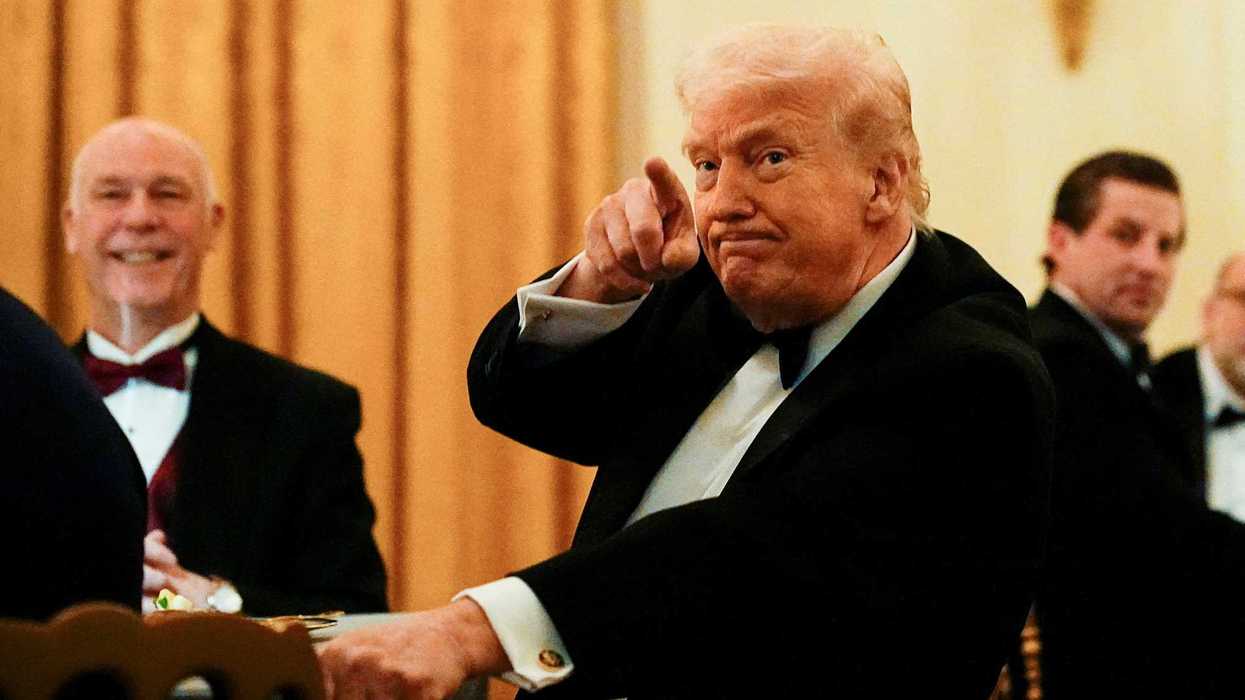
President Donald Trump attends a Governors Dinner at the White House in Washington, D.C., U.S., February 21, 2026.
Editor's Note: The transcript was lightly edited to further clarify the prose.
"They believe a person with a disability who can't work is a waste!" former Social Security Commissioner Martin O'Malley told AlterNet last month, his voice reflecting deep anger. "That an elderly person is a waste! That an orphan child is a waste!"
I thought of my interview with O'Malley as I spoke with Dr. Suzanne Kahn, Senior Vice President of the Think Tank at the Roosevelt Institute. Throughout the conversation, we discussed not only the future of the Social Security program, which serves over 75 million people, but also how the future of that program is intimately tied to deeper debates about the future of capitalism and the proper role of the government in Americans' economic lives. On the one side, you have people like President Donald Trump and Treasury Secretary Scott Bessent who depicts all Democrats as either socialists or potential socialists, and insist they are both a threat to America and (to quote Bessent) "underachievers who are jealous of those who want to go and work every day." By contrast, you have people like O'Malley, who argues that welfare programs like Social Security exist to help vulnerable Americans survive and accuse Trump and his cronies of planning on looting them.
As O'Malley told AlterNet at the time, he believes Americans need to "protect Social Security through the Trump years from being privatized, looted, or funneled into cryptocurrency or Trump accounts."
Who is right? I learned more from Dr. Kahn.
The following interview has been lightly edited for length, clarity and context.
ROZSA: Every year we see a struggle on issues and outcomes between traditional and more moderate Democrats and economic progressives. We're often told by progressives that Americans agree with them on the issues, but that framing like socialism and democratic socialists gets in the way. Is it true that the majority of Democrats agree with them on issues like free grocery stores and guaranteed income? And if so, how come more of the candidates who propose those measures don't win their elections?
KAHN: In general, Americans are clearly very, very concerned about the cost of many things, like groceries, as they continue to rise, and are looking for politicians who have actual solutions that'll make a real difference in their lives in the short term.
ROZSA: What do you think of Social Security in terms of the fact that today it is taken for granted, but when it was first announced, people thought of it as literal socialism?
KAHN: I think Social Security is probably the most popular government program we have. That is because it has been incredibly effective at creating a guarantee that people can count on, that makes a huge difference in people's lives. And it's the proof is in the pudding in that. So, when the government actually shows that it can make a difference in people's lives, people support the programs and will fight to defend them.
ROZSA: Do you think that under Trump right now, Social Security is in danger?
KAHN: I think we are clearly seeing conservatives, including MAGA Republicans, making the case against Social Security and are using the impending trust fund depletion to argue that Social Security needs to be privatized or changed in ways that would make it less reliable, and less of that guarantee that Americans have come to depend on. And that's a real concern, but I also think Social Security is so popular, and Americans are really well organized to defend it. And what we actually need is to respond to what they're asking for, which is figuring out how to make it a guarantee going forward. And doing that requires not changing the fundamental principles of the program, but adjusting its revenue streams to match the economy that we have today.
ROZSA: What can ordinary Americans do to fight for both Social Security and other programs that they depend on?
KAHN: Make their voices heard in all the ways they can, to say these are programs that we believe in, that we want, and that we don't accept are threats to. All Americans living today had Social Security as a guarantee their whole lives, and they should be able to continue to count on that, and they should tell their representatives how much they care.
ROZSA: Do you believe that there are other programs like Social Security that Americans rely on and perhaps even take for granted that are on the chopping block?
KAHN: It's unlikely to be on the chopping block, but we have to be cautious about the reforms that are proposed, to make sure it's not being privatized without Americans noticing, or changed in ways that would make it a less reliable guarantee for Americans. As we've seen under this administration, lots and lots of programs are threatened. People are feeling the effects of the so-called One Big Beautiful Bill right now, as cuts to Medicaid go into place. So we should all be worried about not just dramatic, one-time cuts, but death by a thousand cuts.
ROZSA: Now I want to talk about the implications of Social Security in terms of more broad basic income programs. Do you think that those might become necessary as a result of technological advances like AI?
KAHN: It's very hard to know what is going to happen with AI. I think we need to have in place the strongest versions of the social insurance programs that exist, like Social Security or unemployment insurance. And then from there, there are a lot of options, depending on what actually happens with AI, that we should be thinking about, to make sure that if we actually do see massive increases in productivity, workers get to share in the benefits of that, whether it's through pay or through time.
ROZSA: I want to talk about capitalism more broadly. I would say that a lot of people are becoming anti-capitalist because they think the fruits that capitalism, so to speak, have wrought. Do you think that in recent years there are reasons to question whether capitalism remains viable as an economic system?
KAHN: No. There's a lot of work to be done to ensure that productivity gains, economic gains, growth, are shared equally and equitably across society. I think that obviously we are seeing — we're just in a moment of mass inequality that is not good for the economy, is not good for democracy. And we have a lot of work to do to figure out how to reverse those trends. But I don't think that necessarily means that capitalism has fully failed.
ROZSA: So in that case, how do you feel about the future of Social Security in an economy where capitalism makes income inequality more rampant, and in which wealthy people have so much power that they can essentially loot the coffers. For instance, former Social Security commissioner Martin O'Malley told me he believes Trump, [world's richest man Elon] Musk, and his cronies are planning on doing?
KAHN: We have to take that on head-on, right? Social Security reflects the economy we have, right? The reason that the trust fund is set to be depleted earlier than originally expected is because of widening inequality and the amount of revenue that has moved out, [as well as] the amount of income and wealth that is no longer being taxed [and] the way its distribution has shifted over the last 50 years. And so we need to reform Social Security so that it gets the revenue it needs, in ways that reflect the economy we currently have, right? And that means taking on massive inequality. It means bringing wealth that is outside of the income tax — but that is where a lot of wealth is kept, or that people are gaining outside of income, where a lot of wealth is being made these days — into being taxed by and contributing to Social Security.
It means figuring out how to cover gig workers. There's a lot to be done, and it definitely makes it significantly harder to do it that we are in a moment where oligarchs are trying to prevent it. That's the challenge in front of us.
ROZSA: My final question is, is there anything important you would like to discuss that I haven't brought up with my questions so far?
KAHN: I would just say again, Social Security is an example of how, when the government delivers for people, it helps people — people believe in the government and they believe in the program. Think the popularity of Social Security is well over 90 percent, and that's because it's been an effective program, and, you know, the Trump administration, MAGA Republicans, have been trying to undermine effective programs for a long time. That's the point of DOGE. And we need to both defend and protect Social Security, because that's one of the best examples we have of government doing its job well.

