

'Saw' director: Hollywood blocked my Trump-era political horror scripts
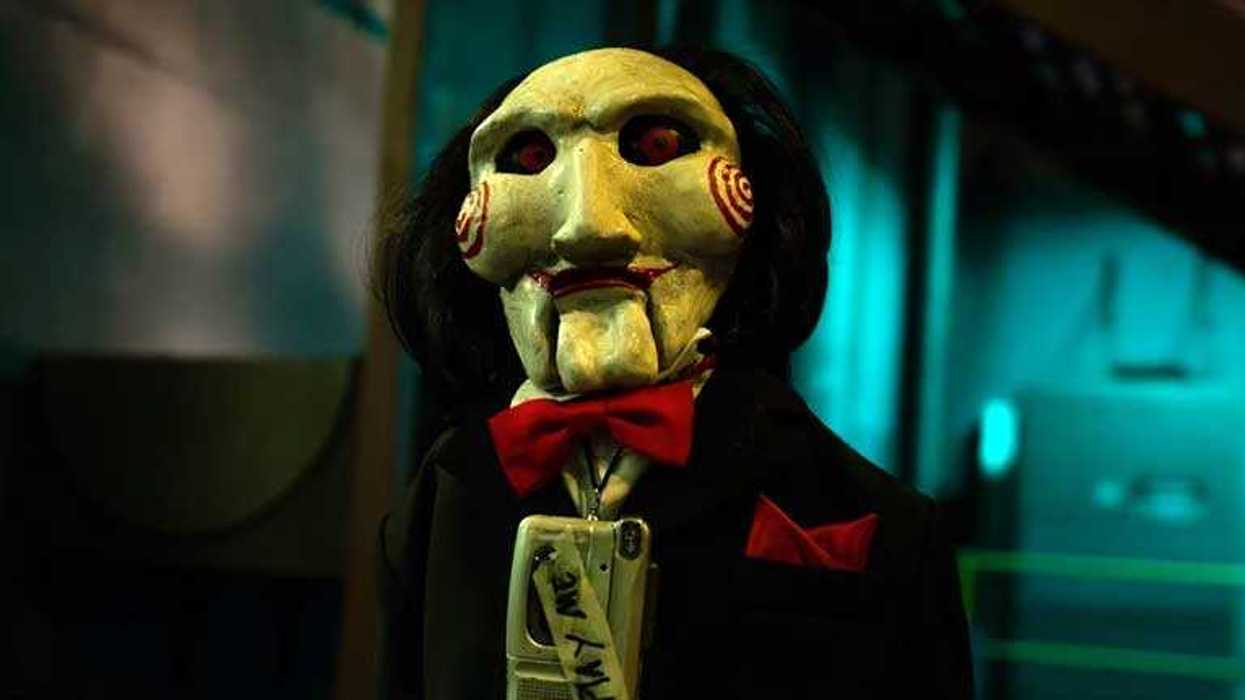
Billy the Puppet, from the Saw movie franchise
Director Kevin Greutert made one of the best political horror films of all time. The premise? Health insurance executives are forced to endure death panels like those to which they subject real-life patients.
I've extensively discussed how "Saw VI" holds up as a work of art and speaks to the zeitgeist of when it was released, a the height of the debate over President Barack Obama's healthcare reform plans; indeed, I've written or spoken an appropriate six times total on this masterpiece of gothic satire. Yet in the age of President Donald Trump — a man who, notably, is working to reverse Obamacare — there is so much to be horrified about that celebrating Halloween feels almost like a farcical afterthought.
Yet the horror genre can provoke thought and moral awakening as well as fear and disgust, and "Saw VI" is just one example of this. As such, I reached out to Greutert — who directed "Saw VI," "Saw VII" and "Saw X," as well as editing most of the rest and also directing "Jessabelle," "Visions" and "Jackals" — for an AlterNet exclusive.
We focused on one question: How are horror movies relevant in the Trump era?
The following interview has been lightly edited for clarity, context and length.
Starting with "Saw."
Matthew Rozsa: In "Saw VI," you have the franchise's Jigsaw killer torture a plethora of health insurance executives by creating death panels akin to the ones the opponents of healthcare reform insisted would exist if reforms were ever implemented. You've told me that the filmmakers did not anticipate President Obama focusing on healthcare reform in his first term's opening year, but clearly you knew you were making a pro-healthcare reform film. To what extent did you feel comfortable being explicitly political, versus making sure to avoid alienating part of your audience?
Kevin Greutert: Well, it was my first film. And the thing is, it's pretty hard to make a film that makes a statement that's possibly going to turn people against you. But at the same time, why not go for it? Because otherwise, what's the point? You ultimately want the film to be entertaining enough that people spend money to go see it, but I know that in my own media consumption, I want to read or view or listen to something that has themes that relate to real life, even if it's a complete fantasy. So I wasn't concerned at all. And frankly, if the producers had known that healthcare reform was going to be such a hot issue, they probably wouldn't have let us use that script. But I think we really just lucked out. And when Republicans started talking about death panels, I remember joking with Marcus Dunstan and Patrick Melton, who wrote "Saw VI," that it's kind of perfect for showing how relevant that movie was.
So I was all for it. And to be frank, I have tried to make even more explicitly political movies. There was a movie that I tried to make in 2017 called "The Endorsement." It was written by this really great screenwriter named Zach Ford. It had to do with a woman who wrote for a small-town newspaper in 2016 and convinced the editorial staff to endorse Hillary Clinton in the 2016 election. At first, they were against it, and then they said, "Go for it." And once it was published, she started getting very creepy, threatening messages and phone calls from somebody who turns out to be a serial killer — a very political serial killer — who's trying to pressure her into reversing the endorsement. So it was a very scary, relatable movie.
Nobody would touch it, though. We had a producer who — I appreciate them trying to get out there and get it financed — but the studios and financiers just said, "No, we can't offend half of the American body politic." So that went away. We were going forward with a version of "Saw XI" that was about John Kramer's relationship with two mayoral candidates in his hometown, and those guys wind up in a very visually election-themed Jigsaw trap. Would've been amazing, but things happened, and a different approach was selected. In any event, I really like the idea of making movies that mean something besides just being entertaining.
Matthew Rozsa: In terms of "Saw VI," I'm reminded of what President Donald Trump said about Luigi Mangione: "I think it's really terrible that some people seem to admire him, like him. That was a terrible thing. It was cold-blooded, just a cold-blooded, horrible killing. And how people can like this guy is, that's a sickness, actually." What are your thoughts about that? I know we've discussed this before, but this is a new article, so I'm going to ask you to repeat yourself. I'm sorry.
Kevin Greutert: I understand. And yeah, there are millions of people that are incredibly frustrated with the healthcare system and the government, but I stand by my earlier statement that killing like this is never, ever acceptable. It's certainly interesting that there are people who feel that Luigi's a hero, but I can't be on board with that, because once you open up the door to that kind of political violence, there's no putting it back in the box.
Trump and the "Body Snatchers."
Matthew Rozsa: Now, I know that you are very anti-Trump yourself, and that this is probably one of the only occasions when you'll ever be on the same side as Trump.
Kevin Greutert: Could be. Yeah.
Matthew Rozsa: I would like to talk about a movie you brought up that reminds me of the climate that Trump is creating in this country: "Invasion of the Body Snatchers."
Kevin Greutert: Sure. The first version.
Matthew Rozsa: The 1956 film, the classic.
Kevin Greutert: Yes. Right.
Matthew Rozsa: It has been interpreted by both sides of the Cold War debate. There are the conservatives who argue that the pod people are meant to symbolize the communists infiltrating our society. And then there are those who argue that their enforcement of conformity represents what the McCarthyists were actually aiming for in the 1950s. I fall into the latter camp. I'm curious what camp you fall into, and regardless, why you mentioned it earlier as a film that you really like.
Kevin Greutert: Well, I think you kind of nailed it: it can be seen by both sides as representing their stance. And that's kind of the brilliance of it. That's probably why they got away with making it. In that regard, I would compare it to the more recent film "Don't Look Up," about the world government's reaction to a giant asteroid approaching the planet. The "we've got to do something about the climate" people claim it as supporting their side, and the other side says it's making fun of them. So it manages to have a theme that's widely open to interpretation. And that's kind of what you have to do sometimes, especially in a political climate like the 1950s Cold War — and today — where you really can get in big trouble by staking a claim that half the country is going to disagree with.
I would compare the original Body Snatchers, in general, to Rod Serling's "The Twilight Zone." That show is really packed with important themes — politics and racism and religion — and he had tried to make plays and movies that explicitly dealt with those themes and was never able to get away with it, or they would be whitewashed before they ever made it to the public. So when he was writing the "Twilight Zone" episodes, he was thinking, "Okay, let's use fantasy and sci-fi and horror to talk about these things." And I think it's really effective. When you watch a lot of those, they're still entertaining, but you can see, "Oh, yeah, he's absolutely talking about our government right now," or racism. And I think that's really cool.
And the fact that you have to be subtle kind of encourages new forms of creativity. So if "Body Snatchers" can be claimed by both sides, I think that's a strength.
Matthew Rozsa: I agree that that is a strength, but I would argue that the weakness is the context of censorship, even if it is not directly imposed by the government. Now we live in an era where the government does attempt to impose direct censorship. They have cronies purchasing major media corporations, like the Ellisons. They have tried to stifle comedians who criticize them, like Jimmy Kimmel. So there does seem to be a genuine risk that Trump is going to erode freedom of creative expression in this country. In your opinion, are there any horror movies that have risen to the occasion of commenting on this moment in history?
Kevin Greutert: Movies that fit squarely into the horror genre?
Matthew Rozsa: Yes.
"Digger" is peak Trump-era horror.
Kevin Greutert: I'm not sure so much. I know you're expecting to talk about "Digger." And even "Don't Look Up," which is even more of a comedy, is still about madmen ruling the world. So those are the ones that I feel come closest to explicitly being about those sorts of political things.
Matthew Rozsa: Let's talk about "Digger." First of all, I want to say that your movie, "Saw VI," in my opinion, captured the zeitgeist of the early Obama presidency: the focus on healthcare reform, the way people had to live and the concerns they addressed day-to-day. "Digger" is not the same, because "Digger" does not capture the zeitgeist of the Trump era. It's not even set in the Trump era. It's set in a not-too-distant future that will exist as a result of the Trump era. I'm just making these observations to distinguish between the two films and how they perform commentary. At the same time, I think "Digger" can be described as horror, because there is a premise of the world ending. Scenes are shot in a way that is meant to make you feel uncomfortable as you're observing them — such as the one in the European Parliament, when he's dealing with his dying cat, when he is confronted with the inevitability of the world ending, and when he's on that abandoned oil rig without food. There are moments that reach the level of horror. Do you think "Digger" can be considered horror? And how do you think it comments on the Trump era?
Kevin Greutert: It's a scary movie deep down, because, as you say, it's filmed in a way that's often funny, but it's an extremely uncomfortable funniness, because we see ourselves and we see our leaders in the characters. And John Goodman's character is, frankly, pretty darn Trumpy. So even though it's got its whole story within a story, I think it's being pretty explicit about billionaires and corrupt politicians. It's horror in the sense that it's about our feeling of helplessness while madmen rule the world. And we're kind of all losers, and we're all complicit in many ways, because, as he points out in his speech before the [European Parliament], we're all benefiting in the short term from plundering the earth. The slightly positive part of that movie is that in the end, after we've seen the world almost end but people are still alive, there's the theme — based on the play within the movie — that there's catharsis in art, catharsis in having lived through a nightmare, and that all we really have is being able to laugh at the screen, or at the people on the stage, as in that film.
So it's very complex, but that really rang true with me: that it's a story for and about us, and not just about the bad guys, the corporate leaders and political leaders.
Matthew Rozsa: Now, I will say that type of horror is a bit too cerebral, I would suspect, for casual moviegoers. I don't mean to condescend to them, but when the average moviegoer wants to be scared, I think they want blood and gore and jump scares. They don't want an abstract philosophical project which requires you to contemplate the future.
Kevin Greutert: True. But in our general theme about politics and horror: politics is about power, right? It's the power of people over other people. You have benevolent leaders — true civil servants, like, in my opinion, Barack Obama and people going back throughout history. They all still need power to be effectual, and they all have to do unsavory things to get there. They have to fundraise and broker deals with people they don't like, that sort of thing. As non-political citizens, there's an underlying uneasiness in knowing that even in a democracy, there are people that we've agreed to let have power over us, and they can potentially turn it against us, ruining our lives and the fabric of society.
We're living through something like that right now, and it feels like horror. A lot of horror movies don't have any intended political agenda at all, but they're showing us a person or an entity that wields malignant, abusive punishment on innocent people. So you get this sense of helplessness watching this abuse, because subtly it feels like it comes close to the real-life experience of living under political leadership that's gone wrong, right? We're all young Catherine in Buffalo Bill's basement, being made to put the lotion on the skin. And we talked about "Barbarian" a bit before. That kind of imagery of being trapped and abused is very political, I think. It's subtle, and it may not even be in the minds of the creators, but they're playing on that same idea of power and the abuse of power.
I think if our current president could, he would treat half of us the way Pinochet did in Chile in the 1970s, when they ripped their political enemies out of bed in the middle of the night and drop them from helicopters into the ocean. I mean, it's scary. We're living through something very scary, and movies give us catharsis. We've got slashers hiding behind masks, and you can compare that to corrupt politicians who pretend to be religious, that sort of thing. So I think it's all very relevant. There's a book that I don't think we've discussed. It's not a horror book, but it's very scary. It's called "Where the Axe Is Buried," by Ray Nayler. I don't know if you've read it. It's a recent novel.
It's kind of like "1984," but it's a future where artificial intelligence and other tech give malevolent dictatorships absolute power over everybody. Some of the governments in the world are even AIs. There's another country where the president never dies; he just keeps getting cloned into a new body. It really brings home how scary things could get. So horror is definitely tied to politics, I guess, is the final statement.
Trump is a barbarian like the antagonist in "Barbarian."
Matthew Rozsa: Okay. I have a couple more questions, and I do have to get back to my shift soon. I want to talk about "Barbarian." When I interviewed you last year for Dread Central about director Zach Cregger — this was before he'd released either "Weapons" or "Resident Evil" — you said: "I only came on briefly to work on Barbarian to focus on some of the horror scenes, but when I saw it, my jaw dropped. I couldn't believe how cool it was. It has a sort of Pulp Fiction vibe to the storytelling style, with some discursive scenes that follow minor characters in different directions. You lean into that movie just based on how many original elements it has. And I think it's very funny in places. Justin Long's character is a breath of relief after all the stuff that's come before it. It's just very, very clever. I think director Zach Cregger is going to be the most famous director in America."
Now, clearly, your prediction seems like it's en route to playing out. But I would like to talk about what you suggested a moment ago, that "Barbarian" is about how we feel in Trump's America: utterly trapped. I would say that there are also themes of exploitation. The film is in large part set in an area of Detroit that is impoverished and persecuted. And there's also the fact that there is a sex abuser who lusts after his own offspring and wants to control the universe to the extent that he can. Frankly, when I think of that character, I think of how Donald Trump has said that if Ivanka weren't his daughter, perhaps he'd be dating her, and that she has "got the best body." What are your thoughts on all of this?
Kevin Greutert: I think you've really nailed it. Most people will probably watch that film and not think explicitly about the themes you're talking about, but they're absolutely true to what Zach has pulled off in that movie. And again, it's that visual of a person who has made his own universe — in this case underground, like in "The Silence of the Lambs" — in order to have control over other people and carry out his darkest fantasies against them. It's a true and real thing, you know? There are bad guys out there, and they're willing to do the same sorts of things you need to do in order to get power. We should all be worried about that, and we should all be voting as quickly as we can, because we've got a really important election coming up.
Matthew Rozsa: To clarify, what exactly did you do on "Barbarian"?
Kevin Greutert: Just in the editing room. I worked on making the scenes as terrifying as possible. That has more to do with editing style than any kind of thematic contribution.
Matthew Rozsa: Got it. I was just curious. My last question, because I have to wrap this up, unfortunately: Are there any horror movies you'd like to mention that we haven't brought up so far that you think are just brilliant politically, regardless of whether they speak to the Trump era?
Kevin Greutert: I've been trying to think of other films, and I feel like we've touched on the important ones. There are things like "The Substance," which we've discussed as being really effective as a satire of the movie industry and personal appearance, that sort of thing. I don't know that it's that political specifically. So, no, I don't really have a new one to contribute.

