
Americans can’t afford to just 'move on' again
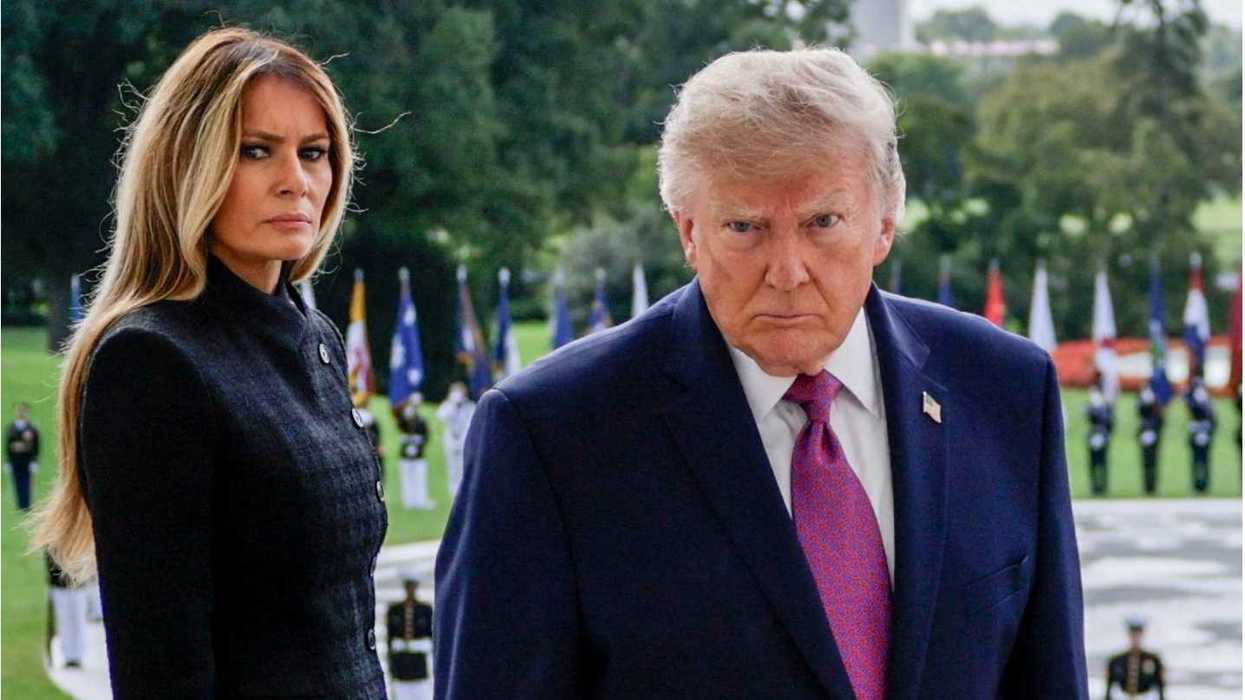
S President Donald Trump, first lady Melania Trump after watching a military demonstration from a balcony of the White House in Washington, D.C., September 24, 2026.
As you know, there is robust debate right now about what the congressional Democrats should do with their power. On the one hand are people who believe they should focus on affordability. On the other hand, it’s accountability. If I were to guess, I would say that most people think these issues overlap and that solutions to one could be solutions to the other. Fortunately, the leaders of the Democratic Party seem to agree. Hakeem Jeffries, the incoming speaker of the House, has often talked about “the cost of corruption.”
There are two non-party factions, however, that stand apart. They believe affordability and accountability are mutually exclusive issues – or want the public to believe they are.
On the one hand are elites, especially those in the Washington press corps, though some of them are also in the Democratic Party. They cynically blur the line between enforcing the rule of law and political revenge. They troll Democrats and the public about the dangers of seeming to be like Donald Trump, who used the law to reward friends and punish enemies. These elites argue that the safe thing for the party to do is focus on affordability, with the implicit result being that their fellow elites avoid the consequences of their actions.
On the other hand are what I will call the Democrats’ fifth column. These are bad actors who identify as populists. They claim to serve democracy by pushing the Democrats left. They call themselves “progressives,” which may be true, but they are illiberal, and because of that, they have more in common with the elites than with the base of the Democratic Party. For them, affordability is a means of avoiding accountability while delivering half measures. Their allegations may seem noble, but their goals are not. They want the Democrats to fail, because in failure lies their best shot at becoming the elites they claim to oppose.
It’s an internecine conflict that by design overlooks the obvious – that this president has done incalculable harm, not only to the economy, not only to the republic, but to the future. We won’t see the consequences of his actions for years, though we can predict what they will be and perhaps try to mitigate them. Even then, however, as Cory Doctorow pointed out recently in an essay called “America cannot undo Trumpism,” our options are already limited.
Immigrants – documented and undocumented alike – have been terrorized for two years and many of them have fled. ICE got what it wanted: they robbed aging, stagnant America of the dynamism, aspiration and youthful vigor of the most ambitious people from every corner of the globe, people who proved their resourcefulness and bravery by making dangerous crossings. Then these immigrants navigated the US immigration system's impenetrable bureaucracy, often working without legal representation, in a language they were just learning, and still managed to clear every bureaucratic hurdle. This alone is a breathtaking demonstration of intelligence, resourcefulness and diligence. Those brilliant, hardworking people aren't coming back: some other country will get the benefit of their life's work and care. Their children will become citizens of other nations.
Again, if I were to guess, I would say most people are focused on fixing problems that we all share, to the degree that we can fix them, and on preventing a repeat occurrence of the greed, corruption and villainy that brought us to this point. I think the sheer magnitude of the destruction puts the moral questions facing the Democrats in line with their political incentives. There is no conflict between affordability and accountability. Addressing “the cost of corruption” gives them an advantage. One informs the other, and anyone insisting otherwise has an agenda that’s neither in the Democrats’ interests nor in the people’s.
Don’t take my word for it. Consider what Joshua Zingher told me. You may remember Professor Zingher from the Election Day edition in which the political scientist predicted “a lot of people are going to wake up Wednesday and realize we're in a new era of American politics.” He was right. Trump woke a sleeping giant. I asked the author of Political Choice in a Polarized America: How Elite Polarization Shapes Mass Behavior what the Democrats should do. “I think the best political strategy is also the morally correct one,” he said.
John Stoehr: Let's start with the big moral question. What should the Democrats do with their power: first, second and third?
Joshua Zingher: My position on this is straightforward. I think the best political strategy is also the morally correct one. I think the first order of business is prosecute corruption on all fronts. There is the obvious stuff: from Trump's crypto scheme and whatever this mess at Nvidia is to the more obscure, like vast amounts of insider trading. The opportunity for a big legislative compromise with Trump is nil, so accountability is the path that's available. This is an opportunity to pick up some easy wins. I think you then move on to building the case for prosecutions in 2029 against people like Hegseth. People don't want political persecutions, so it will be important to convince the public that these people did actual crimes and are not being punished for their politics, a la Tish James of Ilhan Omar.
Are those moral objectives at odds with the Democrats' political goals?
No. The public hates corruption, but they think all politicians are corrupt. So it is hard to explain how uniquely, cartoonishly corrupt the current administration is. The Democrats, both capital D and lowercase d, need to make the case to the American people that our current situation is unique. We need to restore trust in government. One way to do this is to show there are very real consequences for government officials who break the law (which also shows the insanity of the Supreme Court's reasoning in Trump v. United States). For too long, we have let the rich and powerful escape consequences. That needs to change. Most importantly, it's the right thing to do. It's also good political strategy, but this second point is of much less consequence than the first.
Elite consensus seems mixed, with perhaps more urging the Democrats to stay away from accountability. The Democrats don't have a good track record with respect to elites. Are things different now?
This is the million-dollar question. There will be a lot of pressure just to move on in 2029, assuming the Democrats win the presidency. When Biden took office in 2021, I think most Democrats just wanted to take a deep breath and return to normal, but look how that turned out. If the Democrats aren't serious about rooting out corruption and prosecuting crimes, the next iteration of American authoritarianism will be even more oppressive and corrupt. We're learning this lesson the hard way now, but we could be in much worse shape than we are. Normalcy is a privilege. We can only get back to that point if we're willing to do the hard work required to restore it. Absent this, we're just going to repeat the cycle. Republicans will eventually get back in power, the question is what the Democrats do in the meantime to let people know there are real consequences for gross violations of the law and the Constitution.
There is a fifth column to contend with. There are "leftists" and "progressives" among us who want the Democrats to fail, and are spreading misinformation and propaganda toward that end. What can Democrats and democrats do?
I think most of these people are fellow travelers with Trump. It's authoritarianism, just from the left instead of the right. The "Mao was good, actually" crowd is vocal, but small. Fortunately, this faction is small, but they are disproportionately loud. While I think the Democratic Party is a pretty robust centrist-liberal-left coalition, this particular faction shouldn't be considered a friend to either democracy specifically and anti-authoritarianism generally, and should be treated as such.
Returning to No. 3: The cynical strategist would argue that GOP failure is good for Democrats. The appetite for reform may be less than robust, because reform takes away an advantage. What can a good faith democrat say to break that cynical way of thinking?
You are eventually going to get voted out of office no matter what you do as a party in government. Pick your favorite democratically elected leader and there is a very high chance they were voted out of office at least once, if not multiple times. Democracy is a system where parties lose elections. For the Democrats taking office on January 3, 2027, the realization should be simple: we're going to lose power in the future. That's guaranteed. The task at hand is restoring the system so that there are guardrails in place the next time Republicans get into office, because it will happen. This is why prosecuting corruption is so vital. Not only does it punish people who more than deserve it, it sends a signal about what the future will look like for future politicians thinking about breaking the law. Trump largely escaped punishment for his crimes during his first term and he took that lesson to heart. It is vital we don't repeat this mistake.