

Trump was wrong about Dolly Parton: How she completely broke MAGA's brain
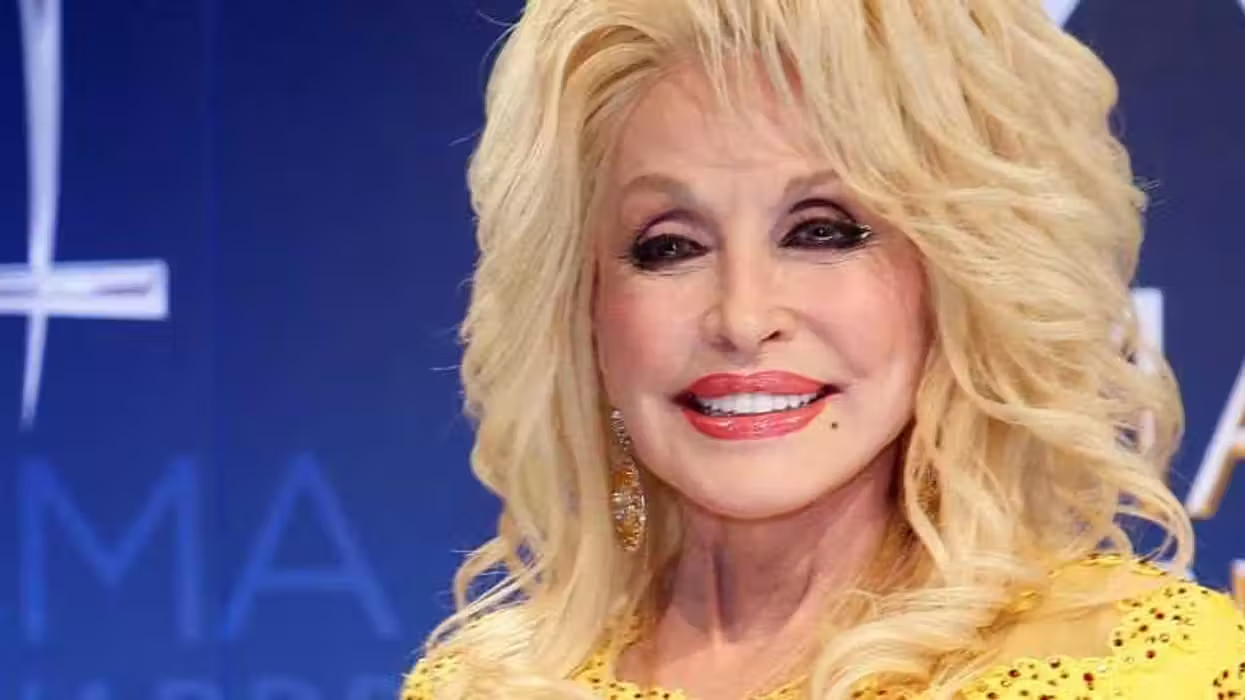
FILE PHOTO: Singer Dolly Parton poses backstage with her Willie Nelson Lifetime Achievement Award during the 50th Annual Country Music Association Awards in Nashville, Tennessee, U.S., November 2, 2016.
Yesterday, during an interview with Glenn Beck, the president made Dolly Parton's death about him. ("She really liked me, I will tell you.") That was no surprise. What was surprising, however, was what Donald Trump said right before that. "She wasn't a very political person."
It was surprising because Dolly Parton was very much a political person. Throughout her long life, she pushed for greater individual liberty, equal rights and representation, and inclusivity. She put her money where her mouth was, too. She funded a library that gave free books to kids. She invested in Black businesses and neighborhoods. She supported up-and-coming artists. Perhaps most famously, she provided seed money for the first covid vaccine.
Parton was often explicit, standing in the gap between respectable (white) society and marginalized groups. She long advocated for LGBTQ rights. "I have some of everybody in my own immediate family and in my circle of employees," she told the Hollywood Reporter in 2023. "I’ve got transgender people. I’ve got gays. I’ve got lesbians. I’ve got drunks. I’ve got drug addicts — all within my own family. I know and love them all, and I do not judge."
And she was explicit in her endorsement of Black Lives Matters.
"Everybody needs to express themselves however they feel they have to," Parton told Billboard in 2020. "I'm not out here to tell you what to do. I don't want you to tell me what to do. But I just do what my heart tells me to do. I ask God to direct me and lead me, and if I've got his direction, I don't have to worry about anything else. But I do understand people having to make themselves known and felt and seen. And of course, Black Lives Matter.
"Do we think our little white a---- are the only ones that matter? No. Everybody matters."
Yet the president doesn't see her politics, nor do members of his party who would otherwise smear and attack trans rights, Black Lives Matter, the poor, and any of their determined advocates. Ted Cruz was apparently so eager to praise Parton that he did not notice the post he retweeted, which celebrated her life, was from an account called "Ted Cruz's tiny ----."
There's clearly something about Dolly that blinds the enemies of the people she loved.
What was it?
There are probably many ways to explore this question. Elias Isquith suggested today that one answer is found in the difference between "advocating for yourself" and advocating for others. From the conservative view, one is politics. The other is charity. "If Parton had been an unapologetic feminist back when that was risky, she’d be seen as 'political' now," he said.
"That she engaged in all of her 'political' activity through acts of charity (literal or the figurative charity of recognizing her queer fans before that was kosher) was unthreatening, especially the kind of people who use the word “political” as an implicit criticism," he said.
This distinction feels right to me, but I want to add that it's more than charity. It's liberal Christian charity. By drawing her politics straight from the mouth of Jesus, from the ethics of the Sermon on the Mount, Parton not only blinded bigots like Trump to the true nature of her project. I think she also provided a model for social change and individual liberty.
Parton believed in her bones that we're all God's children, and on the strength of that belief, she convinced others, and perhaps herself, that she wasn't political. In that same Hollywood Reporter interview, she said: "What I always say, 'I just want everybody to be treated good.' I try not to get into the politics of everything. I try to get into the human element of it."
But the Sermon on the Mount was a revolutionary manifesto. With the rest of Christ's teachings, it detribalized God. As Paul later explained: "There is neither Jew nor Gentile, neither slave nor free, nor is there male and female, for you are all one in Christ Jesus." When you believe that – when you believe God's law is equality – every choice you make is fundamentally political. It just doesn't look that way. It looks merely like "the human element."
Though Dolly's project seemed apolitical, I think she knew the score. In the above interview with Larry King, she talks candidly about how advocacy put her in direct conflict with Christians who refuse to recognize the humanity of the LGBTQ community. She implies that doing the right thing in the belief that we're all God's children comes with consequences, sometimes severe consequences, especially in the face of Christians who profane God's law.
"I suffer for everything I do," she says.
"We should all be more loving, more caring. We are who we are. If you're gay, you're gay. If you're straight, you're straight. And you should be allowed to be ... who you are."
If there's one word to describe Dolly Parton, it might be "free." She was free to do what she wanted, however she wanted, for whomever she wanted, because he liberated herself by sticking to her core belief – that we're all God's children. ("If I've got his direction, I don't have to worry about anything else.") I don't mean she didn't face consequences for her choices. I mean she decided she could live with them, and on that acceptance, she was free.Not everyone can do what Dolly did, but it can't hurt to be like her, and in doing so, bring us all closer to manifesting the redemption spoken of in the Book of James: "Be doers of the word, and not hearers only ... He who looks into the perfect law, the law of liberty, and perseveres, being no hearer that forgets but a doer that acts, he shall be blessed in his doing."
