

Former Trump aide: I think the president made one big mistake on Mueller
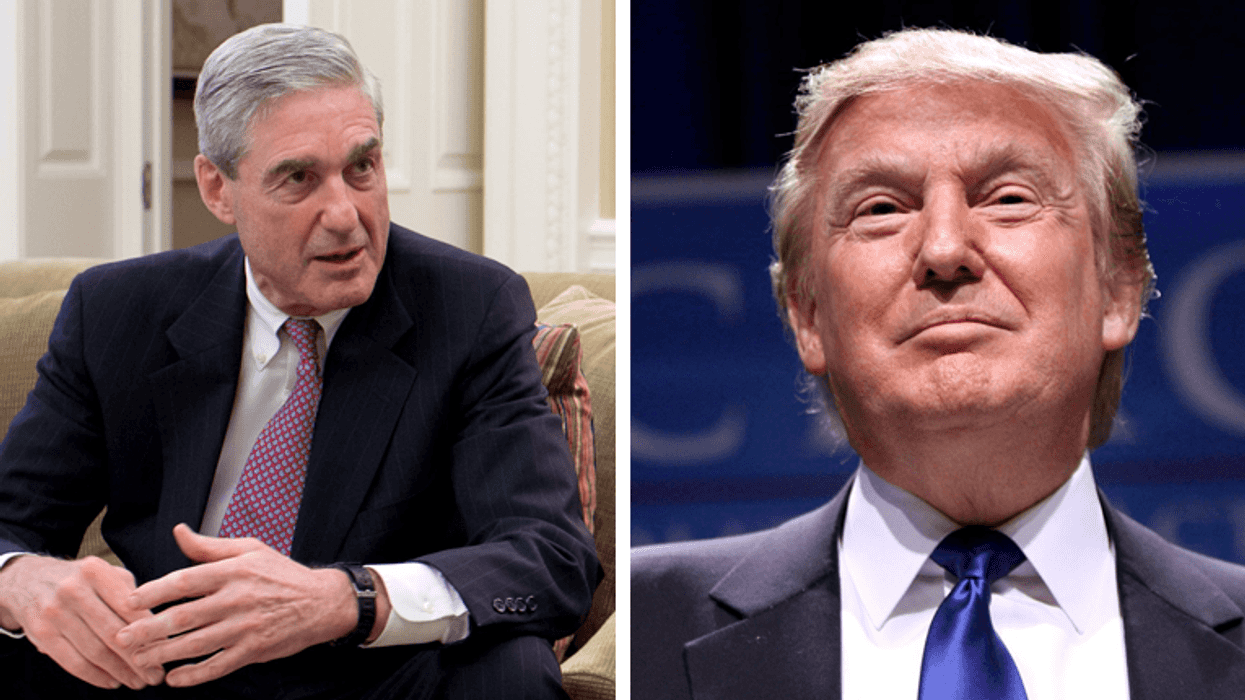
Special counsel Robert Mueller and Donald Trump (Wikimedia Commons)
One of President Donald Trump’s former advisers told AlterNet on Monday that, although he had hoped to receive compensation from the temporarily-cancelled $1.8 billion “anti-weaponization” fund, he believes the president made an early mistake which would have made the fund unnecessary.
“Trump had the full authority to fire Mueller,” Sam Nunberg, a political advisor to Trump's 2016 presidential campaign who was subpoenaed for Special Counsel Robert Mueller's Russia investigation, told AlterNet. “Frankly, he should have done it during the transition — he was advised to, and he didn't. And there was no conspiracy or collusion with the Russians. So it was absolutely ridiculous to have done that.”
Nunberg added, “And the way it was handled — I forget the guy that did it, it wasn't [Attorney General Jeff] Sessions, it was his deputy, Rod Rosenstein — the manner in which it was announced was, you know, absolutely — the government should have — and I believe in this — especially this president would understand that anyone would at least at a minimum deserve legal fees returned. In general, if somebody's a victim of lawfare, yeah, I think they should be compensated.”
Regarding reports that he had applied for compensation from the fund, Nunberg said that “there was no fund” and, when asked by The Wall Street Journal about whether he’d apply, he had merely said that “it was more that if they were going to start a fund, and it could have been applicable to the Mueller investigation, I would have put in an application.”
He also argued that people investigated by Mueller deserve compensation for being allegedly targeted by the government.
“I certainly think that the Mueller investigation, at a minimum, everyone who was either investigated or a witness should be compensated, because that investigation never should have been initiated,” Nunberg said. “I don't necessarily fault the rank-and-file staff, but once they opened that investigation, it was really — any association with Donald J. Trump meant you were going to have to hire a white-collar attorney.”
He elaborated on how it personally impacted him, explaining that he had “to inform my clients, as a fiduciary duty, that I've been called into the investigation. Things like that. I thought it was extremely unfair. It was arbitrary. It didn't have to be started.”
He also argued that people should be eligible for this kind of compensation regardless of their political views.
“If it's a political witch hunt, yeah. I think there should be some kind of compensation fund for it, and I don't care what party the people are from,” Nunberg said.
When it came to the news on Monday that the fund was temporarily cancelled, he expressed appreciation for it existing in the first place, telling AlterNet that “I would say that I appreciate the fact that the president was willing to make this part of his settlement with the IRS. He didn't have to do that.”
At the same time, he offered a criticism of how the fund was created.
“I think there should have been some general guidelines when the fund was announced and/or filed with the judge, some general guidelines about who the potential recipients should have been,” Nunberg told AlterNet. “It could have been handled better by the Justice Department.”
Trump’s $1.8 billion fund was controversial because Trump created it as a settlement between the Internal Revenue Service (IRS), which he sued for $10 billion because a contractor there leaked his tax returns during his first term, and the Justice Department that he himself controls. When the jurist in charge of the case, Judge Kathleen M. Williams, ordered the IRS, Justice Department and Trump legal team to appear before her court on May 20th to ensure that any proposed settlement was legal, all parties involved rushed to arrive at a settlement before the judge’s deadline.
When news of the fund was released, it faced numerous legal challenges and bipartisan congressional scrutiny. Legal scholars argued the settlement violated the separation of powers, with some adding it could have been construed as illegal self-dealing.

