Jared Kushner behind plan to turn over pandemic crisis management to department with little medical experience: report
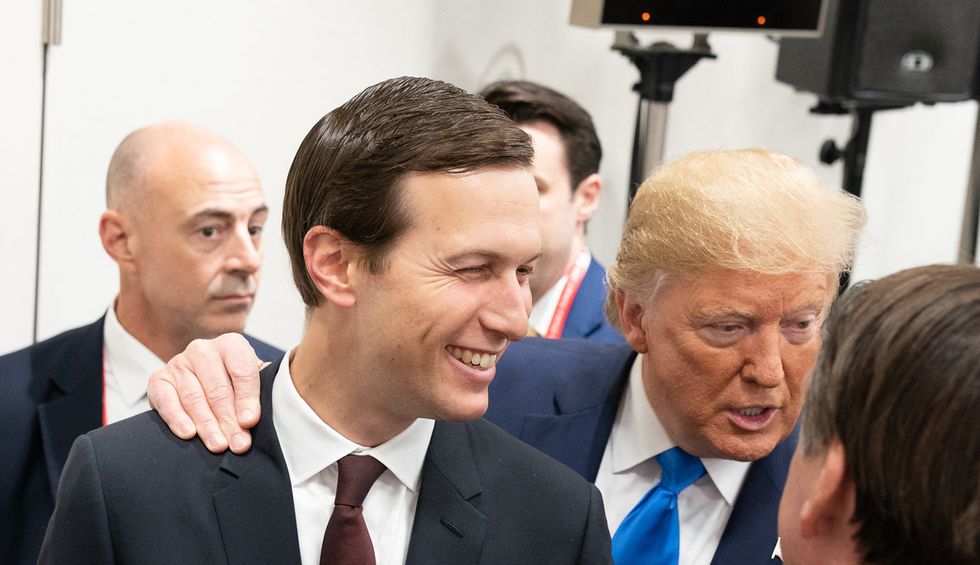
President Donald Trump speaks with Senior Advisor to the President Jared Kushner following the G20 Women’s Empowerment Event in Osaka, Japan. (Official White House Photo by Shealah Craighead)
Buried deep in an article describing the rift between the Trump administration and U.S. companies awaiting instructions on what the government requires of them to slow down the spread of the COVID-19 pandemic, the New York Times reports that White House adviser Jared Kushner was behind a move to transfer responsibility for dealing with health crisis to FEMA although the agency lacks deep experience in dealing with health-related crises.
After noting that “In interviews with participants in the process, from business executives to government officials, there is still widespread confusion about how much and what exactly each firm is supposed to produce,” the Times reports “The government has essentially thrown out its existing playbook for dealing with pandemics, seizing the issue from the Department of Health and Human Services and moving it to the Federal Emergency Management Agency.”
That, the report adds has officials already scrambling to get their arms around containing the pandemic scratching their heads at the decision that was the brainchild of Kushner.
As the Times’ Maggie Haberman, David Sanger and Anna Swanson write, as the “debate has played out in the White House Situation Room, Mr. Trump’s son-in-law, Jared Kushner, has thrown out the established government plan for dealing with pandemics, after concluding it was insufficient because it never envisioned a pandemic of this breadth. Mr. Kushner and other aides concluded that only FEMA had what they internally called the ‘battle rhythm” to be the lead agency.'”
According to former President Barack Obama adviser Christopher Kirchhoff, who wrote a detailed report on the government response to the H1N1 swine flu virus and the Ebola outbreak, the reassignment of responsibility is problematic on its face.
Kirchhoff pointed out that FEMA “…. has experience cleaning up after tornadoes and hauling in trailers for temporary housing,” but “it likely won’t know a thing about medical supply chains and devices.”
“While FEMA knows how to issue contracts rapidly and move goods, it is important not to ‘divorce the expertise from the execution,'” the analyst added.
As evidence of the fumbled turnover, the Times notes that “FEMA administrator, Peter T. Gaynor, an experienced emergency manager, was unable to say how many face masks had been shipped from national stockpiles, or how many had been ordered,” during an interview on CNN over the weekend, leading host Jake tapper to refer to the lack of information as “alarming.”