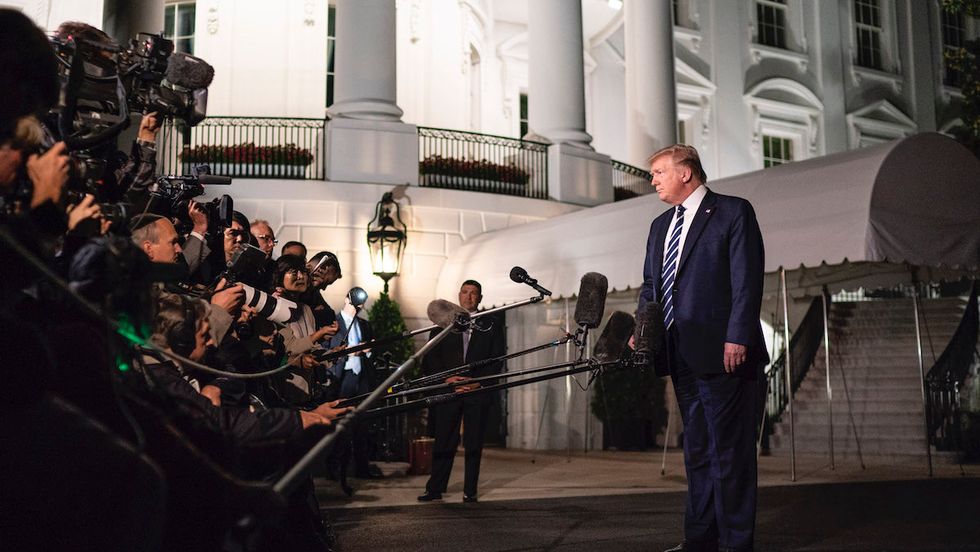
"From a practical standpoint, the question-and-answer sessions represent something of a free-for-all where President Trump is the ringmaster," noted Kumar in her findings. "While other presidents have held these sessions, they have done so more as a way of responding to reporters between the more formal press conferences than as a substitute for them."
The sessions "are terrible for reporters," one White House reporter recently conceded to Politico. "It is impossible to hear, have a substantive dialogue, ask a follow-up question or do any serious pressing of the president. It is a fucking circus." And that's exactly how Trump likes it. He grants "access" to the media completely on his terms, and often uses the sessions to bash reporters.
And because the sessions are strangely covered as breaking news, the Trump lies are instantly boosted by the press, without providing proper context for them. Media Matters found that "the press is particularly vulnerable to Trump’s gaggle falsehoods, often amplifying his inaccurate claims without correction in cable news chyrons and social media postings." In fact, "roughly a third of the chyrons the networks appended to those gaggles referenced a false or misleading Trump statement -- and ... 95% of those chyrons did not dispute his misinformation," Media Matters' Matt Gertz noted.
This accelerated strategy to choke off press briefings is part of a historic, incremental effort by the Trump administration to lock out the press—and, by extension, the public—from the government’s official duties and business.
Of course, the backdrop for all the phony access talk from the White House is the fact that the Trump team has eliminated daily briefings for the press corps, thereby unplugging the daily give-and-take reporters for decades had enjoyed with the White House press secretary. It was during those sessions, which had been televised for past 20 years, that journalists were allowed to pry at length into administration policy. But all of that evaporated under Sarah Huckabee Sanders, and news outlets never put up a fight.
Rather than take a definitive, collective stand and demand access and accountability, news organizations opted for tentativeness, which allowed the White House to erase the briefings in slow motion—to make their absence the new normal. At this point, the fact that the briefings no longer really exist doesn't matter much, since they have been completely useless for a very long time.
Sanders' no-shows at press briefings became such a problem that White House reporters were forced to dash out onto the grounds when they found out she was giving a live, friendly interview to Fox News on the White House lawn. That was the only way they were able to ask Sanders questions on camera. Now, rather than being humiliated while effectively chasing the press secretary across the grounds, reporters are instead demeaned during Trump’s outdoor shoutfests.
By the way, all of this was telegraphed at the outset of the administration. "Routine media access to the White House could be a thing of the past under Donald Trump’s presidency," PBS reported in January 2017. And that's exactly what happened. Yet, more than two years later, the largest news outlets in this country appear flat-footed and unsure of how to respond to the unprecedented Trump White House campaign to choke off all meaningful access.
Eric Boehlert is a veteran progressive writer and media analyst, formerly with Media Matters and Salon. He is the author of Lapdogs: How the Press Rolled Over for Bush and Bloggers on the Bus. You can follow him on Twitter @EricBoehlert.