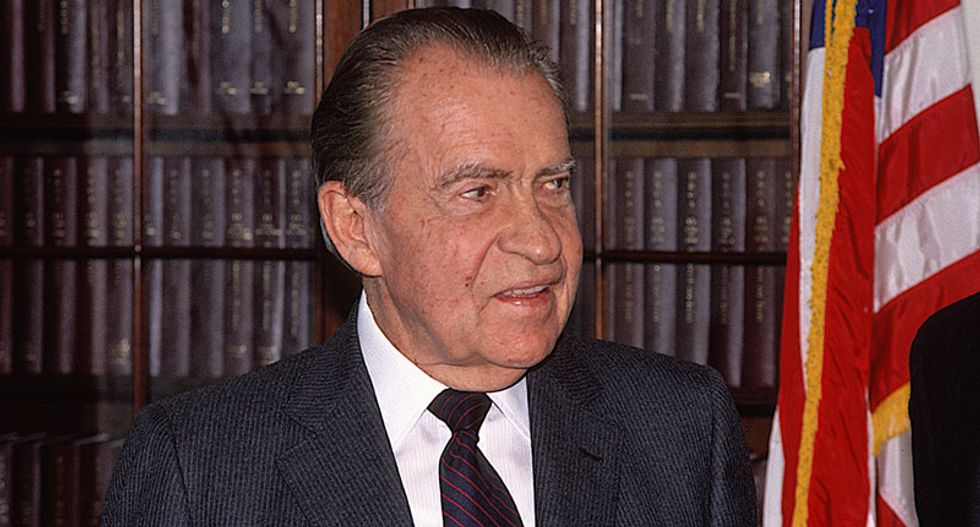
Attorney General William Barr has promised to release a redacted version of special counsel Robert Mueller’s final report for the Russia investigation this week. For historians, Mueller’s in-depth probe, and the prosecutions and indictments it led to, bring back memories of the Watergate scandal of the 1970s. Monday, Washington Post reporter Spencer S. Hsu looked back on =Watergate and Richard Nixon’s presidency in a fascinating interview with the foreman of the Watergate grand jury.
Slovenia native Vladimir N. Pregelj is now 91 and still lives in Washington, D.C., where he spent two years as the foreman on a grand jury that investigated Nixon and Watergate. In Hsu’s article, published April 15, Pregelj didn’t have a lot to say about Mueller’s Russia investigation—although he did comment that “the information gathered by the grand jury should be made public.” But Pregelj has much to say about his activities on the Watergate grand jury of 1972-1974.
Pregelj remembers Nixon’s resignation in August 1974, telling Hsu, “I was, in a sense, disappointed, because I thought with all the evidence that we had, there was enough cause for indicting Nixon.” As Pregelj sees it, “justice didn’t run its course.”
The Watergate grand jury, Hsu notes, indicted seven top Nixon aides in March 1974, including the late Attorney General John N. Mitchell. And Pregelj received both positive and negative feedback in the 1970s. A woman in Wichita, Kansas asserted that everyone on the grand jury “ought to be tarred and feathered” for being “out to get Nixon” and “ruining our country, both home and abroad.” But after President Gerald R. Ford pardoned Nixon in September 1974, a woman in North Carolina complained to Pregelj that she was “sick with outrage” and told him, “I urge you to inform the public of the facts.”
Hsu reminds readers how much of a hardship jury duty can be for some Americans: two of the 23 people on the Watergate grand jury, according to Hsu, lost their jobs as a result. Government workers on the jury maintained their regular salaries, while others were paid $20 per day.
Pregelj moved to the United States after World War II, became a U.S. citizen and was employed by the Library of Congress in 1957.