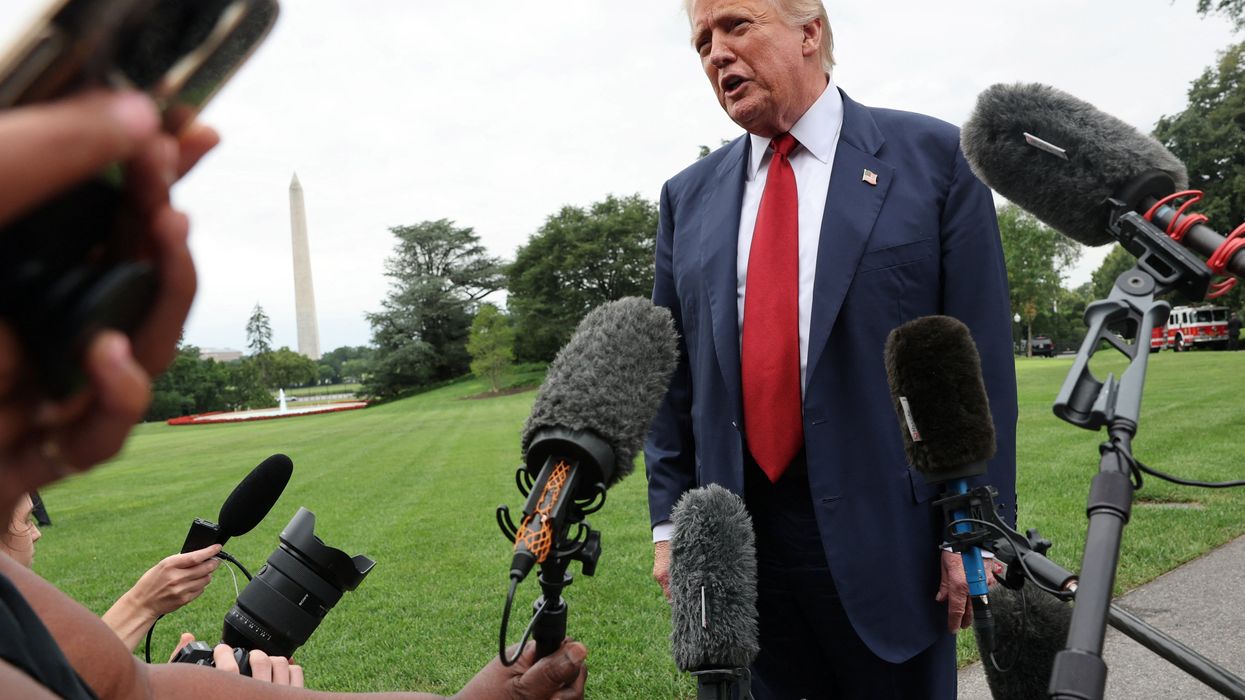
“The walls are closing in” on President Donald Trump, a conservative commentator warned on Monday — and in the process, they are also closing in on the old global order which benefited the United States.
“This isn’t just about dunking on Trump,” The Bulwark’s Jonathan V. Last explained. “It’s about understanding just how weak America’s position is right now. The walls are closing in not just on Trump, but on the old global order.”
Last said this because Trump’s explanations for why America declared war on Iran keep shifting, and with those shifts, America’s military and diplomatic standing become increasingly less credible. To illustrate this point, Last broke down Trump’s ever-altering justifications for the conflict. Initially he framed the strikes as protecting Americans from Iranian threats, then said he wanted to pick Iran’s new government, next he insisted on either a formal announcement of unconditional surrender or Iran simply being unable to continue fighting.
Trump has also declared Iran fully defeated while calling on other countries to help America reopen the Strait of Hormuz, put forward a 15-point peace framework that he has since seemingly ignored and threatened to destroy Iran’s infrastructure to wrap up a conflict he simultaneously claims is already on the road to imminent victory. Last is not alone in saying that all of these details add up to a failed war and possibly a future disaster. Erfan Fard, a Virginia-based counterterrorism expert, had a similar observation earlier this month.
"In public, the Shiite mullahs dominate Iran, but operational authority has, over time, concentrated within the security apparatus — the Islamic Revolutionary Guard Corps, the intelligence services and the security networks," Fard wrote in an editorial published by The Hill. "War has only accelerated this shift. Under external pressure, the regime has thus moved not toward reform or negotiation, but toward militarization. The decapitation of senior commanders and the targeting of main hubs has weakened the system, but it has also created an opening for radical elites to move up."
The Trump administration has also faced criticisms for rising oil prices, which have spiked as a direct result of America invading Iran and Iran consequently working to close off the Strait of Hormuz. In response to these criticisms, Trump and his advisers have argued that gas prices will fall in the long-term despite rising in the short-term. Peter Navarro, one of the chief architects of Trump’s tariff policies, wrote a Wall Street Journal editorial in March claiming that Iran’s terror program “behaves more like a parasite on the global economy — quietly draining growth through slightly higher fuel prices, transportation costs and production expenses year after year.” When two economists, Richard Wolff and Ed Gresser, argued to AlterNet that Navarro’s reasoning was too simplistic, Trump spokesperson Kush Desai insulted Trump’s economic critics.
"These ‘economists’ are idiots,” Desai told AlterNet. “Peter Navarro is an American Patriot whose loyalty to the President and the American people is unimpeachable.” Gresser had told AlterNet that Navarro’s hypothesis has not been “the best-case scenario hasn't typically been the result of previous wars in the Middle East,” while Wolff said Navarro’s claims were too speculative since his “analysis depends entirely on linking rising oil prices to geopolitical and military risks.”