
Former GOP Pentagon official warns Trump about to cost US its 'greatness'
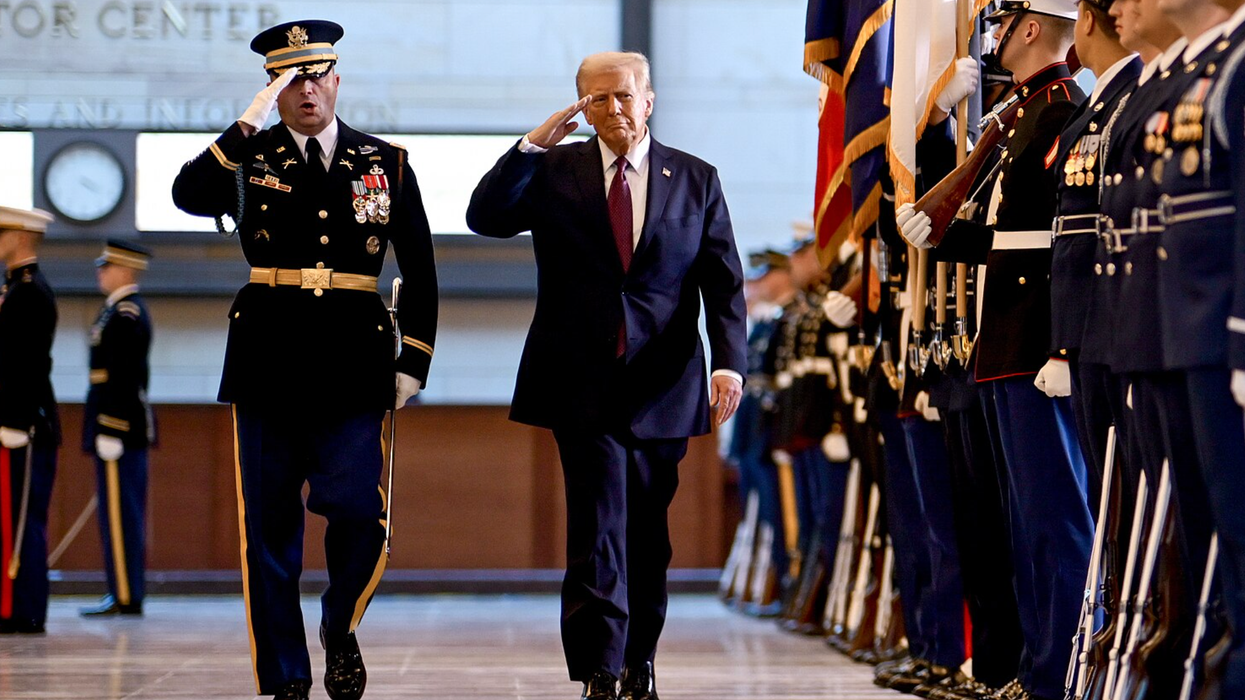

A former foreign policy official who served under Republican President George W. Bush warned in a Tuesday editorial that the foreign policies of the current Republican president, Donald Trump, will cost America its “greatness.”
“History will brand the U.S. failure to ensure Ukraine’s victory and prevent Taiwan’s fall as the time when America fell from greatness and her ‘cunning’ but miscalculating enemies plunged the world into a new global conflict,” wrote Joseph Bosco, who served as China country director under the Secretary of Defense from 2005 to 2006, in The Hill.
Critiquing the Defense Department’s recent National Defense Strategy, Bosco observed that its “muscular” tone belies a “much more restrained” approach toward international affairs.
“Shockingly to students of American history and tradition, [Trump] has openly sided with Russia’s position demanding major concessions of Ukrainian territory and sovereignty,” Bosco wrote. Even as the strategy faults Democratic President Joe Biden for having “enabled” America’s “cunning adversaries,” Bosco points out that “Trump seems not to include Russia among the traditional quartet of ‘cunning adversaries,’ along with China, Iran and North Korea, bent on drawing the U.S. into a two-front or three-front war.” This is especially odd because if Russia succeeds in conquering Ukraine, “history’s lessons teach that such a drastic scenario is far more likely with an appeased but still unsatisfied Russia moving from a partially defeated and weakened Ukraine to the Baltics or Poland. It is not peace through strength.”
Bosco also elaborated on the document’s implications for Taiwan, which relies on US military support to protect it from Chinese aggression much as Ukraine relies on it against Russia.
“The lack of U.S will in Ukraine to defend a strategic and democratic partner against a relentless aggressor that offers economic advantages and personal leadership blandishments,” Bosco wrote. “It is doubtless manipulating geopolitical circumstances to discourage or strategically delay U.S. intervention in a Taiwan contingency.”
Other foreign policy experts from both sides of the aisle have sounded the alarm about Trump’s increasingly transactional and partisan foreign policies. For example Gen. Stanley McChrystal (Ret.) told The New York Times that “once lost, the legitimacy of a military that reflects and represents all Americans will be difficult to recover." Rep. Jason Crow, (D-Colo.), who is a former Army Ranger, similarly told the Times that "the message being sent to those younger soldiers and sailors and airmen and Marines is that politics can and should be part of your military service. It’s a dangerous message."
MS NOW's Steve Benen recently wrote about Trump's partisan speeches to the military, "When he delivers the same message to active-duty military personnel, it's a qualitatively different kind of story. An apolitical military is a foundational, bedrock principle of the United States. Partisan, ideological and electoral considerations must be utterly irrelevant to what the military is and how it functions. It is nevertheless a principle for which Trump appears to have no use, creating an untenable dynamic."
A former high-ranking military officer shared Benen’s critique.
"The very first sentence of Secretary Pete Hegseth's cover memo…. is retrospective and retributive, rather than prospective and mission-oriented," wrote retired Lt. Gen. Mark Hertling for The Bulwark in January about Secretary of Defense Pete Hegseth's stated policies. "Strategy documents…. are not vehicles for settling political scores; they are meant to speak to a professional force tasked with executing national objectives under extreme risk."

