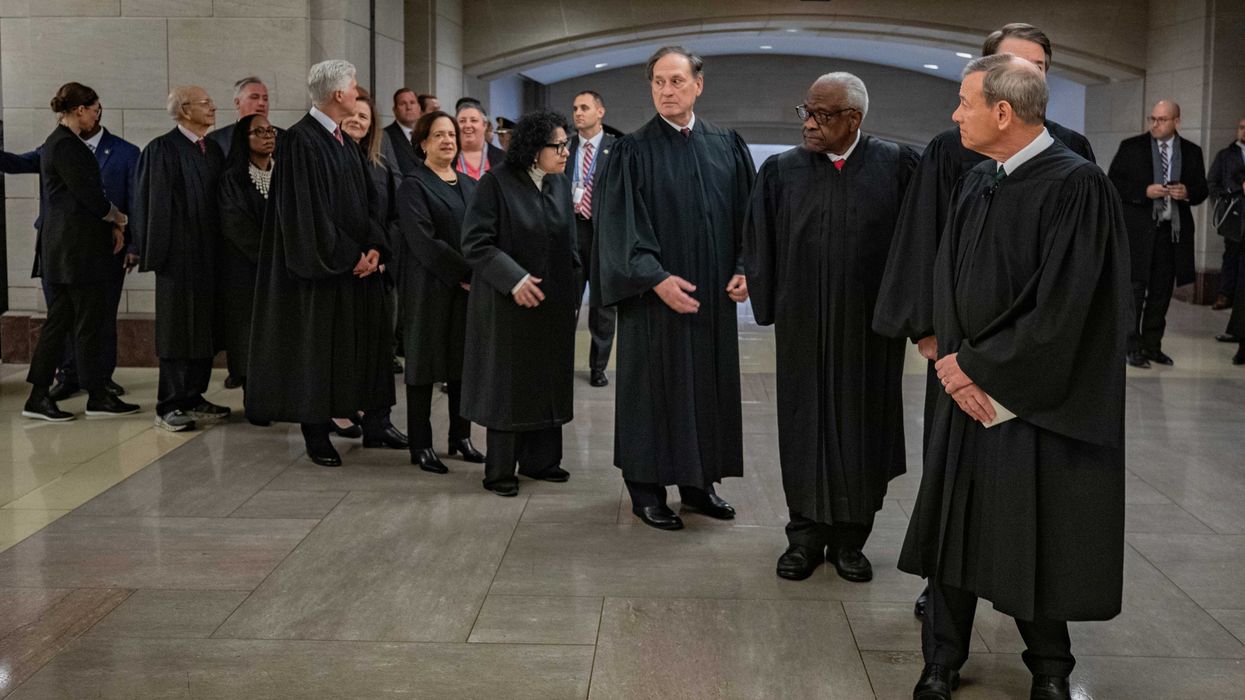
The Supreme Court seems poised to "change everything" for political campaign finance laws with a ruling expected this year, according to a new analysis from NOTUS, with officials from both parties expecting the new rules to give even more influence to the richest donors.
According to NOTUS, the Court is set to weigh in on National Republican Senatorial Committee v. Federal Election Commission by the end of its current term in the spring. The case revolves around a challenge to limits on how much coordination is allowed between party committees and individual campaigns or candidates. With Supreme Court observers arguing that it is likely to rule on the side of lifting these limits, NOTUS reported that "Party leaders aren’t waiting for the justices’ decision before figuring out how to take advantage of the potential new rules."
"Even before the year began, Democrats and Republican strategists began sketching out how the SCOTUS ruling — which could allow for nearly unlimited coordination between party committees and individual candidates and give big donors more influence — would affect their operations," NOTUS's report explained. "It’s causing them to rethink on-the-ground strategies, staffing decisions and how TV and digital ads are funded."
Should the Supreme Court rule as expected, experts believe that the changes could alter "the core of how campaigns operate," giving even more influence on campaigns to wealthier donors "able to give tens or even hundreds of thousands of dollars," a class of donors already considered to have outsized influence on elections and politics at large. "Small-dollar donors," meanwhile, who might only be able to muster "a few hundred dollars" at most, will see their impact on candidates shrink, with NOTUS predicting that the "usually robust operations aimed at enticing smaller donors" could receive less emphasis.
“No matter what side you’re on, it’s going to change everything,” one anonymous national Democratic strategist told NOTUS.
“If the parties can suddenly make unlimited coordinated expenditures, it will greatly enhance the ability of rich individuals to circumvent the contribution limits to what they can give to candidates,” David Kolker, senior counsel for the Campaign Legal Center, told the outlet in a statement.
Any hope that the Supreme Court might keep the current limits in place is largely based on a ruling from 2001, which also involved a challenge to the limit. Now, however, "even some Democrats privately acknowledge that... the coordinated spending limits are likely doomed," given the court's conservative majority. The Supreme Court currently has a 6-3 majority of justices appointed by Republicans, three of whom were appointed by Donald Trump in his first term, and has proven willing in recent years to upend accepted legal norms and precedents.