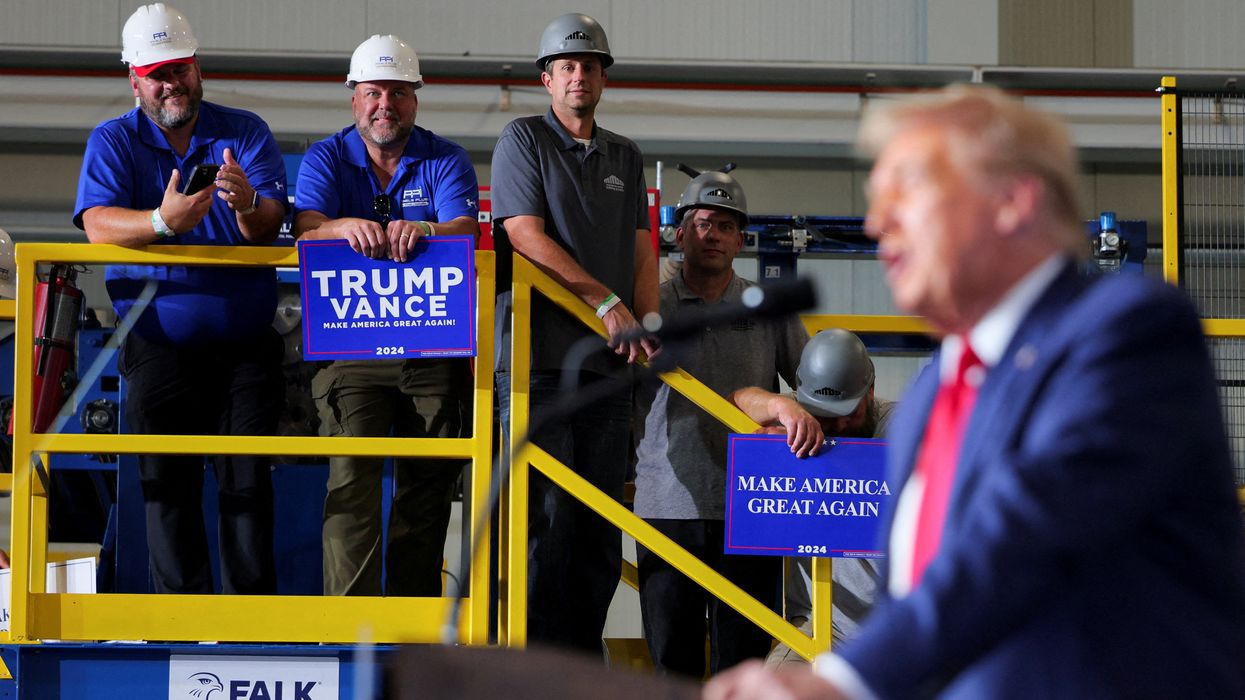
Guardian writer Eduardo Porter reports President Donald Trump’s purported dedication to U.S. manufacturing is a pointless delusion.
“There is an undeniable appeal to the hard hat and the grease-stained overalls; to the sweat on the brow of hard men in vintage posters; to the virtue of a hard day’s labor on the production line. But the American political class would do well to overcome its nostalgia for the past and forget about promises to make manufacturing great again,” said Porter.
Objectives to increase manufacturing don’t even work politically, Porter added, with one study concluding that job losses in big manufacturing counties did not push voters toward Trump in 2016. And despite Biden’s spirited efforts to grow the manufacturing sector through his Inflation Reduction Act, the Chips and Science Act, and the Infrastructure Investment and Jobs Act, even rust belt counties that “benefited richly” from his incentives still voted for Trump in 2024.
“If the politics don’t work, the efforts to ‘restore’ manufacturing – which accounts for less than 8 percent of the jobs in the country – make even less sense in economic terms,” said Porter. “It’s about as sensible as a commitment to restore agriculture – which employs less than 2 percent of Americans – to the place it occupied at the center of the U.S. economy in the 19th century.”
Trump’s tariffs on imports, which the president claims gives U.S. manufacturing a boost, don’t work because more than half of American imports are “capital equipment and intermediate goods” that U.S. manufacturers assemble into finished products, often for export. About 91 percent of respondents in a National Association of Manufacturers survey admit they use imported components, and by raising the price of such inputs, Trump’s tariffs make domestic firms less competitive.
“While the Biden administration’s strategy was not quite as stupid, it was nonetheless ineffectual,” said Porter. “Indeed, despite all the help from the White House, manufacturing output has not recovered its level from before the Covid pandemic. It remains at roughly where it was 20 years ago. And manufacturing jobs show no sign of a revival.”
Porter said there is still “a valid case” for the U.S to nurture some manufacturing industries, particularly advanced semiconductors and advanced energy technologies like the kind required to reduce carbon emissions.
“But the many campaigns Washington has embarked on over the years to restore manufacturing to some image of past glory are largely driven by misplaced nostalgia,” Porter said. “It is true that manufacturing workers earn more, on average, than those employed in the service economy. But that is an argument for policies to raise wages for low-wage service sector workers.”