
Trump’s Freudian 'psychopathology' put US on 'march to disaster': philosopher
REUTERS/Kevin Lamarque
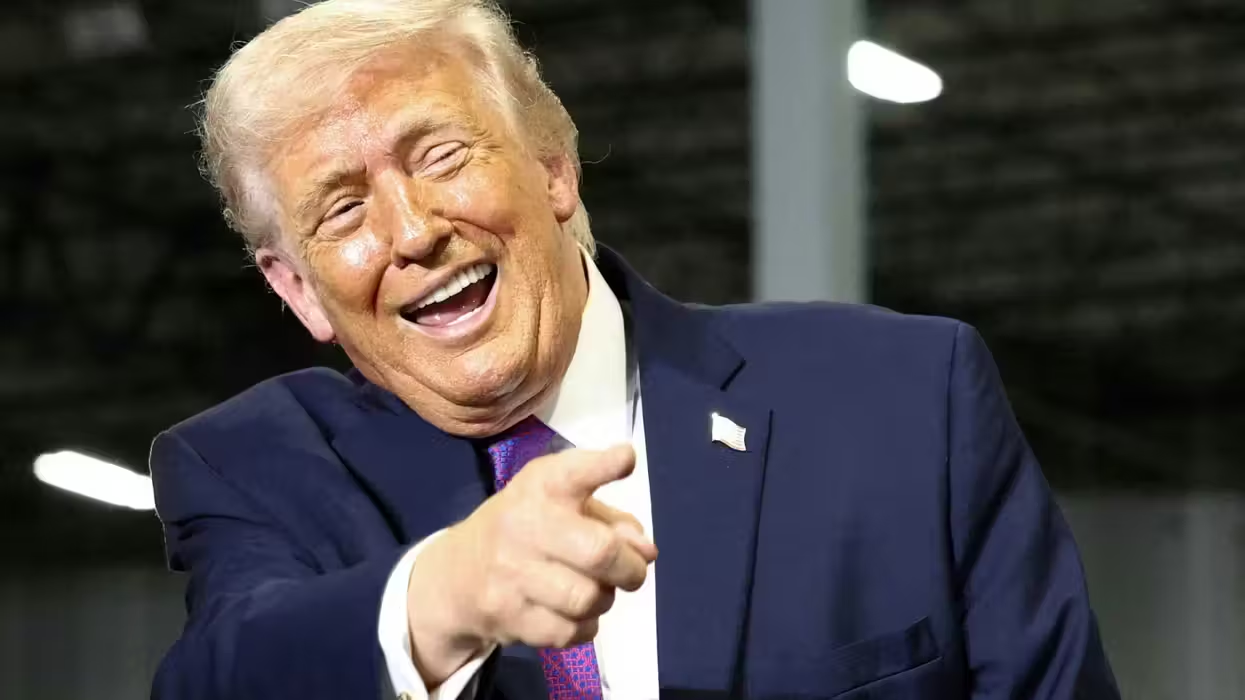
U.S. President Donald Trump gestures during a visit to Verst Logistics in Hebron, Kentucky, U.S., March 11, 2026.

U.S. President Donald Trump gestures during a visit to Verst Logistics in Hebron, Kentucky, U.S., March 11, 2026.
As the Trump administration celebrates what it refers to as a “historic victory” in the wake of Tuesday’s news of a ceasefire with Iran, others are calling it a “march to disaster” initiated due to Trump’s “psychopathology.”
Since launching war against Iran, writes John Gray at the New Statesman, President Donald Trump’s asserted intentions have “shifted from aiming to block Iran achieving a nuclear capability that was supposedly ‘obliterated’ last June to unblocking the Strait of Hormuz and restoring the situation that existed before the operation began.” Now that the war appears to be over, it seems increasingly clear that few to none of Trump’s stated objectives have been achieved, with the president declaring victory despite “surrendering the vital shipping conduit to Iran.”
Because of this and other outcomes of the war, the balance of global power has been upended. “With its proven capacity to wreak havoc on the world economy,” says Gray, “a bombed-out military-theocratic dictatorship has begun the final unraveling of US imperial power.”
According to Gray, this shift is driven by a number of factors. The spiraling economic consequences of the war have "undercut the financial foundations of U.S. hegemony.” “As the arbiter of passage through Hormuz, Iran has become the deciding force in the global oil economy,” resulting in “the re-emergence of Iran as a major power.” NATO is now “operationally defunct,” delivering a major gift to Russia and China, with the latter now eying Taiwan due to the transfer of U.S. military assets from the Asia-Pacific to the Middle East.
As Gray points out, while it would be easy to chalk these mistakes up to “lessons of history being ignored,” Trump’s disastrous “little excursion” to Iran was driven more by his “psychopathology” than anything else.
“Trump's war looks more like an example of what Sigmund Freud described as repetition compulsion — an unconscious process in which the mind acts out what it cannot properly remember,” writes Gray. “A creature of the moment as he may be, Trump seems driven by an impulse to reimagine the past and reassert American — and his own — greatness. When an infantile fantasy of omnipotence comes up against unyielding realities, the response is inchoate rage.”
Gray’s conclusions are not optimistic.
“Donald Trump does not know what he is doing,” he writes, suggesting that the war represents a “point of no return in America's retreat as a global power."

