'Head scratcher': Trump aides struggle to spend $500 billion more the military asked for
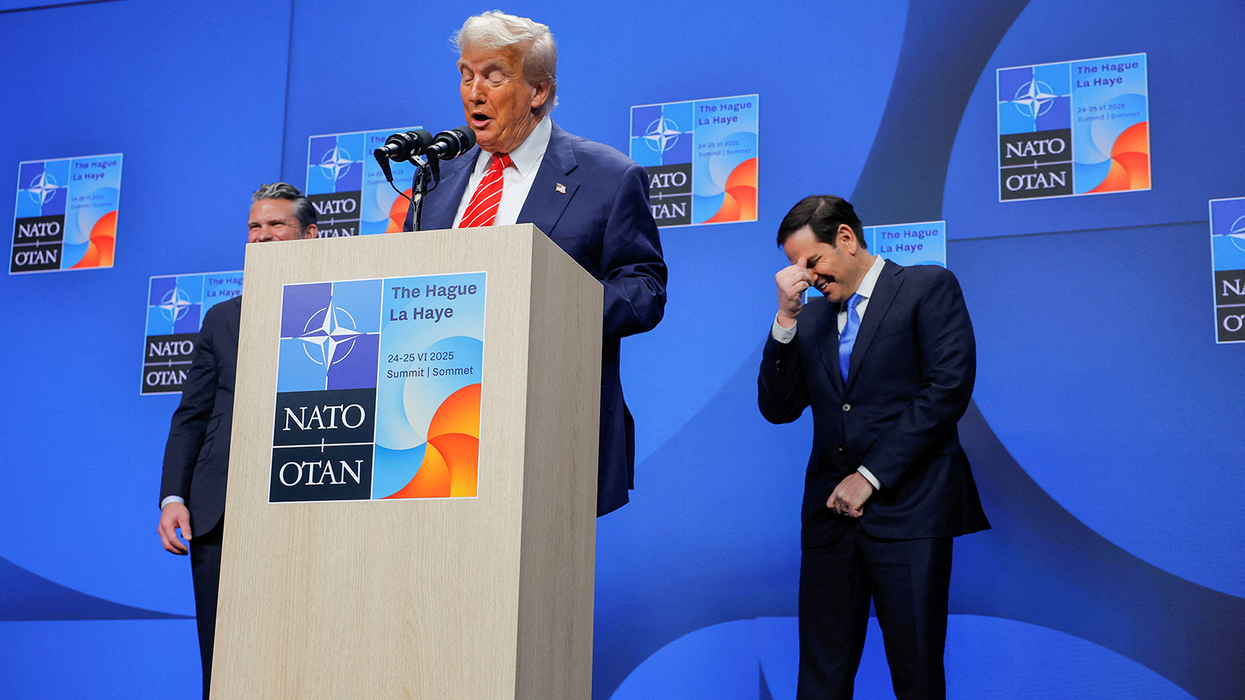
U.S. President Donald Trump speaks at a press conference, as Secretary of Defense Pete Hegseth and Secretary of State Marco Rubio react to a Sky News reporter's question about NATO Secretary General Mark Rutte calling President Trump 'daddy', at the NATO summit in The Hague, Netherlands, June 25, 2025. REUTERS/Brian Snyder
U.S. President Donald Trump speaks at a press conference, as Secretary of Defense Pete Hegseth and Secretary of State Marco Rubio react to a Sky News reporter's question about NATO Secretary General Mark Rutte calling President Trump 'daddy', at the NATO summit in The Hague, Netherlands, June 25, 2025. REUTERS/Brian Snyder
A stunning report in the Washington Post on Saturday reveals aides for President Donald Trump are running into “logistical challenges” surrounding how the U.S. military can spend “a whopping $500 billion in their forthcoming budget.”
According to four people who spoke with the Post, after Trump “agreed to a roughly 50 percent funding boost sought by” Secretary of Defense Pete Hegseth, White House aides and defense officials struggled with "where to put the money, because the amount is so large.” Per the Post, “The White House is more than two weeks behind its statutory deadline to send its budget proposal to Congress, in part because it is unclear how precisely to spend the additional $500 billion.”
As the Post reports, “senior Pentagon officials have consulted with former senior defense officials as they grapple with the challenge.”
Mark Cancian, a retired Marine Corps colonel, said with the spending increase, “it now appears that the Pentagon budget is detached from” a previous defense strategy released by Hegseth’s team in January. That strategy “calls for the Pentagon to focus first on defense in the Western Hemisphere, with less emphasis on Europe, Africa and the Middle East,” the Post reports.
Cancian called it a “head scratcher” that the U.S. would pull back from those regions while also increasing the budget.
“If you’ve got a 50 percent budget increase, you don’t have to do any of that,” Cancian said. “You’d be talking about all the new places you’d making investments.”