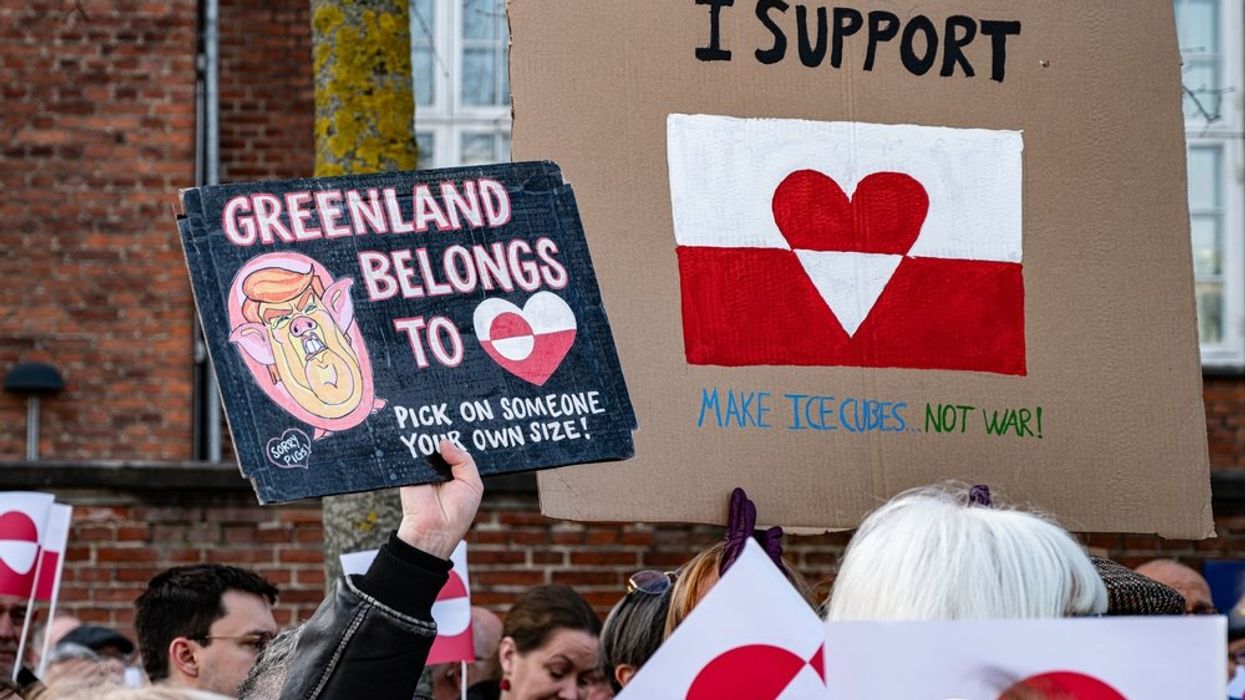
Donald Trump's longstanding obsession with annexing Greenland for the US might have a much more basic motivation than any he has given thus far, as one author who had close access to him wrote for The New Yorker, and it all has to do with how big the island territory looks on a map.
Susan B. Glasser is a New Yorker staff writer and the author of The Divider: Trump in the White House, 2017-2021. In her latest piece from Thursday, she discussed a visit she made to Mar-a-Lago in 2021 with her husband, the New York Times White House correspondent Peter Baker, to speak with Trump for the book she was writing at the time. Near the end of their talk, the couple "threw in one last question: why had he pursued the purchase of the Danish territory of Greenland?"
It had been a while at that point since Trump's fixation on the island had made news, but according to Glasser, it had been "a persistent demand over several years of his Presidency" rather than a simple whim, and "had prompted serious internal study" at the White House. Trump's response indicated that the reason for his fascination was simpler than anyone had ever let on: he likes maps, and Greenland looks "massive" on many maps.
“I said, ‘Why don’t we have that?’" Trump explained, according to Glasser. "You take a look at a map. So I’m in real estate. I look at a corner, I say, ‘I gotta get that store for the building that I’m building,’ et cetera. You know, it’s not that different. I love maps. And I always said, ‘Look at the size of this, it’s massive, and that should be part of the United States.’ It’s not different from a real-estate deal. It’s just a little bit larger, to put it mildly.”
When pressed for a deeper rationale, Glasser said Trump "could not articulate" one, telling the reporter, "from a strategic standpoint, from a locational standpoint, from a geography standpoint, it’s something that we should have."
Trump has provided similarly vague rationales for acquiring Greenland in his public statements over the years, sometimes claiming it was about the island's supply of valuable minerals, but more recently claiming it was necessary for "national security" without elaborating on why. Ryan Cooper, managing editor of The American Prospect, explained in a scathing takedown on Thursday why both of these notions fall flat in the face of reality: Greenland icey landscape and minimal transportation infrastructure render most of its minerals not commercially exploitable, and the US already had full access to the island for defense purposes.
Glasser concluded that, while simple on the surface, Trump's explanation to her about Greenland reveals much about his broader imperial-minded approach to foreign policy.
"Greenland, it turns out, is not a punch line but a template that explains much about Trump’s foreign policy: it’s about a power-grabbing President who looks at territory on a map and says he wants to own it," Glasser wrote, later adding, "Trump’s approach to the world is not the isolationism that many of his supporters celebrated when he returned to the White House, vowing an “America First” shift away from the liberal internationalism of his predecessors, but a narcissistic form of unilateralism that says, loudly, I can do whatever I want, whenever and however I want to do it."