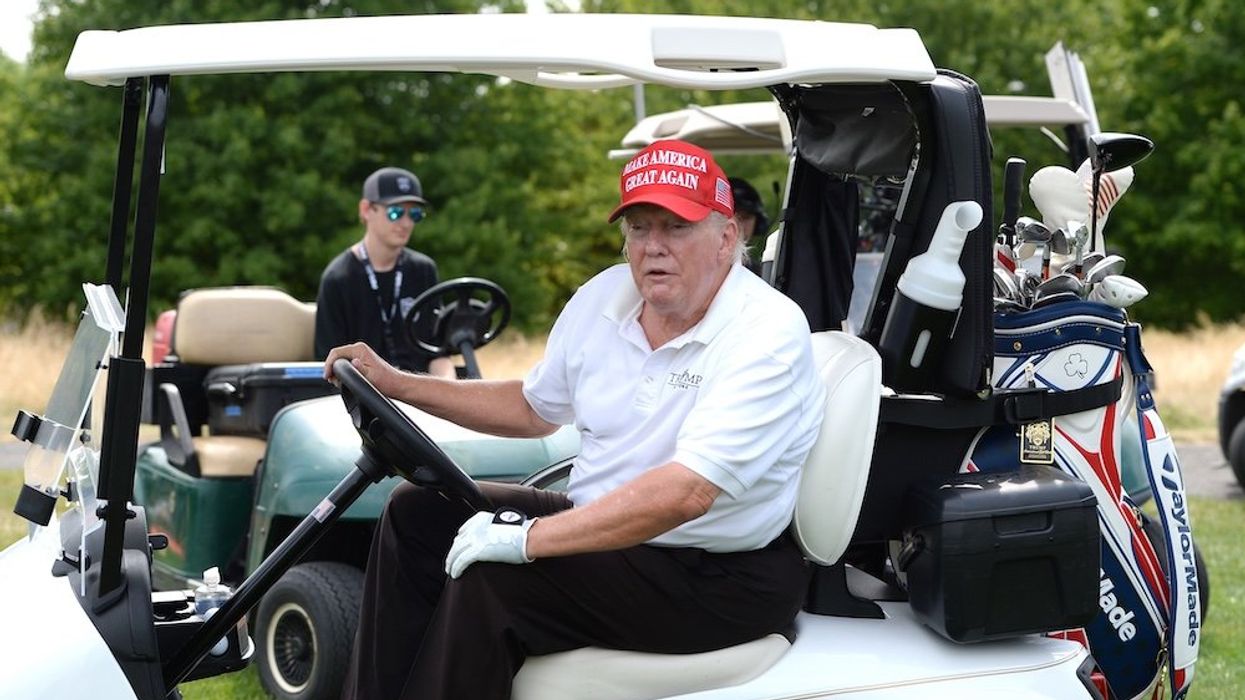
Marking the one-year anniversary of President Donald Trump's "Liberation Day" tariff announcement, analysts speaking to The Guardian suggested that he would have done less damage to the U.S. economy had he "spent the last 14 months on the golf course."
Despite being elected on the promise of tackling runaway high prices, Trump forged ahead early on in his presidency with a sweeping raft of new tariffs against nearly every country in the world. While he claimed that these new import taxes would be paid by other countries and bring vast new wealth to the country, numerous economists stressed that these new costs would be passed on to the end consumers of nearly every imported product, effectively representing a massive new tax on average consumers.
As The Guardian noted in a report on the anniversary on Thursday, "Investors quickly understood that chaos was an essential tool in Trump’s armory," with foreign investors pulling out of American assets as their value began to tank. Dario Perkins, the head of global research at the consultancy firm TS Lombard, told the outlet that it would be foolish to try and spin that sort of result as a win for the U.S. economy.
“If you think that discouraging investors from buying assets in the US is a victory, then you don’t believe in a growing economy,” Perkins said. “If it was possible for Trump to have spent the last 14 months on the golf course, we would be in a better place.”
While the U.S. is still the world's biggest economy despite Trump's chaos, another expert told The Guardian that the uncertainty has given investors pause when considering whether to do business within it.
“America is still home to the world’s largest economy and its reserve currency, as well as the globe’s largest equity and bond markets, but investors continue to reassess their exposure one year on from Liberation Day," Russ Mould, the investment director for the British stockbroker AJ Bell, explained.
Bryan Riley, the director of the National Taxpayers Union Foundation’s free trade initiative, was even more blunt and derisive of Trump's tariffs, arguing that they failed to even live up to the president's own vision for them.
“One year after Liberation Day, the evidence is in," Riley said. "Tariffs failed even by the Trump administration’s own terms. They did not shrink the trade deficit, did not revitalise manufacturing and did not help farmers. It would be a mistake to replace one set of failed tariffs with another.”
The Supreme Court recently ruled that the emergency authority Trump had been using to implement his Liberation Day tariffs without congressional approval was unlawful, forcing him to use other, much more limited authorities. While the average tariff rate has since shrunk considerably, it is still roughly twice as high as it was prior to Trump's return to the White House.