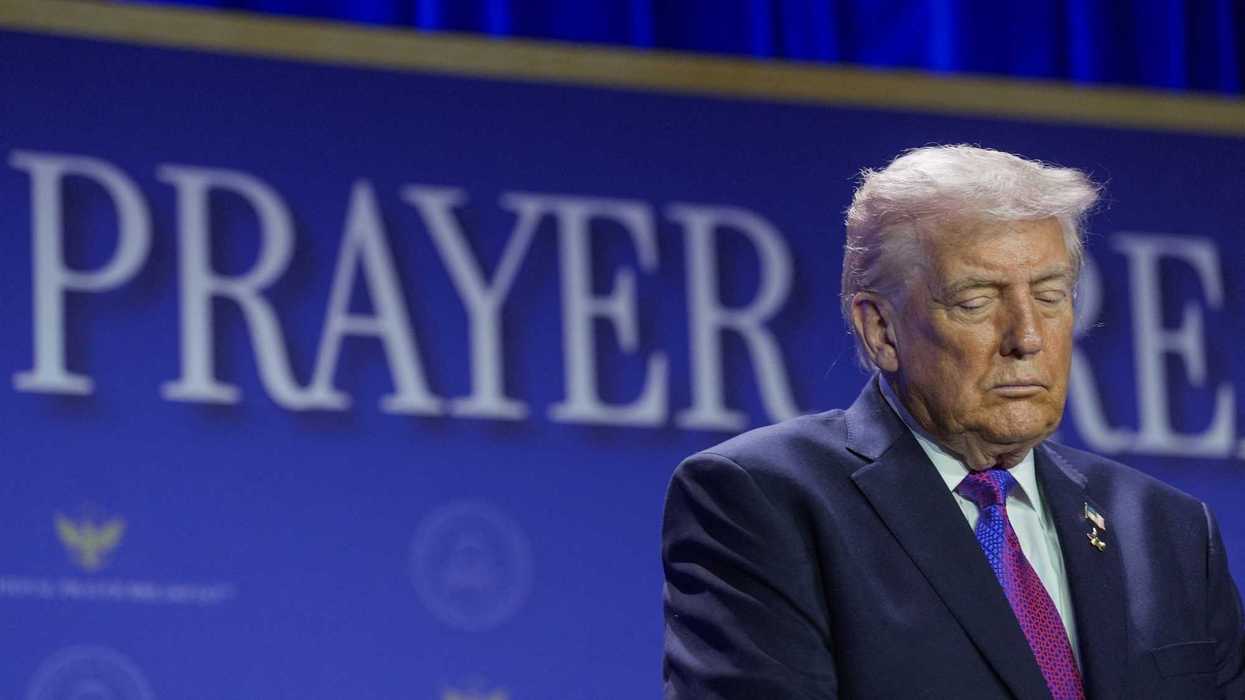
Donald Trump's forceful and brutish handling of his foreign and domestic policies saw him likened to a "pagan king" in a new analysis in The New York Times, with documentary filmmaker Leighton Woodhouse arguing that he has abandoned the true ideals at the heart of "Christian values."
In a piece for the Times published Wednesday, Woodhouse took inspiration from Canadian Prime Minister Mark Carney's comments about Trump's leadership style, which he summed up as, "the strong do what they can, and the weak suffer what they must." Woodhouse delved extensively into the philosophies of ancient, pre-Christian societies, which he argued more closely resemble the operating philosophy of Trump's second presidency.
Trump, Woodhouse wrote, operates as is if "the weak and the vanquished" have no "inherent moral value at all," meaning that the U.S. can do whatever it likes, so long as it has the power to do so. He also cited comments last month from Trump's controversial adviser, Stephen Miller, in which he justified the president's desire to take Greenland by arguing that the world is "governed by strength, that is governed by force, that is governed by power," and that the U.S. can not be bound by "international niceties" if it has the power to do something it wants.
All of that flies in the face of the core principles of Christianity, which Trump and many others in his administration have claimed to fight for. The true values of the religion, Woodhouse explained, are based on the notion that even the weak have inherent worth, and that assaults on them are an affront to God. In this way, he concluded, Trump's conduct puts him more in line with Ancient Greek or pre-Christian Roman rulers.
"By brazenly jacking Venezuela for its oil and threatening to acquire Greenland against its will, the U.S. is acting as the ancient Greeks, the ancient Persians and the Germanic tribes conducted themselves: brutishly, without shame or apology," Woodhouse wrote.
He continued: "And the abdication of Christian values is already shaping the conduct of our government toward its citizens, as in Minneapolis, where immigration agents have killed two protesters. The Trump administration appears unconstrained not only by the limits imposed by the Constitution but by the standards of an average American’s conscience. Federal agents’ treatment of both immigrants and U.S. citizens in Minneapolis is the reflection of a government that has abandoned the moral instinct that it is wrong for the powerful to abuse the weak."
Similar analysis also recently came from The Bulwark's Andrew Egger, who wrote that Trump seems to view himself "as Christianity’s Punisher," someone willing to do the "dirty work" of committing violence to protect the faith. This, Egger argued, runs directly against the religion's core values.
"This is part of what makes Trump-brand Christianity as a cultural and political force so dangerous," Egger concluded. "Trump’s political project is seen by the MAGA faithful as utterly righteous, the work of God on earth against the forces of Satan. But he has broad license to transgress all moral boundaries as he does that work... None of this, it should probably go without saying, is compatible in the slightest with the teachings of actual Christianity. Sin is sin, the faith teaches, no matter whom it’s directed against..."