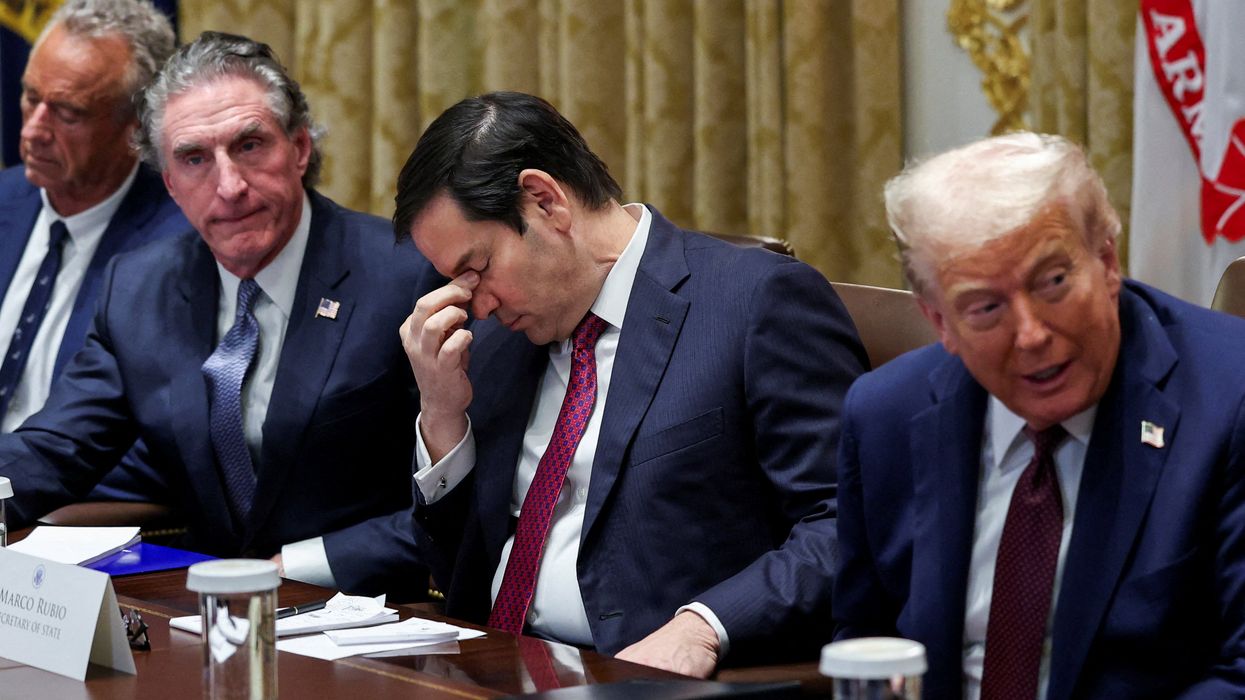
If there was any confusion before, Donald Trump now owns deportation and its tactics.
Having seemingly flip-flopped on his own key decision to flood cities with federal border agents, Donald Trump faces the problem of defining what exactly he does support about deporting millions.
The decision to remove Greg Bovino, Homeland Security's operational commander on the ground in Minneapolis, and to withdraw at least some of the 3,000 armed federal agents there, is being framed as a retreat on his policies forced by protests in the streets.
But at best, what we have heard so far is what he doesn't want, not what the expectation is going ahead.
Trump clearly didn't like association with the bad image of Homeland Security insisting on unsupported explanations contradicted by videos of the killing of Alex Pretti, but his government has yet to change the claims of total immunity and sole federal role for investigation in any of the legal arguments his Justice Department has offered the courts, as well as any noticeable change in tactics. The government told the court it was limiting inquiries to a "use of force" review about possible violation of training standards, not a homicide probe that could lead to murder charges.
Minnesota's chief federal judge has ordered Todd Lyons, acting head of ICE, to appear in his court Friday and threatened to hold him in contempt for what he says has been repeated defiance of judges' orders in the state.
Trump has not walked away from Attorney General Pam Bondi's letter to Gov. Tim Walz essentially offering a reduction of border agents for turnover of voter registration information and details of state fraud investigations involving Somali immigrants.
By handing leadership to White House border czar Tom Homan, answerable only to him, Trump has lost whatever fig leaf of distance from the brutal tactics that have led to two shooting deaths of bystander citizens, forced family separations and rough, random grabs of migrants from job sites and outside schools and immigration offices.
Despite Trump descriptions of "good talks" with Minnesota officials, Trump's decision to keep Homeland Security Secretary Kristi Noem after an emergency, two-hour White House meeting Monday night does not suggest wholesale change is coming. In a speech and interviews into last night, Trump doubled down on attacking protesters as paid agitators and insisted he was removing "murderers" from Minneapolis streets.
Questions Abound
The questions before Trump are numerous. Even as Trump distances himself from his own White House advisers and Homeland Security, his troops and Minneapolis leaders and residents are waiting to hear what replaces a campaign of fear and dread, of aggressiveness on residential streets.
Did Trump just react to news images and citizen upset based on self-serving and offensive lies by his administration, or is he rethinking the deployments that have played out almost inexorably the violence that his aggressive deportations put into motion? Will he proceed with deployments to other cities? Will he force Homeland Security to focus on the migrants with serious criminal records whom he had said he was focused on before turning to roundup of children and separating parents?
Is Trump taking responsibility for his own decisions, never mind the split-second choices facing an under-trained ICE officer being shouted at by protesters? Was this a rueful reassessment of the excesses of random grabbing of residents, migrant or citizen, criminal or not, or merely a chance to deflect blame in the eye of an angry public? Is this retreat only a reflection of obvious unhappiness with pushback from gun groups reacting to federal justification of the death because Pretti was lawfully carrying a holstered handgun?
Is Trump ready to accept state prosecution of a federal agent for what certainly looks to be an unjustified killing, because to date, the only approved investigations are internal to the affected federal law enforcement agencies themselves?
As with Trump's retreats after aggressive moves in tariffs and economics, international conflicts, and even the physical changes at the White House, even his supporters are never quite sure what the current policy says.
On the Streets
Trump is facing significant political problems from his current deportation deployments, even as his advisers, led by Stephen Miller, are plotting expansion from Minneapolis and now Maine.
Trump has a problem maintaining a common message for his administration spokesmen, including Vice President JD Vance, that has worsened now that he has seemed to retreat himself from the most forceful arguments about opposition to deportation in Minnesota.
Whatever he and Gov. Tim Walz discussed seems to change, depending on who is summarizing their conversations.
Confusion and fear on the streets have led to anger and pushback, not submission, with protests in Minneapolis drawing thousands even in sub-zero temperatures. It is doubtful that simply changing ICE leadership from Bovino to Homan will dampen protest about the aggressiveness of the deportation campaign.
In turn, protests have put even many Republican congress members into wanting to question Noem and border officials about training, procedures and the whole policy of deploying thousands of agents to cities that do not want them. Congress now has a problem with passing a budget with money for border agents without also including significant restrictions on tactics and accountability procedures.
Noem faces serious efforts to impeach her.
Chris Madel, a defense lawyer who had been running for governor of Minnesota as a Republican, said he had decided to end his campaign because he had become outraged by the Trump administration's immigration crackdown.
Taken together, Trump appears incapable of outlining clearly exactly what he wants.