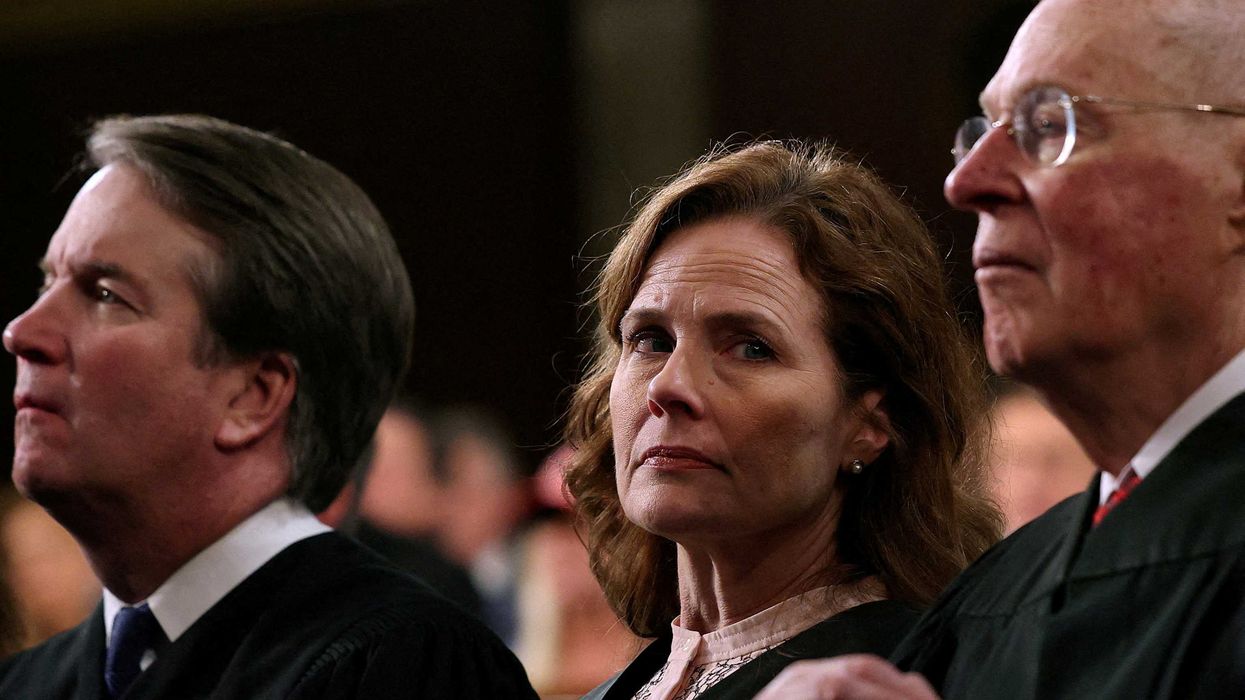
Conservative Supreme Court journalist and SCOTUSblog founder Adam Feldman wrote on Wednesday that — when it comes to determining the outcomes of cases important to President Donald Trump — Justice Brett Kavanaugh is the judge most likely to split from his Republican leader.
On the other hand, Justice Neil Gorsuch is the one most likely to dissent from the Trump line in cases involving Trump and/or his policies. Yet because Kavanaugh is more likely to be a deciding vote in key cases, whereas Gorsuch tends to dissent in cases where Trump’s position nevertheless prevails, Kavanaugh “is the conservative justice most likely to side with liberals in outcomes.”
“This is perhaps not surprising,” Feldman added, pointing out that among the three judges appointed by Trump — a group of three that also includes Justice Amy Coney Barrett — Kavanaugh most frequently votes with the majority. “His liberal-majority votes in close cases are perhaps best explained less by a single subject area (as in the case of Gorsuch) than by a repeatable posture, as he appears most likely to cross over when the liberal position can be framed as institutionally stabilizing and incremental – preserving existing decision rules, cabining remedies, or avoiding structural leaps.”
In terms of Gorsuch, Feldman attributed his comparatively more frequent dissents to a genuine liberal streak in his otherwise conservative philosophy. For example, he took the liberal position in the cases of Arizona v. Navajo Nation and Oklahoma v. Castro-Huerta, both of which involved tribal law, and in criminal cases that even split the liberal bloc such as Pulsifer v. United States and Diaz v. United States.
Overall Kavanaugh joined liberal majorities approximately 74 percent of the time, Gorsuch 73 percent of the time and Barrett 72 percent of the time. These three Trump-appointed judges, along with the three other Republican judges, are expected to split from the president on even more future occasions. NBC News recently speculated that in 2026 the Supreme Court will differ from Trump on issues like his unilateral tariffs, attempted firing of the Federal Reserve’s board of governors and challenging of birthright citizenship.
"In all three cases, the justices could have acted sooner, but the Supreme Court has a long history of waiting until a president has lost some of his post-election power and popularity before delivering major legal losses," said NBC. They quoted Professor Richard Pildes from the New York University School of Law saying “The court is not confronting the president head-on until spring this year. That’s very different in terms of his political strength.”
As recently as January, conservative judges like Kavanaugh, Barrett and Samuel Alito began signaling plans to strike down Trump’s firing of the Federal Reserve board members. Kavanaugh in particular was concerned about setting a negative precedent in terms of allowing unchecked executive power.
“History is a pretty good guide,” Kavanaugh said. “Once these tools are unleashed, they are used by both sides, and usually more the second time around.”