U.S. Secretary of Transportation Sean Duffy, currently serving as acting NASA Administrator, announced plans for the U.S. to build a nuclear reactor on the Moon—but warned that America is “behind” in the global “race to the Moon,” despite having put a man on the Moon in 1969 through the Apollo program.
Speaking about a lunar nuclear reactor, Secretary Duffy told reporters on Tuesday that “this is not a new concept,” and it “has been discussed under Trump I, under Biden, but we are in a race to the moon, in a race with China to the Moon, and to have a base on the Moon, we need energy.”
Duffy explained that while some areas of the Moon are good for solar power, “fission technology is critically important.”
He revealed that the U.S. has already spent hundreds of millions of dollars on feasibility studies.
“We are now going to move beyond studying, and we have given direction to go. Let’s start to deploy our technology to move to actually make this a reality.”
Duffy also said that putting a nuclear reactor on the Moon is critically important “to be able to sustain life on the Moon to then go to Mars.”
He reiterated that “we’re behind,” saying that “If we’re going to engage in the race to the Moon, in the race to Mars, we have to get our act together. We have to marshal all of our resources, all of our focus on going to the Moon, which is what we’re going to do.”
Duffy also pointed to a July 31 directive, as ABC News reported.
“Since March 2024, China and Russia have announced on at least three occasions a joint effort to place a reactor on the Moon by the mid-2030s,” Duffy wrote. “The first country to do so could potentially declare a keep-out zone which would significantly inhibit the United States from establishing a planned Artemis presence if not there first.”
Some criticized the Secretary, calling it an affront to Neil Armstrong—the first man to walk on the Moon—to suggest this would be America’s first lunar mission. Tuesday is the 95th anniversary of Armstrong’s birth.
Others called for the U.S. to spend more on health care, and others still urged building more nuclear reactors in the U.S. before placing them on the Moon.
“Here’s the question,” wrote economist Dr. Pippa Malmgren. “Should the first human institution on the moon be: A. A military base B. A mining or manufacturing company C. An institution designed to ensure that all humanity benefits from the abundance space is set to deliver? Intent matters.”
“It sounds crazy,” added Dr. Catharine Young, “but a nuclear reactor on the moon is key to powering long-term missions. The problem isn’t the vision – it’s that NASA downsized thousands of senior engineers, dismantling the capacity needed to do it safely. This is what happens when science is treated as expendable.”
The people behind centibillionaire Tesla and SpaceX CEO Elon Musk's Department of Government Efficiency (DOGE) are largely unknown to the public. But two journalists recently found a public Google Calendar for one DOGE staffer that sheds light on how the quasi-agency operates.
Business Insider's Jack Newsham and Alice Tecotzky recently discovered that 26 year-old Riley Sennott, who is listed as a "senior advisor" at the National Aeronautics and Space Administration (NASA), had set his Google Calendar to "public" despite deleting his LinkedIn account and setting his X account to private. Newsham and Tecotzky noted that Sennott's affiliation with DOGE has not been previously reported, and the outlet noted that all of Sennott's appointments dating back to 2016 were publicly visible. After Business Insider contacted Sennott for comment, his Google Calendar was reportedly set to private within an hour.
In January, Sennott attended a 15-minute meeting on DOGE recruiting. Less than two weeks later, he attended a meeting instructing "special government employees" (Musk's official designation) about the federal ethics rules that applied to them. In addition to Sennott, other DOGE employees were on that meeting, including Derek Geissler and Brooks Morgan, who are at the General Services Administration and the Department of Education, respectively.
Before he joined DOGE, Sennott may have worked at Tesla, as his X account contains references to it and his calendar showed meetings with various Tesla employees. He also worked for a crypto-related company in 2022 that created blockchain software, and had meetings with various defense contractors and tech companies during a period of 2024 that Business Insider reported was likely part of a job hunt.
The outlet also reported that Sennott was "working with a non-profit team in Ukraine to efficiently deliver aid and support evacuations" in 2023, and may have had an internship at the consulting firm Booz Allen Hamilton (the same firm that hired Edward Snowden in 2013). In college, he reportedly studied symbolic systems and environmental studies. Newsham and Tecotzky added that while they knew Sennott was at NASA as a part of DOGE, his precise role remains unclear.
The New York Times is keeping tabs on DOGE employees who have been publicly identified and the agencies where they've been placed. There are so far more than 50 people who have been linked to Musk's initiative to carry out mass layoffs of federal workers and slash federal budgets, including many people who worked at Musk-led companies like Tesla, SpaceX and Neuralink, among others. DOGE is not yet an official federal agency authorized by Congress.
Click here to read Business Insider's full report (subscription required).
The head of the National Aeronautics and Space Administration (NASA) is now calling for a federal investigation into Tesla and SpaceX CEO Elon Musk after news broke of his relationship with Russian President Vladimir Putin.
On Friday, the Wall Street Journal reported that the world's richest man — who has become one of former President Donald Trump's most outspoken supporters — has had multiple conversations with Putin since late 2022. The paper reported that while the two talked mostly about space exploration in their first call, they have since delved into talks about Russia's ongoing war with Ukraine.
"Musk has forged deep business ties with U.S. military and intelligence agencies, giving him unique visibility into some of America’s most sensitive space programs," the Journal wrote. "SpaceX, which operates the Starlink service, won a $1.8 billion classified contract in 2021 and is the primary rocket launcher for the Pentagon and NASA. Musk has a security clearance that allows him access to certain classified information."
The SpaceX CEO has previously said while campaigning for Trump in Pennsylvania that he already has a top-secret security clearance. Now, NASA administrator (and former U.S. senator from Florida) Bill Nelson is calling for Musk's calls to Putin to be investigated, saying it's "concerning" that someone with access to national secrets is having regular private conversations with a foreign adversary.
"If the story is true that there have been multiple conversations between Elon Musk and the president of Russia, then I think that would be concerning, particularly for NASA, for the Department of Defense, for some of the intelligence agencies," Nelson said at the Semafor World Economy Summit.
It's already a violation of federal law for any private citizen to have conversations with foreign leaders without prior authorization from the sitting administration. The Logan Act of 1799 stipulates that anyone who has unauthorized talks with foreign governments can be punished with fines and/or a prison sentence of up to three years.
The South African centabillionaire has also reportedly had talks with other high-ranking Russian officials. The Journal reported that Musk has spoken with Sergei Kiriyenko, who the DOJ accused in a recent affidavit of creating roughly 30 domains aimed at spreading disinformation. That disinformation campaign was focused on both undermining U.S. support for Ukraine and at sowing false information on Musk's social media platform X (formerly Twitter) about the 2024 election.
Musk is already in hot water over his $1 million daily giveaways to registered voters in battleground states. The Department of Justice recently warned him that paying people to register to vote is a federal crime, which led Musk to suspend his swing state sweepstakes for the remainder of the election cycle.
The White House has not yet stated whether it would investigate Musk, with National Security Council spokesperson John Kirby saying he's familiar with the Journal's reporting on Musk's calls with Putin.
"I’m not a position to corroborate the veracity of those reports, and we would refer you to Mr. Musk to speak to his private communications," Kirby said.
Click here to read the Journal's report in its entirety (subscription required).
Two astronauts have been stranded at the International Space Station (ISS) for weeks. Now, a former NASA astronaut is explaining what needs to be done to get them back on solid ground.
NASA test pilots Butch Wilmore and Suni Williams, who rode the Boeing Starliner capsule to the ISS, almost didn't make it to the research outpost due to helium leaks and what they referred to as "degradation in our thrusters." Even though this was the Starliner's first manned space flight, unmanned launches and re-entries of the capsule had gone off without a hitch.
In a Wednesday interview with CNN host Boris Sanchez, Col. Terry Virts – a former NASA astronaut – explained what went wrong with Wilmore and Williams' trip to the ISS, and how they can get back to Earth safely. Virts joined the interview holding up a model Boeing Starliner. He explained that the astronauts are safe and can come home anytime, but that more research needs to be done in order to determine what caused the thruster failure so future missions won't be jeopardized.
"They have a lot of small RCS [Reaction Control System] jets there on this back part of the capsule, and that's used to orient and point the capsule in the right direction. They also have some large OMAC [Orbital Maneuvering and Attitude Control] engines that are used to actually de-orbit the capsule to get it back to Earth," Col. Virts explained. "So when the capsule undocks, it'll turn around backwards, fire the larger thrusters, the OMAC, thrusters and come back."
"The small thrusters, the RCS, failed during the docking," he continued. "And the problem is, when it comes back to Earth, the capsule with the crew on board is going to separate from the service module. The capsule will come back safely with the heat shield and a parachute, and the service module is going to burn up. So they won't have the thrusters to look at and analyze, they won't have the helium tanks that had some leaks to look at, so they need to keep it on the space station for as long as they need, to get the data they need, before the separation in the service module burns up."
According to Virts, Boeing needs the Starliner to fly a successful manned test flight to and from the ISS in order to get the craft certified by NASA. The craft's next expedition will be an operational flight with four astronauts rather than two, in which the four scientists on board will complete a normal rotation on the ISS.
"They really want that big giant certification stamp so that they can consider the vehicle operational, so I think they're taking as long as they need to make sure they can get that certification," Virts said. "If there was an emergency, we just heard in the press conference, the crew would jump in, close the hatch and come back to Earth. And I don't think there'll be any, no one expects any problems at all, but they do want that certification stamp and so it's a lot better to take a few extra weeks now than to have to fly an entire another test mission which Boeing and NASA definitely don't want."
The Starliner's woes are just the latest headache for Boeing, which has been reeling from numerous whistleblowers coming forward to speak out about the company's lackadaisical attitude for safety regulations. Aerospace analyst Miles O'Brien told CNN last month that the company's thirst for ever-increasing profits may have been what led to the breakdown of the Starliner.
Virts noted that one unexpected silver lining of the malfunction on Boeing's Starliner capsule is that Wilmore and Williams will be able to help other astronauts on the ISS. He explained that more hands are always needed to maintain the jointly operated outpost that the U.S. runs in conjunction with other countries.
The station astronauts are going to be happy to get some free labor," Virts said. "You can never have enough workers on the space station. So this is free free labor to knock off the honey-do list, which is always long on a space station."
If there is one thing that evidently transports President Donald Trump to a state of wide-eyed, childlike wonderment, it is space travel. But Trump doesn't have any apparent understanding of NASA's goals or technological challenges — he just wants them to be the biggest and best at everything during his presidency, with no clear idea of what that means.
Nothing better demonstrates this than a conversation Trump had with former acting NASA administrator Robert Lightfoot, Jr. in April 2017, as detailed by former White House communications official Cliff Sims in his new book, Team of Vipers, and reported by the Daily Intelligencer.
During a congratulatory videoconference with astronaut Peggy Whitson, who had just broken the record for the longest continual spaceflight by an American, Trump asked, "Tell me, Mars — what do you see a timing for actually sending humans?" Whitson said that, "Well, I think as your bill directed, it would be in the 2030s. Unfortunately, spaceflight takes a lot of time and money, so getting there will take some international cooperation."
While that scene was visible to the public, Trump had apparently been pestering Lightfoot about a Mars mission for several minutes before the cameras started rolling:
"Sims wrote that he leaned in toward Lightfoot and made him an offer. 'But what if I gave you all the money you could ever need to do it?' Trump asked. 'What if we sent NASA's budget through the roof, but focused entirely on that instead of whatever else you're doing now. Could it work then?"
Lightfoot told him he was sorry, but he didn’t think it was possible. This left Trump "visibly disappointed," Sims wrote. "But I tried to refocus him on the task at hand. We were now about 90 seconds from going live."
After officials finally convinced a crestfallen Trump that they couldn't put a man on Mars by 2020 just for him, he distractedly strode over to a bathroom mirror, looked at his reflection, and muttered, "Space Station, this is your President," according to Sims.
Sadly for Trump, NASA is nowhere close to sending astronauts to Mars yet. They still need to work out a number of challenges with the spacecraft, nutrition, health, and transmissions — and they also want to launch the mission at the point when Mars is closest to Earth. That moment will be October 2020, one month before the presidential election, but that is not nearly enough time to solve all these challenges, so NASA will need to wait years for the next time the planets get close enough.
If Trump is serious about a Mars mission, either because he thinks it will be of important scientific value or — more likely — because he just thinks it would be awesome, he should absolutely give NASA the funding to do it and play his part in the advancement of space travel. But his hopes of being able to congratulate the astronauts on the surface of Mars from the Oval Office are just not going to happen.
As the Trump administration tries to undermine the COP 24 climate talks in Poland, new U.S. government data shows that ice melt at both of the planet's poles—driven by rising air and ocean temperatures resulting from human-caused global warming—is worse than previously thought.
The latest annual Arctic Report Card from National Oceanic and Atmospheric Administration (NOAA) found that over the past three decades, a "stunning" 95 percent of northern region's the oldest, thickest ice has disappeared.
The finding suggests that the sea at the top of the world has already morphed into a new and very different state, with major implications not only for creatures such as walruses and polar bears but, in the long term, perhaps for the pace of global warming itself.
The oldest ice can be thought of as a kind of glue that holds the Arctic together and, through its relative permanence, helps keep the Arctic cold even in long summers...
If the Arctic begins to experience entirely ice-free summers, scientists say, the planet will warm even more, as the dark ocean water absorbs large amounts of solar heating that used to be deflected by the cover of ice.
"The Arctic is an indication of what's coming to the rest of the globe," noted Walt Meier, a sea ice expert at the National Snow and Ice Data Center (NSIDC). And while the timeline is uncertain, the region appears on-track to experience an ice-free summer.
"In the Arctic Ocean, a difference of 2 degrees can be huge. If it goes from 31 Fahrenheit to 33 Fahrenheit, you're going from ice skating to swimming," Meier told the Post. "Looking down from the North Pole from above, for all intents and purposes, you're going to see a blue Arctic Ocean."
If ice-free summers become the Arctic's new normal, it would be an "unmitigated disaster," concluded Veerabhadran Ramanathan, a climate expert at the Scripps Institution of Oceanography. Such conditions, he warned, could add another half-degree Celsius (0.9 degrees Fahrenheit) to the already-alarming rates of global temperature rise.
Meanwhile, at the world's southern pole, as the Guardian reported, NASA researchers have discovered that "a group of glaciers spanning an eighth of the East Antarctica coastline are being melted by the warming seas." This region, the newspaper noted, "stores a vast amount of ice, which, if lost, would in the long-term raise global sea level by tens of meters and drown coastal settlements around the world."
East Antarctica is relatively unstudied compared with West Antarctica, where "utterly terrifying" findings have fueled demands for urgent action worldwide to dramatically cut planet-warming emissions. For this study, NASA researchers used satellites to analyze ice movements and heights, and measured ocean temperature over time by tagging seals.
The ice retreat they saw, "doesn't seem random, it looks systematic," explained NASA's Alex Gardner. "That hints at underlying ocean influences that have been incredibly strong in West Antarctica." While the observations have experts worried, Gardner said they indicate a need for more research to determine "whether these glaciers will enter a phase of rapid retreat or stabilize."
Are we alone? Unfortunately, neither of the answers feel satisfactory. To be alone in this vast universe is a lonely prospect. On the other hand, if we are not alone and there is someone or something more powerful out there, that too is terrifying.
As a NASA research scientist and now a professor of physics, I attended the 2002 NASA Contact Conference, which focused on serious speculation about extraterrestrials. During the meeting a concerned participant said loudly in a sinister tone, “You have absolutely no idea what is out there!” The silence was palpable as the truth of this statement sunk in. Humans are fearful of extraterrestrials visiting Earth. Perhaps fortunately, the distances between the stars are prohibitively vast. At least this is what we novices, who are just learning to travel into space, tell ourselves.
Cover of the October 1957 issue of pulp science fiction magazine Amazing Stories. This was a special edition devoted to ‘flying saucers,’ which became a national obsession after airline pilot Kenneth Arnold sighted a saucer-shaped flying objects in 1947.
I have always been interested in UFOs. Of course, there was the excitement that there could be aliens and other living worlds. But more exciting to me was the possibility that interstellar travel was technologically achievable. In 1988, during my second week of graduate school at Montana State University, several students and I were discussing a recent cattle mutilation that was associated with UFOs. A physics professor joined the conversation and told us that he had colleagues working at Malmstrom Air Force Base in Great Falls, Montana, where they were having problems with UFOs shutting down nuclear missiles. At the time I thought this professor was talking nonsense. But 20 years later, I was stunned to see a recording of a press conference featuring several former US Air Force personnel, with a couple from Malmstrom AFB, describing similar occurrences in the 1960s. Clearly there must be something to this.
With July 2 being World UFO Day, it is a good time for society to address the unsettling and refreshing fact we may not be alone. I believe we need to face the possibility that some of the strange flying objects that outperform the best aircraft in our inventory and defy explanation may indeed be visitors from afar – and there’s plenty of evidence to support UFO sightings.
The Fermi paradox
The nuclear physicist Enrico Fermi was famous for posing thought provoking questions. In 1950, at Los Alamos National Laboratory after discussing UFOs over lunch, Fermi asked, “Where is everybody?” He estimated there were about 300 billion stars in the galaxy, many of them billions of years older than the sun, with a large percentage of them likely to host habitable planets. Even if intelligent life developed on a very small percentage of these planets, then there should be a number of intelligent civilizations in the galaxy. Depending on the assumptions, one should expect anywhere from tens to tens of thousands of civilizations.
With the rocket-based technologies that we have developed for space travel, it would take between 5 and 50 million years for a civilization like ours to colonize our Milky Way galaxy. Since this should have happened several times already in the history of our galaxy, one should wonder where is the evidence of these civilizations? This discrepancy between the expectation that there should be evidence of alien civilizations or visitations and the presumption that no visitations have been observed has been dubbed the Fermi Paradox.
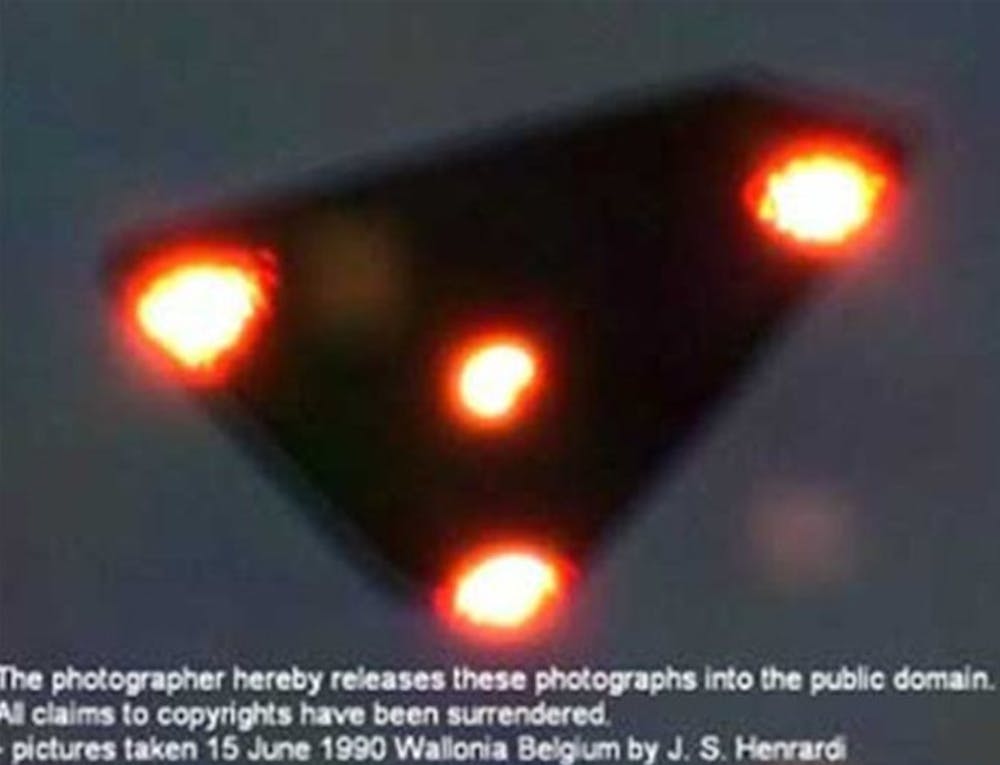
This photograph was taken in Wallonia, Belgium.J.S. Henrardi
Carl Sagan correctly summarized the situation by saying that “extraordinary claims require extraordinary evidence.” The problem is that there has been no single well-documented UFO encounter that would alone qualify as the smoking gun. The situation is exacerbated by the fact that many governments around the world have covered upand classifiedinformation aboutsuch encounters. But there are enough scraps of evidence that suggest that the problem needs to be open to scientific study.
UFOs, taboo for professional scientists
When it comes to science, the scientific method requires hypotheses to be testable so that inferences can be verified. UFO encounters are neither controllable nor repeatable, which makes their study extremely challenging. But the real problem, in my view, is that the UFO topic is taboo.
While the general public has been fascinated with UFOs for decades, our governments, scientists and media, have essentially declared that of all the UFO sightings are a result of weather phenomenon or human actions. None are actually extraterrestrial spacecraft. And no aliens have visited Earth. Essentially, we are told that the topic is nonsense. UFOs are off-limits to serious scientific study and rational discussion, which unfortunately leaves the topic in the domain of fringe and pseudoscientists, many of whom litter the field with conspiracy theories and wild speculation.
I think UFO skepticism has become something of a religion with an agenda, discounting the possibility of extraterrestrials without scientific evidence, while often providing silly hypotheses describing only one or two aspects of a UFO encounter reinforcing the popular belief that there is a conspiracy. A scientist must consider all of the possible hypotheses that explain all of the data, and since little is known, the extraterrestrial hypothesis cannot yet be ruled out. In the end, the skeptics often do science a disservice by providing a poor example of how science is to be conducted. The fact is that many of these encounters – still a very small percentage of the total – defy conventional explanation.
The media amplifies the skepticism by publishing information about UFOs when it is exciting, but always with a mocking or whimsical tone and reassuring the public that it can’t possibly be true. But there are credible witnesses and encounters.
Why don’t astronomers see UFOs?
I am often asked by friends and colleagues, “Why don’t astronomers see UFOs?” The fact is that they do. In 1977, Peter Sturrock, a professor of space science and astrophysics at Stanford University, mailed 2,611 questionnaires about UFO sightings to members of the American Astronomical Society. He received 1,356 responses from which 62 astronomers – 4.6 percent – reported witnessing or recording inexplicable aerial phenomena. This rate is similar to the approximately 5 percent of UFO sightings that are never explained.
As expected, Sturrock found that astronomers who witnessed UFOs were more likely to be night sky observers. Over 80 percent of Sturrock’s respondents were willing to study the UFO phenomenon if there was a way to do so. More than half of them felt that the topic deserves to be studied versus 20 percent who felt that it should not. The survey also revealed that younger scientists were more likely to support the study of UFOs.
UFOs have been observed through telescopes. I know of one telescope sighting by an experienced amateur astronomer in which he observed an object shaped like a guitar pick moving through the telescope’s field of view. Further sightings are documented in the book “Wonders in the Sky,” in which the authors compile numerous observations of unexplained aerial phenomena made by astronomers and published in scientific journals throughout the 1700s and 1800s.
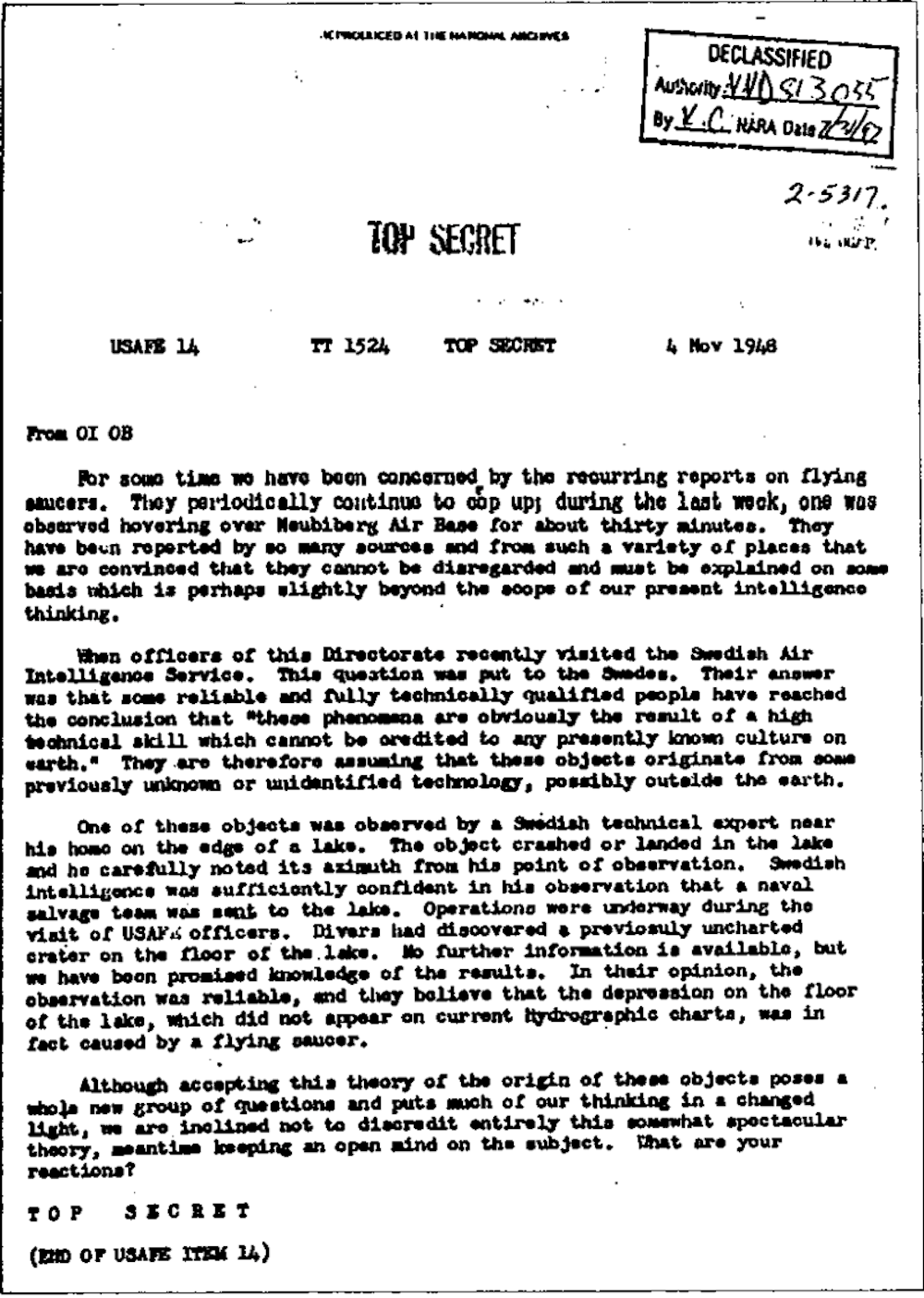
Declassified document describing a sighting of a UFO in December 1977, in Bahia, a state in northern Brazil.Arquivo Nacional Collection
The countries of Brazil, Canada, Denmark, Ecuador, France, New Zealand, Russia, Sweden and the United Kingdom have been declassifying their UFO files since 2008. The French Committee for In-Depth Studies, or COMETA, was an unofficial UFO study group comprised of high-ranking scientists and military officials that studied UFOs in the late 1990s. They released the COMETA Report, which summarized their findings. They concluded that 5 percent of the encounters were reliable yet inexplicable: The best hypothesis available was that the observed craft were extraterrestrial. They also accused the United States of covering up evidence of UFOs. Iran has been concerned about spherical UFOs observed near nuclear power facilities that they call “CIA drones” which reportedly are about 30 feet in diameter, can achieve speeds up to Mach 10, and can leave the atmosphere. Such speeds are on par with the fastest experimental aircraft, but unthinkable for a sphere without lift surfaces or an obvious propulsion mechanism.
In December 2017, The New York Times broke a story about the classified Advanced Aviation Threat Identification Program, which was a $22 million program run by the former Pentagon official Luis Elizondo and aimed at studying UFOs. Elizondo resigned from running the program protesting extreme secrecy and the lack of funding and support. Following his resignation Elizondo, along with several others from the defense and intelligence community, were recruited by the To the Stars Academy of Arts & Science, which was recently founded by Tom DeLonge to study UFOs and interstellar travel. In conjunction with the launch of the academy, the Pentagon declassified and released three videos of UFO encounters taken with forward looking infrared cameras mounted on F-18 fighter jets. While there is much excitement about such disclosures, I am reminded of a quote from Retired Army Colonel John Alexander: “Disclosure has happened. … I’ve got stacks of generals, including Soviet generals, who’ve come out and said UFOs are real. My point is, how many times do senior officials need to come forward and say that this is real?”
A topic worthy of serious study
There is a great deal of evidence that a small percentage of these UFO sightings are unidentified structured craft exhibiting flight capabilities beyond any known human technology. While there is no single case for which there exists evidence that would stand up to scientific rigor, there are cases with simultaneous observations by multiple reliable witnesses, along with radar returns and photographic evidence revealing patterns of activity that are compelling.
Declassified information from covert studies is interesting, but not scientifically helpful. This is a topic worthy of open scientific inquiry, until there is a scientific consensus based on evidence rather than prior expectation or belief. If there are indeed extraterrestrial craft visiting Earth, it would greatly benefit us to know about them, their nature and their intent. Moreover, this would present a great opportunity for mankind, promising to expand and advance our knowledge and technology, as well as reshaping our understanding of our place in the universe.
In a recent speech, President Donald Trump announced a new policy for the American space programme. It is time, he argued, for America to create a “Space Force”. As ever, the policy announcement was full of glittering ideas but short on detail, largely unspecific and even inaccurate. What we do know is that this would be a new and separate military command, “equal” to the American Airforce. But like much of Trumpian vision, superlative expressions shroud reality and do great injustice to the serious issues at stake.
We should all be concerned by the prospect of the nuclearisation and militarisation of outer space. It is crucial for world, and perhaps even intergalactic, peace that the legality of his plans are subject to the fiercest domestic and international scrutiny. At the moment it is unclear how they could possible fit in with existing international legal frameworks.
Militarised space
America has hardly ever disguised its view of space as an extension of military power. The US already has an Air Force Space Command, created by Ronald Reagan in 1982, which is dedicated to using space-based assets to aid its flights, fights, and to win in air, space and cyberspace. Reagan also introduced the “Star Wars” programme and George W. Bush unsuccessfully tried to resurrect it through the Son of Star Wars project. Both were touted as futuristic space-based ballistic missile interceptor programmes. But aside from the fact that they were technically impossible at the time, they also constituted a frontal assault on a previous anti-ballistic missile treaty between the US and the Soviet Union.
Trump’s most recent vision is actually a rehash of existing programmes. The idea of creating a new branch of the military called the “Space Corp” was already in the 2017 National Defence Authorisation Act, which emerged from discussions long predating the current administration. But in the end the plans were dropped because congressional negotiators refused to fund them.
And America is not alone in the quest for a military presence in space. All modern armies rely on space-based applications, such as satellites, and jostle for military advantages in space. Although, military uses of technologies in space may be more useful for domestic conflicts where large swathes of territory fall under terrorist control, such as the Sambisa forest in northern Nigeria, where Boko Haram operates.
China and Russia have space militarisation programmes of their own, much of which take place out of sight. Recently, China attracted suspicion by shooting down one of its own satellites.
But certain aspects of Trump’s recent policy announcement should raise serious alarm. Trump said: “It is not enough to have American presence in space we must have American dominance.” This deviates dangerously from the historical and legal norm. To ensure America’s security interests is one thing. To dominate outer space is another. The former is a legitimate aspiration of any independent state. The latter has already elicited the promise of a “tough response” from Russia.
The risk of contagion
The world accepts the military use of outer space. But it does not accept the unbridled militarisation of space. The moon and other celestial bodies, according to the 1967 UN Space Treaty, must be used exclusively for peaceful purposes. The establishment of military bases, installations and fortifications, the testing of any type of weapons and the conduct of military manoeuvres on celestial bodies including asteroids is forbidden. The UN demands that the exploration and use of outer space should be carried out for the benefit and in the interest of all countries.
There is a complete ban on placing nuclear weapons and weapons of mass destruction in outer space or around the atmosphere of the earth. Other leading space treaties ban the placement of alternative weapons of mass destruction in space. But there is a loophole in that they do not specifically prevent placement of other types of weapons in space.
Right now, a new treaty has been proposed to prevent an arms race in space. But the US, with its large missile defence programme and the technical advantages in potential space weaponry, has refused to enter into discussion over this new treaty. If a space arms race can’t be prevented, there could be a total disruption of the agreed law that outer space is the common heritage of all humankind.
Alternative futures
Past stories of mankind’s endeavours in outer space are centred on the theme of scientific brotherhood. In 1959, the UN General Assembly established the Committee on the Peaceful Uses of Outer Space. By 1975, American and Soviet spacecraft docked together in orbit as part of the Apollo–Soyuz Test Project (ASTP), the world’s first international crewed space mission. Since 2005 there has been a well-respected agreement of cooperation between China and the UK. China’s technological co-operation with Europe puts “science and technology diplomacy” over traditional “economic diplomacy”. China owns up to 5% investment in the European Galileo observation satellite network project. And Britain and African states such as Nigeria also cooperate in space.
We should try our utmost to make sure the future carries on this tradition. The cooperation of humankind in space exploration, which exists in every aspect of space science, space law, space economics and policy must not be sacrificed because of Trump’s dangerous ideas.
Wise leaders facing a crisis want to suss out every bit of solid information they can about the parameters of that crisis and its potential impacts. But America today is led not by the wise but rather a brigade of numbskulls.
And when it comes to the biggest crisis humans have faced since the species arose in Africa 200 to 300 millenniums ago, not only do they not care about gathering data, they don’t even accept the consensus that there is a crisis. Or, in the case of the brighter numbskulls, they accept it, but they prefer to pad their wallets by doing the bidding of the extractive industries and their captive disinformation hubs like the Heartland Institute and Competitive Enterprise Institute. Malignant corruption reigns.
In this regard the man squatting in the White House has been on the attack since he came into office. In particular, he has threatened NASA's earth science budget as well as its other climate-related missions. The latest example of how this is playing out in practice is examined here by Pakalolo. At Science, Paul Voosen gives us the skinny:
You can't manage what you don't measure. The adage is especially relevant for climate-warming greenhouse gases, which are crucial to manage—and challenging to measure. In recent years, though, satellite and aircraft instruments have begun monitoring carbon dioxide and methane remotely, and NASA's Carbon Monitoring System (CMS), a $10-million-a-year research line, has helped stitch together observations of sources and sinks into high-resolution models of the planet's flows of carbon. Now, President Donald Trump's administration has quietly killed the CMS, Science has learned.
The move jeopardizes plans to verify the national emission cuts agreed to in the Paris climate accords, says Kelly Sims Gallagher, director of Tufts University's Center for International Environment and Resource Policy in Medford, Massachusetts. "If you cannot measure emissions reductions, you cannot be confident that countries are adhering to the agreement," she says. Canceling the CMS "is a grave mistake," she adds. [...]
This Trump regime action meshes perfectly with its overall assault on science and its lickspittle kowtowing to the fossil-fuel industries’ objectives of extracting ever more oil and gas from public lands and denying access to informational tools that are essential to the campaign to keep in the ground as much of those prolific greenhouse-gas emitters as possible.
While Trump and his ever-changing parade of minions keep spewing the Make America Great Again campaign slogan, the reality is that killing CMS cedes U.S. leadership to Europe. Duffy points out, "We really shoot ourselves in the foot if we let other people develop the technology."
While Trump has announced that he plans to pull out of the 2015 Paris climate accord, the U.S. cannot do that until 2020. So U.S. negotiators are now in Bonn, Germany, working out the details of how the accord will actually work. According to the BBC, those negotiators are, ironically, insisting on strict rules for measuring and monitoring emissions.
The loss of CMS doesn’t mean NASA will have no carbon-measuring capability. This summer the Global Ecosystem Dynamics Investigation laser system (GEDI) will be launched to the International Space Station. Rachel Licker, a senior climate scientist at the Union of Concerned Scientists, told the BBC that the move to eliminate CMS is nonetheless problematic:
"In the long-term, dismantling the Carbon Monitoring System will adversely affect our ability to track flows of carbon through our land, oceans, and atmosphere," Ms Licker said.
"Being able to better track carbon is critical to evaluating efforts and policies aimed at limiting global warming and its impacts."
But Trump is more interested in wars in outer space than using space science to provide measurements to help us survive on the only planet we know capable of supporting intelligent life. Too bad there’s not a bunch more intelligence down here and a lot less numbskullery.
Many climate change deniers debate whether humanity has played a significant role in changing environmental conditions. In the past, it has been difficult to parse out mankind's contribution to carbon emissions from changes caused by the Earth’s own natural climate system. Now, thanks to new research provided by a NASA satellite, we may have found the definitive answer to that question.
Using information gathered from NASA’s Orbiting Carbon Observatory-2 (OCO-2), a team of researchers from Michigan Technological University recently published the results of five studies in the journal Science. Due to the massive amount of data provided by this three-year NASA mission, the researchers have been able to track global CO2 emissions from both natural and industrial sources.
NASA's OCO-2 carries a single instrument consisting of three high-resolution grating spectrometers that measure properties of light within the electromagnetic spectrum. (image: NASA)
It’s all thanks to that industrious OCO-2 satellite. Since 2014, OCO-2 has been orbiting Earth over 14 times a day, gathering around 100,000 measurements each time and allowing scientists to observe CO2 concentrations in hard-to-reach areas such as the middle of the ocean and the Amazon rainforest. As a result, for the first time ever, we now have a complete map of how carbon dioxide moves around in our atmosphere, particularly with regards to how the gas is absorbed and emitted.
So what have we learned? For one, we now have an idea of how the shifting patterns in tropical Pacific Ocean temperatures that precipitate El Nino storms affect global CO2 levels. There’s also information on how plant photosynthesis has begun to respond to the increased amount of carbon present in the atmosphere. Another significant find from one of the studies has to do with CO2 produced by volcanic eruptions.
Power plants more harmful than volcanos
“Many people may not realize that volcanoes are continuously releasing quite large amounts of gas, and may do so for decades or even centuries,” said volcanologist Simon Carn, a Michigan Tech professor and a lead author of the study. “Because the daily emissions are smaller than a big eruption, the effect of a single plume may not seem noticeable, but the cumulative effect of all volcanoes can be significant. In fact, on average, volcanoes release most of their gas when they’re not erupting.”
In the past, this fact has been used to fuel a myth that volcanoes are the main culprits when it comes to the production of greenhouse gases. Until OCO-2, it’s been impossible to completely rule out this theory by measuring exactly how much carbon dioxide volcanoes produce. One of the published studies chose to focus on this precise question, and found that power plants actually contribute far greater amounts of CO2 to the atmosphere than passive volcanos do.
“The highest emitters [among] the volcanoes are equal [to], or superseded by, about 70 fossil fuel power plants on Earth,” Florian Schwandner, the paper’s lead author, told Bloomberg. “What that shows us is that volcanoes are likely not a significant source of CO2.”
Overall, the study found that volcanoes emit around 540 megatons of carbon dioxide a year—a paltry amount compared to the 38,200 megatons produced by humans.
Solving scientific puzzles
Equipped with this knowledge, we now have a much better picture of exactly how humans are changing the planet. In the past, for instance, using ground-based monitoring devices meant it was difficult to differentiate between urban and rural pollution. But with the data from the satellite, we now know that cities produce over 70 percent of humanity’s CO2 emissions.
“This is really a first for the carbon cycle community,” Abishek Chatterjee, a scientist at the University Space Research Association, told The Verge. Chatterjee co-authored one study that looked at how an El Niño had affected the ocean. A major question scientists sought to answer in the past was how CO2 levels changed during tropical storms in terms of land and ocean absorption. Thanks to OCO-2, Chatterjee said, “[we] have solved that critical scientific puzzle.”
The major implication of these findings is how they can help predict changes brought about by global warming—information that will assist policymakers to put forward plans to help communities be better prepared.
Another finding from one of the studies measured CO2 levels over Los Angeles. The results found that in winter, plants absorb less CO2, which means higher levels in the air. This observation may not seem particularly useful, but it highlights the speed with which the OCO satellite can scan cities for pollution and improve subsequent response times.
A great example of how this could help, explained Schwandner, has to do with monitoring active volcanoes. Having already observed the Yasur volcano in Vanuatu, researchers now have accurate measurements of how much CO2 the volcano produces a day. If those levels were to suddenly drastically rise—a clear sign of volcanic activity—scientists could predict an eruption. “We can’t stop a volcano, but we can evacuate people,” Schwander said. “And the earlier we get the heads-up, the better.”
This is just one example of the ways in which this innovation in CO2 observation might assist humanity in the future. While it’s not going to dig us out of the mess we're in, it brings us one step closer to identifying the extent of our climate change condition. And just maybe, with more knowledge will come acceptance, and who knows, maybe even action.
On Saturday, September 23, the Sun, Moon and Jupiter will conjoin in the constellation of Virgo. Though this celestial event is no news to astrologers or astronomers, David Mead, an amateur stargazer and evangelist, is gaining internet cache by using numerology and the bible to ‘predict’ the world’s demise in another several days.
With much of the planet in crisis, it’s no wonder Mead’s argument is garnering attention from conspiracy theorists and doomsday fans alike—his highly trafficked YouTube video “September 23, 2017—You Need to See This” has already accumulated over 2 million views.
But let’s let the heavens battle within themselves, after all, the earth has enough to be held accountable for.
In recent weeks, historic floods have devastated the American south, southeast and across the globe in Bangladesh. As of last week, President Trump used these devastating hurricanes to speed up tax reforms that benefit the rich. Acts like these express entrenched environmental and political inequalities, accompanied by their own fear-inducing forecasts. As President Trump threatens to quit the nuclear deal with Iran, it’s no wonder some conspiracy-theory enthusiasts are trafficking Mead’s argument, meanwhile perpetuating ineffective and disengaged viewpoints.
In “September 23—You Need to See This,” users find Virgo, played by a slim white woman crowned with stars, pregnant with a child of the divine. Virgo and her child are threatened by the seven-headed dragon who desires her child, and their battle is the celestial stage for Mead’s prediction. As the book of revelations describes it, God throws the dragon down to earth, earth swallows “the dragon”, and Mead interprets the winged-beast as long-debunked dwarf planet Nibiru.
As many epistolary steps as there are to the narrative, this damsel-in-distress narrative seems to be more propagated fantasy, rather than any kind of factually-founded claim. While Mead acknowledges his story is based on the 12th Revelation in the Book of Revelations, the planet Nibiru was actually a fabricated claim made by the late Zecheria Sitchin. Sitchin was known for his borrowed reinterpretation of an ancient Mesopotamian seal, which he used to found his argument for the planet Nibiru and its potential threat—one he hoped would make it to Hollywood. And while Sitchin’s claims remained unsubstantiated, he gathered a cult following that disseminated the lurking tales of Nibiru.
Sitchin’s invention eventually became such public myth that NASA scientist David Morrison made a YouTube video to assure everyone there was no such thing as the planet Nibiru. If there was, astronomists would have been able to see the planet four years ago, making an orbit around the visible Mars. Nothing ever appeared.
Dr. Morrison actually ended up making his video after receiving a letter from a 12-year-old girl, who was both frightened and perplexed about the racialized “brown-dwarf planet” she heard her classmates discussing. Mead is simply volunteering another charged iteration for public distraction.
Otherwise, the rest of Mead’s provocation is based in symbolic math, relying on doomsday predictions via numerology and the number 33. As Mead told the Washington Post, “Jesus lived for 33 years. The name Elohim, which is the name of God to the Jews, was mentioned 33 times [in the Bible].” And September 23, 2017, will make 33 days from the divinely-interpreted solar eclipse, which some evangelical wings have equated with Rapture.
As Mead argues, “The world is not ending, but the world as we know it is ending.” While his claim is meant as a prediction for October’s apocalyptic unfoldings, it could easily be mistaken as a cautionary statement made by climate scientists and political leaders of our times.
Therefore, before we scour the internet in order to interpret heaven-sent signposts and portended apocalypses, perhaps we should take responsibility for human’s impact on the destruction of planet earth. Both deities and humanity are watching alike, but they may not be on YouTube.




 Declassified information from covert studies is interesting, but not scientifically helpful. This is a topic worthy of open scientific inquiry, until there is a scientific consensus based on evidence rather than prior expectation or belief. If there are indeed extraterrestrial craft visiting Earth, it would greatly benefit us to know about them, their nature and their intent. Moreover, this would present a great opportunity for mankind, promising to expand and advance our knowledge and technology, as well as reshaping our understanding of our place in the universe.
 We should try our utmost to make sure the future carries on this tradition. The cooperation of humankind in space exploration, which exists in every aspect of space science, space law, space economics and policy must not be sacrificed because of Trump’s dangerous ideas.

