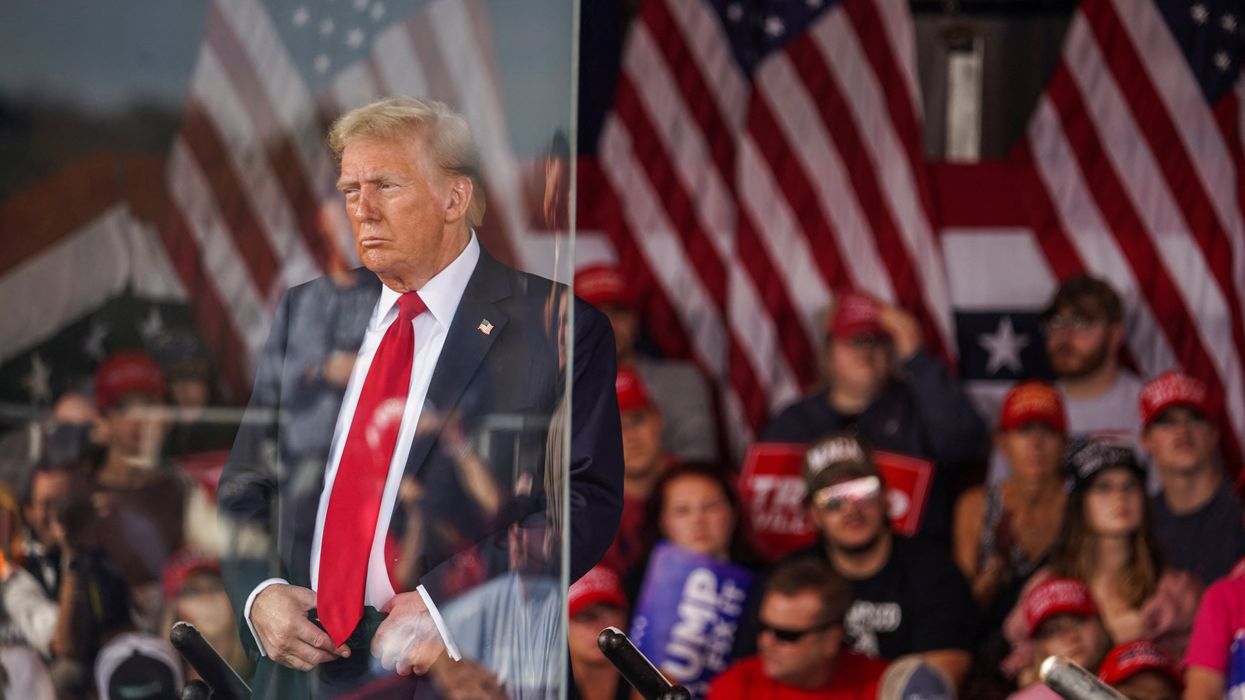
President Donald Trump is in a state of political “free fall,” argued an expert on Tuesday, but that does not mean Democrats are poised to capitalize on it.
“Donald Trump is in trouble,” wrote Time Magazine senior correspondent Philip Elliott. “Poll after poll show him posting his worst numbers yet. Record crowds took to the streets this weekend in the single largest day of political protest in the nation’s 250-year history. His Department of Homeland Security remains shuttered because his allies in the Republican-led Congress cannot sort out a spending plan. Construction projects like a West Wing ballroom and proposed Miami skyscraper of a presidential library are roundly mocked. Gas prices seem to be coasting toward $5 a gallon, consumer confidence is in freefall, and the joint U.S.-Israeli war against Iran remains deeply unpopular.”
Yet despite these theoretical advantages, Elliott warned that Democrats could “stumble” in trying to retake the Senate and House of Representatives, much less doing so by the desired landslides.
“The structural problems that bedeviled the Democrats in 2024 remain,” Elliott wrote. “And their decision last year to shelve an internal autopsy of Kamala Harris' loss to Trump remains emblematic of Democrats’ continued unwillingness to address its problems head on.”
Democrats benefit from a slight edge in most polls, Elliott conceded, but this did not amount to a “slam dunk” in terms of their chances of decisively retaking Congress.
“Cast another way: Democrats are still positioned to have a good election year but may be viewed in hindsight as having let a true blowout slip through their grasp,” Elliott wrote. “Millions of people in the streets signal strength but guarantee nothing, especially with a laundry list of thorny issues like environmental rights, reproductive freedoms, good governance, foreign policy, LGBTQ rights, and economic insecurity all getting lumped together in a sea of posters.”
He added, “The true problem here is that the party hasn’t really carried an identity since the era of Barack Obama. Nothing has really glued the Democrats’ identity together in more than a decade as bridges between the corporate liberals and the in-the-streets progressives have proven impossible to maintain.”
Dr. Robert J. Shapiro, an economic adviser to Democratic Presidents Bill Clinton and Barack Obama, disagreed with the gloomier aspects of Elliott’s analysis.
"Look, the issue is not polls,” Shapiro told AlterNet. “The issue is the conditions that are driving the polls, and those conditions are most likely much more likely to worsen than to improve. That's true with respect to affordability, which is getting worse in part because of the oil price shock that the Trump administration effectively engineered. And it's true with respect to healthcare coverage. It's true with respect to people's general optimism or pessimism about the economy and about the country as a whole. We've created almost no jobs in the last year, after four years of creating millions of jobs every year. The price increases that people confront — particularly in food and gasoline — those are reality. And voters respond to reality, particularly in a midterm election or a presidential reelect, when they perceive the administration to be responsible for it.”
Later he concluded, “All the underlying conditions strongly favor Democrats.”
Regardless of whether one believes Democrats could be weak, Trump is undeniably vulnerable enough as he approaches the midterms that conservative historian Robert Kagan warned CNN’s Christiane Amanpour last month that he would likely try to cancel and/or rig them.
“I am worried, as I have said and others have been pointing out, about whether we will even have free and fair elections in 2026, let alone in 2028,” Kagan said. “I think Trump has a plan to disrupt those elections, and I don't think he's willing to allow Democrats to take control of one or both houses as could happen in a free election.”