
'Full collapse': Ohio farmers lose $76 million in sales due largely to Trump
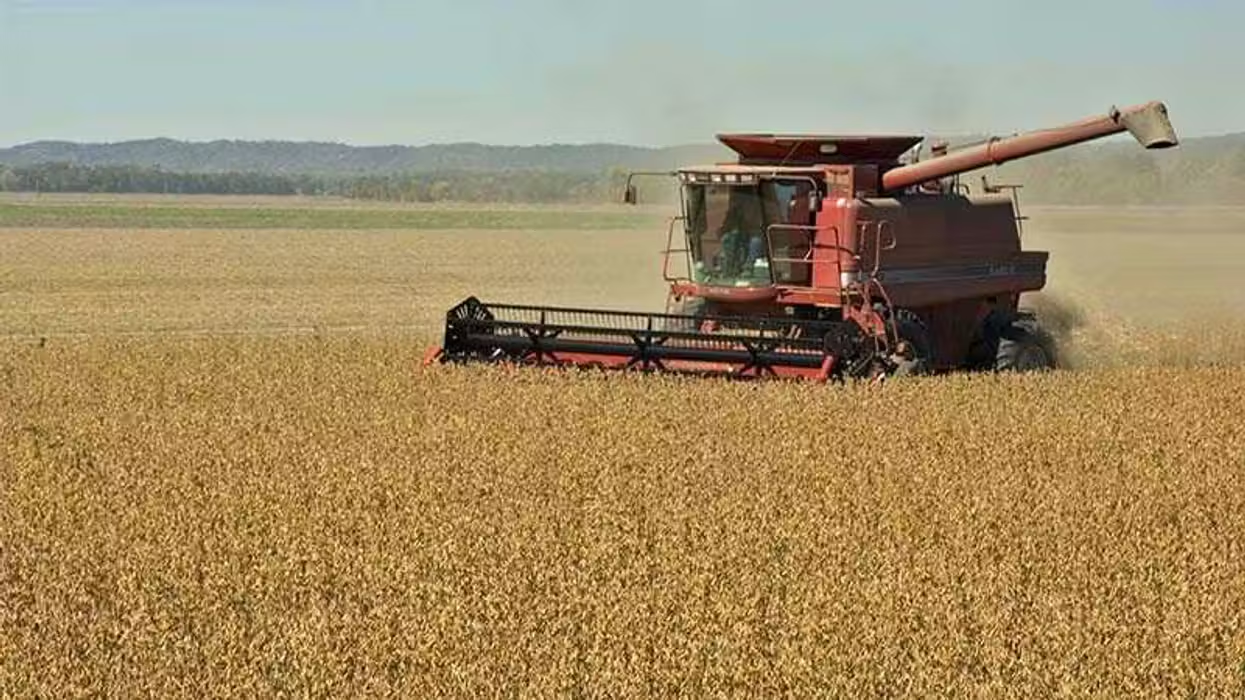
Combine harvests soybeans (Photo: United Soybean Board or the Soybean Checkoff/Flick)
December 16, 2025 | 06:07AM ETEconomy
Combined with other factors, President Donald Trump’s big tariffs on Chinese goods are costing Ohio farmers and their counterparts in other states heavily, according to a new report.
The report shows Ohio farmers lost nearly $76 million of their exports to China this year compared to one year earlier.
Tariffs are taxes on imports, and since the start of his second term, Trump has imposed a shifting array of them on every country in the world — except Russia for some reason, according to the Atlantic Council’s Tariff Tracker.
Economists have said the unpredictability of the measures has slowed some business investment because decision-makers can’t plan. And surveys conducted by the Federal Bank of Cleveland show that regional businesses are seeing higher input costs from them and many are raising prices for their customers.
That’s not helpful as Republicans struggle to deal with a national affordability crisis.
Farmers have faced a double whammy. They’ve seen many of their costs go up because of the import taxes.
Meanwhile, China — the country’s third-largest trading partner — stopped purchases of American soybeans in May before resuming them last month. The stoppage was in retaliation for the tariffs Trump imposed that now are at 20%, according to the tariff tracker.
That could do lasting harm to Ohio soybean producers by pushing China to grow and cement its trade ties with Brazil — another major producer.
Trump imposed 50% tariffs on the South American country in retaliation for imprisoning an authoritarian president who attempted a coup.
Ohio farmers are feeling the pain.
Steady trade relations with China had already been roiled during the first Trump administration, according to Farm Flavor, a media organization that reports on agriculture.
“Over the past decade, the flow of American agricultural goods to China has shifted from reliable seasonality to stark volatility,” it said in a report that was released on Tuesday.
“From 2014 to 2017, exports followed a predictable rhythm throughout the year, peaking each fall with the soybean harvest. That pattern broke with the onset of the 2018 trade war, then rebounded sharply in 2020 and 2021 after the Phase One trade agreement. With Chinese purchasing commitments in place, monthly exports hit record highs in late 2020 and remained elevated through 2022 – fueling optimism that the relationship had stabilized.”
Then in 2023, Brazil saw record soybean and corn harvests, undercutting prices asked by U.S. farmers. And in the wake of the first Trump trade war, China worked to “de-risk” its agricultural supply by strengthening ties with South America, the report said.
“By 2025, these forces — combined with a renewed trade war — converged into a full collapse,” it said.
“After steady declines in 2024, U.S. agricultural exports to China fell by more than half in the first eight months of 2025. The low point came in May, when monthly exports dropped to just $247 million – the lowest level in over a decade.”
Analyzing export data from the U.S. Department of Agriculture, the Farm Flavor report said that Ohio farmers were the 13th hardest-hit, losing nearly three-quarters, or $76 million, of their exports to China this year compared to a year earlier.
Ohio soybean farmers bore the brunt, losing 85% of their exports to China.
Six of the 10 hardest-hit states voted for Trump last year, and the administration might be feeling the heat. Last Tuesday, the president announced a $12 billion bailout of the sector.
But skeptics questioned how a one-time expenditure will make up for a systemic loss that already dwarfs the bailout.
Agricultural trade with China alone is $17 billion less this year than it was last, or 42% more than the total bailout.
Nearly across the board, U.S. agricultural exports to China have been way down this year compared to their 2024 levels, according to USDA data compiled by Farm Flavor.
A sampling, listed in order of total volume:

