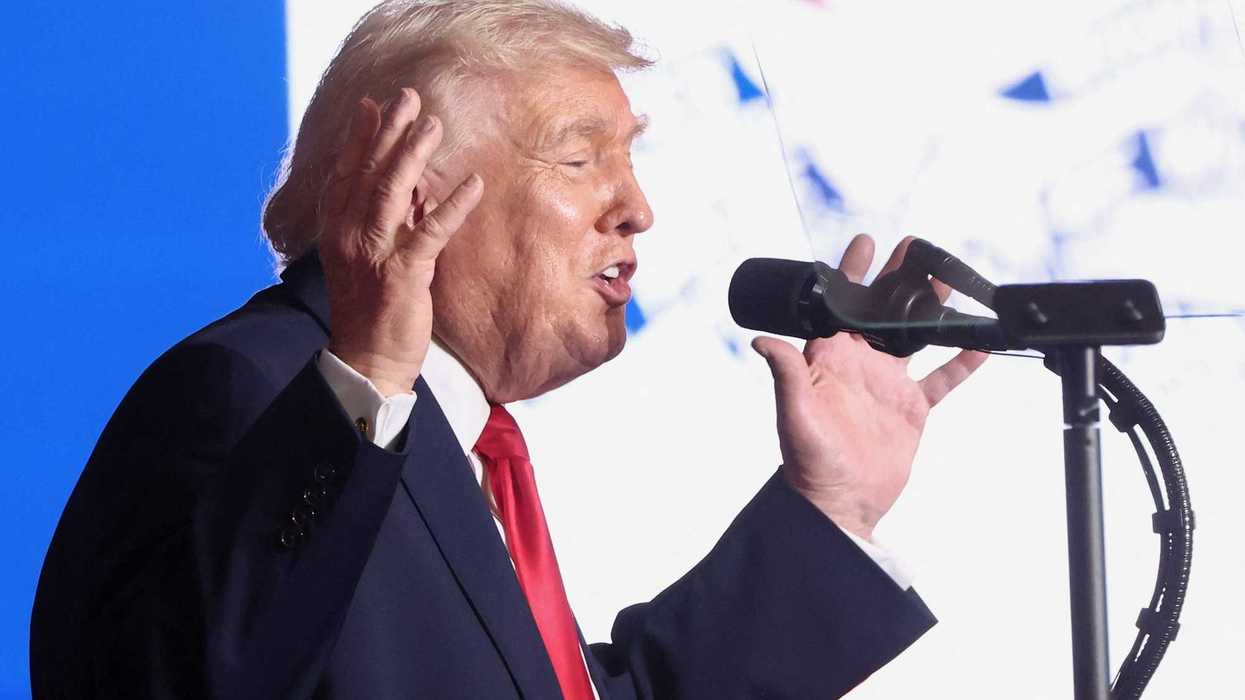
Despite some signs of improvement for Americans under Donald Trump's second term, his approval ratings continue to plummet, and according to a new analysis from The Hill, it all comes down to voters not trusting him.
The breakdown of Trump's troubles was written by Jeff Evans, a communications adviser and political consultant who argued that the president fails to persuade voters that his leadership is accomplishing anything due to a lack of trust. According to Evans, several metrics indicate improved conditions under Trump, such as slowing inflation, fewer border crossings and drops in the violent crime rate.
Though many voters reelected him to address those issues, voter trust means he will fail to reap much benefit from them, for reasons stemming directly from his conduct, as well as from issues that are bigger than his presidency.
"For President Trump, this disconnect between measurable progress and public approval reveals something deeper about how leadership is processed in modern America," Evans wrote, later adding, "Most Americans are not blind to improvement. They understand the border is more controlled than during the period of peak disorder. They see crime statistics trending downward. They know inflation is no longer surging. But acknowledgment is not the same as trust."
Many voters, Evans argued, form strongly held opinions about the state of their world long before leaders can address the issues, or before the issues can stabilize without intervention from leaders. "Instability leaves an imprint," Evans explained, and voters are not likely to change their minds about what leaders are doing for them "overnight" once conditions improve. Despite whatever he may have done to address certain issues, this longstanding discontent from voters still has not dissolved.
This is exacerbated by the fact that the main issues dragging down voter sentiments, inflation and the rising cost-of-living, are problems that have only been slowed down, not reversed altogether. Though prices might not be rising as fast as they were four years ago, Evans noted, voters are still contending with the high prices inflation left behind.
Additionally, Evans argued, Trump's tone as a leader is doing much to sour voters on his leadership, which costs him their trust. His confrontational approach to communication might energize his base, but to anyone outside of that group, it is a major deterrent.
"Trump isn’t merely a policy actor — he is a polarizing presence," Evans wrote. "Supporters view confrontation as strength. Opponents experience it as provocation. The intensity of opposition toward him is extraordinary, and his rhetoric has consistently supplied fuel for it. Tone does not negate policy gains, but it shapes whether those gains expand confidence beyond the base. Escalation energizes loyalty, but it rarely broadens trust."
He continued: "The improvements remain significant. Lower homicide rates save lives. Reduced border encounters alter operational realities. Cooling inflation eases pressure. Strong employment expands opportunity. But results do not interpret themselves. Leadership is not only about producing results. It’s about helping people make sense of them. It’s about connecting statistics to lived experience. It’s about projecting steadiness in posture as well as policy."