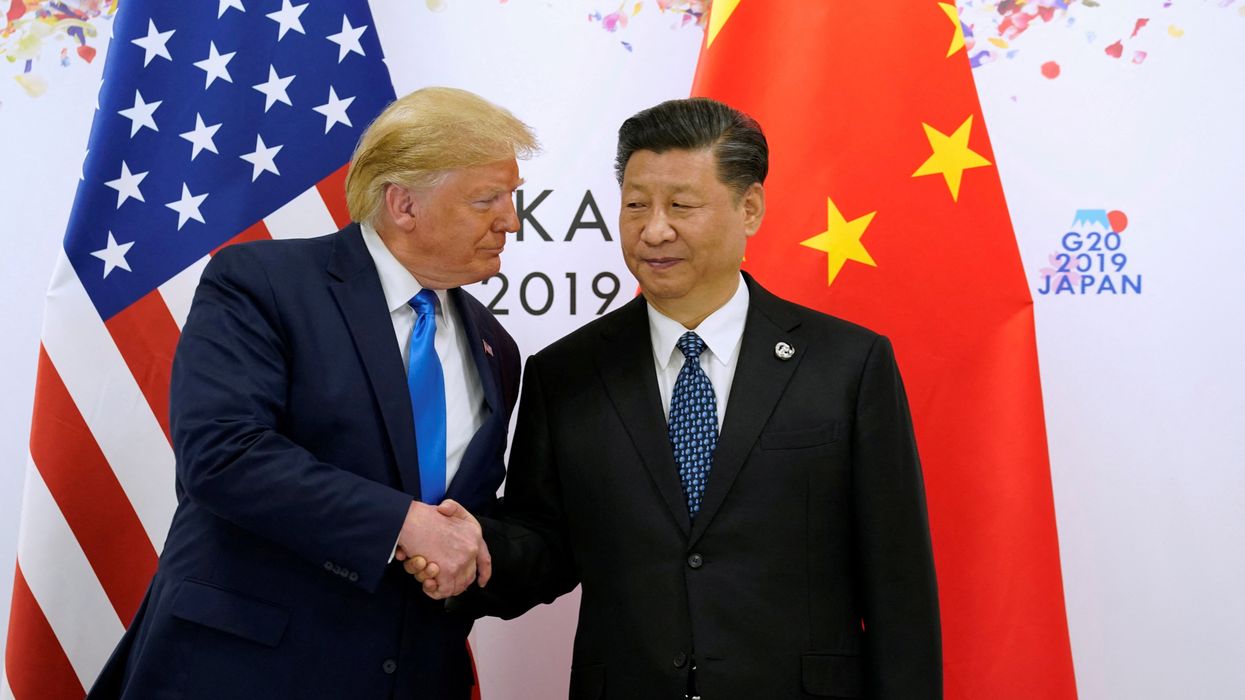
Donald Trump's aggressive "America First" agenda has caused a "profound shift" around the world, with a new analysis reported on by The Guardian showing the extent to which more countries are siding with China as strong U.S. alliances have "crashed."
On Friday, The Guardian published a report sharing the findings of a survey by the firm, FocalData. Using the results of United Nations votes over the first year of Trump's second term as a measure of how much the nations of the world are siding with either the interests of the U.S. or China. The results, as depicted in a chart showing a map of the world, are significant, with many more countries, including once-key allies, shifting towards China, as Trump's machinations have "started to redraw the geopolitical map in favour of China."
Based on the map created with FocalData's findings, every UN country in Europe has shifted more towards China in the last year, as have the likes of Canada, New Zealand and Australia. Most of South and Central America has made the same shift, except for Peru. Africa and Asia are closer to an even split, but countries that shifted towards China are still in the majority, including major players like Japan, South Korea, India and even Russia.
Among the countries that have shifted more towards the U.S. are North Korea, South Africa, Madagascar, Iran, Iraq, Indonesia, and Nigeria.
Though the shifts show some notable trends, many countries have not yet changed their overall voting allegiance. Most of Europe, for example, remains largely aligned with the U.S. despite the shift towards China. Still, the trends show a world power balance in the midst of a historic shift.
"In 2026, the world is now diplomatically closer to Beijing than it has been in recent memory," The Guardian explained. "With significant shifts in alignments taking place during the start of Trump’s second presidential term."
The report further detailed: "The total number of countries strongly aligned with the US has crashed under Trump, in contrast to China, which has maintained its allies. When comparing all of Trump’s years in the White House, including his first term, with those of his immediate predecessors – Barack Obama and Joe Biden – the number of countries strongly aligned with the US has collapsed, from 46 to just seven. The number of countries closely in China’s orbit has remained broadly constant."