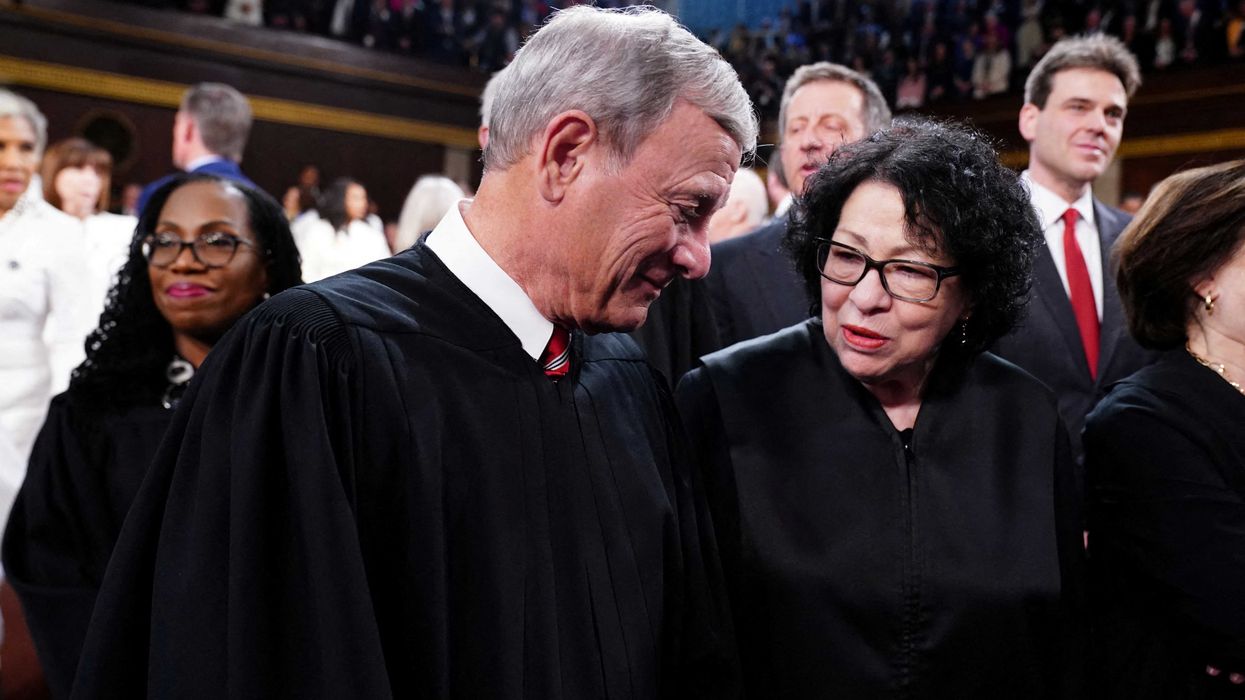
U.S. Supreme Court Justice Sonia Sotomayor blasted loosened campaign finance rules during oral arguments in a case that would allow political parties to receive even more donations.
Calling it “the most consequential campaign finance-related dispute” since Citizens United, Axios explained that “the justices will decide whether to eliminate a federal law that limits the amount of money big-money party committees can spend in direct coordination with favored candidates.”
Appearing skeptical that the Court should rule in his favor, Justice Sotomayor walked Noel Francisco, the attorney for the National Republican Senatorial Committee, through some top donors to both Republican and Democratic presidential candidates while warning about the appearance of quid pro quo.
“Your answer is suggesting to me that every time we interfere with the congressional design, we make matters worse,” Justice Sotomayor said. “You’re telling us that Citizens United and McCutcheon ended up, yes, in amplifying the voice of corporations, but diminishing another voice, that of the party.”
“Now, you want to now tinker some more and try to raise the voice of one party,” she explained. “Our tinkering causes more harm than it does good.”
Disagreeing, Francisco replied, “Your Honor, I personally never think free speech makes things worse. I think it virtually always makes it better.”
Without mentioning any donors’ names, Justice Sotomayor then said that “in the 2016 election, Hillary Clinton set up a joint victory fund with the DNC, 32 state parties, which allowed a single donor to give up to $356,000.”
“In 2024, Donald Trump’s campaign launched a joint fundraising operation with his own leadership PAC, the RNC, and 40 State Republican Party committees, that saw donations of up to $814,600,” she said, noting, “I’m not picking on Donald Trump.”
“Joe Biden’s victory fund, together with the DNC and the party committees of all 50 states, um, raised up to $1.3 billion,” the justice added.
She warned that “once we take off this coordinated expenditure limit, then what’s left? What’s left is nothing. No control whatsoever.”
Francisco disagreed again.
“You mean to suggest,” Justice Sotomayor replied, “that the fact that one major donor to the current president, the most major donor to the current president, got a very lucrative job immediately upon election from the new administration, does not give the appearance of quid pro quo?”
“Your Honor,” Francisco responded, “I’m not 100% sure about the example that you’re looking at, but if I am familiar, if I think I know what you’re talking about, I have a hard time thinking that his salary that he drew from the federal government was an effective quid pro quo bribery, which may be why nobody has even remotely suggested that.”
Sotomayor warned, “Maybe not the salary, but certainly, the lucrative government contracts might be.”