
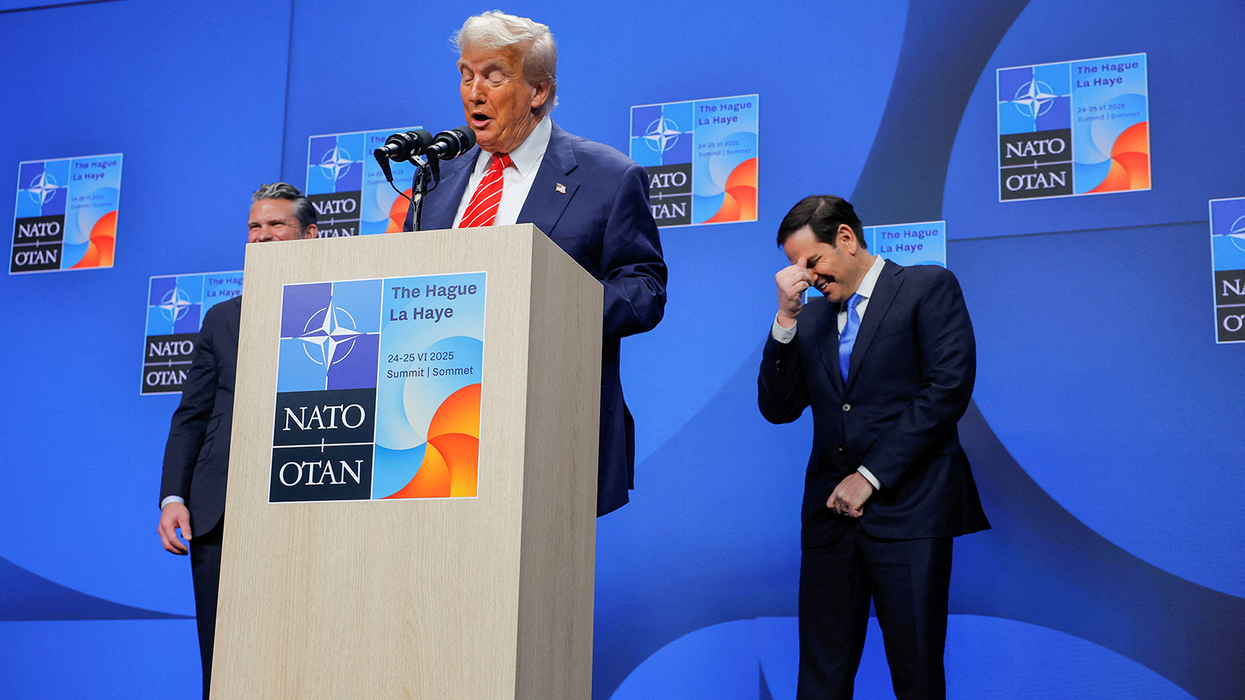


Brash, dehumanizing talk has long been central to Donald Trump’s way of speaking and his administration’s approach to communication. He has frequently used words like “vermin,” “parasite” and “poison” to describe his political opposition, migrants and other targeted communities, to the point where a UN committee has warned that he is inspiring hate crimes.
But now, according to renowned historian and journalist Anne Applebaum, in the context of the war in Iran, his use of such “cartoonish” and “sinister” language may result in “tragedy” not only at home, but for people around the world.
As Applebaum points out, Trump and in-circle allies like Pete Hegseth have leveraged dehumanizing words and memes before, but in Iran, they’ve taken it to new genocidal levels. As she writes, “They talk about Iranians — not the fundamentalist regime, but the Iranian people — as if they are not human.”
It is not difficult to find evidence of this. Applebaum cites, for example, Hegseth’s assertion that “the only ones who need to be worried right now are Iranians that think they’re going to live” and his abhorrence of what he calls “politically correct wars.” He has repeatedly dispelled any form of military restraint as “woke,” to the point where he was being accused of war crimes months before the war in Iran. At the same time, Trump has made incredible claims to wave off civilian casualties, such as blaming the Iranian government for the bombing of a girls’ school that resulted in the deaths of 175, even though footage makes it very clear that the bombing was done via an American Tomahawk missile.
For the Iranian people, this mindset could very easily spell disaster. But as Applebaum explains, Trump and Hegseth’s posturing could mean calamity for people all over the world.
Some have accused the president, for example, of being blatantly dismissive of the deaths of American soldiers. During an event to honor servicemembers killed, so nonchalant was Trump's dress and demeanor that Fox News actually aired clips of an entirely different ceremony, prompting widespread accusations that the network was trying to make it appear as if he was taking the situation more seriously than he was.
“No ‘news’ org would ever make this ‘mistake'," said veteran journalist Bill Carter. "This was clearly a deliberate choice to try to protect Trump from criticism they knew would rain down on him."
Fox later apologized for the switch, calling it a mistake, with Fox host Johnny "Joey" Jones saying he was "embarrassed and ashamed" about it.
And the damage extends far beyond the US and Iran. As Applebaum points out, the Persian Gulf states that have in recent years enjoyed rising stability and security suddenly find themselves targeted by Iranian missile strikes, dashing their image of thriving safety. Oil and water infrastructure throughout the Middle East has been damaged, which will give rise to wide-ranging economic and environmental calamity. In the US, home buyers are seeing mortgage rates climb. In Vietnam, gas stations are running dry. And farmers around the world worry about surging fertilizer prices and unreliable shipping.
None of this will be easy to fix anytime soon. As Applebaum writes, it’s “not just collateral damage, but permanent damage.”
Report typos and corrections to: feedback@alternet.org.

#story_page_sidebar
MOST POPULAR
{{ post.roar_specific_data.api_data.analytics }}
MOST POPULAR
ContactAdvertise with AlterNetPrivacy PolicyWriter GuidelinesPress InformationAbout AlterNetMeet the AlterNet StaffDebug Logs
@2026 - AlterNet Media Inc. All Rights Reserved. - "Poynter" fonts provided by fontsempire.com.