When President Donald Trump signed the Big, Beautiful Bill Act of 2025 into law, his MAGA loyalists praised it as a recipe for major economic growth. But Trump's critics saw the spending package as the worst of both worlds: a bill that would weaken the United States' social safety net while causing the already-huge federal deficit to increase.
The U.S., many of them argued, could not afford $75 billion in new funding for U.S. Immigration and Customs Enforcement (ICE) along with $64 billion in new funding for U.S. Customs and Border Protection (CBP). Between ICE and CBP, the Big, Beautiful Bill set aside $139 billion in new funding.
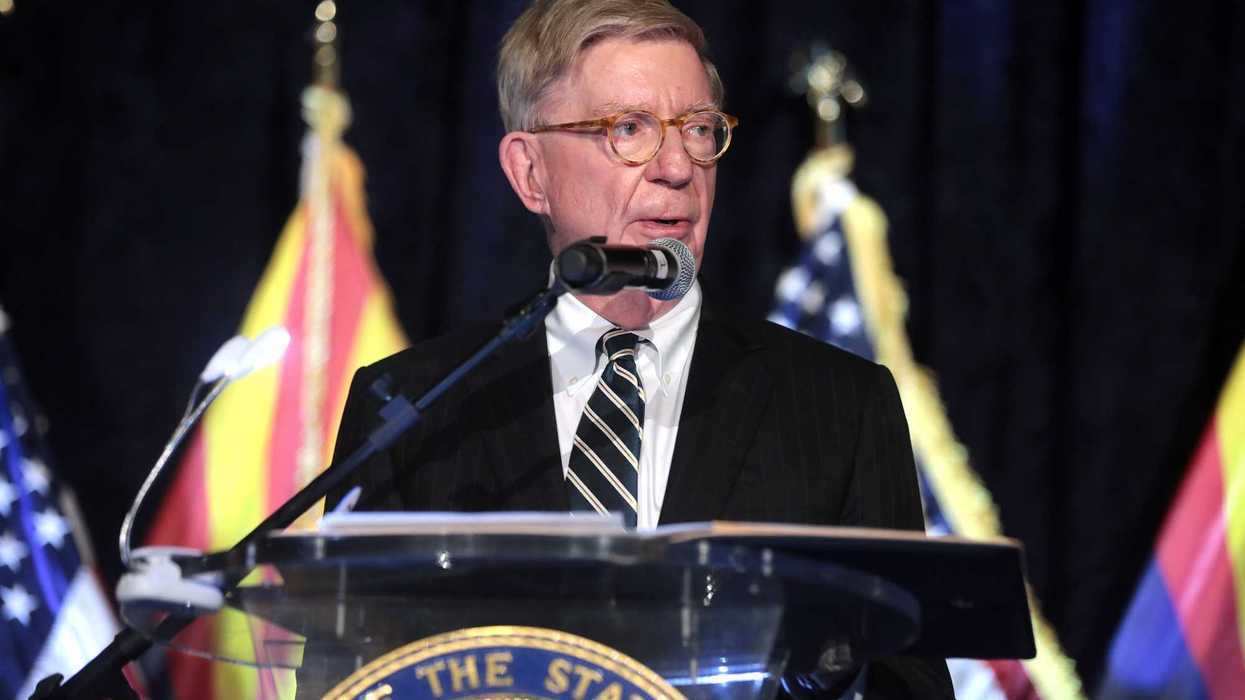
Never Trump conservative George Will, in his February 4 column for the Washington Post, emphasizes that the United States' national debt has reached an historic high and warns that "spiraling debt" could "provoke a financial crisis."
"As the national debt is a few months from reaching $39 trillion, and perhaps $40 trillion by the end of this year," the 84-year-old Will laments, "it is puzzling how unperturbed the political class is…. A bipartisan congressional consensus, more alarming than partisan rancor, is: There are no long-term fiscal gains without intense short-term political pains. So, because today's congressional careers do not yet seem likely to coincide with coming dire consequences, let them come."
Will continues, "In 2016, a budget expert was allotted 20 minutes to brief Donald Trump on those possible consequences. After five minutes, Trump said, 'Yeah, but I'll be gone.' He was perfectly in sync with the political mainstream he professes to supplant."
But ignoring the United States' federal debt, Will stresses, will not make it go away.
The conservative columnist lists "six possible crisis scenarios": (1) "Upwardly spiraling debt could provoke a financial crisis," (2) "An Everest of debt is an incentive for an inflation crisis to reduce the value of existing debt by paying lenders with debased dollars," (3) "An austerity crisis would occur with a large and abrupt combination of tax increases and spending reductions," (4) "A currency crisis would result from a depreciating dollar incentivizing foreign governments and private investors to diversify away from U.S. debt," (5) "A default crisis, although unlikely, would have the merit of bluntness," and (6) "The most probable, and most ominous, outcome would be a gradual crisis."
"In 2021, debt service consumed less than 10 percent of federal revenue," Will explains. "In 2025: 18 percent. By being gradual, a protracted crisis would mean a demoralized nation slowly accommodating perpetual economic sluggishness, waning investments in research and development, social stagnation, diminished contribution from the entrepreneurial energies of talented immigrants, and waning U.S. geopolitical influence."