
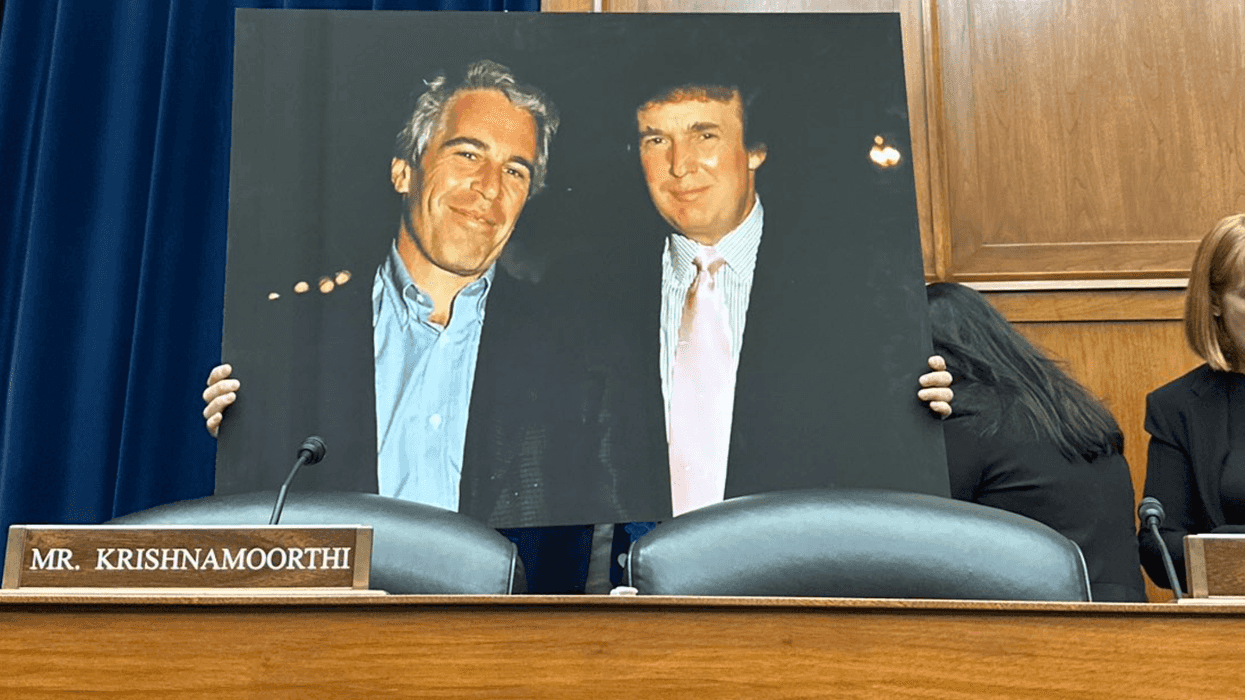


You might well think that Americans have heard more than enough by now about how the influence peddler and sex trafficker Jeffrey Epstein "networked" his accomplices, victims, and apologists. But that plutocracy-serving elite's tawdry cravings for money, sex, power, and, later, conspiratorial dealings were merely symptoms, not causes, of a deeper, more dangerous craving that we need to understand.
No matter whether we characterize it as pathological or as sinful in the nature of our divided human hearts, it's been poisoning the country since long before Epstein and Trump rode it and accelerated it in an ever-widening gyre. I came to it nearly half a century ago, when I got to know, and, soon enough, condemned, a carrier of methods and 'morals' that anticipated Epstein's and Trump's.
Instead of joining the mad scramble to expose more individuals who've worked with Epstein to massage the cravings for money, sex, and political power, we'll be better off facing a fundamental challenge posed by California Congressman Ro Khanna, who has urged Americans "to ask ourselves how we have produced an elite that is so immature, reckless and arrogant."
How, indeed? How and why have "respected" leaders who knew that Epstein was criminally perverse forfeited their public credibility and even their own self-respect by dancing so tightly with him? What did Epstein himself need so desperately that he couldn't stop spinning the vast spider's web that connected and indebted these people to him?
And why did "progressive" opponents of Epstein's most noteworthy patron imagine that "No Kings" protests, impeachment trials, lawsuits, and fiery polemics would stop all the king's horses and all the king's men from putting Trumpty Dumpty back in office again? How did so much of America accept the hand-in-glove fit between Epstein's and Trump's thirst for adulation and their adulators' thirst for cheap simulacra of love, wellbeing, and social standing whose masters lord those delusions over the powerless?
The answers have a lot to do with Epstein's earlier models and predecessors, one of whom I encountered almost half a century ago as a proficient rider of the storm of injustices that's now enveloping us. Recently a veteran New York City police officer warned me that Trump Immigration and Customs Enforcement agents' "bravado, inadequate instruction, lack of transparency, and immunity from prosecution" are "a deadly cocktail being forced down Americans' throats, leaving law-abiding immigrants, asylum seekers and even full citizens fearful, helpless, or dead."
Even when brave Americans in Minneapolis and much of the rest of the country rejected that cocktail, Epstein was stirring and offering another, smoother brew to the roughly 9 percent of Americans whom Yale Law Professor Daniel Markovits has characterized aptly as a "meritocracy-trapped" class that serves the top 1 percent while exploiting (often by bedding) its victims.
The Epstein files "lay bare the once-furtive activities of an unaccountable elite, largely made up of rich and powerful men from business, politics, academia and show business," the Times' Robert Draper noted. "The pages tell a story of a heinous criminal given a free ride by the ruling class in which he dwelled, all because he had things to offer them: money, connections, sumptuous dinner parties, a private plane, a secluded island and, in some cases, sex… That story of impunity is all the more outrageous now in the midst of rising populist anger and ever-growing inequality."
Many in the Epstein elite remind me of the "panderers, procurers, and go-betweens" who were satirized in the 1962 Broadway musical "A Funny Thing Happened on the Way to the Forum," produced when Americans could joke more innocently about ancient, decadent Rome. Many such "middlemen" now perform less funnily at the podiums of Trump administration press conferences and in congressional hearings.
Some of them were drawn into Trump's and Epstein's spider's webs at first by legitimate, pressing needs and projects. But a terminally cynical, corrupt minority has orchestrated such needs without any humane sentiment or scruple, following the example set by Trump, who told New York Magazine in 2002, "I've known Jeff for 15 years. Terrific guy. He's a lot of fun to be with. It is even said that he likes beautiful women as much as I do, and many of them are on the younger side."
Only four years later, when Trump and Epstein had fallen out over unrelated business matters, he denounced Epstein to a police chief who was investigating the solicitations, telling him, 'Thank goodness you're stopping him, everyone has known he's been doing this,' according to a document recounting their conversation… Mr. Trump said it was known in New York circles that Mr. Epstein was disgusting…"
The seduction and entrapment of our plutocracy-serving elite resembles the 18th Century historian Edward Gibbon's observation that "a slow and secret poison" had spread into the vitals of the ancient Roman republic and empire until its citizens "no longer possessed that public courage which is nourished by the love of independence, the sense of national honor, the presence of danger, and the habit of command." They "received laws and governors from the will of their sovereign and trusted for their defense to a mercenary army."
Can America's republic survive the no-longer slow or secret poison that Trump is pushing, presenting himself as the republic's savior even as he's dismantling it? Algorithmically driven consumer capitalism is part of the poison, but some of Trump's and Epstein's perversity has come from their own desperate needs for others' equally desperate adulation.
The social psychologist Harry Stack Sullivan studied what he called a "malevolent transformation" of yearnings for love in which would-be mentors, teachers, professional healers, and self-styled social and political saviors feed off the insecurities of desperate people and questing youths, harnessing their talents to fill an emptiness in themselves. They distort loving relationships by intensifying their dependents' or clients' attentions and debts to themselves, as Epstein and Trump have done. Somewhere beneath their busy, dramatic "leading" and "caring" lurks a fatal indifference to their targets' thwarted needs and love.
Sullivan warned that economic and cultural pressures toward malevolent transformations proliferate in a society whose pathways to opportunity and emotional support have become twisted or blocked. Predators like Epstein and Trump play upon that blockage and its victims' desperation by staging illusory breakthroughs (as in Trump's repetitive "You've never seen anything like it!").
Trump's malevolent transformation has turned some of his female loyalists into cruel parodies of the "Me Too" movement who "lean in" to force their patron's deadly cocktail down Americans' throats. I'll name them: Attorney General Pam Bondi, former Homeland Security Secretary Kristi Noem, National Intelligence director Tulsi Gabbard and presidential spokesperson Karoline Leavitt. (Among men, there are Deputy Chief of Staff Stephen Miller, Secretary of War Pete Hegseth, Budget Director Russell Vought, Border Czar Tom Homan, Commerce Secretary Howard Lutnick, and others, some of them now out of office, who've bound themselves to a man who has made himself a walking, steaming, stinking tower of malevolence.)
The only effective antidote will have to come, indispensably if not wholly, from a civil society whose faith passes the understanding of these lost souls and their puppet masters. For them signs of others' suffering and anguished yearnings become mere "data points" to masters of corporate affairs and public relations who, like some of my former Yale students, are charming, astutely discerning, but hollow to the core.
_____
Forty-five years ago I was invited to help a predator use "data points" to guide something like "the Epstein treatment" as he offered me good money and powerful "connections." Epstein himself was only 29 at the time, just getting started as a consultant. I was similarly young, an editor of a small weekly newspaper whose struggle to survive in Brooklyn, NY drove me into delicate negotiations with the "Epstein" of that time and place, a wealthy businessman-turned congressman, Fred Richmond.
Richmond wanted me on his staff as soon as possible. I wanted an advance on the nice salary that he was offering so that I could give my newspaper colleagues just enough funding to keep the publication alive by attracting new ads through wider distribution. Although Richmond and I professed similar values and interests in our first meetings, his interests and mine soon pivoted on irreconcilable political premises, social preferences, and moral boundaries. Therein lies my tale that anticipated Epstein's modus.
I told it all in "What's Really Wrong With Fred Richmond?," an essay that The Village Voice published at the time, on March 30, 1982, and that it has just now re-published, with an editorial note explaining that that old essay lights up the analogy between my long-ago dalliances with Richmond and others' more-recent dalliances with Epstein. Although the latter's crimes and cruelties were more devastating than Richmond's, the same corrupt and corrupting dynamics have been in play.
Anyone who has indulged, sought, or embraced Epstein's loaded "generosity" and networking will be struck by my account of what I experienced and condemned in 1982. Although Epstein, unlike Richmond, never sought public office to "elevate" his private misdeeds, many of Richmond's actions and relationships do jump off the page now as if they were Epstein's own tactics. I hope that my account will prompt one or two of Epstein's former collaborators and victims to give us their own testaments.
Report typos and corrections to: feedback@alternet.org.

#story_page_sidebar
MOST POPULAR
{{ post.roar_specific_data.api_data.analytics }}
MOST POPULAR
ContactAdvertise with AlterNetPrivacy PolicyWriter GuidelinesPress InformationAbout AlterNetMeet the AlterNet StaffDebug Logs
@2026 - AlterNet Media Inc. All Rights Reserved. - "Poynter" fonts provided by fontsempire.com.