
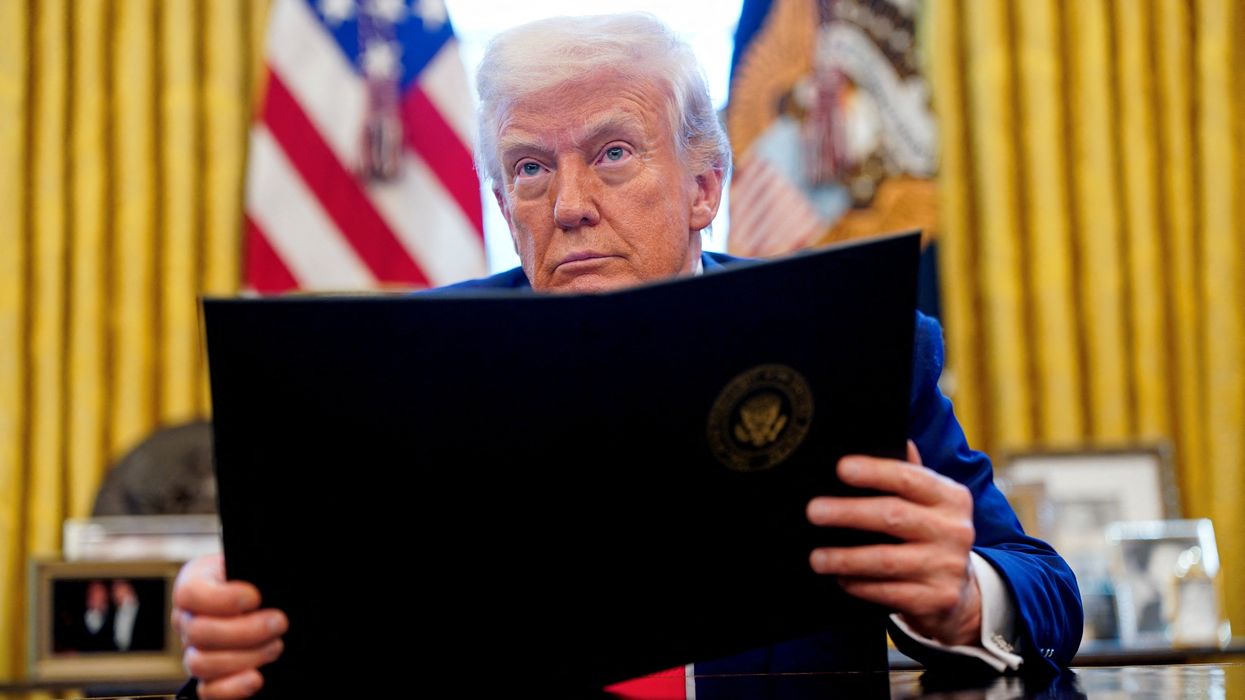


President Donald Trump’s economy seems to be doing well now but that could rapidly change, according to a respected financial journalist.
“Based solely on performance, Wall Street has been thrilled to have President Donald Trump in the White House,” wrote The Motley Fool's Sean Williams on Sunday. “During Trump's first, non-consecutive term, the mature-stock-driven Dow Jones Industrial Average (DJINDICES: ^DJI), benchmark S&P 500 (SNPINDEX: ^GSPC), and tech-stock-inspired Nasdaq Composite (NASDAQINDEX: ^IXIC) rallied 57%, 70%, and 142%, respectively.”
Williams added, “While these major indexes have risen under most presidents since the late 1890s, the annualized returns under Trump are among the best.”
One problem facing Trump’s economy is the artificial intelligence (AI) revolution. While it has added trillions in value to the economy, and has even been conjoined with lucrative flushes for the quantum computer and space industries, all of these trends may prove ephemeral. Indeed, Trump has already added one element to the economic brew that could throw a wrench into all of the gears.
“On Feb. 28, at Trump's command, U.S. military forces, along with Israel, began military attacks against Iran,” Williams wrote. “Shortly after these military operations commenced, Iran virtually closed the Strait of Hormuz to oil exports. Approximately 20 million barrels of petroleum liquids, equating to 20% of the world's demand, pass through the Strait of Hormuz daily.”
He added, “While Iran partially reopened the Strait of Hormuz on April 5, we're still talking about the largest energy supply disruption in history. This energy supply chain monkey wrench has sent crude oil prices soaring.”
Williams elaborated on how crude oil prices are rising and there is sticker shock at the fuel pump. “Keep in mind that this rapid uptick in inflation comes at a time when the price stickiness of Donald Trump's tariffs is still being felt in the goods sector,” he also observed. Then you throw the expensiveness and volatility of a Middle Eastern war into the mix, and it all starts to look terrible economically.
“Even if the Iran war wraps up in the next couple of weeks, the inflationary effects of this conflict will linger for several quarters to come,” Williams wrote. “It's a worst-case scenario for the Trump bull market.”
Earlier on Sunday, Williams wrote a separate piece linking the Iran war’s effects to the economy.
“Though the toll on human life is incalculable during war, military conflicts often have far-reaching effects that extend beyond the battlefield,” Williams wrote. “The most notable impact of the Iran war, which began on Feb. 28 at Trump's command, has been observed in the energy arena.”
He added, “Shortly after the U.S. and Israel commenced attacks on Iran, the latter closed the Strait of Hormuz to most oil exports. Although this closure remains somewhat fluid, as of this writing on April 8, what can be said with certainty is that, for over a month, we've witnessed the largest energy supply disruption in modern history. In the wake of this virtual closure, crude oil prices have soared. This has led to higher prices at the pump for consumers, as well as steeper transportation and production costs for businesses.”
Report typos and corrections to: feedback@alternet.org.

#story_page_sidebar
MOST POPULAR
{{ post.roar_specific_data.api_data.analytics }}
MOST POPULAR
ContactAdvertise with AlterNetPrivacy PolicyWriter GuidelinesPress InformationAbout AlterNetMeet the AlterNet StaffDebug Logs
@2026 - AlterNet Media Inc. All Rights Reserved. - "Poynter" fonts provided by fontsempire.com.