Congressional Republicans may largely back President Donald Trump’s pro-AI policies, but the GOP leader is receiving pushback from an unexpected source — state legislative Republicans.
State senators and representatives from Vermont, New York and Maryland to Ohio, Oklahoma, Virginia and Georgia have proven willing to “break with President Donald Trump and most congressional Republicans” when it comes to allowing data centers in their constituents’ communities, reported Samuel Larreal of NOTUS. “I just don’t understand my Republican Party on this one,” said Oklahoma state Sen. Kendal Sacchieri, the Republican sponsor of a bill in her state that would pause construction of data centers for three years. Sacchieri said data centers could increase utility bills, cause noise pollution, lower property values and skew the economic outcomes of tax incentives in ways unfavorable to working class voters.
“I don’t think that data centers are being taken seriously by a lot of my own party right now,” Sacchieri said. “Since I filed the moratorium, I’ve heard from people from other districts who have told me they wanted this so bad. You know that those legislators have to be hearing from them as well.”
On the other side of the country, Republican Ohio state Sen. Louis Blessing argued to NOTUS that “these are multi-trillion-dollar market cap companies that get enormous tax benefits,” and expressed concern for this reason about whether this favored treatment will be reflected in the broader public interest.
“I mean, you can argue that that is infrastructure, but it’s not the same as roads, bridges, power plants, public water facilities, so on and so forth. … Maybe let’s slow this down and make sure our infrastructure is in place, not just for the data centers, but for everybody,” Blessing said.
She also expressed concern that the issue is unpopular with Republicans outside the MAGA base.
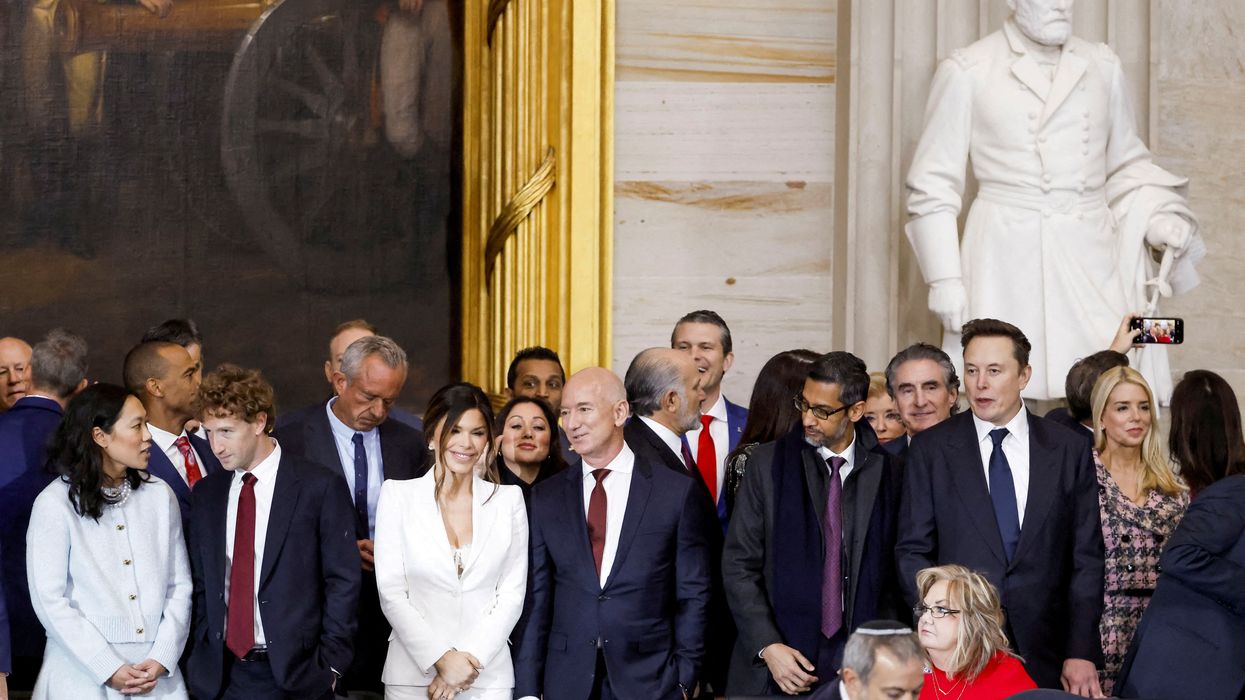
“One of the things that’s really hurting Trump’s approval number, along with Republicans, is that people see things like the inauguration and see who was standing behind you, it was [Jeff] Bezos and Sundar Pichai, and all these Big Tech titans,” Blessing said. “And you seem to be giving away the farm to Big Tech.”
Republican Jason Anavitarte, the majority leader of the Georgia state Senate, sponsored a bill to repeal his state’s tax breaks for data centers. At the same time, he seemed to try to find a middle road between the anti-AI and MAGA forces.
“State and federal leaders need to listen to the citizens and balance what the citizens are saying against the research and what the technology experts are saying and figure out what is the common ground, while also recognizing the geopolitical impacts of data centers in terms of this technology arms race,” Anavitarte told NOTUS, explaining that he believes America can remain competitive in the AI race without entirely disregarding citizen complaints. “I don’t want China and other adversarial nations to one-up us when it comes to technology investments.”
Maryland Republican state Del. Brian Chisholm co-sponsored a bill banning construction of new data centers until there are regulations in place to address the impact on the power grid. “Everybody probably fully grasps that you’re not going to slow down data or AI right now,” Chisholm told NOTUS. “Everybody understands there’s tremendous upside for everyone if it’s done correctly, and I think that’s why you’re starting to see a little more bipartisan support. It’s certainly not a cut-and-dry issue.”
The internal Republican debate about AI has reached the halls of the White House itself. Trump's 2025 executive order blocking states from regulating AI is believed by critics to clash with the Tenth Amendment, while tech lobbying has killed attempts at regulation on the state level. Trump adviser Mike Davis worked behind the scenes to kill pro-AI legislation, leading to an outburst in November with Trump’s AI czar David Sacks. Populist conservatives who normally support Trump, like Steve Bannon and Tucker Carlson, also oppose what they perceive as Trump's growing deference to Big Tech. Similarly a normally pro-Trump Republican, Gov. Ron DeSantis of Florida, voiced support for data center restrictions in his state.
Even Trump’s own secretary of energy, Chris Wright, admitted last year that many voters from all walks of life are concerned about data center construction.
"In rural America right now, where data centers are being built, everyone’s already angry because their electricity prices have risen a lot," Wright said in a December address at the North American Gas Forum. "‘I don’t want them in my state’ is a common viewpoint."
Despite this opposition, technology giants like Google, Amazon and OpenAI have pledged trillions of dollars to the construction of new data centers by the end of the decade with Trump’s support.