

Donald Trump wants you to love him again
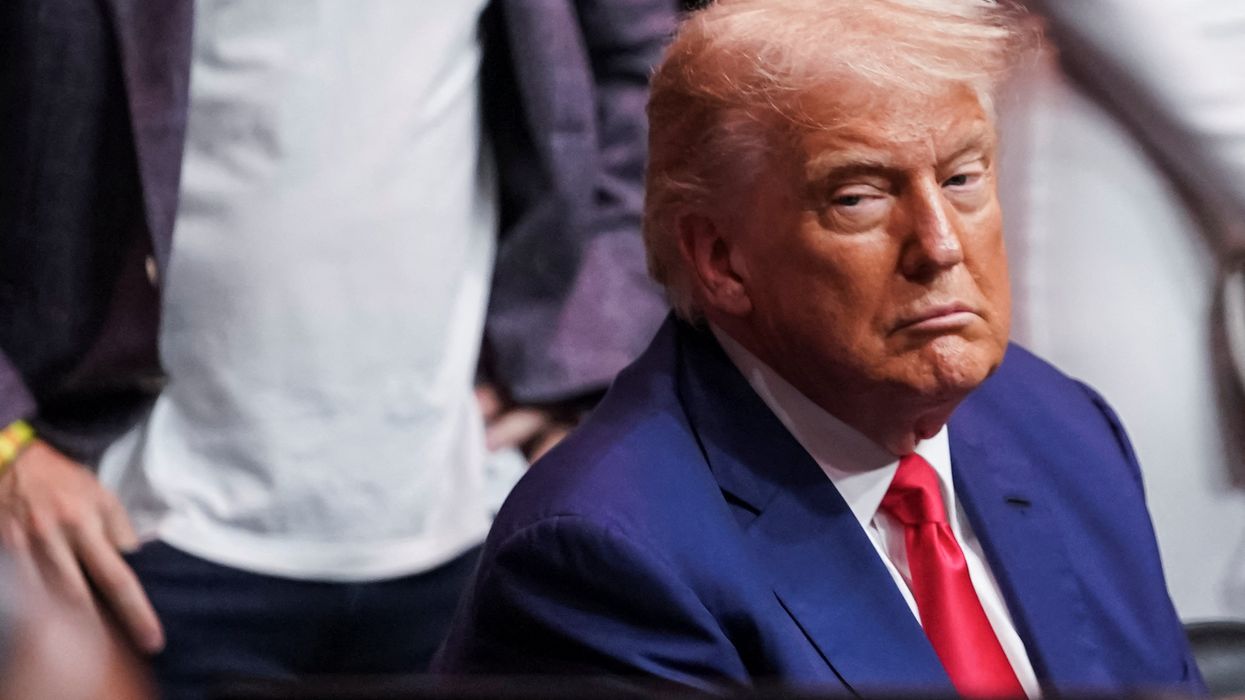
Donald Trump
Donald Trump is ready to launch an illegitimate war against a nation that did us no harm in a cynical bid to make America love him again.
I think it’s that simple.
No, his war-mongering isn’t about the midterms. If the president cared about politics, he would act politically. He would, for instance, prevent his supporters from being immiserated by skyrocketing health insurance premiums. As it is, he allows the House speaker to suggest in front of television cameras that some Trump voters are expendable.
If Trump cared about politics, he would care about his public image – and the effect of that image on the GOP’s fortunes. He wouldn’t piss on the still-warm bodies of Rob Reiner and his wife, who seem to have been killed by their troubled son. He wouldn’t suggest that the creator of beloved films like This Is Spinal Tap, Stand by Me and The Princess Bride had it coming. He wouldn’t hint at wanting more of the same.
If Trump cared about politics, he would do what every single president has done in the face of economic crises. He would say something to the effect of “I get it. Things are bad right now and I’m gonna do something about it.” Lots of presidents can’t live up to their promises, or don’t bother to follow through on them, but no president in our lifetimes has said to the American people that their hardship is “a hoax” and anyway, kids don’t need that many Christmas presents.
Some say the president’s saber-rattling over Venezuela is a bid to revive his party’s chances before the midterms. Others say it’s just another distraction from issues that are dogging him (eg, “the Epstein files”). But I think the reasons are dumber. Consider Henry Enten:
"The report card is negative. Every single day since March 12, Trump has been in the red. Two hundred and twenty-eight days in a row. The bottom line is Americans don't like what Trump is doing and they haven't liked what Trump's been doing for a long period of time."
To Donald Trump, for whom “ratings” are everything, this is certainly evidence of America falling out of love with him. What can he do? Oh, America loves a war president! They are strong. They are tough. They look good on TV! If Donald Trump can become a war president, no matter how much he’s failing otherwise, America will love him again!
What we’re seeing isn’t the behavior of a politician.
It’s the behavior of a man drunk on power.
In understanding this, let’s thank Susie Wiles. Trump’s chief of staff told Vanity Fair that JD Vance has “been a conspiracy theorist for a decade.” She said Elon Musk is “an avowed ketamine” user and “an odd, odd duck.” She said Russ Vought is “a right-wing absolute zealot.” And she said Pam Bondi “completely whiffed” at handling “the Epstein files.”
But her greatest unintentional insight was reserved for Trump.
He “has an alcoholic’s personality,” she said.
In characterizing him that way, Wiles brings forward the idea that there’s no higher-order thing – not morality, decency or honor – that can rival Trump’s insatiable need. In his case, it’s not a need for booze. It’s a need for power, attention, validation, and, I would suggest, love.
Everyone must love him or everyone must pay. The president might turn desperate in order to make that happen, even launching a war against a nation that did us no harm. But he won’t succeed. Drunks, or in his case dry drunks, can’t get enough. They can only hit bottom.
In threatening war to force us to love him, Donald Trump illustrates something Jen Mercieca told me. A communications and journalism professor at Texas A&M, she said autocrats “try to project strength, masculinity and virility, because they believe that those are the characteristics of strong leaders. Yet scholars who study leadership find that those autocratic ways of leading are actually weaknesses.”
That weakness could be hastening Trump’s descent to the bottom, she said. “According to recent polling, this government is very unpopular. If the elections are fair and free in 2026, we would expect to see what they called an ‘electoral purification’ in 1816. That's when the majority of Congress were kicked out for the self-dealing Compensation Act.”
A president drunk of power is in need of purification.
Here’s my conversation with Jen.
After the election, you wrote: "The fascists won temporarily, but fascism is for losers. They'll fail. They are con men and swindlers. And when they do lose, we make a real democracy. The kind they hate. Their ‘creative destruction’ will be democracy rising."
How are we doing now?
The only way forward is through it. And we're going through it. The rule of law does not constrain autocrats. Rather, they "rule by law" – using the law as a cudgel to punish enemies and outsiders.
Autocrats are not "cognitively responsible" leaders. They don't want to explain why they do things. They act first and make up reasons later.
This is the way Trump's second term has operated and so problems like the economy and affordability are only getting worse. That's the way it works when all accountability is stripped from government.
According to recent polling, this government is very unpopular. If the elections are fair and free in 2026, we would expect to see what they called an "electoral purification" in 1816. That's when the majority of Congress were kicked out for the self-dealing Compensation Act.
Before Trump returned, he presented himself rhetorically as macho. His campaign regularly featured the song "Macho Man" (without being aware, seemingly, that it's a gay anthem.) Yet now, the long macho man con is slipping. What should his opponents do with that?
It's almost cartoonish to think about what autocrats think is leadership and what actually constitutes good leadership. Autocrats try to project strength, masculinity and virility, because they believe that those are the characteristics of strong leaders. Yet scholars who study leadership find that those autocratic ways of leading are actually weaknesses. The best leaders are empathetic, inclusive and dialogic – the very opposite of the autocratic projection. Trump's opponents should hold him accountable to the rule of law, the Constitution of the US, and the basic American values of dignity, decorum and decency.
Marjorie Taylor Greene seemed to signal to QAnon believers that Trump isn't the hero of the story about the battle between good and evil. What's going on? Did Trump take believers for granted?
Trump is a lame duck, so lots of people are trying to figure out how to take over after he is out of power. Greene seems to be making a play to inherit the maga movement and it appears as though she's decided to make that play by attempting to erode Trump's base of support.
She would like to drive a wedge between Trump and his followers, which would position her for 2028 as an outsider. Essentially, Greene has argued that she knows exactly why America is still corrupt, even after Trump promised that he would end corruption. Politicians typically run on a hero narrative that argues that they are the right hero for the moment and only their election can save the nation.
In 2016, Trump argued that he had been a corrupt insider himself and because of that, only he knew how to fix corruption and make America great again. Based on recent polling, most Americans don't think that Trump has made America any greater, so it is perhaps politically expedient to separate Trump from the maga movement – though it's unclear if that movement can survive without Trump.
You have said that the public square is dominated by conspiracy theory. Everyone knows at least one person who's been indoctrinated. It's like McCarthy never died. What can we do?
Conspiracy is incredibly enticing and most of us have succumbed to conspiratorial ways of thinking. A conspiracy theory is a narrative that is "self-sealing," meaning evidence is not allowed to count against it. The narrative can never be proven, but it can also never be disproven.
Conspiracy rhetoric is like a “self-sealing” tire that has magic goo in it to prevent it from popping when you run over a nail. Conspiracy rhetoric is a “self-sealing” narrative that prevents it from popping when confronted by facts, logic or evidence. We're all vulnerable to conspiracy narratives, because believing in them makes us heroes.
We're vulnerable because of basic cognitive biases like motivated reasoning and confirmation bias. We're also vulnerable because our information environment is designed to spread conspiracy. And we're vulnerable because we've lost trust in institutions, the political process, the media and each other. We're quite vulnerable to conspiracy, which makes it a profitable way to engage in the public sphere for people who like to exploit our vulnerabilities.

