

An overlooked detail in the Renee Good video
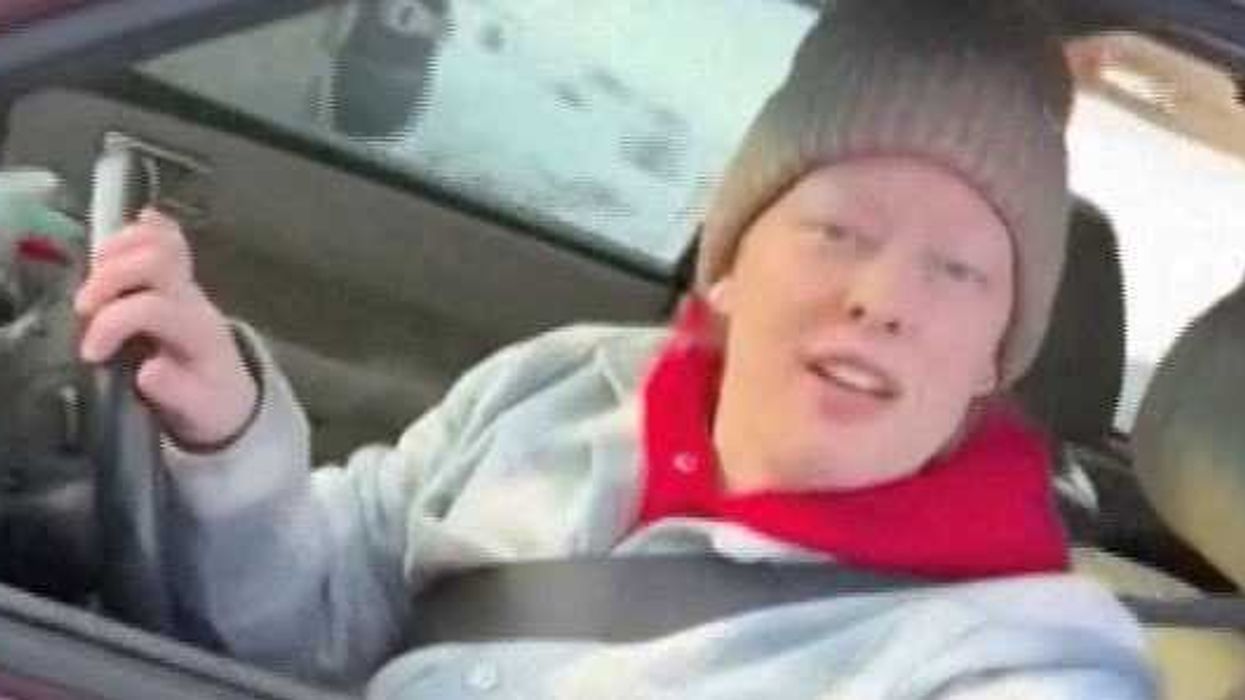
Renee Nicole speaks while sitting in the driver's seat of a car, moments before she was shot by a U.S. Immigration officer, in Minneapolis, Minnesota, U.S., January 7, 2026, in this screengrab from video. Alpha News/via REUTERS
A small detail has stayed with me from the video of Renee Nicole Good being shot to death in Minneapolis by ICE officer Jonathan Ross.
In the video, she’s behind the wheel, signaling with her left hand to the driver of an ICE vehicle that she’s letting him go before she goes. Then out of that vehicle come two officers. One goes straight to her door.
“Get the f--- outta the car,” says the officer, who is not Ross.
Then he tries to open her door.
That’s the small detail I’m talking about and here’s the reason it has stayed with me. I have been pulled over a few times in my life – for speeding or turning right on a red light when it should not have. But I cannot recall a time when the police officer tried to open my door.
Forget about swearing at me. That’s never happened either. But no law enforcement officer has communicated to me a hint of physical aggression, even when I deserved it (a story for another time). I don’t mean speaking sternly. I mean with his body – like he intends to hurt me. That’s surely the message received by Renee Nicole Good.
There’s another thing about this detail worth dwelling on.
The fact that I have never experienced a police officer who has communicated to me a hint of physical aggression is due, at least in part, to the fact that I am white. I’m also a man. A white man in a country that was built for white men can live his whole life in blissful ignorance of state violence experienced by nonwhite counterparts.
I bring this up, because I wonder about the role of Renee Nicole Good’s race in her experience of the ICE officer acting like he’s gonna hurt her. As I said, he strides over to her, and tries to open her door. (It’s locked.)
What did she feel? It must have been a shock.
To even the wokest white person, violence by the state is still mostly theoretical. We might believe it’s true. We might trust Black people and other people of color are speaking truthfully about their experience. We might see videos online. But we don’t know what it feels like.
What I’m trying to say is that it makes sense to me if Renee Nicole Good experienced panic on two levels at the same time. Once, because here’s a “cop” trying to open her door, acting like he’s gonna hurt her. Twice, because the abstractions of white power were suddenly real.
I would have panicked, too.
She was right to be afraid. As she focused on the ICE officer cussing her out and trying to open her door, something that I’m pretty sure she had never experienced before, ICE officer Jonathan Ross took a position in front of her car, as she was backing up. Before moving forward, she turned the wheel to the right to avoid him. That’s when Ross crouched, aimed and fired, first through the windshield, then the open window.
Ross’s defenders want us to believe the fear felt by Renee Nicole Good doesn’t count. The only fear that counts is Ross’s. They say he believed she would have killed him. They say he was justified in killing her.
It’s that classic closed-circuit logic.
“It's so f------ convenient that they get to ‘fear for their lives’ anytime they want to absolve themselves of anything,” said writer Luke O’Neil, “and when we actually fear for our lives because of them and do anything a scared person would do it's justification for our death.”
It’s also ridiculous.
“The obvious critique I have not heard explicitly articulated is that the point of making a self-defense argument would be saying ‘but for’ his shooting her, she would have killed him,” said Jonathan Kahn, a law professor at Northeastern. “Clearly, had he not shot her, the outcome for him would have been just the same - ie, no threat to his life.”
The irony is that Renee Nicole Good did not seem afraid of Ross. That’s clear from the video that Ross took during the shooting and that he leaked afterward to a sympathetic media outlet. He released it in the apparent belief that it proves he acted in self-defense. It doesn’t.
In that video, Renee Nicole Good can be seen smiling at Ross. As he’s walking around her car, recording her, taking note of her out-of-state license plate, she tells him: “That’s fine, dude. I’m not mad at you.”
Everything changes when the other ICE officer, who can also be seen in Ross’s video, strides toward her vehicle, tries to open the door, cussing as he orders her to get out. She was evidently sensing danger. Ross was not justified in killing her. But she was justified in trying to get away.
Perhaps the most shocking thing, according to David Lurie, an attorney who writes for Public Notice, is what all this says about dissent.
Ross’s defenders argue that his video proves Renee Nicole Good and her spouse, Rebecca Good, were a threat in that they “were not fans of ICE and were in fact protesting the thugs’ activities,” David told me.
In other words, their dissent was a threat. If Ross and his defenders actually believe that, David told me, “that is also deeply creepy.”
“It is effectively a declaration that dissent merits death.”
Jonathan Ross leaked his video Friday. Afterward, I got in touch with David Lurie to discuss it. Here’s the rest of our conversation.
Jonathan Ross appears to believe that his video absolves him -- that he killed Renee Nicole Good in self-defense. I don't see it. Do you?
First of all, how that video ended up being published is a major issue, which we can discuss. Second, it is not remotely exculpatory – and it takes a truly twisted mind to see it that way.
Why is it a major issue in your view?
It is yet another indication that the FBI investigation is entirely unreliable. The FBI should have control of all of the evidence, including and especially any recordings or other records created by the officers.
And, of course, it should not be releasing those materials piecemeal.
If the officer retains control of the recording, and is engaging in his own publicity campaign, then that necessarily means the FBI is not conducting a professional and reliable investigation.
And if the FBI is itself releasing items of evidence to favored press outlets piecemeal, while freezing out state law enforcement authorities from the investigation, then that is as bad or worse.
You have seen the video. You say it's not exculpatory. Is it damning? It seems to show her steering away from him.
What I focused on is that it confirmed that the victim was – including by her words – trying to deconflict the situation, which is what cops are supposed to do, while it was the ICE thugs who were escalating.
It was chilling.
There’s another disturbing insight.
Apparently, the perpetrator or others in the Trump regime think the video "justifies" the murder, presumably because it shows that the victim and her spouse were not fans of ICE and were in fact protesting the thugs’ activities.
That is also deeply creepy, because it is effectively a declaration that dissent merits death.
That's what I was thinking. If you do not immediately comply, that is justification enough for use of maximum force. And that would be a perversion of law and order, not its preservation. Thoughts?
Agree.
Also, in fact, she was not getting clear instructions from the menacing gang of masked thugs that appeared around her, and to the extent that some of the thugs were demanding to get access to her person, she had every reason not to freely comply.
The fact that the cameraman thug turned out to be a reckless and amoral murderer itself demonstrates that she was rightfully fearful of getting out of her car.
What now? The FBI is blocking state investigators, though local prosecutors are apparently gathering their own evidence.
You are ahead of me on news of the prosecutors, but that does not surprise me. They have the ability to gather a lot of probative evidence without the cooperation of the thugs and their bosses or the FBI.
But it is obviously problematic for state or local authorities to undertake a criminal investigation of the conduct of a federal law enforcement officer while the federal government is actively obstructing the investigation.
Assuming the (clearly wrongful) obstruction of the Minnesota investigation continues, it seems more than likely that the Minnesota authorities will seek judicial intervention to force the feds to give them access to the investigatory materials.
We shall see how that plays out.
If Ross is arrested and there's an indictment and so on, a big if, couldn't the feds just ask a judge to move the case to federal court, where they can have the charges dropped? If so, what then?
There is a lot to be said on that topic. But here are the basics. If there is a criminal case, it will be tried in a federal court, even if it is a state prosecution. Although it seems a bit odd, a state law criminal prosecution of a federal officer for state criminal violations is highly likely to be "removed" to federal court under applicable law.
But if it is removed, it will still be prosecuted by state officials, and state criminal laws will apply to the case, but before there is a trial, there will likely be a "Supremacy Clause immunity" issue to be resolved.
This sounds arcane, but is conceptually simple. While the constitutions define state and the federal governments as "sovereigns," with independent authority to enforce their respective laws, where there is a conflict between state and federal law, under the Constitution's Supremacy Clause, federal law prevails.
It follows that if the allegedly criminal conduct of a federal law enforcement officer was consistent with federal law, including governing law enforcement policies, then it is unconstitutional to permit a state law prosecution to proceed.
But it is not going to be enough for the officer to put Kristi Noem in front of the court and for her to make bogus claims about the facts and about federal law enforcement policies. The court will undertake its own independent review of those matters.

