


More than five years after the great recession hit, the US economy is still sputtering. The government revised GDP growth figures down last month to a meager 1.8% for the first quarter of this year. It doesn't take a PhD in economics to understand why: we have a demand problem. And we have a demand problem because the vast majority of consumers – aka workers – are not earning enough to pay for healthcare, education and retirement, let alone all the other stuff stores and service providers have to sell.
The reality is that we're hollowing out the middle class by wiping out well-paid jobs with benefits and replacing them with low-wage ones that often lack them. That's damaging not only to people who are living on smaller paychecks – or who are indeed unemployed – but also to the health and viability of the overall economy.
No matter what New York Times columnist Thomas Friedman and his followers say, we are not living in a "sharing economy". We are living in a zero-sum economy – in which a handful of investors and owners win at everyone else's expense.
But ultimately, it will catch up with investors, too. The US economy is engaged in a vicious cycle in which low-wage jobs and under-employment stimulate little demand, giving companies little reason to hire workers. Would-be workers then get discouraged and drop out of the workforce. They lack money to buy things, so consumer spending sags and companies don't hire or offer raises to workers they know they can keep. Repeat.
So, sorry Friedman et al: you can strain your brains for as many offbeat ideas and back-of-taxicab discoveries as you like, but the only way to break the cycle is to ensure everyone can work – and that those workers get more of the fruits of their labor. Until we address the following 10 problems head-on, the idea that the economy is truly recovering will remain a fantasy.
Problem 1: wages are falling
The recession caused a giant drop in consumer demand, but the culprit wasn't just a loss of housing wealth. Wages for most workers are either stagnating or declining. In fact, real median wages fell by about 2.8% between 2009 and 2012. That's bad for workers and bad for the economy. It's also insulting because the drop happened even as productivity increased 4.5%. So much for the sharing economy.
What's worse, lower-wage workers – who are already struggling to keep up – saw bigger declines than those in the middle and higher end. Those earning between $10.61 and $14.21 per hour saw real wages drop by 4.1% on average.
As Reuters' Felix Salmon points out in his crafty analysis of the data, hairstylists and cosmetologists earned $12 an hour on average in 2009. But by 2012, they earned just $10.91 an hour – a drop of more than 9%. Restaurant cooks lost 7.1% over the same period.
Problem 2: the middle class is losing ground and getting hollowed out
The most recent census data shows that while a small group of rich people are getting richer, the middle class is taking a serious beating. US median income fell to $50,054 in 2011, the most recent full year in which that data is available. That's down 8.1% since 2007, just before the great recession started. Overall, median income has fallen 8.9% from its peak in 1999. Meanwhile, the middle class is shrinking, as many Americans slide down the economic ladder – the very inverse of the American dream of economic mobility.
Problem 3: McJobs are taking over
The economy is shedding good jobs, which are increasingly replaced with low-wage, often part-time jobs. During the recovery, job gains have been concentrated in lower-wage occupations, which grew nearly three times as quickly as middle- and higher-wage occupations. State and federal governments, for example, have cut 835,000 jobs over the past four years – many of them middle-income positions.
Job growth projections show that this trend will continue. The healthcare, social assistance and retail sectors are among areas expected to add the most jobs by 2020 – all industries notorious for jobs with meager pay and poor working conditions. A lot of these positions will pay the federal minimum wage ($7.25 an hour) – the inflation-adjusted value of which has declined by more than 30% since the 1960s. That's not going to help the approximately 100 million Americans – one in three – either living in poverty or in "the fretful zone just above it", as the New York Times put it.
Problem 4: capital is hammering labor
Again, so much for the sharing economy. Workers' wages as a percentage of the economy just hit another all-time low. In other words, corporations are now paying employees less than they ever have done, as a share of GDP.
At least in the short term, less for workers means more for corporations: corporate profits as a percentage of GDP are now at an all-time high. Big companies are hoarding cash at historically high levels – not using it for investment, hiring, pay raises or even to reward shareholders. Last time I checked, hoarding is the opposite of sharing. Again, it's a zero-sum economy, and workers are losing. Badly.
Problem 5: unemployment is twice what they say
Our official 7.6% unemployment rate is bad enough, but the real number is actually about twice that. Buried in the monthly jobs report, you'll find what's called the U-6 figure, which includes the unemployed, plus those "marginally attached" to the labor force (that is, they want a job but have largely given up looking), plus those working part-time but who want a full-time job. The U-6 number for June 2013 was an astonishing 14.3%, up half a percentage point from May.
Problem 6: America is going part-time – and not for fun
In staggering numbers, more Americans are working part-time – but not because they want to. These involuntary part-timers now number more than 8.2 million – an increase of 322,000 workers from May and almost double the number this time five years ago. It's the highest it's been all year, and the trend line is going in the wrong direction.
Problem 7: workers aren't working
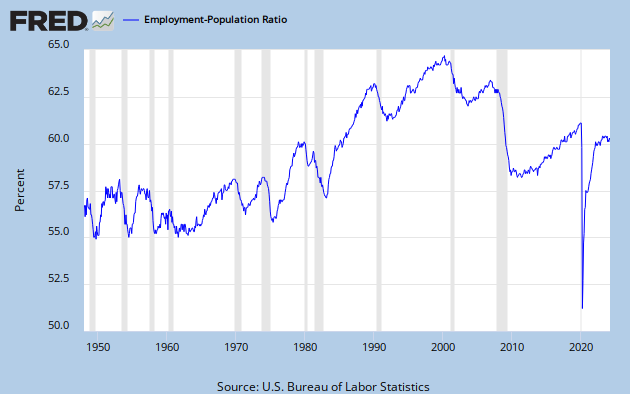
Here's another way of looking at under-employment: fewer working-age Americans are working than at any time in the past three decades. That is, the employment-to-population ratio has collapsed. In June, the ratio was 58.7% – a drop from 63% five years ago, before the recession hit. Of course, workers sitting on the sidelines aren't collecting paychecks, meaning they have much less to spend.
Problem 8: union wages are harder to come by. Much
There is power in a union. There's also a higher wage. In 2012, the median salary for a unionized worker was about $49,000, as opposed to about $39,000 for their non-union counterparts. But fewer and fewer workers are earning union salaries. Thirty years ago, one in five US workers were union members; now, it's about one in 10.
Problem 9: the cost of college is skyrocketing
Higher education in the US is becoming an unaffordable luxury. By conservative estimates, the cost of a college education is now 50% higher than it was 30 years ago. Public colleges and universities are cheaper, but not cheap enough. As states cut funding, the cost of attending a four-year public institution has risen by 5.2% each year of the last decade. Student loan debt in this country now exceeds $1tr.
Upon graduation, debt-saddled young people face a fierce job market; youth unemployment has hovered around 16% for the last year and a half. The conundrum is that, although college degrees are exorbitantly expensive, they're increasingly necessary to even get in the door for a decent job.
Problem 10: inequality is getting worse
It's well-known that the US ranks near the top of most unequal countries in the developed world – and that income inequality here has reached its highest levels since the great depression. A few statistics fill out the bleak picture: the top 1% of earners took 93% (pdf) of the income gains in the first full year of the recovery. The poorest 50% of Americans now collectively own just 2.5% of the nation's wealth.
What level of inequality is healthy for a society may be debatable, but an increasing number of economists and regulators – including those at the IMF and Federal Reserve – are recognizing that US-style inequality is bad for business, and the economy as a whole.
As these experts are starting to realize, the recovery will only come when workers get their due. Until then, American corporations are sowing the seeds of their own destruction – and taking the rest of us down with them.
Report typos and corrections to: feedback@alternet.org.

#story_page_sidebar
MOST POPULAR
{{ post.roar_specific_data.api_data.analytics }}
MOST POPULAR
ContactAdvertise with AlterNetPrivacy PolicyWriter GuidelinesPress InformationAbout AlterNetMeet the AlterNet StaffDebug Logs
@2026 - AlterNet Media Inc. All Rights Reserved. - "Poynter" fonts provided by fontsempire.com.