Despite Pope Leo XIV repeatedly calling on Christians to honor the Bible's multiple instructions to care for and welcome immigrants and refugees, House Speaker Mike Johnson (R-La.) is insisting that the scripture says otherwise.
The Daily Beast reported Tuesday that Johnson was confronted in a Capitol Hill hallway by a reporter who asked him about the pontiff's words on providing a safe haven to immigrants fleeing oppression. Pablo Manriquez — a reporter with liberal outlet MeidasTouch — asked the speaker: "Pope Leo has cited Matthew 25:35 to critique Donald Trump’s mass deportation agenda. How would you respond to Pope Leo in scripture?"
"So you want me to give you a theological dissertation? All right. I tell you what. I’ll post it on my website later today, but let me give you a quick summary," Johnson said. "When someone comes into your country, comes into your nation, they do not have the right to change its laws or to change a society. They’re expected to assimilate. We haven’t had a lot of that going on."
Johnson later posted a lengthy screed to his official Facebook page laying out what he called "the Christian case for border security." He argued that Leviticus 19:34 — which decrees that "the foreigner residing among you must be treated as your native-born" — is often quoted without appropriate "context."
"It is, of course, a central premise of Judeo-Christian teaching that strangers should be treated with kindness and hospitality," Johnson wrote. "However, that 'Greatest Commandment' was never directed to the government, but to INDIVIDUAL believers."
Pope Leo XIV – the first American-born pope in history — has urged Catholics to consider "deep reflection" about how immigrants are treated in the United States. The pontiff cited the Gospel of Matthew — specifically Jesus' parable of the sheep and the goats — to argue that Christians have a responsibility to welcome those from other nations seeking safety. He has also called on American bishops to be "more forceful" in pushing back against President Donald Trump's administration in how it treats immigrants.
"Jesus says very clearly at the end of the world, we’re going to be asked, you know, how did you receive the foreigner? Did you receive him and welcome him or not? And I think that there’s a deep reflection that needs to be made in terms of what’s happening," the pope said in November.
The election of Robert Prevost as the first American pope is being seen as a significant development, especially given his opposition to some of President Donald Trump's policies.
Earlier in February, Prevost had posted about Vice President JD Vance that has now gone viral. Sharing an opinion piece from the National Catholic Reporter critical of Vance, he reposted the headline of the op-ed: "JD Vance is wrong: Jesus doesn't ask us to rank our love for others."
In an article published Thursday, Politico quoted Ramesh Ponnuru, a conservative commentator and practicing Catholic, as saying: “The fact that he’s American raises the possibility that the front-and-center issues are going to continue to be sort of first-world issues — and that could be, again, a recipe for division and tension with the administration."
Prevost has enough local credibility to influence Catholic Republicans more effectively than his predecessor and to speak with a stronger impact in the United States, the article notes.
Reacting to the news of his election, the present said in a post on his Truth Social platform: “It is such an honor to realize that he is the first American Pope. What excitement, and what a Great Honor for our Country. I look forward to meeting Pope Leo XIV. It will be a very meaningful moment!”
While Trump welcomed Prevost's election, analysts believe the pope may continue to speak his mind about the administration, which could lead to conflict.
"Like his predecessor, Leo hails from a more progressive, inclusive wing of Catholicism, preaching peace and the importance of building bridges in his first address from the balcony of St. Peter’s Basilica, though it appears he still holds traditional Catholic views on LGBTQ+ issues," the article said.
"Already, the pope is earning enemies in his homeland as conservative Catholics in Washington, D.C., sent flurries of texts Thursday afternoon sharing posts from a social media account under Leo’s name criticizing Trump and Vice President JD Vance," the article added.
Meanwhile, according to Vatican analyst Katie McGrady, Prevost "has the training to put all of the loud American Catholics in their place."
"He's a canon lawyer. He knows the teachings of the church and the laws of the church very intimately," she said during an appearance on CNN Thursday.
Cardinal Dr. Robert Prevost has officially taken the name Pope Leo XIV, becoming the first American head of the Catholic Church in history. And a tweet Prevost wrote earlier this year about Vice President JD Vance is going viral.
In February, Prevost amplified an op-ed published in the National Catholic Reporter in which author Kat Armas criticized the vice president (who converted to Catholicism in 2019) over his remarks suggesting there was a hierarchy of Christian priorities. Vance told Fox News in late January: "There is a Christian concept that you love your family and then you love your neighbor, and then you love your community, and then you love your fellow citizens, and then after that, prioritize the rest of the world. A lot of the far left has completely inverted that."
Prevost's tweet repeated the headline of the op-ed: "JD Vance is wrong: Jesus doesn't ask us to rank our love for others."
"[The Apostle] Paul reminds them: love starts close. It moves first toward those in front of us, ensuring widows were not abandoned while preserving the church's resources for those truly without support," Armas wrote in the op-ed. "But make no mistake — this isn't about love confined to bloodlines or geographic boundaries. It's about love rooted in responsibility, expanding outward. And it was subversive even then."
Prevost/Leo XIV's tweet lit up social media, with various journalists and commentators like Democratic strategist Matt McDermott celebrating "our new woke pope."
"Well this will be fun," Independent D.C. bureau chief Eric Michael Garcia tweeted.
"Get in loser we're combing through the new pope's old tweets," Business Insider senior politics reporter Bryan Metzger tweeted.
Dan Cluchey, who was a speechwriter for former President Joe Biden, also celebrated the tweet by observing that the "new pope already upholding the only tradition that matters: s----ing on JD Vance."
Tahra Hoops, who is the director of economic analysis at the Progress Chamber, combed into the op-ed Leo XIV tweeted and opined that he was "abundance-pilled," referring to the political theory that public policy should be oriented around making sure all members of society have a high standard of living.
President Donald Trump has not yet commented on Leo XIV's tweet, but delivered a statement on his Truth Social account writing: "Congratulations to Cardinal Robert Francis Prevost, who was just named Pope. It is such an honor to realize that he is the first American Pope. What excitement, and what a Great Honor for our Country. I look forward to meeting Pope Leo XIV. It will be a very meaningful moment!"
Not long after Pope Francis' death, President Donald Trump posted an AI-generated image of himself in papal garb on both his Truth Social account and on the White House's official X account. Catholics have been speaking out against the image despite Trump's assertions that it wasn't offensive.
Newsweek reported Monday that Trump waved off concerns about the image, which has yet to be taken down on either account. The president insisted that he was simply attempting to be humorous.
"You mean they can't take a joke?" Trump said in response to a question about Catholics being upset about the image. "You don't mean the Catholics, you mean the fake news media. The Catholics loved it. I had nothing to do with it. Maybe it was AI."
However, many prominent Catholics — including conservative ones – have been outspoken in their disdain for the image. Bishop Robert Barron (described as a "neoconservative" by conservative media) said Trump's post was a "bad joke" and "sophomoric," and added: "I wish he hadn't done it." Cardinal Timothy Dolan, who is known for his conservative views on abortion and same-sex marriage, also blasted Trump over the image.
"It wasn't good," Dolan told reporters over the weekend, adding that Trump was a "brutta figura" which translates to "making a fool of oneself."
Former Republican National Committee chairman Michael Steele — a never-Trump conservative who trained to be a Catholic priest before entering politics — was also outspoken in his condemnation of the president over the image. He noted that the Catholic Church is still in the period of Novemdiales, which is the time after the death of a pope, and that Trump's "narcissism" was the primary motivator for the image.
"More to the point, this affirms how unserious and incapable he is," Steele tweeted. "At 78 he remains a 10 [year-old] child, emotionally scarred and broken while desperate to prove he could be somebody. His problem: he can’t grow up to prove it."
The percentage of Americans who do not identify with any religious tradition continues to rise annually. Not all of them, however, are atheists or agnostics. Many of these people believe in a higher power, if not organized religion, and their numbers too are steadily increasing.
The history of organized religion is full of schisms, heresies and other breakaways. What is different at this time is a seemingly indiscriminate mixing of diverse religious traditions to form a personalized spirituality, often referred to as “cafeteria spirituality.” This involves picking and choosing the religious ideas one likes best.
At the heart of this trend is the general conviction that all world religions share a fundamental, common basis, a belief known as “perennialism.” And this is where the unlikely figure of Meister Eckhart, a 14th-century Dominican friar famous for his popular sermons on the direct experience of God, is finding popular appeal.
Who was Meister Eckhart?
I have studied Meister Eckhart and his ideas of mysticism. The creative power that people address as “God,” he explained, is already present within each individual and is best understood as the very force that infuses all living things.
He believed this divinity to be genderless and completely “other” from humans, accessible not through images or words but through a direct encounter within each person.
The method of direct access to the divine, according to Eckhart, depended on an individual letting go of all desires and images of God and becoming aware of the “divine spark” present within.
Seven centuries ago, Eckhart embraced meditation and what is now called mindfulness. Although he never questioned any of the doctrines of the Catholic Church, Eckhart’s preaching eventually resulted in an official investigation and papal condemnation.
Significantly, it was not Eckhart’s overall approach to experiencing God that his superiors criticized, but rather his decision to teach his wisdom. His inquisitors believed the “unlearned and simple people” were likely to misunderstand him. Eckhart, on the other hand, insisted that the proper role of a preacher was to preach.
He died before his trial was complete, but his writings were subsequently censured by a papal decree.
Since then, he has attracted many religious and non-religious admirers. Among the latter were the 20th-century philosophers Martin Heidegger and Jean-Paul Sartre, who were inspired by Eckhart’s beliefs about the self as the sole basis for action. More recently, Pope John Paul II and the current Dalai Lama have expressed admiration for Eckhart’s portrayal of the intimate relationship between God and the individual soul.
During the second half of the 20th century, the overlap of his teachings to many Asian practices played an important role in making him popular with Western spiritual seekers. Thomas Merton, a monk from the Trappist monastic order, for example, who began an exploration of Zen Buddhism later in his life, discovered much of the same wisdom in his own Catholic tradition embodied in Eckhart. He called Eckhart “my life raft,” for opening up the wisdom about developing one’s inner life.
Richard Rohr, a friar from the Franciscan order and a contemporary spirituality writer, views Eckhart’s teachings as part of a long and ancient Christian contemplative tradition. Many in the past, not just monks and nuns have sought the internal experience of the divine through contemplation.
Among them, as Rohr notes were the apostle Paul, the fifth-century theologian Augustine, and the 12th-century Benedictine abbess and composer Hildegard of Bingen.
In the tradition of Eckhart, Rohr has popularized the teaching that Jesus’ death and resurrection represents an individual’s movement from a “false self” to a “true self.” In other words, after stripping away all of the constructed ego, Eckhart guides individuals in finding the divine spark, which is their true identity.
Eckhart and contemporary perennials
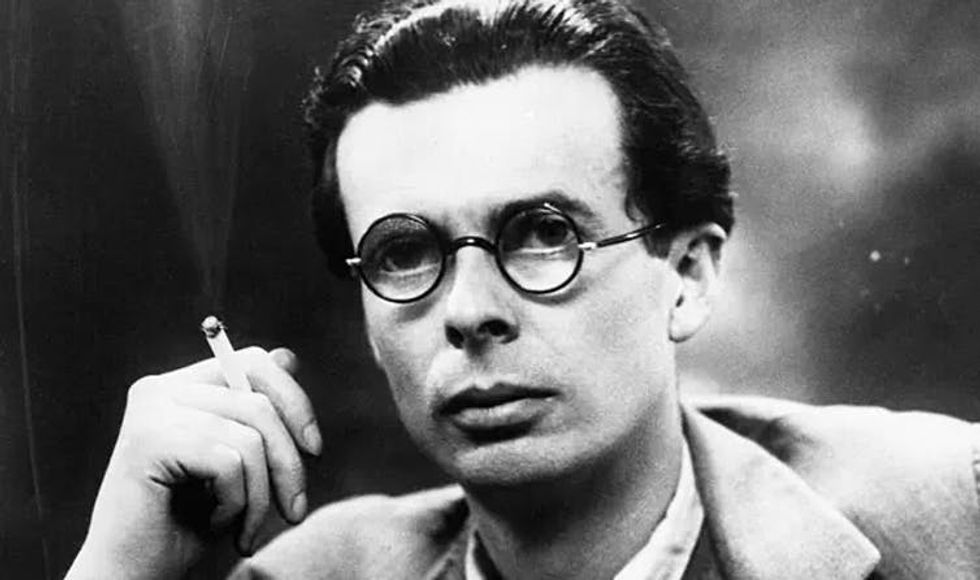
Novelist Aldous Huxley frequently cited Eckhart, in his book, ‘The Perennialist Philosophy.’ RV1864/Flickr.com, CC BY-NC-ND
This subjective approach to experiencing the divine was also embraced by Aldous Huxley, best known for his 1932 dystopia, “Brave New World,” and for his later embrace of LSD as a path to self-awareness. Meister Eckhart is frequently cited in Huxley’s best-selling 1945 spiritual compendium, “The Perennialist Philosophy.”
More recently, the mega-best-selling New Age celebrity Eckhart Tolle, born Ulrich Tolle in 1948 in Germany and now based in Vancouver, has taken the perennial movement to a much larger audience. Tolle’s books, drawing from an eclectic mix of Western and Eastern philosophical and religious traditions, have sold millions. His teachings encapsulate the insights of his adopted namesake Meister Eckhart.
The cautionary note, however, is in too simplistic an understanding of Eckhart’s message.
Eckhart, for instance, did not preach an individualistic, isolated kind of personal enlightenment, nor did he reject as much of his own faith tradition as many modern spiritual but not religious are wont to do.
The truly enlightened person, Eckhart argued, naturally lives an active life of neighborly love, not isolation – an important social dimension sometimes lost today.
Meister Eckhart has some important lessons for those of us trapped amid today’s materialism and selfishness, but understanding any spiritual guide – especially one as obscure as Eckhart – requires a deeper understanding of the context.
During a closed-door meeting with oil executives at the Vatican on Saturday, Pope Francis gravely warned against further fossil fuel exploration and extraction, arguing that continued use of dirty energy could ultimately "destroy civilization."
"Carbon dioxide emissions remain very high. This is disturbing and a cause for real concern," Francis said in an address at the close of a two-day conference titled Energy Transition and Care of Our Common Home. "More worrying is the continued search for new fossil fuel reserves, whereas the Paris Agreement clearly urged keeping most fossil fuels underground."
In attendance at the conference were several major players in the oil and gas industry, according to Reuters, including ExxonMobil and Shell—both of which denied the reality of climate change in public for decades despite knowing privately about the threat soaring carbon emissions posed to the planet.
A total of fifty industry executives were reportedly in attendance at the two-day event.
Denouncing "unlimited faith in markets and technology" exuded by corporate executives in an effort to justify the disastrous status quo, the pontiff argued that a just transition to clean, renewable energy is "a duty that we owe towards millions of our brothers and sisters around the world, poorer countries, and generations yet to come."
"We know that the challenges facing us are interconnected. If we are to eliminate poverty and hunger...the more than one billion people without electricity today need to gain access to it," Francis said.
"Our desire to ensure energy for all must not lead to the undesired effect of a spiral of extreme climate changes due to a catastrophic rise in global temperatures, harsher environments, and increased levels of poverty," he added.
Pope Francis has criticised journalists who dredge up old scandals and sensationalise the news, saying it’s a “very serious sin” that hurts all involved.
Francis, who plans to dedicate his upcoming annual communications message to “fake news”, told Catholic media on Saturday that journalists perform a mission that is among the most “fundamental” to democratic societies.
But he reminded them to provide precise, complete and correct information and not to provide one-sided reports.
The pope said: “You shouldn’t fall into the ‘sins of communication:’ disinformation, or giving just one side, calumny that is sensationalised, or defamation, looking for things that are old news and have been dealt with and bringing them to light today.”
He called those actions a “grave sin that hurts the heart of the journalist and hurts others”.
An article being described as “explosive,” written by two allies of Pope Francis in a Vatican-reviewed publication, is taking on the “spurious alliance between politics and religious fundamentalism” in the United States.
Antonio Spadaro and Marcelo Figueroa call out the dominionist groups “composed mainly of whites from the deep American South” for their rejection of the “global ecological crisis” and their Armageddon-infused rhetoric, pointedly drawing parallels to Islamic fundamentalism.
They accuse these evangelical fundamentalists of seeking “influence in the political and parliamentary sphere and in the juridical and educational areas so that public norms can be subjected to religious morals.”
And, they name names:
This is the doctrine that feeds political organizations and networks such as the Council for National Policy and the thoughts of their exponents such as Steve Bannon, currently chief strategist at the White House and supporter of an apocalyptic geopolitics.
But it’s not just evangelical fundamentalists who desire “religious influence in the public sphere”:
Appealing to the values of fundamentalism, a strange form of surprising ecumenism is developing between Evangelical fundamentalists and Catholic Integralists. . . . Some who profess themselves to be Catholic express themselves in ways that until recently were unknown in their tradition and using tones much closer to Evangelicals. They are defined as value voters as far as attracting electoral mass support is concerned. . . . This meeting over shared objectives happens around such themes as abortion, same-sex marriage, religious education in schools and other matters generally considered moral or tied to values.
More than 15 years after the Catholic bishops helped get George W. Bush elected president and nearly eight after the signing of the Manhattan Declaration, the Vatican has discovered what had become the defining feature of the Christian Right in America: the conservative evangelical-Catholic convergence.
And while Spadaro and Figueroa are critical of the sublimation of gospel values to the goal of right-wing political domination, it’s worth noting that the two issues that drove this convergence in the first place—abortion and same-sex marriage—haven’t exactly been abandoned by Pope Francis.
As for the “glue” that holds this altogether—and formed the underpinning of the Manhattan Declaration coalition—Francis has been a proponent of the idea that the “religious liberty” of Catholics is under attack in western democracies such as the United States, even as Spadaro and Figueroa criticize its use for political ends:
The erosion of religious liberty is clearly a grave threat within a spreading secularism. But we must avoid its defense coming in the fundamentalist terms of a “religion in total freedom,” perceived as a direct virtual challenge to the secularity of the state.
While much of their criticism is justified, Spadaro and Figueroa are silent about the role that Pope John Paul II and Pope Benedict played in the creation of the “evangelical Catholics” they complain about and about the role that the U.S. Conference of Catholic Bishops played in driving conservative Catholics into the arms of the Republican Party, and, eventually, Trump.
Nonetheless, they correctly call-out the “shocking rhetoric” of the Church Militant and other pro-Trump organizations that are “openly in favor of a political ultraconservatism and uses Christian symbols to impose itself”:
. . . it has created a close analogy between Donald Trump and Emperor Constantine, and between Hilary Clinton and Diocletian. The American elections in this perspective were seen as a “spiritual war” . . . Church Militant asks if Trump’s victory can be attributed to the prayers of Americans. The response suggested is affirmative. The indirect missioning for President Trump is clear: he has to follow through on the consequences. This is a very direct message that then wants to condition the presidency by framing it as a divine election.
For conservatives, however, this is not political warfare cloaked as spiritual warfare, but a logical and necessary outcome of attacks on the traditional church. Philadelphia Archbishop Charles Chaput calls the article “an exercise in dumbing down and inadequately presenting the nature of Catholic/evangelical cooperation on religious freedom and other key issues”:
The cooperation of Catholics and evangelicals was quite rare when I was a young priest. Their current mutual aid, the ecumenism that seems to worry La Civilta Cattolica, is a function of shared concerns and principles, not ambition for political power. . . . Dismissing today’s attacks on religious liberty as a “narrative of fear”—as the La Civiltà Cattolica author curiously describes it—might have made sense 25 years ago. Now it sounds willfully ignorant. It also ignores the fact that America’s culture wars weren’t wanted, and weren’t started, by people faithful to constant Christian belief.
But Spadaro and Figueroa call this a false ecumenism, “an ecumenism of conflict that unites them in the nostalgic dream of a theocratic type of state” and that “wants walls and purifying deportations.” By contrast, they say, Francis’ ecumenism “moves under the urge of inclusion, peace, encounter and bridges.”
Regardless of whose brand of ecumenism you subscribe to, one thing is for sure. Francis, they say, “wants to break the organic link between culture, politics, institution and Church.” But this link underpins much of the conservative religious understanding in the United States today. And breaking it may take more than just words.
According to reports from the presidential press pool, Laudato Si’, the letter on environmental stewardship Francis wrote in 2015, was given to Trump along with other religious texts the pope has written.
The pope also handed Trump a signed copy of his World Day of Peace message about nonviolence, saying: “I signed it personally for you”.
According to pool reports seen by The Hill, Trump promised Francis he would read them. The letter on ecology alone runs to 184 pages.
The presentation happened after the two men met privately on Wednesday morning. The agenda for their conversation was reported by CNN to include climate change.
The climate encyclical begins with a prayer from St Francis of Assisi, from whom the pontiff takes his papal name and who is often associated with early Christian environmental thought.
The pope’s message calls the climate a “common good” and notes the “very solid scientific consensus” on the changes being wrought by carbon pollution.
“Many of those who possess more resources and economic or political power seem mostly to be concerned with masking the problems or concealing their symptoms, simply making efforts to reduce some of the negative impacts of climate change,” the encyclical reads.
Trump has questioned the science behind climate change and is considering whether he will withdraw the US from the Paris climate agreement. His budget, released in full on Tuesday, nixed U.S. assistance to poor countries to help them tackle climate change.
Trump’s meeting with the pope comes days before he heads to Sicily to sit with G7 leaders. The president has said he would make up his mind about the Paris accord after that meeting.
A series of global leaders have urged him to keep the U.S. in the process. Germany’s Angela Merkel was the latest to do so, in a speech on Tuesday.
Francis’ encyclical was lauded when it first emerged—in the months leading up to the pivotal Paris climate conference—as a dramatic intervention from an institution that had been marked by conservatism under other leaders.
Trump has said in the past that he rarely, if ever, has time to read. But even if he dips into the pope’s climate decree, it may not have the desired effect.
A survey published on Tuesday by the Annenberg Public Policy Centre (APPC) at the University of Pennsylvania found that, in the U.S. at least, the pope’s message had failed to make conservative catholics more concerned about climate change. It did however, raise awareness of climate change among liberally-minded catholics.
Lead author Asheley Landrum said: “To use a political analogy, the pope excited his base. Liberals who had already expressed concern about climate change agreed more with the Pope’s message that climate change will disproportionately affect the poor.”
This article was originally published by Climate Home.
"In the election campaign, he even said it was a Chinese invention to criticize America," Argentine Bishop Marcelo Sanchez Sorondo told Italian wire service ANSA. "But this president has already changed about several things, so perhaps on this as well."
"They will come to an agreement, since the president claims to be a Christian, and so he will listen to him," Sanchez Sorondo said.
Sanchez Sorondo, the chancellor of the Pontifical Academy of Sciences and the Pontifical Academy of Social Sciences, works closely with the pope and has been outspoken on the issue of global warming and its effect on the world's migrant crisis.
In his interview with ANSA, he called the president's anti-climate executive orders "against science" and "against what the pope says."
Refuting Trump's infamous saying that climate change is a Chinese "hoax," Sanchez Sorondo commented, "Today the Chinese are actually very collaborative as concerns the commitments they took on climate with the Paris Climate Conference."
"Even large capitals that have thus far invested in fossil fuels are beginning to be concerned about the effects of climate change and see new investment and research opportunities to find different energy solutions that are 'clean' or renewable," he said.
Earlier this month, Pope Francis said he would be "sincere" with Trump over their diametrically opposed views on subjects such as immigration and climate change.
"Even if one thinks differently, we have to be very sincere about what each one thinks," Francis said. "Topics will emerge in our conversations. I will say what I think and he will say what he thinks. But I have never wanted to make a judgement without first listening to the person."
Also in the ANSA interview, Sanchez Sorondo claimed the fossil fuel industry tried to influence the pope's climate encyclical:
"When he was preparing the Laudato Si, oil lobbies did everything in their power to prevent the pope from saying what he did, meaning that climate change is caused by human activity that employ fossil fuels.
Perhaps the oil companies wanted a 'light' encyclical'—a romantic one on nature that wouldn't say anything at all.
Instead, the pope followed what the scientific community says.
If the president does not follow science, then that is the president's problem."
Pope Francis appears ready and willing to troll Donald Trump in an effort to prevent World War III.
In an interview that lasted more than an hour with Spanish newspaper El Pais and conducted just as Donald Trump was being sworn in as the 45th U.S. president on Friday, the leader of the Roman Catholic Church warned against the rise of populist leaders like Adolf Hitler.
“Hitler didn’t steal the power, his people voted for him, and then he destroyed his people,” Pope Francis noted. The pope explained to the paper that he worries about the rise of populism in the United States and Europe.
“In times of crisis, we lack judgment, and that is a constant reference for me,” he said. “The case of Germany is classic,” he continued, adding that Hitler gave them a “deformed identity and we know what it produced.”
“After the crisis of 1930, Germany is broken, it needs to get up, to find its identity, a leader, someone capable of restoring its character, and there is a young man named Adolf Hitler who said ‘I can do it.'”
Pope Francis declined, however, to take his trolling to the next level and directly link Trump to Hitler. “We will see how he acts, what he does, and then I will have an opinion,” he said. He argued that “being afraid or rejoicing beforehand because of something that might happen is, in my view, quite unwise.” Instead, Francis said, “We must wait and see”:
We need specifics. And from the specific we can draw consequences. We are losing our sense of the concrete. The other day, a thinker was telling me that this world is so upside down that it needs a fixed point. And those fixed points stem from concrete actions. What did you do, what did you decide, what moves did you make? That is why I prefer to wait and see.
Asked if he feared that Trump’s success may give rise to even more extreme right-wing populist movements in Europe, Pope Francis referenced a conflict he’s had with the newly elected president.
“In times of crisis we lack judgment,” he said. “Let’s look for a savior who gives us back our identity and let us defend ourselves with walls, barbed-wire, whatever, from other people who may rob us of our identity.”
Last February Trump lashed out at Pope Francis after he criticized Trump’s plans for a constructing wall along the U.S.-Mexican border. “A person who thinks only about building walls — wherever they may be — and not building bridges, is not Christian,” Pope Francis said of Trump. “I’d just say that this man is not Christian, if he said it this way.”
In his typical, over-the-top fashion, Trump responded by invoking the possibility of a terror attack on the Vatican.
“If and when the Vatican is attacked by ISIS, which as everyone knows is ISIS’s ultimate trophy, I can promise you that the pope would have only wished and prayed that Donald Trump would have been president because this would not have happened,” Trump said in a statement on his website.
On Friday Pope Francis warned against leaders who use the threat of terror to start war.
“Can borders be controlled? Yes, each country has the right to control its borders, who comes in and who goes out, and those countries at risk — from terrorism or such things — have even more of a right to control them, but no country has the right to deprive its citizens of the possibility to talk with their neighbors,” Pope Francis argued.
“That is why I always try to say: Talk among yourselves, talk to one another,” he added.
A day after Trump was sworn into office, French far-right leader Marine Le Pen told several hundred supporters in Germany that his inauguration speech included “accents in common” with the message of reclaiming national sovereignty by Europe’s far-right leaders.
She said to loud applause that “2016 was the year the Anglo-Saxon world woke up. I am sure 2017 will be the year the people of continental Europe wake up.”
Le Pen was spotted at Trump Tower in New York City just days before Trump’s inauguration.



_BW_Meister_Eckhart_(Skulptur).JPG)