nixon

'Demagogue': Watergate prosecutor reveals why Trump poses greater threat than Nixon

Before attorney Richard J. Davis served as assistant treasury secretary in the Carter Administration, he was a Watergate assistant special prosecutor. Davis, half a century after Watergate, makes a Donald Trump/Richard Nixon comparison in op-ed published by The Hill on February 21 — and wonders if President Trump will be able to collapse U.S. democracy in ways that Nixon wasn't.

"President Trump has now made clear he believes he is above the law, posting on social media, 'He who saves his country does not violate any Law,'" Davis warns. "This is not the first time that the U.S. has faced the danger of a president ignoring the law and potentially even defying a court order. Over 50 years ago, we escaped that risk during Watergate. But unless the public better understands the dangers of an 'I am above the law' president, the result today will not be the same."

The attorney stresses that the United States has a much different "media environment" than it did during Nixon's presidency.

READ MORE: 9/11 cancer research funding saved from DOGE 'chopping block' after bipartisan outcry

"We obviously no longer live in 1973," Davis writes. "Trump is an effective demagogue, and he has created a climate of fear that has led to a Republican Party dominated by officeholders fearful of meaningfully challenging him or who share his disdain for constitutional norms. In 1973, the non-print media reporting the news was largely three respected national television networks. Today, we have Fox News, many other right-wing media and parts of social media that are all willing to parrot Trump's propaganda rather than challenge the legality of his actions."

Davis continues, "Most important, however, we have a large percentage of the public seemingly not sufficiently motivated to rise up in protest to demand action from their elected leaders when Trump — and his 'co-president,' Elon Musk — simply ignore the law or threaten to defy court orders. The changed media environment and Trump’s demagogic skills reinforce this."

Trump's opponents, according to Davis, "must find better ways to warn all Americans of the dangers of a president ignoring the requirements of statutes passed by Congress or the orders of courts declaring executive actions illegal."

"Our democracy has flourished for nearly 250 years because the respective roles of the three branches of government were respected," Davis argues. "The Congress makes the law, the president implements and enforces the law, and the Supreme Court both interprets the law and makes sure the other branches abide by any legal or constitutional restrictions. With all the problems that now exist in America, this system of government has enabled us to become the most successful nation in history. It is up to all of us to do all that we can to preserve it."

READ MORE: 'Traitor': Trump-friendly union leader blasted for 'shameful' cozying up to GOP

Richard J. Davis' full op-ed for The Hill is available at this link.


How do Trump’s attacks on the media stack up against Nixon’s?

Thomas Jefferson stated, “Liberty depends on the freedom of the press and that cannot be limited without being lost.” He went on to say that his preference was for a free press without government rather than government with no free press. Despite the extreme endorsement of a free press by one of our most revered of Founding Fathers, many presidents have been highly critical of the free press and some including Jefferson have taken action to limit the free press. 

Keep reading...Show less

Why This Watergate Anniversary Says So Much About Donald Trump

Forty-four years ago as of today, Richard Nixon resigned from the office of President of the United States.

Keep reading...Show less

Here’s Why the GOP Will Survive Donald Trump’s Disastrous Presidency - Just As It Survived So Many Scandals in the Past

If there is any lesson to be learned, above all others, from the last 90 years of Republican Party politics, it is: never underestimate the GOP’s ability to bounce back from one scandal, debacle and blunder after another. President Donald Trump’s numerous critics in the Democratic Party are hoping that his disastrous presidency will eventually be the nail in the coffin of the Republican Party. But Trump—regardless of his controversial meeting with Russian President Vladimir Putin in Helsinki, Finland on July 16 or allegations that he had sex with porn star Stormy Daniels and paid her hush money to keep quiet—remains popular among Republican voters. In fact, Trump’s approval among registered Republicans has been hovering around 90% in recent Gallup polls. And whatever happens with Trump’s presidency in the future—even if there are more scandals or if Democrats manage to recapture the U.S. Senate or the U.S. House of Representatives in the November midterms—Democrats should never underestimate the Republican Party’s ability to bounce back time and time again no matter how badly it screws up.

Keep reading...Show less

The GOP's History of Racism And Why the Party Shouldn’t Be Shocked that Its Voters Are in the Tank for Trump

From his statements about Mexican rapists, murderers, and infestation, to his action on the Southern border, to his call for a ban on Muslim immigration, to his remark about good people on both sides in Charlottesville, Donald Trump has been the face of white racism. From his 2016 campaign to the current administration, he has appealed to white people fearful of a country changing its racial color. The political vehicle enabling Trump’s rise to power has been the Republican Party. How could that have happened? As historians know momentous change does not occur overnight. Seeds are planted and cultivated before a flowering takes place. That happened in the Republican Party.

Keep reading...Show less

Americans Distrusted US Democracy Long Before Trump’s Russia Problem

White House special counsel Robert Mueller recently issued 12 indictments alleging that Russian intelligence agents sought to tilt the vote in Donald Trump’s favor by hacking prominent Democrats during the 2016 U.S. presidential campaign.

Keep reading...Show less

Donald Trump’s Presidency Has Hit Remarkable New Heights of Corruption - and Most of It Is Legal

If there has been one overarching theme of the Trump presidency, it has been that of corruption. After less than a year and a half in office, Donald Trump’s White House is on pace to becoming the most corrupt and scandal-ridden administration since at least Richard Nixon’s — and perhaps in the entire history of the country. Rather than “draining the swamp,” Trump has ushered in a new age of corruption in Washington that reminds one of the brazen and widespread corruption of the gilded age.

Keep reading...Show less

Here's One More Watergate Parallel For President Trump

President Donald Trump is responding to the raid on the office of his attorney, Michael Cohen, by making arguments reminiscent of another Republican president with whom he probably doesn't want to be associated — President Richard Nixon.

On an immediate level, this may seem like a simple case of Trump and Cohen grasping at straws to conceal whatever they feel might be legally damaging to them in Cohen's documents. It is unlikely that the presiding judge will allow them to effectively transform the search warrant into a subpoena — which is what the pair are essentially requesting, when they ask to be able to go through the documents to remove anything that might be protected by attorney/client privilege.

But there is an aspect of this that is positively Nixonian in nature. When Nixon was ordered by special prosecutor Archibald Cox to turn over tapes of secret recordings he had made of White House conversations, the president refused. When the U.S. Court of Appeals ruled that Nixon had to comply with Cox's request, the president attempted to craft a deal with Attorney General Elliot Richardson that would allow him to review what was in the tapes first, summarize their contents to a federal judge and then allow Sen. John Stennis (who, despite being a Democrat from Mississippi, was not unsympathetic to Nixon) to listen to the recordings and independently verify that Nixon had not left anything important out of them.

The Nixon camp had claimed this was to protect matters of interest to national security. But although Richardson agreed to the compromise, Cox did not, and Nixon ordered him fired. What followed was the "Saturday night massacre": Richardson resigned instead of following through on the unconstitutional order; Deputy Attorney General William Ruckelshaus likewise resigned instead of doing so, so the job of firing Cox was ultimately left to U. S. Solicitor General Robert Bork — whose actions served as the argument against his confirmation to the Supreme Court 14 years later.

Which brings us to 2018. Both Nixon and Trump have said they should have the right to review documents seized in order to investigate potential criminal activity, and cited legal rights that may not apply to their situations. For Nixon, it was executive privilege; for Trump and Cohen, it is attorney-client privilege. The courts found that Nixon's argument was invalid, and they're now looking at Trump's claims.

When Nixon was invoking his privilege, the former president was trying to hide something — a so-called "smoking gun" in which Nixon was heard asking his officials to try to convince the CIA to request that the FBI stop investigating the Watergate burglary on the grounds of national security (that just happened to be the same logic Nixon used to try to keep the tapes from Cox).

Special prosecutor Leon Jaworski concluded that, by doing this, Nixon had entered into a criminal conspiracy to obstruct justice.

We don't know what Michael Cohen has. Maybe the information could pertain to the payment made to porn star Stormy Daniels to cover up her alleged affair with Trump — or to other women with whom the president may have been romantically involved. It also could pertain to the ongoing probe into possible collusion between the Trump campaign and Russian government officials. Or both.

Nixon was convinced that the investigation into his actions was politically motivated — or, at the very least, that the accusation of partisan bias was enough for Republicans to discredit it. Just as Nixon claimed that the Watergate scandal had been cooked up by his political enemies, Cohen's court filing argued that "the appointment of a Special Master will protect the integrity of the Government's investigation from the toxic partisan politics of the day and attacks on the impartiality of the Justice Department and USAO."

A legal filing from the firm McDermott, Will & Emery also mentioned that "as the Court is surely aware, there is a growing public debate about whether criminal and congressional investigations by the government are being undertaken impartially, free of any political bias or partisan motivation."

One thing is clear, though. Presidents like Nixon and Trump don't ask to cherry pick what the people investigating them can see because they fear it will make themselves look too good. The fact that this request is even being made strongly suggests that Trump and Cohen know they will find themselves in big trouble. The only question is what the trouble will be and why.

Meanwhile, a pair of legal experts sounded off on the Trump's lawyers' demands to review Cohen's computers, and explained just why Trump's request was so odd.

First there was Professor Orin Kerr of the University of Southern California's Gould School of Law.

1/ In a new legal filing tonight, President Trump's lawyers argue that they should be able to review Michael Cohen's computers to separate out files that they think are covered by the attorney/client privilege so the government doesn't see them. https://drive.google.com/file/d/1mqr11-ABFbHNVgxuLjV-RNDn7MoUASx6/view 

1/ In a new legal filing tonight, President Trump's lawyers argue that they should be able to review Michael Cohen's computers to separate out files that they think are covered by the attorney/client privilege so the government doesn't see them. https://drive.google.com/file/d/1mqr11-ABFbHNVgxuLjV-RNDn7MoUASx6/view 

2/ Cohen made a similar argument last week, and Trump has now intervened. I'm not aware of a client ever being able to conduct the first review of whether a lawyer's files are privileged. And for an obvious reason: If the files sought involve an alleged crime/fraud, the client

2/ Cohen made a similar argument last week, and Trump has now intervened. I'm not aware of a client ever being able to conduct the first review of whether a lawyer's files are privileged. And for an obvious reason: If the files sought involve an alleged crime/fraud, the client

3/ will say that those e-mails are privileged. Trump in effect wants the warrant to be executed like a subpoena to him personally, in which he gets to decide what the government sees. But that's not how it's done: the point of using a search warrant is to block that. Trump's

3/ will say that those e-mails are privileged. Trump in effect wants the warrant to be executed like a subpoena to him personally, in which he gets to decide what the government sees. But that's not how it's done: the point of using a search warrant is to block that. Trump's

4/ argument is that as the client, he is uniquely situated to understand the documents and uniquely incentivized to respect the A/C privilege. But the law's goal here is to have a neutral assessment of what is privileged, not an incentivized one. Trump also relies on the Martha

4/ argument is that as the client, he is uniquely situated to understand the documents and uniquely incentivized to respect the A/C privilege. But the law's goal here is to have a neutral assessment of what is privileged, not an incentivized one. Trump also relies on the Martha

5/ Stewart case, in which (as he notes on p3) the defendant was given a copy of the the files so she could also review the docs for privilege. But at least as I read the Stewart case, in that case the court appointed a neutral special master to review the materials, with both

5/ Stewart case, in which (as he notes on p3) the defendant was given a copy of the the files so she could also review the docs for privilege. But at least as I read the Stewart case, in that case the court appointed a neutral special master to review the materials, with both

6/ the govt and defense getting a copy so they could make objections to the special master's recommendations that were then reviewed de novo (without deference) by the trial judge. That's not the defense doing the review; that's both sides getting to weigh in on the special

6/ the govt and defense getting a copy so they could make objections to the special master's recommendations that were then reviewed de novo (without deference) by the trial judge. That's not the defense doing the review; that's both sides getting to weigh in on the special

7/ master's recommendations, and ultimately, on what the presiding judge thinks is correct. Anyway, that's my quick sense of things. Oh, and although I long ago read the cases on reviewing files in the A/c priv context, it has been a long time, and I'm not an expert on this.

7/ master's recommendations, and ultimately, on what the presiding judge thinks is correct. Anyway, that's my quick sense of things. Oh, and although I long ago read the cases on reviewing files in the A/c priv context, it has been a long time, and I'm not an expert on this.

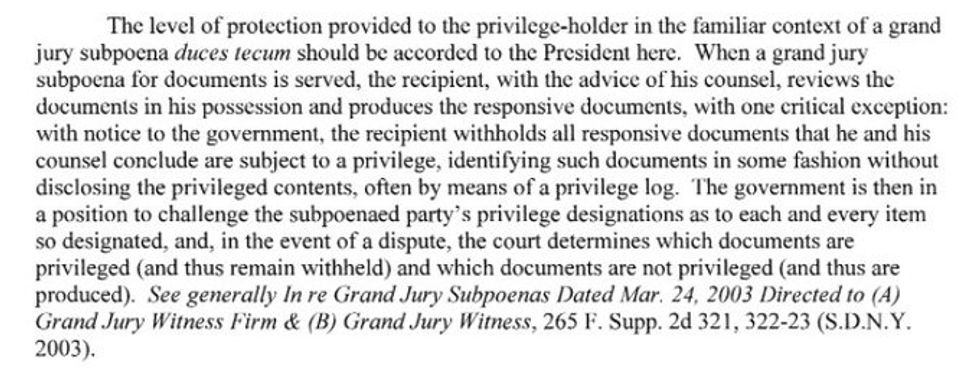
8/ Also note that Trump is not claiming that his legal team will get the last word. He proposes that his team gets the first cut, and tells the government about what has been withheld; the government can challenge Trump's designation, and the court will decide. From the brief: pic.twitter.com/XpVb3mrUEY

View image on Twitter

8/ Also note that Trump is not claiming that his legal team will get the last word. He proposes that his team gets the first cut, and tells the government about what has been withheld; the government can challenge Trump's designation, and the court will decide. From the brief: pic.twitter.com/XpVb3mrUEY

9/ I see that @renato_mariotti is tweeting a thread on the same topic now, too. At least so far (#13) we're on the same page. Renato has more and more recent experience on this than I do, so check out his thread, too, if you've read so far here. https://twitter.com/renato_mariotti/status/985696333234401281 

9/ I see that @renato_mariotti is tweeting a thread on the same topic now, too. At least so far (#13) we're on the same page. Renato has more and more recent experience on this than I do, so check out his thread, too, if you've read so far here. https://twitter.com/renato_mariotti/status/985696333234401281 

10/ One additional thought. It is supremely weird that this filing came not from some random suspect in a random fraud case but from the President of the United States.

Then there was former federal prosecutor and current candidate for Illinois Attorney General Renato Mariotti.

THREAD: What should we make of the filing by Trump’s lawyers demanding that Trump be permitted to review the documents seized by the government and remove any he believes are privileged? https://twitter.com/big_cases/status/985694811184300033 

THREAD: What should we make of the filing by Trump’s lawyers demanding that Trump be permitted to review the documents seized by the government and remove any he believes are privileged? https://twitter.com/big_cases/status/985694811184300033 

1/ The letter linked above was sent by Trump’s lawyers to the judge overseeing Cohen’s challenge to the prosecution’s seizure of documents from Cohen’s office, home, and hotel room pursuant to search warrants signed by a federal judge.

1/ The letter linked above was sent by Trump’s lawyers to the judge overseeing Cohen’s challenge to the prosecution’s seizure of documents from Cohen’s office, home, and hotel room pursuant to search warrants signed by a federal judge.

2/ As a starting point, Cohen’s challenge to the search warrants is extraordinary, and Trump’s intervention into Cohen’s legal action is even more unusual. It’s not clear that Trump has the right to challenge the government’s review of documents seized from Cohen at this stage.

2/ As a starting point, Cohen’s challenge to the search warrants is extraordinary, and Trump’s intervention into Cohen’s legal action is even more unusual. It’s not clear that Trump has the right to challenge the government’s review of documents seized from Cohen at this stage.

3/ Typically when the government executes a search warrant, the government uses a “taint team”—a group of lawyers walled off from the investigators—to deal with privilege issues. Taint teams often aren’t necessary but are required when a lawyer is involved.

3/ Typically when the government executes a search warrant, the government uses a “taint team”—a group of lawyers walled off from the investigators—to deal with privilege issues. Taint teams often aren’t necessary but are required when a lawyer is involved.

4/ Although searches of lawyer’s offices are unusual, there are established Justice Department procedures for handling them. Those procedures typically include using a taint team. On Friday, Cohen objected to using a taint team and asked to review the documents himself.

4/ Although searches of lawyer’s offices are unusual, there are established Justice Department procedures for handling them. Those procedures typically include using a taint team. On Friday, Cohen objected to using a taint team and asked to review the documents himself.

5/ As you can imagine, this was a non-starter for the prosecutors. The reason prosecutors obtained the search warrant is because they convinced a judge that there was good reason to believe Cohen committed a crime and evidence of the crime was in his office, home, and hotel room.

5/ As you can imagine, this was a non-starter for the prosecutors. The reason prosecutors obtained the search warrant is because they convinced a judge that there was good reason to believe Cohen committed a crime and evidence of the crime was in his office, home, and hotel room.

6/ If Cohen had the ability to go through the documents and remove documents he didn’t want the prosecution to see, he could abuse that by removing documents that prove his guilt.

6/ If Cohen had the ability to go through the documents and remove documents he didn’t want the prosecution to see, he could abuse that by removing documents that prove his guilt.

7/ The typical way that prosecutors obtain records in white collar cases is through subpoena, not search warrants. If the prosecutors sent Cohen a subpoena, he *could* have gone through the records on his own and removed some of them.

7/ The typical way that prosecutors obtain records in white collar cases is through subpoena, not search warrants. If the prosecutors sent Cohen a subpoena, he *could* have gone through the records on his own and removed some of them.

8/ Prosecutors typically use that process despite the risk because it’s more efficient and cost-effective for the prosecution. But in this case, they had a reason not to—they believed Cohen would not turn over everything. Using a search warrant takes Cohen out of the process.

8/ Prosecutors typically use that process despite the risk because it’s more efficient and cost-effective for the prosecution. But in this case, they had a reason not to—they believed Cohen would not turn over everything. Using a search warrant takes Cohen out of the process.

9/ That’s why Cohen’s request was so incredible—he was essentially asking the court to transform the search warrant into a subpoena, which doesn’t require the government to prove things to a judge. It is likely to fail. So what about Trump’s filing?

9/ That’s why Cohen’s request was so incredible—he was essentially asking the court to transform the search warrant into a subpoena, which doesn’t require the government to prove things to a judge. It is likely to fail. So what about Trump’s filing?

10/ Trump is essentially asking the judge for the same thing Cohen is—he wants the right to go through Cohen’s documents and pull out ones he believes are privileged. In a way, that’s even more unusual because the documents aren’t his, although he has an interest in them.

10/ Trump is essentially asking the judge for the same thing Cohen is—he wants the right to go through Cohen’s documents and pull out ones he believes are privileged. In a way, that’s even more unusual because the documents aren’t his, although he has an interest in them.

11/ In the letter, Trump’s lawyers cite no law, rule, or legal opinion that grants Trump the right to go through documents seized by the government pursuant to the search warrant. They’re essentially asking the judge to do so based on “fairness.” (The exact word they use.)

11/ In the letter, Trump’s lawyers cite no law, rule, or legal opinion that grants Trump the right to go through documents seized by the government pursuant to the search warrant. They’re essentially asking the judge to do so based on “fairness.” (The exact word they use.)

12/ Even if the judge had the power to do that—I’m not sure she does—I highly doubt she will. One thing she may do is appoint a neutral “special master” to review the documents to determine if they’re privileged. That person would be a “taint team” but appointed by the court.

12/ Even if the judge had the power to do that—I’m not sure she does—I highly doubt she will. One thing she may do is appoint a neutral “special master” to review the documents to determine if they’re privileged. That person would be a “taint team” but appointed by the court.

13/ Appointing a special master is not without precedent, but it wouldn’t get Cohen or Trump much as a practical matter. In a filing on Friday, prosecutors noted that they previously executed other search warrants on Cohen’s email accounts and found that he wasn’t practicing law.

13/ Appointing a special master is not without precedent, but it wouldn’t get Cohen or Trump much as a practical matter. In a filing on Friday, prosecutors noted that they previously executed other search warrants on Cohen’s email accounts and found that he wasn’t practicing law.

14/ Only communications regarding legal advice are privileged, and even those communications can lose their privilege if they’re furthering a crime.

14/ Only communications regarding legal advice are privileged, and even those communications can lose their privilege if they’re furthering a crime.

15/ If recent press reports are correct, the warrants sought communications between Trump and Cohen, which indicates that they were discussing a topic that relates to the crime under investigation by prosecutors.

15/ If recent press reports are correct, the warrants sought communications between Trump and Cohen, which indicates that they were discussing a topic that relates to the crime under investigation by prosecutors.

16/ As a practical matter, a special master won’t make determinations about privilege that will be much different from a “taint team.” Given that these communications were sought by the warrant, I’d expect prosecutors will obtain what they were looking for. /end

Keep reading...Show less

Key Watergate Scandal Figure John Dean Says Nunes Should Go to Prison for ‘Betraying National Security’

A key figure from the Watergate scandal which brought down administration of President Richard Nixon believes that House Intelligence Committee Chairman Devin Nunes (R-CA) should serve time in jail for his “scam” of a memo.

Keep reading...Show less

Don Lemon Cracks Up On Air Watching Republicans Lavish Trump with Praise

CNN's Don Lemon briefly dissolved into laughter as he explained the bizarre show of effusive praise Republicans heaped on President Donald Trump after passing the tax cut bill on Wednesday.

Keep reading...Show less
@2026 - AlterNet Media Inc. All Rights Reserved. - "Poynter" fonts provided by fontsempire.com.