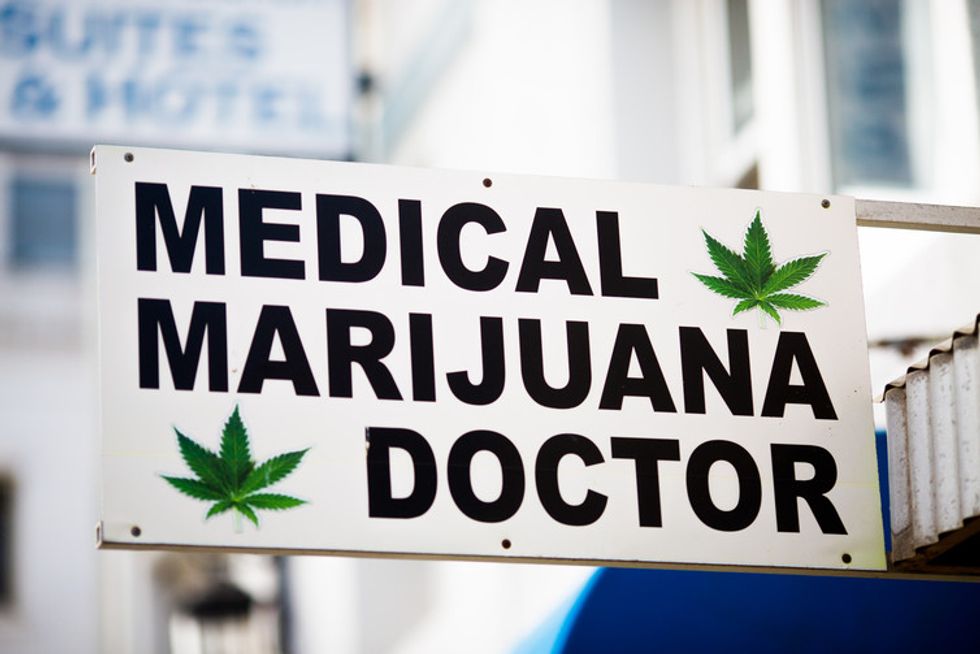
A growing majority of Americans support the legalization of marijuana for personal use, according to a new poll by NBC News/Wall Street Journal.
Sixty percent of those surveyed said adults should have the right to buy marijuana, with even higher levels of support among Democrats and respondents under the age of 35.
The survey results were consistent with another recent poll taken by Pew Research Center earlier this month, which found that 61 percent of Americans back legalization.
Nearly three-quarters of people ages 18 to 34 supported legalization according to the new poll. While support was lower among those ages 35 to 49 and 50 to 64, majorities in both age groups said the substance should be legalized.
The poll showed an increase in support since 2014, when only 55 percent of Americans supported legalization.
The survey results came out days after Vermont became the ninth state to legalize recreational marijuana use for adults ages 21 and older, with a law that will go into effect in July. The state is the first to pass legalization through its legislature rather than a ballot initiative. Maine, Massachusetts, California, Oregon, Washington, Colorado, and Alaska have all decriminalized the substance in recent years.
New Jersey and Michigan are expected to vote on legalization this year, while groups in red states including Oklahoma and Utah are mounting efforts to include medical marijuana use on this year's election ballots.
Thirty states and the District of Columbia currently have laws broadly legalizing marijuana in some form. The herb has been shown to have significant therapeutic value for a wide range of medical conditions, including cancer, Alzheimer’s disease, multiple sclerosis, epilepsy, glaucoma, lung disease, anxiety, muscle spasms, hepatitis C, inflammatory bowel disease and arthritis pain. The community of Americans who rely on legal medical marijuana was estimated to be 2.6 million people in 2016 and includes a variety of mainstream constituency groups like veterans, senior citizens, cancer survivors and parents of epileptic children. Unlike patented pharmaceuticals, which are now the leading cause of death from drug overdose, there have been no recorded deaths from marijuana overdose in the U.S. By comparison, alcohol causes 30,000 deaths annually, and prescription drugs taken as directed are estimated to kill 100,000 Americans per year.
Under federal law, however, marijuana remains a Schedule I controlled substance—a “deadly dangerous drug with no medical use and high potential for abuse”—and its possession remains a punishable offense.
On the presidential campaign trail, Donald Trump said the issue of marijuana legalization should be “up to the states,” continuing the “hands off” policy established under President Obama. Under the 2013 Cole memorandum, the Department of Justice said it would not prosecute individuals and companies complying with robust and well-enforced state legalization programs. But on January 4, Attorney General Jeff Sessions rescinded that memo and gave federal prosecutors the authority to pursue marijuana cases at their own discretion, even in places where the herb is legal under state law. The action has made banks even more afraid to take marijuana cash, which can be prosecuted as money laundering, an offense that can incur stiff criminal penalties.
Money laundering is generally understood to be the practice of taking ill-gotten gains and moving them through a sequence of bank accounts so they ultimately look like the profits from legitimate activity. Institutions, individuals, and even governments who are believed to be aiding and abetting the practice of money laundering can be indicted and convicted, even though they may be completely unaware that the money being transferred with their help was of criminal origin.
The law has focused on banks, but all sorts of businesses accept money without asking where it came from or being required to report “suspicious activity.” As Rahn observes, even governments can be indicted for and convicted of money laundering. Strictly construed (as Sessions insists when interpreting the law), that means the U.S. government itself could be indicted.
In fact, the U.S. government is the largest launderer of marijuana cash in the nation. The IRS accepts this tainted money in the payment of taxes, turning it into “clean” money; and it is not an unwitting accomplice to the crime. Estimates are that marijuana business owners across the U.S. will owe $2.8 billion in taxes to the federal government in 2018.
The government makes a massive profit off the deal, snatching up to 70 percent of the proceeds of the reporting businesses, as opposed to the more typical rate of 30 percent. It does this by branding marijuana businesses criminal enterprises, which are not entitled to deduct their costs when reporting their income.
This is not only a clear case of the unequal protection of the laws but is a clear admission by the government that it is knowingly accepting illegal funds. The government is a principal beneficiary of a business the government itself has made illegal.
Under those circumstances, both marijuana businesses and banks should be able to raise the “unclean hands” defense. As summarized in Kendall-Jackson Winery, Ltd. v. Superior Court (1999):
The defense of unclean hands arises from the maxim, “He who comes into Equity must come with clean hands.” The doctrine demands that a plaintiff act fairly in the matter for which he seeks a remedy. . . . The defense is available in legal as well as equitable actions. . . . The doctrine promotes justice by making a plaintiff answer for his own misconduct in the action. It prevents a wrongdoer from enjoying the fruits of his transgression.
The government is enjoying the fruits of money it considers “dirty.” It has unclean hands and should not be allowed to prosecute others for the same crime.
Should “Money Laundering” Even Be a Crime?
If the government itself is profiting handsomely from this laundered money, the question arises whether money laundering should even be a crime. Rahn thinks it should not. It became a criminal activity in the U.S. only in 1986, and in many countries it still is not a crime. Banks operating in the U.S. must now collect and verify customer-provided information, check names of customers against lists of known or suspected terrorists, determine risk levels posed by customers and report suspicious persons, organizations and transactions. The reporting requirements are so burdensome and expensive that they have caused many smaller banks to sell out to larger banks or close their doors. Moreover, they have not been cost-effective in deterring crime. According to Rahn, in an article titled “Why the War on Money Laundering Should Be Aborted”:
[I]t has failed to produce the advertised results and, in fact, has not been cost effective, has resulted in wholesale violations of individual civil liberties (including privacy rights), has violated the rights of sovereign governments and peoples, has created new opportunities for criminal activity, and has actually lessened our ability to reduce crime. …
Banks are required to supply the government with not only Currency Transaction Reports but also Suspicious Activity Reports. These reports impose huge regulatory costs on banks and require bank employees to operate as police officers. As a result, the total public and private sector costs greatly exceed $10,000,000 per conviction. This whole effort not only does not make any economic sense, but is clearly incompatible with a free society. The anti-money laundering laws allow almost complete prosecutorial discretion.
One small banker complained that banks have been turned into spies secretly reporting to the federal government. If they fail to comply, they can face stiff enforcement actions, whether or not actual money-laundering crimes are alleged. In 2010, one small New Jersey bank pleaded guilty to conspiracy to violate the Bank Secrecy Act and was fined $5 million for failure to file suspicious-activity and cash-transaction reports. Another small New Jersey bank closed its doors after it was hit with $8 million in fines over its inadequate monitoring policies. The cost of compliance and threat of massive fines for not complying have been major factors in the collapse of the community banking sector. The number of community banks has fallen by 40 percent since 1994 and their share of U.S. banking assets has fallen by more than half, from 41 percent to 18 percent.
“Regulation is killing community banks,” Treasury Secretary Stephen Mnuchin said at his confirmation hearing in January 2017. If the process is not reversed, he warned, we could “end up in a world where we have four big banks in this country.” That would be bad for both jobs and the economy. “I think that we all appreciate the engine of growth is with small and medium-sized businesses,” said Mnuchin. “We’re losing the ability for small and medium-sized banks to make good loans to small and medium-sized businesses in the community, where they understand those credit risks better than anybody else.”
If the goal of the anti-money laundering statutes is to identify and deter criminal activity, strictly enforcing the law could actually backfire in the case of state-legalized marijuana businesses. As noted in a Jan. 9 article in The Daily Beast:
Marijuana businesses have to register and incorporate in states and that puts them on the IRS radar. … Sky-high federal taxes on top of state taxes can make it almost impossible to operate a legal business. … If the government fails to cut businesses a break, legal marijuana could be sold on the black market to dodge taxes.
On the black market, cash proceeds can be dispersed in a way that avoids banks and makes the money hard either to trace or to tax.
Federal Law Needs to Change
With more than half the states legalizing marijuana for medical purposes, Congress needs to acknowledge the will of the people and remove this natural herb from the Schedule I classification that says it is a deadly dangerous drug with no health benefits. The Tenth Amendment gives the federal government only those powers specifically enumerated in the Constitution, and regulating medical practice is not one of them. Federal courts have held that the federal Controlled Substances Act does not allow the federal government to usurp states’ exclusive rights (pursuant to their inherent police powers) to regulate the practice of medicine.
H.R. 1227, the Ending Federal Marijuana Prohibition Act, sponsored by Virginia Republican Thomas Garrett and 15 cosponsors, would remove marijuana from Schedule I and eliminate federal penalties for anyone engaged in marijuana activity in a state where it is legal. Congress just needs to pass it.
In its zeal for eliminating burdensome, costly and ineffective regulations, the Trump administration should also consider lightening the heavy reporting burden that is killing community banks and the local businesses that have traditionally relied on them for affordable credit. On Tuesday, a bipartisan coalition of state attorneys general sent a letter to leaders in Congress requesting advancement of legislation such as the Secure and Fair Enforcement (SAFE) Banking Act to “provide a safe harbor” for banks that provide financial products or services to state-legal marijuana businesses. If the government can accept marijuana money in the payment of taxes, banks should be able to accept it, keep track of it and prevent the crimes associated with storing and transporting large sums of cash.
Days after California’s first new adult-use pot shops opened their doors this week, Attorney General Jeff Sessions announced he would allow federal prosecutors to crack down on marijuana operations in states that have legalized marijuana.
His decision overturns an Obama-era Justice Department policy, set in motion by the Cole Memo, that instructed prosecutors to make pot their lowest priority in legal weed states. While the Obama administration’s decision was lauded on both sides of the aisle, the opposite is true of Sessions’ announcement. The backlash so far has been sizeable and bipartisan, splitting the GOP and bolstering Democrats and others who favor legalization.
Speculations abound over how Sessions’ new decision might impact the nascent legal weed industry in California and the thriving, lucrative industries that already exist in the five other states that have legalized pot over the last half decade.
What might this mean for the future of weed in 2018 and beyond? To help sort through this potentially chaotic new territory, we’ve compiled the best observations from experts on some surprising, unintended consequences of Sessions’ announcement.
1. Federal prosecutors might choose to keep their distance from state-legal weed, despite Sessions’ decision.
Tamar Todd, the Drug Policy Alliance’s senior legal affairs director, told the Washington Post it’s not likely U.S. attorneys in legal pot states will start “busting down the doors of marijuana dispensaries” tomorrow. Todd is quoted in the piece explaining how federal attorneys rely on cooperation with state authorities for many drug cases, and that there are plenty of illicit drug operations for them to focus on already.
Todd’s overall message was that it would be unwise on many levels for federal prosecutors to start attacking states’ legal pot industries, and the prosecutors likely know it. Any feds who went after state-legal weed would be isolated, the Post piece notes, because “such a crackdown would produce an outcry from both Democrats and Republicans, in addition to state government and law enforcement officials.”
Colorado’s Democratic governor, John Hickenlooper, also said it’s unlikely Sessions’ decision will send hordes of prosecutors after his state’s incredibly lucrative pot operations—at least not right away.
According to a New York Times piece by Harlie Savage and Jack Healy, Hickenlooper “expressed skepticism that United States attorneys would want to siphon resources from other prosecutions so they could close a marijuana dispensary operating under state regulations.”
Colorado’s Republican Senator Cory Gardner, chair of NRSC, put an ultimatum out to Sessions in response to his pot decision:
“I will be putting a hold on every single nomination from the Department of Justice until Attorney General Jeff Sessions lives up to the commitment he made to me in my pre-confirmation meeting with him. The conversation we had that was specifically about this issue of states’ rights in Colorado. Until he lives up to that commitment, I’ll be holding up all nominations of the Department of Justice,” Gardner said. “The people of Colorado deserve answers. The people of Colorado deserve to be respected.”
2. California will likely join forces with other pro-pot states to stand up for the weed industry.
The states where pot is legal have heavy incentive to protect their pot businesses, because, as the industry has already proven, legalization brings with it staggering tax revenues, cash flow, jobs and other benefits. California alone is set to collect $1 billion in taxes this year via retail cannabis.
California Lt. Gov. Gavin Newsom has vowed to encourage cooperation between states with legal cannabis laws, and said to the New York Times: “This brings states together around issues of freedom, individual liberty, states’ rights... all of the principles that transcend red and blue.”
Newsom said in a separate statement, “Today, Jeff Sessions and the Trump administration destructively doubled down on the failed, costly and racially discriminatory policy of marijuana criminalization, trampling on the will” of voters.
California may be poised to designate itself a “sanctuary state” for pot, following the model of its designation as a sanctuary state for immigrants against deportation. In response to Sessions announcement, Assemblyman Reggie Jones-Sawyer (D-Los Angeles) has redrafted an earlier proposal of Assembly Bill 1578, which would prevent state and local agencies from assisting federal drug enforcement agencies in targeting the state’s cannabis industry without a federal court order.
“The impacts of this ill-conceived and poorly executed war [on marijuana] are still being felt by communities of color across the state. The last time California supported the federal government’s efforts, families were torn apart and critical state resources were used to incarcerate more black and brown people than ever before in the history of our state.”
California State Attorney General Xavier Becerra has been reaching out to the Department of Justice on the issue, and told Sacramento Bee he has not ruled out a lawsuit to “protect the state’s laws.”
“We’ll do whatever we must to make sure that California’s laws are obeyed,” Becerra said.
3. More skittish cannabis investors might pull out, and a pot stock sell-off has already begun. But many cannabis investors are activists for the industry who were there prior to the Cole Memo, and they're not going anywhere.
The cannabis investment firm Poseidon Asset Management was managing investments in pot more than six months before the Cole Memo came out in 2013. Attorney Cristina Buccola, whose practice focuses on the pot industry, says in a Forbes article that Sessions’ memo has not impacted her clients. “This is not causing [investors] to turn away from these investment opportunities,” she told Forbes. “None of the projects have been put on pause.”
Forbes also quotes an email from Ryan Ansin—a cannabis investor, president of the Family Office Association and managing director of Revolutionary Clinics—noting that Sessions’ memo doesn’t impact the laws. Pot was already federally illegal, and continues to be federally illegal, “and informed investors know that,” Ansin says.
4. The political, economic and social effect of Sessions' decision might boost the Dems and tip the scales in Congress to legalize pot at the federal level.
A growing majority of Americans think pot should be legal in some form; 61 percent think it should be legal for adult use, according to the most recent Pew Research Center polling, out this week.
Even Republicans hate Sessions’ pot announcement, and the GOP is split apart in its wake. This is one of many reasons Paul Waldman gives in his Washington Post article, “Why Jeff Sessions’s marijuana crackdown is going to make legalization more likely," arguing that the backlash to Sessions’ decision could spell doom for Republicans and prohibitionists. "A backlash could help more Democrats get elected, and push elected Democrats to more unambiguously support legalization,” he writes.
Public opinion is so far away from backing Sessions and the Trump administration’s attempt at reversing marijuana legalization progress that Republicans are in an “awkward position,” Waldman notes. Many have "released outraged statements condemning the decision, but it might not be enough to persuade voters not to punish President Trump by voting them out. ”
In Politico, James Higdon quotes California Republican Dana Rohrabacher in a conference call with five members of the Congressional Cannabis Caucus, arguing that the Sessions announcement is likely to have an inverse effect of turning a states issue into a national priority.
“It’s a big plus for our efforts that the federal government is now aware that our constituents have been alerted,” Rohrabacher said. "We can be confident we can win this fight, because this is a freedom issue.”
Because of its illegal status over the past 80 years, the controversial cannabis plant has taken on a number of names. But where did these marijuana slang terms come from?
Reefer
As many will attest, cannabis stokes the imagination. It generates revelations and epiphanies. We see things differently. On sailing ships, the act of reefing a sail reduces the sail’s area by folding or rolling one edge of the canvas in on itself; a “reefer” is the sailor who rolls it. Apparently, a reefed sail resembles a joint. But there’s also evidence that the Spanish slang word grifo had some influence on the rise of the word “reefer.” Grifo has a few different meanings including “curly-haired,” “tap” and “spigot.” It’s unclear, but in the 1920s, somehow it gained popularity as a derogatory term for a cannabis user and became a common adjective to describe inebriation.
Marijuana
It’s the most common term for cannabis—and pretty much everyone believes it means “maryjane” in Spanish, with roots in Old Mexico. But not so fast. Certainly it was popular slang used by Mexican immigrants at the beginning of the 20th century, but many etymologists believe the origins of “marijuana” spring from Chinses: ma ren hua means “hemp seed flower.” There’s also speculation that the word is derived from Hebrew and Arabic languages; marjoram, the aromatic spice, could be related to the word, as well as “mejorana,” a Spanish word for marjoram. History suggests that anti-cannabis politicians and bureaucrats latched on to “marijuana,” in order to demonize the plant with racial overtones, claiming that Mexicans and blacks would be preying upon white women in a marijuana-induced frenzy. To that end, cannabis was criminalized in 1937 via the Marijuana Tax Act of 1937.
Although it’s a widely used term for cannabis, many activists and advocates dislike the word “pot” because it connotes a stoner sensibility. To be sure, you’ll rarely hear Tommy Chong refer to cannabis as anything else! But how did pot come to be known as “pot?” Its etymological roots aren’t hard to trace. Potación de guaya, a Spanish term, is a wine or brandy in which cannabis leaves or buds have been steeped. Literally, it means “drink of grief.” The concoction predates cannabis prohibition, giving credence to the fact that the plant has been used traditionally as medicine for eons. Over the years, its name contracted to “potiguaya.” Then in the 1930s, it was shortened to “pot,” further fueling the racializing of cannabis use.
Dope
Not widely used any longer as a term for cannabis, primarily because it’s also a common term for heroin. “Dope,” in fact, has been commonly used to describe drugs en masse. Illegal drugs like meth, opium, cocaine, cannabis and heroin have all been placed under the “dope” umbrella. The word springs from the Dutch word doop, which means a thick sauce. It wasn’t too far a leap to call a thickheaded individual a doop. It gained popularity as a drug-oriented term in the late 1800s, a word to describe the act of smoking a semi-liquid opium preparation.
Ganja
Ask most people and they’ll tell you “ganja” is the Jamaican word for cannabis. (Um, Jamaican isn’t a language.) Without a doubt, ganja is inextricably attached to Jamaica, but the word’s roots are from the Hindi term for cannabis—ganjha. But how did the term travel to Jamaica? In 1833, Britain outlawed slavery but it still needed laborers for its massive plantations in the Caribbean. The British Empire shipped 40,000 indentured laborers from India to Jamaica between 1845 and 1917. As Indian and Jamaican cultures merged, “ganja” became the common term for the cannabis that the field workers smoked. Today, smoking ganja is a central component of the Rastafarian religion.
During the 1960s and 1970s, the term “grass” was in vogue. It seems quaint now, a word that hearkens back to the days of hippies and flower power. Widespread use of the term was no doubt fueled by its appearance. Most of the cannabis available then was green and of lesser quality, often resembling lawn clippings. But it’s important to know that cannabis is mentioned in the Hindu sacred text Atharvaveda(Science of Charms) as “sacred grass,” one of the five sacred plants of India. Sacred grass is used both medicinally and ritually as an offering to Shiva.
Cheeba
Unfortunately, this innocent-sounding word carries some serious baggage. Chiva is Spanish slang for heroin. Literally it can mean “beard’ or a “young female goat.” But on the streets of the inner city, “cheeba” became the name for black tar heroin. Perhaps, “cheeba” gained popularity as cannabis slang as growers upped the quality of their product and buds became stick and gooier.
Mota
This one’s a puzzler, because mota in Spanish means a tiny bit or a speck of dust. Spaniards in the 18thcentury referred to the fuzz residue left behind from making linen as “mota.” How mota became a widely used term for cannabis by the late 1800s is a mystery. Regardless, a mota smoker can be called a “moto” or “motorolo.”
In the West Side Story song “Gee, Officer Krupke,” the Sharks, one of the rival street gangs, sing: “My daddy beats my mommy, my mommy clobbers me, my grandpa is a commie, my grandma pushes tea, my sister wears a mustache, my brother wears a dress… goodness gracious that’s why I’m a mess!” You probably understood everything in the lyrics but “my grandma pushes tea.” “Pushing tea” is slang for pot dealing. Tea, of course, is the pot itself. Why “tea?” Once again, cannabis has long used for poultices and medicinal beverages in folk medicine. The plant is steeped in hot water, just like tea—ergo this archaic term, which was coined in the 1930s.
Weed
Just one more inaccurate term for the cannabis plant spawned by generations who didn’t understand its benefits. “Weed” is defined as a wild plant growing where it is not wanted and in competition with cultivated plants. How could a term for cannabis be so off the mark? Cannabis is definitely “wanted” and if it’s “in competition with cultivated plants,” it’s winning hands down, now the most valuable cash crop in modern America.
A local Colorado NBC-affiliated news station recently ran a misleading story with the headline, “Colorado doctors claim first marijuana overdose death.” In reality, experts have drawn no scientific link or otherwise solid correlation between cannabis and the death in question.
The story is based on a recent case report on the death of an 11-month-old who experienced a seizure and myocarditis, or inflammation of the heart muscle. While the baby was exposed to cannabis prior to death, and had "cannabis toxicity," according to the case study, there is no further connection—no cause-and-effect scenario—to speak of. The researchers said they found no other cause for the death, and recommend further investigation.
Noah Kaufman, a Northern Colorado emergency room physician, told the Washington Post that the claims of death due to marijuana overdose are "not based on reality. It’s based on somebody kind of jumping the gun and making a conclusion, and scientifically you can’t do that.”
The Washington Post reports that Thomas Nappe, the co-author of the case study, said, “We are absolutely not saying that marijuana killed that child.” Nappe is the director of medical toxicology at St. Luke’s University Health Network in Bethlehem, Pa. As the Post notes in a recent story about the case study in question, “[Nappe] explained that the doctors simply observed this unusual sequence of events, documented it and alerted the medical community that it is worth studying a possible relationship between cannabis and the child’s cause of death.”
The Post also notes that the observation was not part of a scientific study or research report, but a case study, which is not enough evidence to establish a causal relationship.
The case study report states that the baby’s parents admitted to drug possession and lived in an “unstable motel-living situation.” The baby’s death occurred following exposure to cannabis, though thus far there is no direct evidence to link the baby’s death to ingesting cannabis.
Experts and lawmakers agree that every possible effort should be made to avoid childhood exposure to cannabis and that cannabis should be kept out of reach of children (unless they are prescribed it for medical reasons).
If further investigation reveal the baby's heart failure stemmed from cannabis ingestion, it would be a one-off incident, and “very unusual” as Keith Humphreys, a Stanford University psychiatry professor who served as a senior policy adviser at the White House Office of National Drug Control Policy during the Obama administration, said to the Washington Post.
According to the U.S. Drug Enforcement Administration, there has never been an overdose death from cannabis. One researcher found that in order to fatally overdose on cannabis, an adult would have to consume 1,500 pounds of it in 15 minutes—an amount that is physically impossible, as author David Schmader notes in his book "Weed: The User's Guide").
Several other news channels have picked up the story, erroneously calling it the “first marijuana overdose.”
Move over, Napa Valley, there's a new kid on the block. When it comes to spending on mind-altering substances, Americans and Canadians are shelling out just about as much for weed as they do for wine.
In its executive summary of a yet-to-be-released report, Arcview Marijuana Research pegs the size of the North American marijuana market—legal and illegal—at $53.3 billion, which puts it roughly even with the market in wine. According to Statista, US retail wines sales sit at $55.8 billion, and Canadian government figures put sales there at $3.2 billion.
Weed has not yet overtaken wine, but it's damned close. And this is happening in a marijuana market that is still mostly illegal. Yes, Canada will legalize marijuana, but it hasn't done so yet. And yes, more than half the states allow medical marijuana and eight of them have legalized it for adults, but illegal sales still account for 87% of the market, according to Arcview.
For Arcview CEO Troy Dayton, the huge illegal market is not a bane, but a boon.
"The enormous amount of existing, if illicit, consumer spending sets cannabis apart from most other major consumer-market investment opportunities throughout history," he explained. "In contrast to comparable markets with fast growth from zero to tens of billions in recent decades such as organic foods, home video, mobile, or the internet, the cannabis industry doesn’t need to create demand for a new product or innovation - it just needs to move demand for an already widely-popular product into legal channels."
As the adult use markets in the newest legal US states (California, Maine, Massachusetts, and Nevada) and Canada are established, Arcview predicts the illegal market's share of total sales to decline. The legal market should grow from $6.9 billion last year to $21.6 billion by 2021. But even then, Arcview says, the black market will still account for two-thirds of all sales.
That's because black market operators in states that have not legalized even medical marijuana, not to mention recreational weed, will continue to thrive on an "illegality premium" or "prohibition tax" built into black market prices with no competition from legal operators.
The marijuana market is huge, and it's not going away—despite what happens in Washington, DC. That's something to ponder as you sip your Chablis.
In the last week we’ve heard from NBA legend Phil Jackson and Golden State Warriors head coach Steve Kerr talking about their own marijuana use and how they think professional sports leagues like the NBA and NFL should change their marijuana policies.
Marijuana should not be a banned substance in professional sports.
Marijuana is legal for medical use in 28 states and recreational use in 8 states plus Washington D.C., yet it is a banned substance in most professional sports and athletes are not allowed to use it. It is time for the sports world to catch up with the times and adopt more rational marijuana policies.
The National Football League (NFL) is the clearest example of a backwards marijuana policy. The NFL ignores the medicinal benefits of marijuana, most notably its ability to treat chronic pain, and that comes with the territory of being a professional football player.
Instead, prescription opioid painkillers are the preferred treatment method. Former Pro-Bowler Calvin Johnson spent nine years on the Detroit Lions and said painkillers were handed out “like candy.” Retired players like Jim McMahon and others have talked about developing an addiction to those medications. NBA All-Star Blake Griffin supports medical marijuana specifically because “many guys would probably benefit from it and not take as many painkillers, which have worse long-term effects.”
If people are suffering from chronic pain, using marijuana with painkillers can help reduce the amount of painkillers needed, and in some cases people have been able to completely replace their use of painkillers with marijuana. Overdose is an issue being discussed across the country right now and a 2014 study showed that opiate overdoses decreased by a nearly 25 percent average in states that have implemented medical marijuana laws compared to states that have not.
The NFL is also dealing with a concussion crisis — many players are retiring earlyand some people are choosing not to play football at all because of the consequences that can come later in life after having too many head injuries. The non-psychoactive part of marijuana known as CBD has the potential to treatand even prevent concussions. The NFL should set an example by investing in marijuana research to see how it can help improve the health of its players.
Former Super Bowl champions Marvin Washington, Scott Fujita and Brendon Ayanbadejo helped start a conversation two years ago calling on the NFL to incorporate medical marijuana in their strategy for treating and preventing concussions. Eugene Monroe continued the debate earlier this year when he became the first current player to call on the NFL to look at the benefits of medical marijuana. He has since been joined by Derrick Morgan.
Last month Buffalo Bills offensive lineman Seantrel Henderson was suspended for 10 games because he uses marijuana to treat Crohn’s disease, which is a qualifying condition under New York’s medical marijuana program. Athletes should not be treated differently when it comes to marijuana — they should be able to use it in places where it is legal.
Earlier this year, NBA veteran Al Harrington came out in strong support of California’s Prop. 64 to legalize marijuana — not only because he thinks it should be legal, but because he sees marijuana legalization and drug policy reform as a racial equity issue. He said, “I’ve been in the marijuana-industry space for the last five years, and I’ve seen that it’s a predominately white space. And minorities, we’re the ones that are locked up behind it.”
Attitudes about marijuana are changing rapidly; 60 percent of Americans are in favor of legalizing it. Athletes and sports leagues in general have a large influence on our culture, and if these leagues change their marijuana policies they can make a big impact to help change the way people think about marijuana (and the people who use it).
It’s time for all professional sports leagues to do the socially responsible thing: stop using the playbook and rhetoric from the failed drug war and create more fair marijuana policies.
On Election Day, my home state of California voted to legalize recreational cannabis, as did Massachusetts, Maine and Nevada. So the 2016 elections represented a substantial victory for the legalization movement, which has managed to pass referendums in seven states. With 57 percent of the country now supporting marijuana legalization, according to Pew, it seems likely there will be a nationwide victory sometime in the next few years. However, the War on Drugs is far from over.
Even if marijuana is legalized throughout the United States, there will still be numerous drugs in this country that remain very much illegal, and Americans will suffer because of this. Drugs like psilocybin mushrooms, LSD and MDMA have all demonstrated great potential when it comes to medical benefits, and shown little potential for harm. Still, the idea of legalizing those drugs any time soon seems as likely as Donald Trump hosting a quinceañera.
“LSD, psilocybin and MDMA, when combined with psychotherapy, have tremendous medical potential for treating psychiatric illnesses in people for whom other treatments have failed,” Rick Doblin, founder and executive director of the Multidisciplinary Association for Psychedelic Studies (MAPS), told me in an email. “These psychedelic drugs need to be legalized, both through scientific drug development studies designed to obtain FDA approval for prescription use and through political means so that they are legalized for non-medical purposes like personal growth, spirituality, couples therapy, creativity, innovation, and celebratory experiences.”
Researchers in Switzerland found in 2014 that LSD can be helpful for patients dealing with end-of-life anxiety related to a terminal illness. The same sort of conclusion has been drawn for psilocybin. Psilocybin has also proven useful for treating severe depression. MDMA has shown great promise for treating PTSD, when used alongside psychotherapy. All of the drugs remain illegal in the United States, and there has been little effort to change that.
Let’s not stop there, though. The War on Drugs has cost America well over $1 trillionsince it began under Richard Nixon. This war has been the main cause of our country’s mass incarceration problem. As it is often noted, we have 5 percent of the world’s population and roughly 25 percent of its prisoners. You cannot have a War on Drugs, you can only have a war on people. As Gore Vidal famously used to say of the War on Terror, you cannot have a war on a noun, as that is like saying you’re at war with dandruff. Too many can’t get jobs because of criminal records or lose decades of their lives over small offenses.
We must legalize all drugs. You cannot regulate a drug that is not legal, and you cannot stop addiction by throwing citizens in cages and putting in no effort to rehabilitate them. I am not arguing for the selling of meth and heroin at your local Target store, but I am arguing for a scenario where you are not put in cuffs for having one of those drugs in your pocket.
Portugal decriminalized all drugs nearly decades ago, and the country has not spiraled into hellfire and cannibalism. In fact, drug use decreased, drug-related deaths went down and the instances of HIV infections decreased severely. Of course, the country also initiated harm-reduction programs and invested in reducing addiction, but it appears decriminalizing the drugs didn’t turn every corner into a wanton cocaine party. Perhaps we could learn from this example.
Thanks to abuse of prescription painkillers, this country faces a widespread opioid crisis — and all those drugs are legal. While we divvied out legal pills that people didn’t really need to fill the pockets of greedheads, as Hunter S. Thompson called them, we locked up people using a different version of the same drugs. Many who got addicted to painkillers while on prescription turned to heroin when they couldn’t be prescribed them any more or couldn’t afford them. The whole system is toxic.
I’m calling for a true legalization movement. No longer should lives be ruined because of some minor drug experimentation or because a citizen who needed to make an extra buck sold some substances to a willing buyer. The legalization of marijuana will be a milestone, especially since it’s the most popular drug out there, but we cannot stop there. We should murder the War on Drugs and burn its cadaver. This “war” has been one of the biggest policy failures in American history, and we’ve known this for quite some time. Let’s grow up and move forward. We cannot call ourselves the land of the free when we represent the land of the detained.
This is a call to action to mothers across California to use your moral authority to speak out to end a broken system of marijuana prohibition that has been tearing our families apart for far too many decades.
It may seem counter-intuitive that responsible mothers are promoting marijuana legalization, but it is, indeed, for the sake of our children and future generations.
Proposition 64 will put an end to a criminal justice response to cannabis that has led to mass incarceration of non-violent drug offenders. Every year there are over 8,800 felony marijuana arrests in California. The war on drugs has not only failed, but it is decimating families across all social and cultural spectrums.
I’m not pro marijuana, but I am against a system that criminalizes young people, thus disrupting and destroying lives and saddling them with the lifelong exclusionary consequences of a felony drug conviction.
Currently marijuana is widely accessible to our kids in all neighborhoods. And, our drug laws are disproportionately harming black and Hispanic communities. Proposition 64 will prevent the destruction of thousands of California families.
Mothers, please don’t be swayed by the scare tactics of the criminal justice system, which has a financial stake in keeping people behind bars. Unfortunately, when in doubt, parents often remain silent, but we can’t afford to accept the status quo any longer. Our children’s futures are at stake.
By voting in favor of legalization and regulation you are in good company with a broad ranged coalition of supporters including many law enforcement officers, more than 50 physicians and the California Medical Association.
Prop 64 is called the Adult Use of Marijuana Act because it allows adults over 21 to use marijuana responsibly while providing strong safeguards to protect our youth. It also protects children under 18 from arrest for marijuana violations, so that a youthful mistake doesn’t become a pipeline to prison.
As a mother whose son spent 11 years of his young life cycling in and out of prison for marijuana possession, I know first-hand the hardships that these punitive prohibitionist policies create for both the individual and their families. One of the most significant parts of Prop 64 is that it allows people like my son to reclassify past marijuana convictions on their records. It is a historic opportunity for reparation.
Punitive and senseless drug policies have resulted in mass arrests and a shocking number of children who are robbed of mothers and fathers. As moms, we need to be sure that our communities don’t continue to suffer these tragedies. Prop 64 will allow law enforcement to use their resources to protect our communities from real crimes. And, tax revenues will be dedicated to youth drug prevention, education and after-school programs.
Today the easiest drug for teens to obtain is marijuana, because drug dealers don’t ask for IDs. Prop 64 will provide a much-needed comprehensive system of regulation and control. It will reduce youth access by banning marijuana advertising to minors and near schools. It has strict requirements for packaging and labeling. Four states have already legalized marijuana and the sky didn’t fall. In fact the latest data indicates that teen drug use is slightly down in Colorado.
Ask yourself: Do you think your family, community and country would be better off if we reinstated prohibition of alcohol, making its use criminal as it was in the 1920’s, rather than a regulated, taxed and legally used substance as it is today? And, marijuana is actually a safer substance than alcohol in most respects.
The tide is turning on the drug war, because people are speaking out to demand human rights. Five states have legalization measures on their ballots in 2016. It isn’t a matter of “if” we will end the war on marijuana or “when.” I believe the time is now, because we can’t afford to lose any more lives and liberties.
Moms…take back your power. Vote for change and right these disastrous wrongs. Vote Yes on 64!
We have no political position on cannabis legalization. We study the cannabis plant, also known as marijuana, and its related chemical compounds. Despite claims that cannabis or its extracts relieve all sorts of maladies, the research has been sparse and the results mixed. At the moment, we just don’t know enough about cannabis or its elements to judge how effective it is as a medicine.
What does the available research suggest about medical cannabis, and why do we know so little about it?
While some researchers are investigating smoked or vaporized cannabis most are looking at specific cannabis compounds, called cannabinoids.
From a research standpoint, cannabis is considered a “dirty” drug because it contains hundreds of compounds with poorly understood effects. That’s why researchers tend to focus on just one cannabinoid at a time. Only two plant-based cannabinoids, THC and cannabidiol, have been studied extensively, but there could be others with medical benefits that we don’t know about yet.
THC is the main active component of cannabis. It activates cannabinoid receptors in the brain, causing the “high” associated with cannabis, as well as in the liver, and other parts of the body. The only FDA-approved cannabinoids that doctors can legally prescribe are both lab produced drugs similar to THC. They are prescribed to increase appetite and prevent wasting caused by cancer or AIDS.
Cannabidiol (also called CBD), on the other hand, doesn’t interact with cannabinoid receptors. It doesn’t cause a high. Seventeen states have passed lawsallowing access to CBD for people with certain medical conditions.
Our bodies also produce cannabinoids, called endocannabinoids. Researchers are creating new drugs that alter their function, to better understand how cannabinoid receptors work. The goal of these studies is to discover treatments that can use the body’s own cannabinoids to treat conditions such as chronic pain and epilepsy, instead of using cannabis itself.
Cannabis is promoted as a treatment for many medical conditions. We’ll take a look at two, chronic pain and epilepsy, to illustrate what we actually know about its medical benefits.
Is it a chronic pain treatment?
Research suggests that some people with chronic pain self-medicate with cannabis. However, there is limited human research on whether cannabis or cannabinoids effectively reduce chronic pain.
Research in people suggest that certain conditions, such as chronic pain caused by nerve injury, may respond to smoked or vaporized cannabis, as well as an FDA-approved THC drug. But, most of these studies rely on subjective self-reported pain ratings, a significant limitation. Only a few controlled clinical trials have been run, so we can’t yet conclude whether cannabis is an effective pain treatment.
An alternative research approach focuses on drug combination therapies, where an experimental cannabinoid drug is combined with an existing drug. For instance, a recent study in mice combined a low dose of a THC-like drug with an aspirin-like drug. The combination blocked nerve-related pain better than either drug alone.
In theory, the advantage to combination drug therapies is that less of each drug is needed, and side effects are reduced. In addition, some people may respond better to one drug ingredient than the other, so the drug combination may work for more people. Similar studies have not yet been run in people.
Well-designed epilepsy studies are badly needed
Despite some sensational news stories and widespread speculation on the internet, the use of cannabis to reduce epileptic seizures is supported more by research in rodents than in people.
In people the evidence is much less clear. There are many anecdotes and surveys about the positive effects of cannabis flowers or extracts for treating epilepsy. But these aren’t the same thing as well-controlled clinical trials, which can tell us which types of seizure, if any, respond positively to cannabinoids and give us stronger predictions about how most people respond.
While CBD has gained interest as a potential treatment for seizures in people, the physiological link between the two is unknown. As with chronic pain, the few clinical studies have been done included very few patients. Studies of larger groups of people can tell us whether only some patients respond positively to CBD.
We also need to know more about the cannabinoid receptors in the brain and body, what systems they regulate, and how they could be influenced by CBD. For instance, CBD may interact with anti-epileptic drugs in ways we are still learning about. It may also have different effects in a developing brain than in an adult brain. Caution is particularly urged when seeking to medicate children with CBD or cannabis products.
A jar of medical marijuana.David McNew/Reuters
Cannabis research is hard
Well-designed studies are the most effective way for us to understand what medical benefits cannabis may have. But research on cannabis or cannabinoids is particularly difficult.
In order to study cannabis, a researcher must first request permission at the state and federal level. This is followed by a lengthy federal review process involving inspections to ensure high security and detailed record-keeping.
In our labs, even the very small amounts of cannabinoids we need to conduct research in mice are highly scrutinized. This regulatory burden discourages many researchers.
Designing studies can also be a challenge. Many are based on users’ memories of their symptoms and how much cannabis they use. Bias is a limitation of any study that includes self-reports. Furthermore, laboratory-based studies usually include only moderate to heavy users, who are likely to have formed some tolerance to marijuana’s effects and may not reflect the general population. These studies are also limited by using whole cannabis, which contains many cannabinoids, most of which are poorly understood.
Placebo trials can be a challenge because the euphoria associated with cannabis makes it easy to identify, especially at high THC doses. People know when they are high.
Another type of bias, called expectancy bias, is a particular issue with cannabis research. This is the idea that we tend to experience what we expect, based on our previous knowledge. For example, people report feeling more alert after drinking what they are told is regular coffee, even if it is actually decaffeinated. Similarly, research participants may report pain relief after ingesting cannabis, because they believe that cannabis relieves pain.
The best way to overcome expectancy effects is with a balanced placebo design, in which participants are told that they are taking a placebo or varying cannabis dose, regardless of what they actually receive.
Studies should also include objective, biological measures, such as blood levels of THC or CBD, or physiological and sensory measures routinely used in other areas of biomedical research. At the moment, few do this, prioritizing self-reported measures instead.
Cannabis isn’t without risks
Abuse potential is a concern with any drug that affects the brain, and cannabinoids are no exception. Cannabis is somewhat similar to tobacco, in that some people have great difficulty quitting. And like tobacco, cannabis is a natural product that has been selectively bred to have strong effects on the brain and is not without risk.
Although many cannabis users are able to stop using the drug without problem, 2-6 percent of users have difficulty quitting. Repeated use, despite the desire to decrease or stop using, is known as cannabis use disorder.
As more states more states pass medical cannabis or recreational cannabis laws, the number of people with some degree of cannabis use disorder is also likely to increase.
It is too soon to say for certain that the potential benefits of cannabis outweigh the risks. But with restrictions to cannabis (and cannabidiol) loosening at the state level, research is badly needed to get the facts in order.
Gary Johnson does not anticipate a 2020 presidential run, the Libertarian candidate revealed on "Jimmy Kimmel Live" Wednesday night when asked by "undecided voter" Ken Bone.
And even though Johnson is currently leading among active military personel, he's far from breaking apart the two party system.
"I feel like your message would resonate a lot more if you were rolling a joint while you said these things," Jimmy Kimmel told the Libertarian. Johnson admitted he hadn't rolled a joint in "probably 20 years."
"It's like riding a bike," Kimmel told him. "You just rode 70 miles."
"90 actually," Johnson corrected the host. He then explained his ingenious fundraising idea.
"Anyway, I thought when I was running for President in 2012, I thought that everyone that smoked marijuana, 100 million Americans plus, would give me a dollar. And it didn't work out at all, so I gotta tell you this is a dead end right here."
"They were too lazy to send you money," Kimmel pointed out.
"That or they're not political. They don't get out and vote," Johnson mused.
Kimmel aked if there were any exciting fringe benefits to Johnson's candidacy.
"Do people bring you weed at your events?" Kimmel asked.
"They do," Johnson told him.
"I've been on the chair lift in Taos, skiing is my passion," Johnson said. "I've been on the chair lift and a guy looks over [and says] 'man you look like Gary Johnson.' I said 'Oh, I get that all the time' and he goes, "Yeah, Gary's a lot bigger than you are... [but if] you are Gary Johnson I'd be so honored if you'd smoke some reefer with me."