During a Los Angeles press conference on Thursday, personnel accompanying Homeland Security Secretary Kristi Noem tackled and arrested Sen. Alex Padilla (D-Calif.) as he attempted to ask a question.
Fox News national correspondent Bill Melugin tweeted the video of the confrontation, in which Padilla attempts to talk up to Noem as she's speaking. Several men immediately swarmed Padilla and attempted to drag him out of the room, despite him identifying himself as a U.S. senator.
"I'm Senator Alex Padilla. I have questions for the secretary," Padilla said before he was dragged out of the room. "Because the fact of the matter is — hands off!"
Padilla's staff also posted video of Padilla being thrown to the ground in the hallway with several officers kneeling on him while cuffing his hands behind his back. It remains unknown whether any formal charges will be filed against him.
Reactions were indignant on social media, with both elected officials and commentators condemning the treatment of Padilla at the hands of law enforcement. Former CNN reporter John Harwood tweeted that he was no longer shocked at seeing actions like the tackling of Padilla, declaring that "we are living under corrupt authoritarian thugs." Bulwark podcaster Tim Miller wrote: "Who do these goons think they are? This is a press conference in a free country. It’s not a police state yet. Get your hands off our elected officials."
"I cannot get over this: a United States Senator at a PUBLIC press conference in HIS HOME CITY was brutalized by people employed by our own government," tweeted Matt Norambuena, who is deputy press secretary for Sen. Jacky Rosen (D-Nev.) "Fascism off the charts."
Actor John Cusack asked his followers if they've "had enough yet" after pointing out that "homeland security goons manhandle[d]" a sitting United States senator. Rep. Mark Takano (D-Calif.) opined that the Trump administration "cannot handle dissent of any kind," and that "they will rough up citizens, protesters, even U.S. senators."
Nearly a dozen former Republican members of the House of Representatives and U.S. Senate are now publicly speaking out against the arrest of Rep. Lamonica McIver (D-N.J.) at an Immigration and Customs Enforcement (ICE) facility.
USA TODAY reported Thursday that the 11 Republicans issued a statement defending McIver, who they argued was simply doing her job as an elected official conducting oversight of a federal facility in her district before she was arrested. They also called on other Republicans to join them in condemning President Donald Trump's administration over its indictment of McIver. Interim U.S. Attorney Alina Habba, who was Trump's personal attorney for his New York civil cases, charged McIver with two felonies after she was part of a scuffle outside of Delaney Hall in Newark, New Jersey.
"The constitutional duties of Members of Congress include not only passing legislation but also oversight of executive branch implementation of those laws. That is an essential dimension of American checks and balances," the group said in a joint statement exclusively provided to USA TODAY. "Rep. Mclver was present at the ICE facility as part of her official congressional duties. We believe this extreme response to the events of that day is unwarranted.”
“This behavior by the Trump administration is outrageous,” former Rep. Claudine Schneider (R-R.I.) told USA TODAY. “Every member of Congress, both past and present, should be speaking up. If not, we will very soon lose our ability to do so.”
The signatories of the statement include former Reps. Barbara Comstock (R-Va.), Mickey Edwards (R-Okla.), David Emery (R-Maine), Wayne Gilchrest (R-Md.), Denver Riggleman (R-Va.), Christopher Shays (R-Conn.), Peter Smith (R-Vt.), David Trott (R-Mich.) and Joe Walsh (R-Ill.) Former Sen. Gordon Humphrey (R-N.H.) also signed on.
Both McIver and Newark mayor Ras Baraka were arrested outside Delaney Hall, though the Trump administration ultimately dropped its charges against Baraka. Reps. Bonnie Watson Coleman (D-N.J.) and Robert Menendez (D-N.J.) were also present at the time of the scuffle that led to McIver's arrest, though they were not charged.
So far, no current House Republicans have spoken out against McIver's arrest. Rep. Nancy Mace (R-S.C.) introduced a resolution to expel McIver from Congress, though it is not expected to pass.
New York University law professor Ryan Goodman says he sees two big flaws in the federal charges against Milwaukee County Circuit Judge Hannah Dugan for obstruction and concealing an individual from arrest.
FBI Director Kash Patel said on X in a Friday morning post: “We believe Judge Dugan intentionally misdirected federal agents away from the subject to be arrested in her courthouse, Eduardo Flores-Ruiz, allowing the subject — an illegal alien — to evade arrest.”
“Thankfully our agents chased down the perp on foot and he’s been in custody since, but the Judge’s obstruction created increased danger to the public,” Patel added before deleting the post (he eventually reposted it later on Friday).
Attorney General Pam Bondi immediately went on Fox News on Friday, calling Dugan and a second New Mexico judge who resigned after the arrest of an alleged gang member in his home, “deranged.”
“I think some of these judges think they are beyond and above the law," Bondi said. “And they are not.”
“The affidavit itself said that at a certain point the court deputy tells two federal agents ‘you need to leave the courtroom’ and they agree to do that,” said Goodman, a former Special Counsel at the Department of Defense. “The entire thing is tainted … because they’re inside her courtroom. They’re not supposed to be there. That’s one piece of it.”
But the second issue is the affidavit’s claim that Dugan acted to conceal Eduardo Flores-Ruiz when she sent him through the court’s jury exit and into the hall with agents.
“The affidavit itself says what happens to the man when he goes through the jury door. Where does he end up? According to the affidavit he enters a public hallway. How do we know this, because two DEA agents observe him there. And then where does he go? Into the elevator. Who’s in the elevator with him? One of the agents,” argues Goodman.
"It just doesn’t seem like a case that’s going to hold up, that you would charge somebody … for concealment. It seems like they were able to pick him up," he added.
On Friday, FBI agents arrested Milwaukee County, Wisconsin Circuit Court Judge Hannah Dugan, who was charged with two federal felonies. One former judge is now calling the arrest an "escalation" of President Donald Trump's war on the judiciary.
According to the Milwaukee Journal-Sentinel, Dugan's arrest was first announced by FBI Director Kash Patel on social media before he deleted the post. The Trump administration is accusing the judge of "harboring" undocumented immigrant Eduardo Flores Ruiz, who was facing deportation, and for obstructing federal immigration enforcement. Ruiz was eventually arrested by federal agents after they chased him through an alley.
In a segment with CNN host Boris Sanchez, retired New York State Supreme Court Justice Diane Kiesel opined that the administration's decision to arrest Dugan was heavy-handed and that there were "other methods" they could have pursued.
"20 years ago in New York, a judge interfered with an arrest, and she got removed from the bench. The Justice Department could have complained to the Wisconsin State Commission on Judicial Conduct and said this woman overstepped her bounds," Kiesel said. "Arrest? That feels very chilling. And it and very concerning."
Kiesel said that even if assuming the Trump administration's allegations are true, the burden of proof on the government would be very high to succeed in a trial. She observed that the administration would have to prove in court that Dugan "intended to interfere with the arrest and that she was able to do so, that she was aware of what was going to happen outside the hallway when he left the courtroom and that she deliberately decided that she did not want that to happen."
"That feels like excessive to me," Kiesel said. "Overcharging is the word I would probably use."
"It is yet another example of the one entity that has been standing up to the administration, which is the judiciary. as we've seen in multiple cases around the country, the one entity standing up to the Trump administration may now be the target," she continued. "I can't tell you how strongly I feel that judges are sworn to uphold the law. If this happened, i don't necessarily condone it. However, going after judges by arresting them just feels like it's escalating this battle, if you will, between the administration and the judiciary. And it's a bad road to be going down."
Emory University economics professor Caroline Fohlin approached several police officers who were holding a student down on the ground on Thursday and demanded an explanation—but by the end of the day videos of her own arrest became some of the most widely circulated images of the rapidly spreading anti-war movement on college campuses across the U.S.
As she knelt down to ask the university officers, "What are you doing?" another law enforcement agent grabbed her arm and pushed her away before repeatedly ordering her to "get on the ground."
"Stop it!" Fohlin yelled before the officer pushed her to the ground and called for more police to help subdue her.
Fohlin then screamed, "Oh my God!" as the police pushed her down and told the police that she was a professor at the university as they held her on the ground.
Fohlin's arrest—after which she was detained for 11 hours and then charged with "battery of a police officer"—came a week after Columbia University suspended more than 100 students for setting up an encampment in solidarity with Gaza, where more than 34,000 Palestinians have been killed by the U.S.-backed Israel Defense Forces (IDF) since October, and allowed police to arrest them. The mass arrests only served to galvanize students and faculty at Columbia and at dozens of other schools, with more than 400 peoplebeing detained so far.
The American Association of University Professors called the arrest "antithetical to the mission of higher education."
"Our institutions exist to foster robust exchanges of ideas and open dialogue in service of knowledge and understanding," said the group. "Sometimes that includes open dissent. Peaceful campus protests should never be met with violence."
Foreign policy expert Trita Parsi suggested that Fohlin's arrest was among the on-campus incidents that have strained the Democratic Party's argument that "democracy is on the ballot in November."
"To sustain this level of blind support for Israel, the U.S. must erode its own democracy. And that is what we see happening on U.S. campuses now," said Parsi, executive vice president of the Quincy Institute for Responsible Statecraft, sharing a video of police tasing an Emory student who was already being held down on the ground.
Emil' Keme, a professor of English and Indigenous studies at Emory, toldDemocracy Now! on Friday that the scene on campus resembled "a war zone," especially after university and Atlanta police deployed tear gas and rubber bullets to disperse protesters.
"I started feeling the tear gas, and I held arms with some people," he said. "We were being pushed back out of the encampment. And the student I was holding arms with, she was then arrested and the next thing I knew I was on the floor and I was being arrested."
Writer Abdullah Shihipar said Emory president Gregory Fenves—and all university administrators who have allowed the arrest of students who have peacefully protested, including several who have unilaterally altered school codes in order to ban protests—should resign.
"It has been a disgusting and embarrassing week for higher education," said Shihipar.
The crackdown on Emory students and faculty came a day after Texas state troopers descended on the University of Texas at Austin campus, some on horseback, and clamped down on a student walkout there, arresting more than 50 protesters.
Also on Thursday, students at Indiana University and Ohio State University (OSU)—where more than 30 and a dozen students were arrested, respectively—reported seeing snipers stationed on the rooftops of campus buildings, which an Ohio State representative denied.
The Biden administration has not directly addressed the protests or their demands since Monday, when President Joe Biden suggested the nationwide student uprising is "antisemitic."
"The use of state violence against peaceful protestors is unacceptable," said Sara Haghdoosti, executive director of Win Without War. "Police batons deployed against students calling for peace in Gaza are not a source of safety on campus, nor are they a bulwark against antisemitism. They hurt people, impinge on fundamental liberties, and serve an extreme right-wing agenda that threatens Jews, Muslims, and the right to protest across the country. University leaders and government officials must take steps to protect students exercising their right to protest, not enlist police to attack them."
"Antisemitism and anti-Muslim bigotry are on the rise and serious issues nationwide, including on college campuses," continued Haghdoosti. "The people endangered by these scourges deserve better than to be the targets of cynical political ploys or to be used as excuses for violent repression. No one is made safer by police violence, and politicians who say otherwise are only attempting to sow division for their own reprehensible ends. What we need from our leaders right now is to de-escalate, permit protests, and not allow state violence against people exercising their fundamental rights."
Irene Khan, the United Nations special rapporteur on the promotion and protection of the right to freedom of opinion and expression, said Thursday that the protests spreading across the U.S. and internationally are a sign that "the Gaza crisis is truly becoming a global crisis of the freedom of expression."
"Legitimate speech must be protected," Khan said Thursday, "but, unfortunately, there is a hysteria that is taking hold in the U.S."
"We must not mix [antisemitism] up with criticism of Israel as a political entity, as a state," she added. "Criticizing Israel is perfectly legitimate under international law."
An Ohio city agreed to pay $80,000 to settle a First Amendment lawsuit filed by a black man who said police took him into custody for laughing at officers — and made up claims about him to justify the arrest.
Robert Spencer was arrested in July 2017 by Garfield Heights police officers Kenneth Falzini and David Simia, who said he threatened and shoved them while resisting arrest, but video shot by his girlfriend contradicted their claims, reported the Plain Dealer.
“I was arrested and prosecuted for laughing while black,” Spencer said.
The video showed Spencer insult the officers as “Beavis & Butthead” and “Elvis,” and the black man told them at one point “y’all got the motherf*cking right to remain rank.”
Spencer’s girlfriend told police that he had not threatened them with harm, and that he had been “out here talking bullsh*t with the kids” who can be heard and seeing playing in the background and laughing at the man’s wisecracks.
But police handcuffed Spencer and placed him in a patrol car, according to the suit.
“All you had to do was shut the f*ck up,” Simia said, according to the lawsuit. “We weren’t even going to arrest you.”
Spencer was jailed for three days before posting bond, and a corrections officer forced him to clean his cell and others under threat of pepper spray.
A jury later acquitted Spencer on charges in the case, and the 30-year-old filed a lawsuit in July that the city agreed to settle this week.
In addition to paying damage, Garfield Heights agreed to train its officers on the First Amendment and its relationship with their duties, and on limitations on forced labor by inmates.
Spencer, who has prior felony convictions on weapons charges, is currently awaiting trial in two separate felony cases in Cuyahoga County, facing charges of failure to comply, obstructing official business and drug possession and trafficking.
On Monday, Greenpeace co-founder Rex Weyler and the children of founding family members were arrested while peacefully protesting the expansion of the Kinder Morgan Trans Mountain pipeline. They were joined at the independently organized protest on unceded Coast Salish Territories (Vancouver, Canada) by Canadian and American allies who oppose the pipeline for violating Indigenous rights, worsening the effects of global warming, harming the environment and its wildlife, as well as threatening the health and well-being of local communities from Canada to the Pacific Coasts of Washington, Oregon, and California.
Rex Weyler, a founding member of Greenpeace, said: “Forty-six years ago, Greenpeace got its start right here in Vancouver protecting this coastline, and the world, from the sorts of ecological disasters and social disruption that Kinder Morgan’s pipeline threatens. Like then, we stand now for protection of the natural bounty that keeps our communities alive and prosperous. We stand here on the land and by the waters of the Tsleil Waututh people, who have shown us generosity and taught us responsibility, in solidarity and prepared to go to jail, to preserve the ecological integrity of this coast for ourselves and future generations.”
Barbara and Bob Stowe, daughter and son of Greenpeace founders Dorothy and Irving Stowe, said: “We see a lot of parallels between the fight against Kinder Morgan today, and Greenpeace's first action: sailing a boat to stop nuclear bomb tests in Alaska in 1971. Like Kinder Morgan’s pipeline, those tests did not have Indigenous consent and would devastate a pristine environment. Both projects amounted to a government-approved home invasion on indigenous territory. Today, we will stand with Coast Salish Peoples against it. If our parents were alive today, they'd be standing right here with us.”
A British Columbia judge recently issued an injunction to stifle protests along the route of the Trans Mountain pipeline. Weyler, an American-Canadian who grew up and was educated in the United States, was joined by Barbara and Bobby Stowe, the children of Greenpeace co-founders Dorothy and Irving Stowe. They protested in solidarity with Indigenous and environmental allies, risking arrest to stop construction of the Kinder Morgan pipeline and to prove that Big Oil CEOs won’t succeed in limiting the free speech of concerned citizens and their right to peaceful assembly. This comes against the backdrop of Energy Transfer Partners’ (ETP) baseless $900 million lawsuit against Greenpeace and others alleging that independent organizations formed a “criminal enterprise” that instigated violence to damage the company. But the transparent goal of the oil industry is to squelch any and all opposition to its pipelines.
Monday's protest, however, continues the overwhelming momentum in the fight to keep the Trans Mountain pipeline expansion from being constructed. Today’s protest was one of several independently planned this week by Canadian and American individuals and follows the recent Indigenous-led march of more than 10,000 people who voiced their opposition to the pipeline and its harmful effects, making international news in the process. This was followed by the announcement of Washington Governor Jay Inslee that he too opposes the Trans Mountain pipeline expansion because it would threaten our climate and the existence of the Endangered Southern Resident Killer Whale. Greenpeace applauded Governor Inslee and called for him to continue using the full weight of his influence to ensure the Trans Mountain expansion is never completed, and for his fellow elected officials in Washington, Oregon, and California to do the same
Pipelines like Trans Mountain, Keystone XL, and Enbridge’s Line 3 worsen the effects of climate change because of their high carbon emissions when oil is extracted and burned. Further, research into Kinder Morgan, Trans Canada, and Enbridge have shown that from 2010 to the present they have had 373 hazardous liquid spills from their U.S. pipeline networks, jeopardizing the safety of drinking water. Further, expansion of the Trans Mountain pipeline would increase tar sands oil tanker traffic along the Pacific Coast. The noise these ships make would jeopardize the survival of the Southern Resident Killer Whale, whose numbers have dwindled to just 76 in recent years. And since more tankers mean more spills, any increase in coastal traffic puts marine life and local fish populations at risk, including the tourism and fishing industry jobs they support.
In the lead-up to March 8, I am sometimes asked whether we really still need an International Women’s Day (IWD). Though my greatest hope is to see a day when gender inequity and gender injustice are social artifacts of the past, that day feels nowhere near.
I celebrated March 8, 2016 in Tehran by walking in the streets, riding the Metro to attend a discussion group and reading some Happy Women’s Day greetings on social media. In my heart and mind, I celebrated these Iranian women in the women-only train compartments in their colourful outfits and loose scarves, resisting the regime’s attempt to control their bodies and eliminate their choices.
I celebrated their incredible entrepreneurship, which has turned the women’s sections of the busy Tehran Metro into platforms for public discussion on matters that concern them and a shopping mecca full of women from all walks of life, shopping for an incredible variety of goods despite ongoing pressure from the authorities to shut down their informal and innovative methods of boarding and exiting the trains to sell their kitchen equipment, clothing, makeup, sports gear and other goods.
On a high note, I went to sleep that night feeling optimistic as I prepared to leave Iran on the 10th. But on the evening of March 9, as I was packing, my apartment was raided by Revolutionary Guards. I was eventually arrested and ultimately sent to Evin prison, charged with “dabbling in feminism and security matters” — a crime that does not actually exist.
Knowing that my incarceration was just one tiny incident amid a huge history of women’s struggles helped keep my spirits up for the 121 days I was in prison. So did the songs that played in my head: The feminist anthem of my youth, Bread and Roses, and the Iranian song Zan (Woman) by Ziba Shirazi, telling Ayatollah Khomeini that women are softer than flower petals and stronger than iron, do not try to veil us, reminding him that he and all other men owe their very existences to women.
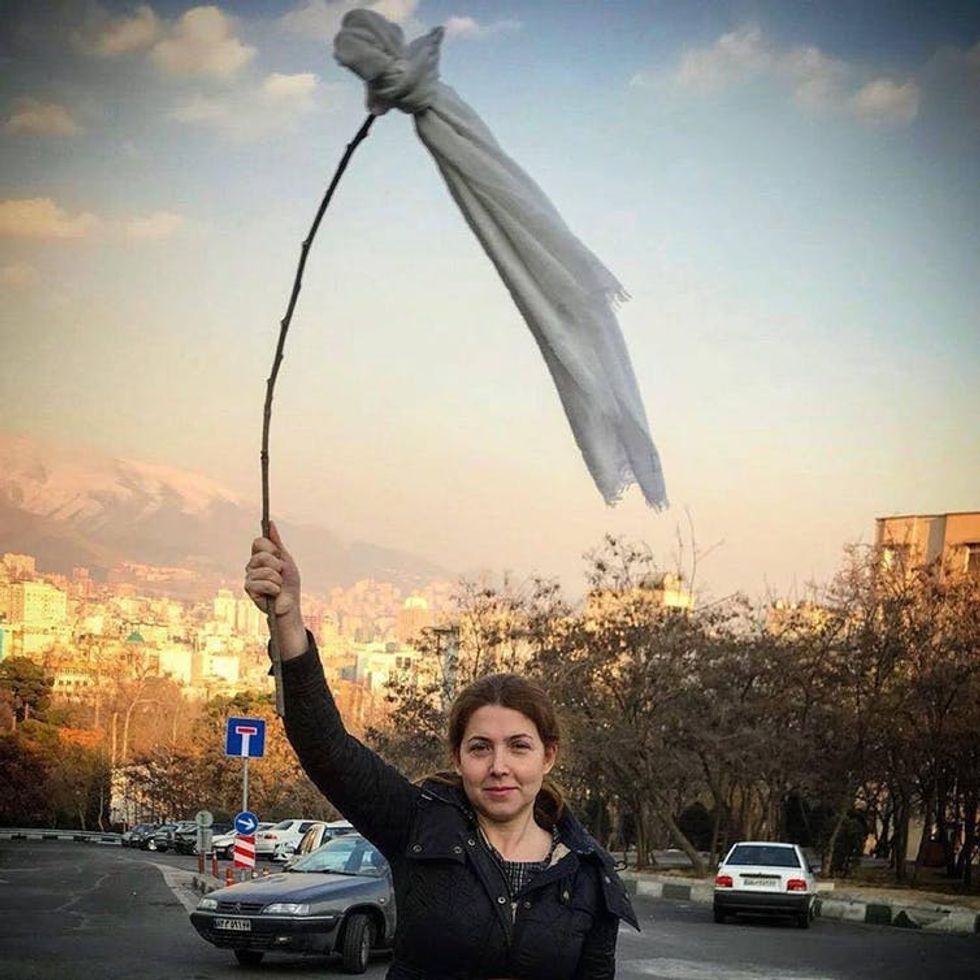
Women protest their lack of bodily autonomy daily in Iran. The number of women making flags out of their headscarves in public spaces is increasing.Facebook/mystealthyfreedom
Unified global voices
This March 8, as we remember the struggles that have brought us closer towards gender equality, we also must consider the social and legal inequalities women continue to face worldwide. While women’s quests for gender equality, dignity and justice are arguably universal, strategies and solutions vary widely under a vast range of social, cultural and political conditions and constraints. Not recognizing this multiplicity has undermined feminist solidarity and has prevented a diversity of strategic solutions.
As an Iranian woman, I well know the fragility of gains women have made. I recall my pain and frustration in the weeks following the 1979 revolution, when Ayatollah Khomeini and others in charge passed Shari’ah laws in conjunction with practices straight out of the Middle Ages, and rendered Iranian women second-class citizens. In Pakistan, President Zia ul-Haq soon followed Khomeini’s lead.
These developments encouraged Algerian Islamists who kidnapped and sexually enslaved women throughout the 1980s. They harassed unveiled women, and women working and studying outside the home. A similar story unfolded in Sudan. In Afghanistan, beginning in 1994, the Taliban, once considered U.S. allies and championed as freedom fighters by western media, took the oppression of women to new levels.
Throughout the 1980s, Amnesty International — then the most prominent of human rights’ organizations — refused to campaign for jailed and tortured gender activists, insisting they were not political activists and so outside their mandate. Amnesty also refused to condemn governments that ignored non-state actors’ violations against women. Among feminists and within women’s organizations, frustration and disappointment with Amnesty deepened.
This disappointment, spurred the emergence of a truly transnational women’s movement. At that time, I could not imagine Amnesty would one day take the lead in campaigning to free me from Iran’s Evin prison 25 years later.
But that was during the 1990s, and well before Amnesty’s change in mandate. The internet and social media, and even affordable international telephone connections and fax machines, were not yet a reality.
Advocates of all ages, nationalities, religions, gender orientation and political affiliations mobilized to research, and collected thousands of testimonies of violence against women: Second World War rape survivors; German women raped by Russian soldiers; Korean women used as sexual slaves for Japanese military personnel; Bangladeshi women raped during the 10-month Liberation War of 1971; Bosnian women raped as part of the “ethnic cleansing strategies.”
The data was presented at regional meetings, national and international tribunals and finally at the UN Human Rights Committee in June 1993 that established women’s rights are human rights with the Declaration on the Elimination of Violence against Women. The global demand for gender equity and justice is also reflected in the 1995 Beijing Platform for Action signed by U.N. members at the 1995 Women’s Conference in Beijing.
These declarations provided women around the world a framework for working towards gender justice and for holding their national governments accountable in the process. But even though change continues to ripple, the full achievement of the goals laid out 30 years ago are far from realized.
The North America-based #MeToo and #TimesUp movements are among many ongoing fights against the commodification and victimization of women as sexual objects and the gendered power differentials that persist in ways that gravely constrain the lives of girls and women everywhere.
Though it may seem obvious to younger generations, the ideas of “women’s rights as human rights” is only 25 years old, and is still frighteningly tenuous in many contexts.
1979: Imposition of the hijab
As an Iranian, this is not a hypothetical issue for me. In 1979, I saw how easily the limited reforms and modest gains that Iranian women had previously struggled for were annulled within two weeks of the end of the Revolution. As post-Revolution generations of Iranians have learned, without protection and nurturing, rights perish.
In the early days of the Islamic Republic of Iran (IRI), leaders decided that women would collectively symbolize the Islamicization of the nation to Iranians and the world. On March 7, 1979, the IRI imposed a compulsory hijab for women. The next morning, coincidentally the 8th of March — a day not normally marked or noticed in Iran — thousands of women all across the country poured into city streets to protest compulsory veiling.
The vociferous opposition took the new leaders by surprise and they temporarily retreated. Over the next two years, however, the regime used the rhetoric of patriotism to gradually reimpose veiling, first for government employees, then for any woman accessing government offices and buildings, then for students.
Ultimately, public veiling was imposed for all females, Muslims or not, over the age of nine. The state claimed that unveiled women caused men’s immoral thoughts – a persistent trope in the history of female diminishment and male impunity.
Extreme political suppression in the early years of the IRI and the bloody and costly Iran-Iraq war (1981-88) made organized, collective action for women’s rights impossible. Yet various strategies for resistance continued. For example, many women refused to wear the all-enveloping black chador (literally tent) favoured by some conservative groups and promoted by the Republic, arguing that the black chador did not exist at the time of the Prophet.
Instead, they wore scarves and ‘manteaux.’ They challenged the government’s colour restriction as well, (brown, white, navy blue and gray), arguing that even the most conservative interpretation of Islamic text fails to even hint at colour restrictions, and that the Prophet’s favourite colour was pink.
In those early years, many women, myself included during my visits, wore the very bright and shiny colour known as Saudi green, which annoyed the regime to no end, but which the morality police were at a loss to address since green is generally considered the colour of Islam. Within a few years, women started to appear in public in other bright colours.
Women walking in the streets of Isfahan, Iran, in August 2016.Shutterstock
The hijab was also intended by the regime to demonstrate national pride in opposition to the alleged Western hedonism of fashion popularized by the previous government. Iranian women continued to subvert the regime’s intentions by styling “traditional” attire in new ways, donning bright-coloured ethnic patterns that nevertheless completely conformed to Islamic codes of modesty.
Thus the morality police and other state agents had no easy justification for arresting women for dress-code violations, and tactics for expressing agency and opposition by this first generation of women living under the IRI continued.
Daughters of the revolution
Over time, among many demographics, successive generations of girls born and raised in the IRI have worn increasingly shorter and tighter tunics over their leggings; their scarves have become ever smaller and looser. Older women, claiming as a result of age to no longer be seductive, have allowed their head coverings to slip lower as they moved through their cities and towns going about daily business.
Despite the state’s investment of massive resources to employ hundreds of thousands of paid and volunteer morality police, and almost 40 years of school curricula designed to inculcate “Islamic’ values as defined by the regime, the regime has not accomplished its goals.
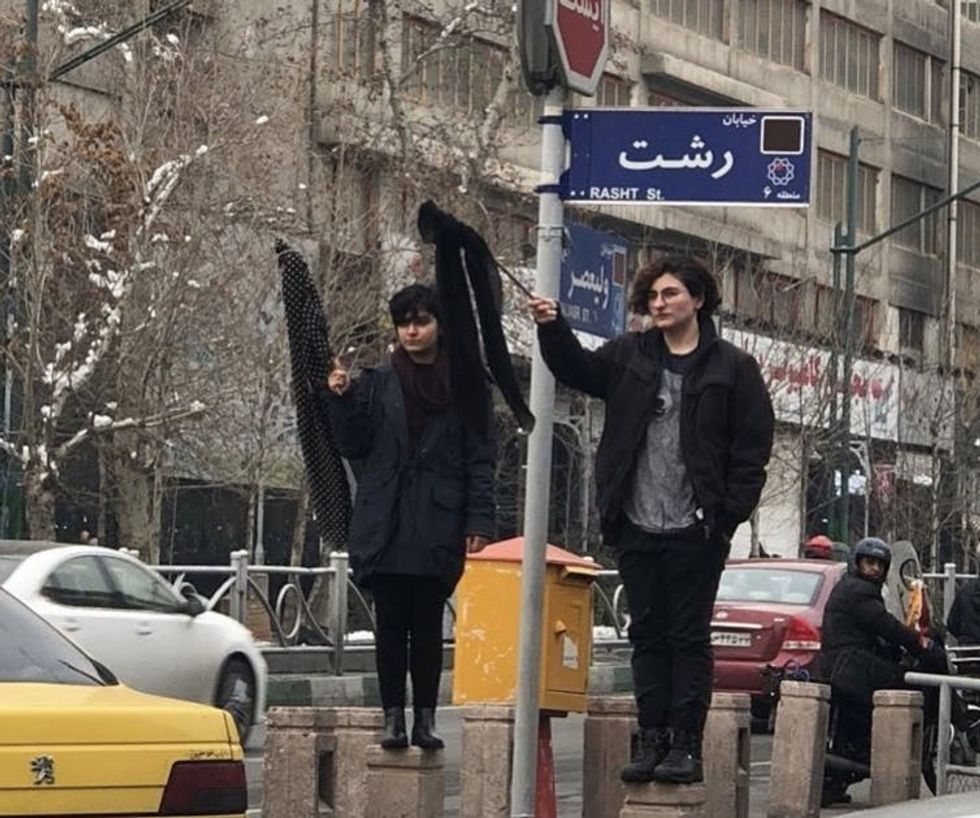
The world has been surprised recently by a new wave of women’s activism in Iran. Bareheaded Iranian women climb on platforms and benches in public spaces, white scarves tied to the ends of poles, waving their hijab flags to protest compulsory veiling.
Women have been climbing on platforms to protest compulsory hijab.(White Wednesday Campaign/@masihpooyan)
Alone and silent, the women can hardly be charged with mobilizing against the state or disturbing the peace — the usual justifications for arresting demonstrators. While some have been arrested for baring their heads in public, often the authorities are generally looking away to avoid escalating tension, drawing attention to the women and fuelling the movement.
The young protesters are being called "daughters of the revolution.” The movement has taken the regime by surprise; there has been no coherent response and the number of women making flags of their headscarves in public spaces is increasing. There is no organized, central orchestration of these actions, though they have attracted many supporters.
Rather, we see an organic civil movement manifesting the widespread dissatisfaction of large segments of both the male and female population, including many women who will wear the veil regardless but object to the compulsory hijab.
There has been at least one instance of a woman in full chador climbing onto a platform on a busy street and waving a scarf to protest her lack of bodily autonomy. The struggle is not about a piece of cloth on a woman’s head, it is about the gender politics that cloth symbolizes, and its use to silently and broadly communicate a rejection of state control over women’s bodies.
The political aspect of the struggle over the veil can be perplexing to outsiders, who wonder why some groups of women in Turkey and Europe fight for the right to wear the veil while in Iran many women — including some devout women — have fought for almost four decades for the right to remove their veils. In all cases, women are demanding state recognition of bodily autonomy as an essential step to recognition of their full personhood and citizenry rights.
And so, I continue to both protest and celebrate on International Women’s Day.
We need this day of conscious connection to the long, sometimes violent history of women’s struggles for personhood; a day to reflect on the rights we have gained; and a day to recognize the vigilance required to retain those rights — rights women of many nations and contexts have yet to achieve. This I know from personal experience.
The 8th of March is a day for global, collective reflection on that history and on the conditions we must continue to challenge that create barriers to women’s full, free and fearless participation in all facets of human social life.
Demonstrators were expected to reconvene near St. Louis on Sunday afternoon for a third day of protests, following the acquittal of a white former police officer in the fatal shooting of a black man.
Jason Stockley, the officer who shot dead Anthony Lamar Smith in 2011, told a city newspaper he was “just not the guy” to blame.
Late on Saturday in the Delmar Loop area of University City, a suburb about 10 miles west of downtown St Louis known for concert venues and night life, a group of demonstrators refused to disperse, broke windows and threw objects at police. Officers moved in with riot gear and armoured vehicles and the disturbances resulted in several arrests.
During demonstrations on Friday night, police said 32 people were arrested and 10 officers injured.
The St Louis Post-Dispatch published an exclusive interview with Stockley on Friday. “I can feel for and I understand what the family is going through and I know everyone wants someone to blame, but I’m just not the guy,” he said.
St Louis circuit judge Timothy Wilson ruled that the state had not proved beyond a reasonable doubt that Stockley “did not act in self-defense” when he shot Smith, 24. Stockley shot Smith after the suspected drug dealer fled from officers trying to arrest him. Stockley, 36, testified he felt he was in danger because he saw Smith holding a silver revolver when he backed his car toward officers then sped away.
Prosecutors said Stockley planted a gun in Smith’s car. The officer’s DNA was on the weapon but Smith’s was not. Dashcam video from Stockley’s cruiser recorded him saying he was “going to kill this motherfucker”. Less than a minute later, he shot Smith five times.
“It feels like a burden has been lifted but the burden of having to kill someone never really lifts,” Stockley told the Post-Dispatch. “The taking of someone’s life is the most significant thing one can do, and it’s not done lightly … My main concern now is for the first responders, the people just trying to go to work and the protesters. I don’t want anyone to be hurt in any way over this.”
The interview is the first time Stockley has publicly addressed the case. “I did not murder Anthony Lamar Smith,” he said. “I did not plant a gun.”
Stockley said he understood why video of the shooting looked bad. “Every resisting [arrest] looks bad, it never looks good,” he said. “So what you have to separate are the optics from the facts, and if a person is unwilling to do that, then they’ve already made up their mind and the facts just don’t matter. To those people, there’s nothing that I can do to change their minds.”
Judge Wilson found that the 15 seconds Stockley took to get out of his car, unholster his weapon and fire at Smith proved the incident was not an execution.
Stockley, a West Point graduate and Iraq war veteran, defended his use of an AK-47 with 100 rounds that he used to shoot Smith as justified, given the level of firepower he saw on the city’s streets.
“I used it as a deterrent and I believed it was better to have it and not need it than to need it and not have it,” he told the paper. “I accept full responsibility for violating the rules. But it’s not a moral crime. It’s a rule violation.”
Stockley resigned in 2013 after a suspension for carrying the AK-47. Later he took a job with an oil company in Texas. It was not until May 2016 that he was charged with first-degree murder. He said that decision was “an emotional decision for personal and political reasons, not a legal one”.
Prosecutors alleged Stockley told his partner he was going to kill Smith while they were pursuing him. At trial, Stockley said he did not remember making the comment. Judge Wilson said the comment lacked context.
Stockley said his memory of events was imperfect and that the first time he heard himself saying what he said in the car was when he met the FBI. He said he could only speculate why he had said it, “whether it was in the heat of the moment or whether it was part of a larger conversation”.
In his interview, Stockley said: “I can tell you with absolute certainty that there was no plan to murder Anthony Smith during a high-speed vehicle pursuit.”
The judge said there was no evidence proving the gun in Smith’s car had been planted, and it had been reasonable to believe Smith was reaching for a gun when he was shot.
Stockley’s lawyer, Neil Bruntrager, told the Washington Post: “This wasn’t a routine traffic stop. This was a drug-related stop. Those by their very nature – they’re deadly.
“It’s important to look at the video, but that’s not all of the evidence … I would encourage people to read Judge [Timothy] Wilson’s opinion because here’s a detailed examination of the facts of the case, and it leaves no stone unturned.”
Bruntrager also represented Darren Wilson, the officer who shot dead Michael Brown, an unarmed teenager, in Ferguson near St Louis in 2014. A grand jury’s decision not to bring charges in that case prompted serious rioting.
(Richmond, CA) — In a sign of growing escalation, protesters Monday locked themselves to steel barrels and blocked three gates of the Kinder Morgan Richmond Terminal for the second time in two weeks, demanding that the company halt its new Trans Mountain pipeline in Canada. Two were arrested. In what many environmental and Indigenous activists are starting to call the “Standing Rock of the North,” the controversial project would triple the capacity of an existing pipeline from Edmonton, Calgary to Burnaby, British Columbia—an increase to 890,000 barrels per day. This project is based on the extraction of tar sands oil, one of the world’s dirtiest fossil fuels.
"Our First Nations relatives are not going to allow the Trans Mountain pipeline to go through their territories in Canada,” said Pennie Opal Plant of Idle No More SF Bay. “Investing in any fossil fuel infrastructure is foolish. We all know that we must transition off of fossil fuels in order to prevent catastrophic climate change. Why waste so many resources on a losing proposition?"
The growing Bay Area resistance to this Kinder Morgan pipeline stands with over 140 tribes comprising The Treaty Alliance Against Tar Sands Expansion. The groundbreaking alliance of Indigenous nations formally opposes all tar sands pipelines crossing their traditional lands and waters. The recently elected government of British Columbia also opposes the project.
"Thanks to California's brand new cap and trade climate bill AB 398, it’s now extremely likely that this very terminal we are blocking today will be a destination point for the tar sands oil that would be piped in by Trans Mountain,” said Andres Soto of Communities for a Better Environment. “AB 398 is an abomination and a threat to environmental justice worldwide.”
AB 398 passed just two weeks earlier despite opposition from a broad coalition of climate and environmental justice groups. The new law blocks the ability of local air quality agencies from establishing rules limiting greenhouse gases and opens up the door for refining tar sands crude in Richmond, which would worsen air pollution in surrounding communities.
“From the fence-lines of Richmond, we stand in solidarity with the First Nations fighting on the frontlines of tar sands extraction,” said Adrian Wilson of Diablo Rising Tide. “It is time to start fighting back against these oil companies polluting our communities from the cradle to the grave of the fossil fuel death cycle.”
Kinder Morgan, a spin-off from Enron, is one of North America’s largest energy infrastructure companies. The company claims it will start construction on its 715-mile Trans Mountain pipeline in September despite fierce opposition to the project from numerous First Nations and other communities and cities along its path.
"We salute all the water protectors, coast protectors and climate warriors on the front lines of these pipeline battles, standing up for Indigenous rights, the water and a safe climate,” said Grand Chief Serge Simon of the Mohawk Council of Kanesatake on behalf of the Indigenous Nations who have signed the Treaty Alliance Against Tar Sands Expansion. "Resistance to Kinder Morgan's Trans Mountain Expansion tar sands pipeline and tanker project will be strongest in British Columbia, but it won't stop there: Kinder Morgan can count on fierce resistance all over North America by Indigenous People and their allies."
“This is clearly just the beginning,” said Patrick McCully of Rainforest Action Network. “This is the second week in a row that activists are blockading this facility — and you can expect protests up and down the West Coast as banks and oil companies continue to try and profit from climate chaos and human rights violations that will be caused by these disastrous tar sands pipelines. Companies like Kinder Morgan are on notice. Banks like JPMorgan Chase are on notice. Get out of tar sands. Get out of extreme oil. Get out of the climate change business and get on the right side of science and history.”
See the photos of Monday's action (all photos credit: Rudi Tcruz):
Recently, for the second time in 15 months, noted Palestinian professor and astrophysicist Imad Al-Barghouthi was arrested by Israeli authorities. Barghouthi, a professor of space physics at al-Quds University, was arrested at an Israeli military checkpoint in the West Bank on his way home. According to the New Arab news source, Barghouthi, “a leading researcher, publishing frequently in academic astrophysics journals,” has previously worked for NASA. In what appears now as an extended manipulative game played by the Israeli government, Barghouthi was arrested, released, re-arrested, exonerated, and yet not released as should have been the case. Rather, after the prosecutor for the initial charge said he had no compelling evidence to keep Barghouthi under detention, and thereupon the military court said it would release Barghouthi, a new charge of “incitement” has been cooked up to keep him detained.
Barghouthi was never charged by the military court. His administrative detention was based on "secret information" that has not been disclosed to him or to his lawyer. This system of administrative detention is a flagrant violation of international law. An occupying force has the obligation to protect the fundamental rights of the occupied people under the Fourth Geneva Convention. The suspicion is that both detentions were due to Barghouthi’s posts on Facebook condemning the Israeli occupation. Indeed, for some time now Israel has been monitoring Palestinian Facebook accounts, arresting individuals and shutting down accounts. The flimsiness of the case was made evident by his attorney.
Several days ago it appeared Barghouthi was to be released on May 29, after tremendous international protest, manifested in an Open Letter signed by 340 intellectuals and activists from around the world, including Angela Davis, Noam Chomsky, and Judith Butler. However, on that very day, Israel announced that that was not going to happen. The release authorized by the military court was rescinded. As the Electronic Intifada reports:
The Palestinian Prisoners Club said in a statement on Sunday that Israeli occupation forces had canceled Barghouthi’s expected release after military prosecutors filed charges over statements the Al-Quds University professor allegedly made on Facebook.
Jawad Boulos, a lawyer from the Palestinian Prisoners Club, described the latest Israeli move as “shameless.”
Boulos said the Israeli military prosecutor had told the military judge that he had examined Barghouthi’s file and found insufficient evidence to charge him.
It was on that basis that the prosecutor had asked the military judge to extend Barghouthi’s administrative detention, which the military court refused to do.
Boulos said that Barghouthi’s case “demonstrates to anyone who still needs proof that all of the ‘legal’ procedures established by the occupation forces … are flimsy and fake and give no heed to legal principles.”
Those working to secure Barghouthi’s release are increasing their efforts, driven even more by this latest flagrant act of intimidation and harassment. And they have a widening circle of supporters to draw on. What is perhaps most significant about the list of signatories is the overwhelming presence of luminaries from the international scientific community, a group not usually associated with protesting the treatment of Palestinians by the Israeli state. Those signing the statement include leading physicist Freeman Dyson at the Institute for Advanced Study in Princeton; David Mumford, recipient of the Fields Medal 1974 (the “Nobel prize of math"); and Chandler Davis, Professor Emeritus of Mathematics at the University of Toronto.
We are writing to urge you to order the immediate release of Dr. Imad Ahmad Barghouthi from Israeli military custody.
Dr. Barghouthi, a Palestinian resident of the West Bank, is an astrophysicist and professor of physics at Al-Quds University in Jerusalem. He was reportedly arrested by Israeli soldiers at the military checkpoint at Nabi Saleh in the West Bank, northwest of Ramallah on 24 April 2016. The Times of Israel reported that "neither the IDF nor Israel Police would comment on the matter, and it remains unclear which branch of the Israeli security forces was responsible for his arrest." The Palestine Information Center reported that on 2 May 2016, "An Israeli court ... issued an administrative detention order against Professor Barghouthi. " Professor Barghouthi is being held without charge, a serious violation of human rights.
As described in the journal Nature, Professor Barghouthi was previously arrested without charge by Israeli Border Police on 6 December 2014 when he attempted to cross the border from the West Bank to Jordan to board a flight to the United Arab Emirates so that he could attend a meeting of the Arab Union of Astronomy and Space Sciences, an organization he helped to found.
Professor Barghouthi's attorney at that time, Jawad Boulos, alleged that Dr. Barghouthi was arrested because of his statements in support of Palestinian activities during Israel’s invasion of the Gaza Strip the previous summer, and that during interrogations Dr. Barghouthi was asked what statements he wrote on Facebook and what he said on television in opposition to the Israeli occupation [3]. Following letters of protest from international scientific organizations, including the Committee of Concerned Scientists in the United States, Dr. Barghouthi was released on 22 January 2015.
The re-arrest of Professor Barghouthi is part of a broader pattern of disruption and suppression of Palestinian educational systems. The University of Gaza has been bombed multiple times. Birzeit University in the West Bank has been closed down at least 15 times by the Israeli military, and its former president, Dr. Hanna Nasir, a physicist, was deported and remained in exile for 19 years. Arrests of faculty and students, in some cases because of Facebook posts in opposition to military occupation, have continued into 2016. Israel has destroyed or damaged hundreds of Palestinian schools, even kindergartens.
Article 26 of The Universal Declaration of Human Rights, to which Israel is a signatory, grants all people the right to education. We urge you henceforth to respect those principles and to order the immediate release of Professor Imad Barghouthi.
I asked scientific scholars from around the world why they were drawn to this issue, and what they felt was most significant about the protest. Upon hearing the news, Ahmed Abbes, a French mathematician, told AlterNet: "The decision of the military court to release Imad Barghouthi after an international campaign of the scientific and academic community shows that Israel is sensitive to international pressure. The new charges filed by the military prosecutors, after the military court refused to extend Barghouthi’s administrative detention on their request, lays bare the arbitrary character of the judicial system to which the Palestinians are subjected."
David Klein, Professor of Mathematics at California State University Northridge and member of the USACBI Organizing Collective notes, “A large number of the signers of the open letter are graduate students, visiting postdocs, and assistant professors. They took courageous and principled stands because of probable opposition by more senior colleagues. But more support is needed. The continued detention of Professor Barghouthi is an illustration of how the entire legal system in Israel is just a network of Kangaroo courts. What is this charge of 'incitement'? It is nothing more than a charge of principled opposition to the racist policies of the apartheid regime of Israel. We should all demand to be charged with 'incitement'."
Mario Martone, an Italian particle physicist, also drew particular attention to “the many non-tenured researchers who have taken a courageous stand showing unequivocal support for the liberation of Professor Barghouti. Having paid a heavy price while a graduate student at Cornell University for my pro-Palestine stands, I know too well the extent of the pressure on young researchers to be silent on this issue. Dr. King once said: ‘The arc of moral universe is long but it bends toward justice.’ In fact, despite all of that, the support for justice and fair treatment of Palestinians is fast growing even within US academic institutions.”
Dr. Chanda Prescod-Weinstein, a theoretical physicist at the University of Washington, had this important insight with regard to the racist element in Barghouthi’s persecution:
The continued imprisonment of astrophysicist Imad Barghouti makes clear why Moshe Ya'alon recently resigned as Israeli Defense Minister while decrying Israel's policies as extremist and racist. These kinds of actions are fascist in nature. Of course they are not new, but the apartheid state is becoming more and more brazen in its efforts to suppress free debate about its segregationist and violent treatment of Arab Israelis, African migrants, and Palestinians in the occupied territories.
As a Black and Jewish American, I understand the very real dangers posed by a race-based system of mass incarceration and death that penalizes people just got daring to breathe. I also recognize in Professor Barghouthi a fellow theoretical astrophysicist who is passionate about the universe in all its aspects, whether it is understanding the inner workings of our home star or pushing for equality and justice in the communities where we come from. I am disgusted that Israel would attack the very basis of a free, democratic society -- free speech -- in the name of protecting Jews like me. Not in my name.
Finally, I spoke with Dr. Anat Matar, senior lecturer at the Department of Philosophy, Tel Aviv University; and head of the Israeli Committee for the Palestinian Prisoners, who offered this critical statement:
In the bigger picture of the Israeli oppression of the Palestinian society, the aspect of the Palestinian academic community is quite seldom mentioned. But Palestinian campuses are often raided by the Israeli army; faculty and students are arrested and put in administrative detention, or sentenced for all sorts of “security” offences; difficulties in traveling abroad or getting visit permits for foreign lecturers are less dramatic than these phenomena, but still hamper the academic life in the OPT.
The absence of almost any mention of these obstacles to Palestinian academic life is particularly resounding given the Israeli (and partly international) outcry against the Palestinian call for a boycott, divestment and sanctions against Israeli academic institutions. Apart from the exception of several Israeli academics, one can hardly detect any interest among the Israeli academic community regarding the situation of the Palestinian academy.
All this is true in general. The recent arbitrary arrest of Professor Imad al Barghouti reminds us both of the daily oppression suffered by the Palestinian academic community and of the heavy silence with which it is usually met.
This is not the first time an international outcry causes the military prosecution to change course, and instead of administrative detention, to press concrete charges. A few months ago we witnessed a similar procedure in the case of member of the Palestinian parliament, Khalida Jarrar. She was first put in administrative detention but after a very short while – and following an energetic international campaign – she was put to trial for all sorts of ridiculous offences.
It is obvious that the military prosecutor believes that the international community would be silenced by such a move, since the legal status is now “normalized”, and there seems to be no indefinite arbitrary detention. But he’s wrong. We’re talking about a military court – no justice is done there. The case of MP Jarrar shows precisely that: the trial goes on and on, an endless line of witnesses is brought – or often not brought, as the testimonies are postponed – and thus the arrest period turns out to be much longer than the expected sentence. Hence, the accused signs a bargain deal, admitting to have committed some of the offences. Bingo.
So technically, this may be the case with Professor al-Barghouti. But the international pressure should not – and would not – stop; neither would the boycott.
At the time of Barghouthi’s first release, he told the scientific journal Nature that he believed that “the letters of support from international scientific organizations, which were presented to the judge by his lawyer, were instrumental in persuading the court to release him.” He stated, “"I am a scientist and I am devoted to research but I am also a firm opponent to occupation." As much as there is little doubt that Israel will continue its pattern of harassment and intimidation, we can also be sure it will be met with the same resistance. And this resistance on the part of Palestinians is now being supported by a growing group of scientific leaders—these kinds of attacks on one of their own are making them, and the world community, increasingly aware of the oppressive nature of the Israeli regime.
When those arguing against the academic boycott of Israel voice concerns about how it might “threaten” academic freedom, they should take into account these very real, and persistent, attacks on the academic freedom of Palestinians and their supporters. Just as Anat Matar drew attention to the fact that Israeli critics of the boycott pay no attention to the denials of academic freedom to Palestinians, so too the mathematician Michael Harris conveyed to Alternet the paradox in the American academy: “When our colleagues attack the academic boycott of Israel as incompatible with academic freedom, they should be asked repeatedly: where were you when a Palestinian astrophysicist was imprisoned without charges and without trial? Why is it not your concern when a Palestinian academic is denied not only academic freedom but even the most elementary protections of the rule of law?”