Search results for "Julian Assange"

'Extraordinarily dangerous': Fears grow Trump nominee would turn FBI’s powers on enemies

President Donald Trump’s nominee for FBI director, Kash Patel, a Trump loyalist who has promoted right-wing conspiracy theories, is “one of Donald Trump’s most disturbing picks” who seems poised to use the office to go after journalists and other Trump critics, says Chip Gibbons of the civil liberties organization Defending Rights & Dissent.


This is a rush transcript. Copy may not be in its final form.

AMY GOODMAN: This is Democracy Now!, democracynow.org. I’m Amy Goodman.

We turn now to two other confirmation hearings that took place Thursday for roles overseeing American intelligence and law enforcement. Director of national intelligence pick Tulsi Gabbard faced bipartisan skepticism, while Trump’s pick to head the FBI, Kash Patel, appeared to have the support he needs despite vocal opposition from the Democrats. Kash Patel testified before the Senate Judiciary Committee, downplaying his past promotion of right-wing conspiracy theories and said only 40% of Americans have faith in the FBI. While Republicans hailed him as a reformer, Democrats grilled Patel over his past comments calling for a so-called enemies list and praising the January 6th rioters. This is Democratic Senator Dick Durbin, ranking member of the Senate Judiciary Committee.

SEN. DICK DURBIN: Mr. Patel posted on social media, quote, “January 6th, never an insurrection. Cowards in uniform exposed,” end of quote. Let me repeat that: “Cowards in uniform exposed.” Who was in the Capitol Building on January 6th in uniform? The Capitol Police were. Do you think they were cowards? Many of them risked their lives, and some gave their lives, in defense of this building. How about the D.C. police, who were here, as well? They were in uniform. Cowards? Risking their lives, as well, some of them being battered and beaten by these mobsters that came into the Capitol. And Mr. Patel claims that the FBI agency aspires to lead — get this now — was planning January 6th for a year. He says the FBI was planning January 6th for a year. That’s a quote. Mr. Patel has gone so far as to co-produce and sell musical recordings of a song performed by January 6th rioters in jail.

AMY GOODMAN: Democrats also focused on Kash Patel’s record of going after journalists and calling for retribution against people he believes are trying to undermine President Trump. This is Democratic Senator Sheldon Whitehouse of Rhode Island questioning Patel.

SEN. SHELDON WHITEHOUSE: Here’s what this nominee himself has said about using his office to prosecute journalists. “We will go out and find the conspirators, not just in government, but in the media. We’re going to come after you, whether it’s criminally or civilly.” Is that a correct quotation, Mr. Patel?
KASH PATEL: Senator, that’s a partial quotation.
SEN. SHELDON WHITEHOUSE: But it’s correct.
KASH PATEL: In part.
SEN. SHELDON WHITEHOUSE: Regarding his publication of his enemies list, Mr. Patel proclaimed, “The manhunt starts tomorrow,” and reposted a video depicting him taking a chainsaw to his political enemies. Is that you, Kash Patel, retruthed, reposting that at the top of that page?
KASH PATEL: Senator, I had nothing to do with the creation of that meme.
SEN. SHELDON WHITEHOUSE: “Is that you reposting it?” was my question.
KASH PATEL: And that’s me at the top.
SEN. SHELDON WHITEHOUSE: You said FBI agents were responsible for the violence on January 6th — and I quote you here — “beyond a reasonable doubt.” Is that what you said?
KASH PATEL: That’s completely incorrect, and I appreciate the opportunity to address that.
SEN. SHELDON WHITEHOUSE: I’ll give that you an opportunity in writing, but this is my time now.
KASH PATEL: You can have at it.
SEN. SHELDON WHITEHOUSE: An inspector attorney general investigation found that that was false. And you said we should impeach judges who rule against Donald Trump who are, in your words, “political terrorists.”

AMY GOODMAN: So, that was Senator Whitehouse questioning Kash Patel. This is Democratic Senator Amy Klobuchar of Minnesota.

SEN. AMY KLOBUCHAR: Have you referred to the media as “the most powerful enemy of the United States that they have ever seen”? Is that right?
KASH PATEL: Again, you’re reading a quote. I tape regularly and actively —
SEN. AMY KLOBUCHAR: It’s to CPAC, 2-23-24. You said, “We’re going to come after the people in the media who lied about American citizens, who helped Joe Biden rig the elections. We’re going to come after you, whether it’s criminally or civilly.” Is that something you said?
KASH PATEL: That’s a partial statement of what I said.
SEN. AMY KLOBUCHAR: Steve Bannon’s podcast. You also said you would put the entire fake news mafia press corps on your list. Is that correct? Is that what you said?
KASH PATEL: I don’t have that in front of me.
SEN. AMY KLOBUCHAR: Benny Johnson podcast, 8-21-23.

AMY GOODMAN: For more on the Kash Patel and Tulsi Gabbard nomination hearings, we’re joined now by Chip Gibbons from Washington, D.C., journalist, policy director of Defending Rights & Dissent, where he’s advised multiple congressional offices on reforming the Espionage Act, currently working on a book on the history of the FBI for Verso Books.

Chip, thanks for joining us. Before we move to Tulsi Gabbard, if you can talk about Kash Patel talking about going after journalists and also making an enemies list?

CHIP GIBBONS: Well, Kash Patel is one of Donald Trump’s most disturbing picks, and that is saying something. Patel’s comments about going after journalists should be very alarming, first of all because no one should be in a law enforcement or intelligence position who wants to go after journalists.

I think we have to clarify that the FBI is both a law enforcement agency and an intelligence agency. It’s been a hybrid agency since Hoover, and Hoover used the intelligence aspects of the FBI to go after King, to go after civil rights protesters. And in spite of this myth of sort of the reformed FBI, ever since then, they’ve been doing exactly the same thing. While writing my book, I’ve come up with documents from right before 9/11 that showed them spying on World Bank protesters, with incredibly intrusive means. So the FBI is a political police force. And we are nominating someone who has shown themselves to be gleeful about using his political policing powers.

The journalism comments are extremely disturbing because the FBI has broad powers to go after journalists. Because the unauthorized disclosure of national defense information is governed by the Espionage Act, authority for enforcing leak investigations is in the intelligence division of the FBI, the division with the least restrictions and most surveillance. And I will note that the Heritage Foundation, in Project 2025, has called for hiring more FBI counterintelligence agents with the goals of finding journalists’ sources and imprisoning them. Unfortunately, there has been a bipartisan trend in this country to come after first journalists’ sources, like Edward Snowden and Chelsea Manning, and then, under the Trump and Biden administrations, to go after journalist Julian Assange. When you look at what was in the plea deal that Julian Assange agreed to — that he is a journalist, and he worked with a source to publish classified information, and that is a conspiracy under the Espionage Act — Kash Patel has the perfect tool to go after Trump’s critics in the media.

So, Patel’s desire to go after journalists and their sources, the fact that both parties have created and cemented the tools to do so, and the fact that the FBI is a political policing bureaucracy makes Patel an extraordinarily dangerous figure. And we should be extremely concerned about what’s coming down the pike, while also acknowledging that if we did not have this bipartisan building up of the surveillance state, this bipartisan ratification of the Espionage Act, this bipartisan use of it against whistleblowers like Snowden, with journalists like Assange —

AMY GOODMAN: Chip —

CHIP GIBBONS: Yes, yes.

Lawlessness, disorder and the hypocrisy of Donald Trump’s exile threats

In 2020, in response to the riots that followed the murder of 46-year-old Black man George Floyd, Donald Trump declared himself the “president of law and order.” During the same speech, he threatened to use the military to suppress the civil unrest that erupted after a police officer killed Floyd.

One American pundit argued that Trump was “tapping into a long history of presidents leaning on the idea of strict adherence to the rule of law to squelch civil disobedience, often by minority communities in the country.”

His fixation continues in his second presidency. A convicted felon himself, Trump recently proposed a plan to exile Americans who are repeat offenders. Notably, America has never used exile as a form of punishment.

Trump stated:

“We’re going to get approval, hopefully, to get them the hell out of our country, along with others. Let them be brought to a foreign land and maintained by others for a very small fee, as opposed to being maintained in our jails for massive amounts of money.”

The history of exile

I’m a scholar in public policy administration, law and ethics. Trump’s exile proposals in the wake of his pardon of the Jan. 6 rioters reveal significant ethical lapses.

In the modern era, exile is regarded as problematic. But in ancient times, like during the Roman Empire, voluntary exile was an alternative to capital punishment, underscoring its severity.

When the poet Ovid was exiled to Tomis (now Constanța, Romania), he described his experience as a “a living death.”

Similarly, in England, James II, a Catholic king, was the last monarch involuntarily removed from power during the Glorious Revolution. Jacobitism, the political movement aimed at restoring James and his descendants to the throne, stemmed from his exile.

Given this history, it’s not surprising that Article 9 of the Universal Declaration of Human Rights states: “No one shall be subjected to arbitrary arrest, detention, or exile.”

In modern times, people who go into exile are typically deposed heads of state like Syria’s Bashar al-Assad, those avoiding legal issues such as Julian Assange or Asil Nadir, or those escaping violence or persecution, such as Salman Rushdie.

Trump, who has initiated the largest and most ambitious removal program of undocumented migrants in America history, has made clear he wants to treat violent repeat American offenders no differently than violent immigrant offenders:

“I don’t want these violent repeat offenders in our country any more than I want illegal aliens from other countries who misbehave,” he said.

The Jan. 6 pardons

Trump’s stance as a “law and order” president is contradictory and hypocritical given his pardons of more than 1,500 Jan. 6 rioters on his first day back in the Oval Office.

The pardons drew unanimous criticism from Democrats and some Republican lawmakers, including senators Mitch McConnell and Lindsey Graham.

Even Vice President J.D. Vance has said any Jan. 6 rioters convicted of violent offences should “obviously” not be pardoned.

The law enforcement community — the actual front line of law and order — also expressed outrage at the pardons, and experts worry the move could embolden extremists to lawlessness and disorder rather than Trump’s supposedly preferred state of law and order.

Polls reveal that two-thirds of Americans — across party lines — also opposed pardoning Jan. 6 rioters who committed violent crimes.

More than 600 — or approximately one-third — of the defendants charged in the Jan. 6 insurrection faced accusations of assaulting or interfering with law enforcement officers. Of the 174 charged with using a deadly or dangerous weapon, 169 of them eventually pleaded guilty to assaulting police officers.

Other charges included trespassing, disrupting Congress, theft, weapons offences, making threats and conspiracy, including seditious conspiracy — the most serious offence.

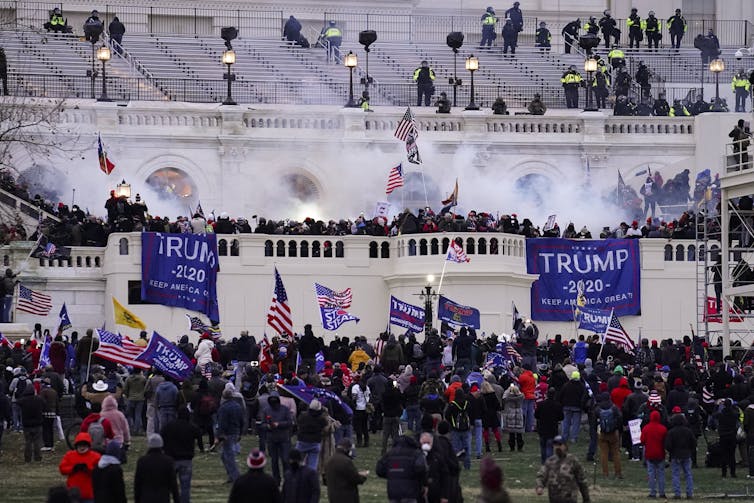
Trump 2020 signs hang in front of the Capitol Building.
Violent protesters, loyal to then-President Donald Trump, storm the U.S. Capitol on Jan. 6, 2021. (AP Photo/John Minchillo)


Repeat offenders

A bipartisan Senate report linked nine deaths to the Jan. 6 raid on the Capitol, including four police suicides in the aftermath and two riot participants who died at the event.

Unlike those whose Black Lives Matter protests Trump found disorderly back in 2020, the vast majority of the Jan. 6 convicts are not from racialized communities.

Dozens of the Jan. 6 rioters also had prior convictions or pending charges, including child abuse, child pornography, predatory criminal assault of a child, rape, drug trafficking, assault with a deadly weapon, possession of controlled substances, battery, criminal confinement and manslaughter. Peter Schwartz, one of rioters, has a record 38 prior convictions going back to 1991.

The irony of Trump’s position on pardons, repeat offenders and exiles is apparent. The very people he pardoned are now potential candidates for his proposed exile program due to their repeat offender status.

Daniel Ball, a pardoned rioter, was arrested for federal gun charges a day after his pardon. The charges predated the riots.

Matthew Huttle of Indiana, another Jan. 6 rioter pardoned by Trump, was killed three weeks after his release while resisting arrest and in possession of a firearm. His uncle, Dale Huttle, also pardoned, has no regrets about participating in the riot, stating: “I’m not ashamed of being there. It was our duty as patriots.”

Similarly, Enrique Tarrio, who received a 22-year prison sentence for his role in the riots, declared after his pardon: “It’s going to be retribution.”

He expressed a desire for vengeance against those who investigated and prosecuted him, stating: “Now it’s our turn. The people who did this, they need to feel the heat.” These three examples all occurred in the seven days following the pardons.

Karma in terms of Trump’s exile proposals may be awaiting the pardoned rioters, however, amid this pattern of defiance. Their emboldened sentiments following Trump’s pardons could suggest they’re at a higher risk of becoming repeat offenders, making them prime candidates for the president’s proposed exile program — that is, of course, unless he pardons them again.The Conversation

Ako Ufodike, Associate Professor, Administrative Studies, York University, Canada

This article is republished from The Conversation under a Creative Commons license. Read the original article.

To thwart Trump killing spree, Biden urged to commute death penalty cases

A large and diverse coalition of broad coalition of rights organizations on Monday sent a letter to U.S. President Biden Monday, urging him to commute the sentences of all 40 individuals who are on federal death row.

The letter adds to a chorus of voices—including prosecutors and law enforcement officials—advocating for Biden to use his clemency powers to issue such commutations before he departs office.

The calls for Biden to issue pardons and commutations have only grown since the president issued a pardon for his son, clearing Hunter Biden of wrongdoing in any federal crimes he committed or may have committed in the last 11 years.

The joint letter to Biden was backed by over 130 organizations, including the ACLU, Brennan Center for Justice, and The Sentencing Project, commends his administration's "actions to repudiate capital punishment, including imposing a moratorium on executions for those sentenced to death, and for publicly calling for an end to the use of the death penalty during your 2020 campaign. In the face of a second Trump administration, more is necessary."

"President Trump executed more people than the previous ten administrations combined. Of those he executed, over half were people of color: six Black men and one Native American. The only irreversible action you can take to prevent President-elect Trump from renewing his execution spree, as he has vowed to do, is commuting the death sentences of those on federal death row now," the letter states.

The letter cites additional reasons that Biden ought to commute the sentences, including that the death penalty "has been rooted in slavery, lynchings, and white vigilantism."

A separate letter to Biden—sent in November by group of attorneys general, law enforcement officials, and others—argues that "condemning people to death by the state does not advance public safety. The death penalty fails as an effective deterrent and does not reduce crime. As an outdated, error-riddled, and racially-biased practice, its continued use—and the potential for its abuse—erodes public trust in the criminal legal system and undermines the legitimacy of the entire criminal legal system."

Matt Bruenig, president of the People's Policy Project think tank, directly tied Biden's inaction on this issue to the pardon he issued for his son in a blog post last week, writing that "if Biden does not act, there is little doubt that Trump will aggressively schedule executions in his next term. Their blood will primarily be on Trump's hands, but, if Biden does not act to prevent it, his hands will be bloody too."

The call for commutations for death row prisoners aligns with a wider push for the President to use his clemency powers before he leaves office.

Rep. Ayanna Pressley (D-Mass.), who has been particularly vocal on this issue, said Sunday on social media that President Biden "must use his clemency power to change lives for the better. And we have some ideas on who he can target: Folks in custody with unjustified sentencing disparities, the elderly and chronically ill, people on death row, women punished for crimes of their abusers, and more."

Pressley was one of over 60 members of Congress who sent a letter to Biden last month, encouraging Biden to intervene to help these groups.

Several lawmakers have specific pardons or commutations in mind, according to Axios. For example, Rep. Thomas Massie (R-Ky.) has urged Biden to pardon Julian Assange of WikiLeaks, and Rep. Alexandria Ocasio-Cortez (D-N.Y.) has called for a pardon of Indigenous activist Leonard Peltier, per Axios.

So far, Biden has granted far fewer clemency petitions (161 total) than former President Barrack Obama, according to the Department of Justice's Office of the Pardon Attorney, and a few dozen less than President-elect Trump did during his entire first presidency. However, in 2022, Biden did grant full and unconditional pardons to all U.S. citizens convicted of simple federal marijuana possession—a move that was cheered by advocates.

According to The New York Times, White House press secretary Karine Jean-Pierre said last week that Biden was expected to make more clemency announcements "at the end of his term."

"He's thinking through that process very thoroughly," she said.

'Where did all the money go?' Report reveals Trump DNI pick has multiple PACs

Tulsi Gabbard, President-elect Donald Trump’s nominee for Director of National Intelligence, would, if confirmed by the U.S. Senate, oversee the entire U.S. Intelligence Community, encompassing all 18 agencies. Like many of Trump’s nominees, Gabbard, a controversial former Democratic Congresswoman and failed presidential candidate turned ultra-MAGA Republican who, as Mother Jones reports, has numerous political action committees (PACs).

“It’s uncommon for a politician to have three or four separate PACs, though they can be used for different purposes,” political scientist and campaign finance expert Sarah Bryner told Mother Jones. “The most common number is one. Generally the more you have is because of obfuscation. It confuses people.”

Mother Jones’s D.C. Bureau Chief David Corn, writes: “If Gabbard reaches a Senate confirmation hearing, there will be much for the senators to grill her on, especially her sympathetic views regarding Putin and Russia and her support for Syrian dictator Bashar al-Assad, as well as her efforts to help Edward Snowden and Julian Assange, who each exposed top-secret information that caused damage for the intelligence community.”

“A key question will be whether someone as excessively partisan as Gabbard can be a fair-minded and even-handed overseer of the intelligence agencies, the intelligence they produce, and the covert actions they mount. Senate Intelligence Committee investigators should be sure to examine the network of organizations she has built and the flow of money in and out of her nonprofit. There are few jobs in the federal government as important as managing the sprawling US intelligence community. With no direct intelligence experience, Gabbard deserves scrutiny of all matters that can shed light on her fitness for this post,” Corn warns.

READ MORE: ‘Much Like the 11th Century’: Trump Defense Pick Called for American ‘Crusade’

Former Trump National Security Adviser John Bolton called Gabbard “the worst cabinet-level appointment in history,” and told CNN (video below) it is “an absolute necessity” Gabbard and all of Trump’s nominees have a full FBI background check.

According to Mother Jones, Gabbard’s PACs include Defend Freedom, Inc., which is “is one of a network of organizations Gabbard has assembled in recent years.”

Gabbard also has a Super PAC called For Love of Country, Inc., which “described itself as ‘Tulsi’s vehicle for messaging in the 2024 election, including a national ad campaign to communicate with middle-of-the-road voters, disenfranchised Democrats, and undecided Independents.’ It claimed, ‘For Love of Country PAC will use traditional and disruptive methods to blend the tried-and-true approach with innovation to reach otherwise unlikely voting demographics.'”

“It looks as if this PAC funded by pro-Trump Republican money-bags mostly existed to cover the costs of Gabbard’s political team,” Corn writes.

There is another PAC, Our Freedom, Our Future, and still another, Team Tulsi, along with a nonprofit, We Must Protect.

“Tens of thousands of people,” Mother Jones reports, contributed to Gabbard’s Defend Freedom PAC. “Through mid-October it raised $1.9 million, including a $16,552 transfer from another Gabbard PAC called Team Tulsi.”

But, out of “all the money it pulled in, Defend Freedom, Inc. devoted only $20,000 to contributions for a small number of candidates, all far-right MAGA-ish Republicans: US Senate candidates Kari Lake and Tim Sheehy, and US House contenders Joe Kent, Brian Jack, and Mayra Flores. (Before running for a congressional seat in 2022, Flores published social media posts promoting QAnon.) Where did all the money go?”

“Gabbard’s outfit spent $1.3 million on operating expenses—at least $1 million on fundraising and direct mail, according to its filings with the Federal Election Commission. Like many PACs, it acted mainly as a money-churning machine that generated donations that mostly profited vendors and consultants.”

READ MORE: ‘Declaration of War on Expertise’: Experts Explain Danger of Trump ‘MAGA Zealot’ Nominees

Corn also reports that Gabbard’s For Love of Country PAC “banked hefty checks from several big-money Republican funders. The biggest amount came from a donor named David Flory, who sent Gabbard’s PAC a whopping $100,000. On the PAC’s FEC filing, it neglected to note—as it is compelled to do—Flory’s occupation and employer.

Corn details how he tried to track down more information about the donation and the donor.

“Asked about the $100,000 contribution to Gabbard’s PAC and the address tied to it, [Flory] said, ‘Doesn’t sound familiar,’ and he tried to end the conversation. Pressed as to whether he had made a donation to Gabbard, he said, ‘I’m not interested in talking to you about it.’ Sounding irritated, he addressed his wife, ‘Julie, don’t take these calls. Just hang up on them.’ He then left the call.”

On social media, Corn adds: “An investigation of Tulsi Gabbard’s PACs shows much of the funds raised have gone to fundraising & to pay her advisers, not the stated mission of the PACs. Plus, she won’t reveal the donors to a charity she runs. All this needs vetting.”

Watch the video below or at this link.

After Hunter Biden pardon, activists ask president to 'extend same compassion' to cannabis prisoners

Despite committing to tackling mass incarceration during his presidential campaign, President Joe Biden has rarely used the presidential pardon to commute sentences during his time in office. As his term draws to a close and amid outrage over the pardon of his son Hunter, advocates are pressuring Biden — who has pardoned thousands who had been convicted of federal drug charges but were not incarcerated at the time of their pardons — to grant clemency to thousands more who are still in prison over cannabis offenses. The president has a chance to atone for his past support of “tough on crime” measures, says the Last Prisoner Project’s Jason Ortiz. He says Biden has an opportunity of “correcting the injustices that were done over the past 20 or 30 years” and should “extend the same grace and compassion” he showed his son Hunter “to all the folks that he helped put in prison to begin with.”


This is a rush transcript. Copy may not be in its final form.

AMY GOODMAN: This is Democracy Now!, democracynow.org, “War, Peace and the Presidency.” I’m Amy Goodman, with Juan González.

President Biden is continuing to face criticism over his decision to issue a sweeping pardon to his son Hunter Biden. But the president’s decision has also brought renewed attention to the power of the presidential pardon. Biden is now facing renewed pressure to commute the sentences of death row prisoners and to pardon or grant clemency to political prisoners like Indigenous leader Leonard Peltier, imprisoned in Florida, and the whistleblowers Edward Snowden and Julian Assange. The group Last Prisoner Project is calling on Biden to use his clemency power to free those still incarcerated in federal prison for cannabis crimes.

We’re joined now by Jason Ortiz, director of Strategic Initiatives at the Last Prisoner Project.

This is very interesting, Jason. I think they say that Hunter Biden has been clean for something like just over five years. His father has openly talked about his son, formerly an addict. And as he faces bipartisan criticism, talk about what you think this is an opening for.

JASON ORTIZ: Sure. So, this is definitely an opening for folks to talk about exactly how expansive we can use the pardon power of the president to make sure that we’re correcting the injustices that were done over the past 20 or 30 years when it comes to cannabis crimes. President Biden himself was actually one of the architects of the 1994 crime bill that created a lot of the outrageous sentences that we’re now dealing with today.

And so, we’re seeing that there are over 3,000 federal cannabis prisoners currently incarcerated on cannabis charges, and these are all folks that also have families and have parents and have loved ones. And we have examples, like folks like Jonathan Wall, who is somebody that was a Maryland resident. He was sentenced to 10 years in federal prison for his first offense. And so, while I can understand why the president wants to have compassion for his own son, where we’re really getting frustrated is that he’s refusing to extend that compassion to all the parents that are currently watching their kids waste away in prison. Mitzi Wall, who works with the organization Freedom Grow, is the mother of Jonathan Wall. She was joining me this past week when we had the congressional press conference, when we were joined by folks like James Clyburn, Congressman James Clyburn, asking for freedom and clemency for folks like Jonathan Wall. And so, that’s one example of 3,000 folks that are currently in prison.

Some of the charges are far more egregious. Folks like Edwin Rubis was sentenced to 40 years in federal prison in the '90s. And so, he's someone that hasn’t had a Christmas or holidays with his family. He has a son that’s 27 years old. He has currently served 27 years of that federal sentence. He hasn’t had a single Christmas with his son because of charges that were orchestrated and architected by President Biden, then as senator, in the crime bill. We have folks that are serving life sentences. Ismael Lira, for a trafficking charge, is currently sentenced on a life sentence for the same activity that is now legal across the country in 25 —

AMY GOODMAN: Which is what?

JASON ORTIZ: — different states, including — trafficking. And so, that would be the distribution of cannabis. And so, there is a specific differentiation between what President Biden’s previous pardons were intended to do, which was only covering things like simple possession, where right now we have folks that are serving decades for trafficking, which is exactly what the hundreds of legal cannabis businesses across the country are currently doing on a regular basis, including right in Washington, D.C. And so, we’re now seeing people sitting in prison for decades for the same activity that is currently generating tax revenue for cities and states across the country. We’re paying for schools and building bridges with cannabis activity dollars, but still letting folks waste away in prison. And so, while I can definitely understand why a father would want to have compassion for his son and avoid prison time for his son, we’re really asking him to extend that same compassion to all the folks that he helped put in prison to begin with.

JUAN GONZÁLEZ: [Jason], you mentioned the previous pardons for simple cannabis possession, but that hasn’t led to the release of many of those incarcerated individuals. Can you talk about that?

JASON ORTIZ: Yeah, absolutely. So, those pardons were for simple possession, for folks that were currently charged on a federal possession charge. And, now, it is very rare for someone to actually serve prison time for a simple possession charge at the federal level. That generally happens to folks — somebody maybe got caught; they were smoking at a national park or some other sort of federal property where they were unaware of it. But there are nobody in prison for simple possession in the federal prison system whatsoever. So, despite his pardoning of 6,000 charges, zero people were released.

However, the charges that we’re looking to actually have folks released for, things like cultivation of cannabis, sales of cannabis, those are the charges that folks are currently in prison for. And we want him to expand his use of the pardon to cover all cannabis crimes that are now legal in the majority of the country.

JUAN GONZÁLEZ: Yeah, and, Jason, apologies, but, Jason, during your press conference last week, you spoke of, quote, “the heartbreaking number of Latino fathers incarcerated for life or near-life sentences.” How do these cases reflect systemic inequalities in federal sentencing?

JASON ORTIZ: So, we’ve seen for the past 50 years or so that the war on drugs has been racially motivated, specifically targeting young Black and Brown men, and many of those are Latinos, here in the city of New York. There was millions of arrests across the country. We’ve seen countless young fathers that have been ripped from their families, simply because they were trying to make money to help feed their families.

And so, I was somebody who was arrested in high school at the age of 16. I was lucky enough not to get incarcerated, but only because my parents were able to help me through this ridiculous legal process of keeping a 16-year-old out of prison.

And so, we’re seeing across the country that while these laws are changing, the retroactive relief and the restorative justice for the folks that were impacted has not followed suit with all of the cannabis profits that we’re seeing developed across the country. And we know without a doubt that the war on drugs was and is still racially motivated, specifically targeting Blacks and Latinos. And so, we’ve yet to actually wrestle with that real racist history of the war on drugs. We’re simply trying to just move on without addressing the past.

And I think the president has an incredible opportunity now to really address the issues that have been developed over the last few years by taking real expansive action, using his clemency power to commute the sentences of the folks that are currently in prison. And roughly half of the folks that are on our list of constituents are Latino. And you can see very clearly just by looking down the list of names who is in there and who is getting out in the future. And Latinos are definitely overrepresented in the prison population generally, but especially in the federal system for cannabis crimes.

AMY GOODMAN: So, if you look at the clemency statistics by president, Biden is at almost the lowest, outside of George H.W. Bush. Biden, Trump, Obama, W., Clinton, H.W. and Reagan — he’s number two, among the lowest. Are you speaking directly, are your groups speaking directly with the Biden clemency office? How far are these demands going? You’re talking about thousands of people.

JASON ORTIZ: Yeah. So, we have met with White House officials multiple times, and we’ve explained exactly the folks that we believe are the top candidates for clemency. And while they have been receptive, they have not told us that they’re going to take any particular action to help these folks out at all.

And so, what we are really doing is hoping that they will take action sooner rather than later. It is true that most of the time most presidents use their clemency powers at the very end of their presidency. However, President Biden has clearly shown that he’s not going to wait for everyone to wait until the end of his presidency. He was willing to do it a little bit earlier for his son. And so, we’re asking him to extend the same grace and compassion to all the folks that are currently incarcerated and release them immediately, let them join their families for the holidays, let them see their families grow up, and bring joy and happiness back into their lives.

These are folks that have served a tremendous amount of time already. This is not folks that we’re saying did not commit the crime and should be, you know, released without any sort of punishment. Folks like Edwin Rubis have already served 27 years of their life in federal prison for a cannabis charge.

And so, while he could wait, we are asking him not to wait, to do this immediately, to show the people that his presidency is going to be one where he will be remembered as addressing the issues that he created and coming to this from a place of compassion, and not continuing the process and continuing the damage done by punitive drug policies.

AMY GOODMAN: Well, Jason Ortiz, we thank you so much for being with us, director of strategic initiatives at the Last Prisoner Project.

Trump surrogate’s tweet about Biden’s 'desperate gambit' backfires when reporter brings receipts

WikiLeaks founder Julian Assange has been released from a U.K. prison after reaching a plea deal with the U.S. Department of Justice (DOJ). Assange, according to NBC News, will avoid incarceration in the U.S. by pleading guilty to a conspiracy charge.

MAGA businessman Vivek Ramaswamy, who ran against Donald Trump in the 2024 GOP presidential primary but endorsed the presumptive nominee after dropping out of the race, used Assange's release to attack President Joe Biden in a June 25 post on X, formerly Twitter. But Ramaswamy got a fact-check from Semafor's David Weigel.

Ramaswamy posted, "It's great that Julian Assange will finally be released (in what smells like a desperate Biden gambit for libertarian votes), but it's shameful that he had to spend years rotting in a foreign prison for doing what other reporters do regularly, while the government employee who leaked to him - Chelsea Manning - had her sentence commuted by Obama because she's a member of a favored political class (transgender)."

READ MORE: Ramaswamy acquires 'activist stake' in BuzzFeed: 'Attractive investment opportunity'

The far-right MAGA Republican added, "Julian Assange deserves a pardon & it's long past overdue to restore one standard of law again in America."

After seeing Ramaswamy's tweet, Weigel briefly explained why his premise was misleading.

Weigel tweeted, "He was indicted by Bill Barr’s DOJ!" And the Semafor journalist linked to a May 23, 2019 DOJ press release headlined, "WikiLeaks Founder Julian Assange Charged in 18-Count Superseding Indictment."

The DOJ press release read, "A federal grand jury returned an 18-count superseding indictment today charging Julian P. Assange, 47, the founder of WikiLeaks, with offenses that relate to Assange's alleged role in one of the largest compromises of classified information in the history of the United States…. The superseding indictment alleges that Assange was complicit with Chelsea Manning, a former intelligence analyst in the U.S. Army, in unlawfully obtaining and disclosing classified documents related to the national defense."

READ MORE: Vivek Ramaswamy rouses Michigan GOP with claim there is 'a war in this country'

How the persecution of Julian Assange 'emasculated investigative journalism': Chris Hedges

LONDON: The persecution of Julian Assange, along with the climate of fear, wholesale government surveillance and use of the Espionage Act to prosecute whistleblowers, has emasculated investigative journalism. The press has not only failed to mount a sustained campaign to support Julian, whose extradition appears imminent, but no longer attempts to shine a light into the inner workings of power. This failure is not only inexcusable, but ominous.

This article originally appeared on ScheerPost.

The U.S. government, especially the military and agencies such as the CIA, the FBI, the NSA and Homeland Security, have no intention of stopping with Julian, who faces 170 years in prison if found guilty of violating 17 counts of the Espionage Act. They are cementing into place mechanisms of draconian state censorship, some features of which were exposed by Matt Taibbi in the Twitter Files, to construct a dystopian corporate totalitarianism.

The U.S. and the U.K. brazenly violated a series of judicial norms and diplomatic protocols to keep Julian trapped for seven years in the Ecuadorian Embassy after he had been granted political asylum by Ecuador. The CIA, through the Spanish security firm UC Global, made recordings of Julian’s meetings with his attorneys, which alone should invalidate the extradition case. Julian has been held for more than four years in the notorious Belmarsh high-security prison since the British Metropolitan Police dragged him out of the embassy on April 11, 2019. The embassy is supposed to be the sovereign territory of Ecuador. Julian has not been sentenced in this case for a crime. He is charged under the Espionage Act, although he is not a U.S. citizen and WikiLeaks is not a U.S.-based publication. The U.K. courts, which have engaged in what can only be described as a show trial, appear ready to turn him over to the U.S. once his final appeal, as we expect, is rejected. This could happen in a matter of days or weeks.

On Wednesday night at the School of Oriental and African Studies, University of London, Stella Assange, an attorney who is married to Julian; Matt Kennard, co-founder and chief investigator of Declassified UK, and I examined the collapse of the press, especially with regard to Julian’s case. You can watch our discussion here.

“I feel like I’m living in 1984,” Matt said. “This is a journalist who revealed more crimes of the world’s superpower than anyone in history. He’s sitting in a maximum-security prison in London. The state that wants to bring him over to that country to put him in prison for the rest of his life is on record as spying on his privileged conversations with his lawyers. They’re on record plotting to assassinate him. Any of those things, if you told someone from a different time ‘Yeah this is what happened and he was sent anyway and not only that, but the media didn’t cover it at all.’ It’s really scary. If they can do that to Assange, if civil society can drop the ball and the media can drop the ball, they can do that to any of us.”

When Julian and WikiLeaks released the secret diplomatic cables and Iraq War logs, which exposed numerous U.S. war crimes, including torture and the murder of civilians, corruption, diplomatic scandals, lies and spying by the U.S. government, the commercial media had no choice but to report the information. Julian and WikiLeaks shamed them into doing their job. But, even as they worked with Julian, organizations such as The New York Times and The Guardian were determined to destroy him. He threatened their journalistic model and exposed their accommodation with the centers of power.

“They hated him,” Matt said of the mainstream media reporters and editors. “They went to war with him immediately after those releases. I was working for The Financial Times in Washington in late 2010 when those releases happened. The reaction of the office at The Financial Times was one of the major reasons I got disillusioned with the mainstream media.”

Julian went from being a journalistic colleague to a pariah as soon as the information he provided to these news organizations was published. He endured, in the words of Nils Melzer, at the time the U.N. Special Rapporteur on Torture, “a relentless and unrestrained campaign of public mobbing, intimidation and defamation.” These attacks included “collective ridicule, insults and humiliation, to open instigation of violence and even repeated calls for his assassination.”

Julian was branded a hacker, although all the information he published was leaked to him by others. He was smeared as a sexual predator and a Russian spy, called a narcissist and accused of being unhygienic and slovenly. The ceaseless character assassination, amplified by a hostile media, saw him abandoned by many who had regarded him a hero.

“Once he had been dehumanized through isolation, ridicule and shame, just like the witches we used to burn at the stake, it was easy to deprive him of his most fundamental rights without provoking public outrage worldwide,” Melzer concluded.

The New York Times, The Guardian, Le Monde, El Pais and Der Spiegel, all of which published WikiLeaks documents provided by Julian, published a joint open letter on Nov. 28, 2022 calling on the U.S. government “to end its prosecution of Julian Assange for publishing secrets.”

But the demonization of Julian, which these publications helped to foster, had already been accomplished.

“It was pretty much an immediate shift,” Stella recalled. “While the media partners knew that Julian still had explosive material that still had to be released, they were partners. As soon as they had what they thought they wanted from him, they turned around and attacked him. You have to put yourself in the moment where the press was in 2010 when these stories broke. They were struggling for a financial model to survive. They hadn’t really adapted to the age of the internet. You had Julian coming in with a completely new model of journalism.”

There followed a WikiLeaks-isation of U.S. media outlets such as The New York Times, which adopted the innovations pioneered by WikiLeaks, including providing secure channels for whistleblowers to leak documents.

“Julian was a superstar,” Stella said. “He came from outside the ‘old boys’ network. He talked about how these revelations should lead to reform and how the Collateral Murder video reveals that this is a war crime.”

Julian was outraged when he saw the heavy redactions of the information he exposed in newspapers such as The Guardian. He criticized these publications for self-censoring to placate their advertisers and the powerful.

He exposed these news organizations, as Stella said, “for their own hypocrisy, for their own poor journalism.”

“I find it very ironic that you have all this talk of misinformation, that’s just cover for censorship,” Stella said. “There are all these new organizations that are subsidized to find misinformation. It’s just a means to control the narrative. If this whole disinformation age really took truth seriously, then all of these disinformation organizations would hold WikiLeaks up as the example, right? Julian’s model of journalism was what he called scientific journalism. It should be verifiable. You can write up an analysis of a news item, but you have to show what you’re basing it on. The cables are the perfect example of this. You write up an analysis of something that happened and you reference the cables and whatever else you’re basing your news story on.”

“This was a completely new model of journalism,” she continued. “It is one [that] journalists who understood themselves as gatekeepers hated. They didn’t like the WikiLeaks model. WikiLeaks was completely reader-funded. Its readers were global and responding enthusiastically. That’s why PayPal, MasterCard, Visa and Bank of America started the banking blockade in December 2010. This has become a standardized model of censorship to demonetize, to cut channels off from their readership and their supporters. The very first time this was done was in 2010 against WikiLeaks within two or three days of the U.S. State Department cables being published.”

While Visa cut off WikiLeaks, Stella noted, it continued to process donations to the Ku Klux Klan.

Julian’s “message was journalism can lead to reform, it can lead to justice, it can help victims, it can be used in court and it has been used in court in the European Court of Human Rights, even at the U.K. Supreme Court in the Chagos case here,” she said. “It has been used as evidence. This is a completely new approach to journalism. WikiLeaks is bigger than journalism because it’s authentic, official documents. It’s putting internal history into the public record at the disposal of the public and victims of state-sponsored crime. For the first time we were able to use these documents to seek justice, for example, in the case of the German citizen, Khalid El-Masri, who was abducted and tortured by the CIA. He was able to use WikiLeaks cables at the European Court of Human Rights when he sued Macedonia for the rendition. It was a completely new approach. It brought journalism to its maximum potential.”

The claims of objectivity and neutrality propagated by the mainstream media are a mechanism to prevent journalism from being used to challenge injustices or reform corrupt institutions.

“It’s completely alien, the idea that you might use journalism as a tool to better the world and inform people of what’s happening,” Matt said. “For them it’s a career. It’s a status symbol. I never had a crisis of conscience because I never wanted to be a journalist if I couldn’t do that.”

“For people who come out of university or journalism school, where do you go?” he asked. “People get mortgages. They have kids. They want to have a normal life…You enter the system. You slowly get all your rough edges shorn off. You become part of the uniformity of thought. I saw it explicitly at The Financial Times.”

“It’s a very insidious system,” Matt went on. “Journalists can say to themselves ‘I can write what I like,’ but obviously they can’t. I think it’s quite interesting starting Declassified with Mark Curtis in the sense that journalists don’t know how to react to us. We have a complete blackout in the mainstream media.”

“There has been something really sinister that has happened in the last twenty years, particularly at The Guardian,” he said. “The Guardian is just state-affiliated media. The early WikiLeaks releases in 2010 were done with The Guardian. I remember 2010 when those releases were happening with The Guardian and The New York Times. I’d read the same cables being covered in The Guardian and The New York Times and I’d always thought ‘Wow, we’re lucky to have The Guardian because The New York Times were taking a much more pro-U.S. pro-government position.’ That’s now flipped. I’d much prefer to read The New York Times covering this stuff. And I’m not saying it’s perfect. Neither of them were perfect, but there was a difference. I think what’s happened is clever state repression.”

The D-notice committee, he explained, is composed of journalists and state security officials in the U.K. who meet every six months. They discuss what journalists can and can’t publish. The committee sends out regular advisories.

The Guardian ignored advisories not to publish the revelations of illegal mass surveillance released by Edward Snowden. Finally, under intense pressure, including threats by the government to shut the paper down, The Guardian agreed to permit two Government Communication Headquarters (GCHQ) officials to oversee the destruction of the hard drives and memory devices that contained material provided by Snowden. The GCHQ officials on July 20, 2013 filmed three Guardian editors as they destroyed laptops with angle grinders and drills. The deputy editor of The Guardian, Paul Johnson — who was in the basement during the destruction of the laptops — was appointed to the D-notice committee. He served at the D-notice committee for four years. In his last committee meeting Johnson was thanked for “re-establishing links” between the committee and The Guardian. The paper’s adversarial reporting, by then, had been neutralized.

“The state realized after the war in Iraq that they needed to clamp down on the freedom in the British media,” Matt said. “The Daily Mirror under Piers Morgan…I don’t know if anyone remembers back in 2003, and I know he is a controversial character and he’s hated by a lot of people, including me, but he was editor at The Daily Mirror. It was a rare opening of what a mainstream tabloid newspaper can do if it’s doing proper journalism against the war, an illegal war. He had headlines made out of oil company logos. He did Bush and Blair with blood all over their hands, amazing stuff, every day for months. He had John Pilger on the front page, stuff you would never see now. There was a major street movement against the war. The state thought ‘Shit, this is not good, we’ve gotta clamp down.’”

This triggered the government campaign to neuter the press.

“I wouldn’t say we have a functioning media in terms of the newspapers,” he said.

“This is not just about Assange,” Matt continued. “This is about all of our futures, the future for our kids and our grandkids. The things we hold dear, democracy, freedom of speech, free press, they’re very, very fragile, much more fragile than we realize. That’s been exposed by Assange. If they get Assange, the levies will break. It’s not like they’re going to stop. That’s not how power works. They don’t pick off one person and say we’re going to hold off now. They’ll use those tools to go after anyone who wants to expose them.”

“If you’re working in an environment in London where there’s a journalist imprisoned for exposing war crimes, maybe not consciously but somewhere you [know you] shouldn’t do that,” Matt said. “You shouldn’t question power. You shouldn’t question people who are committing crimes secretly because you don’t know what’s going to happen…The U.K. government is trying to introduce laws which make it explicit that you can’t publish [their crimes]. They want to formalize what they’ve done to Assange and make it a crime to reveal war crimes and other things. When you have laws and a societal-wide psyche that you cannot question power, when they tell you what is in your interest, that’s fascism.”


Chris Hedges lays out what’s at stake if Julian Assange is extradited to the US

High Court Judge Jonathan Swift — who previously worked for a variety of British government agencies as a barrister and said his favorite clients are “security and intelligence agencies” — rejected two applications by Julian Assange’s lawyers to appeal his extradition last week. The extradition order was signed last June by Home Secretary Priti Patel. Julian’s legal team have filed a final application for appeal, the last option available in the British courts. If accepted, the case could proceed to a public hearing in front of two new High Court judges. If rejected, Julian could be immediately extradited to the United States where he will stand trial for 18 counts of violating the Espionage Act, charges that could see him receive a 175-year sentence, as early as this week.

This article originally appeared on ScheerPost.

The only chance to block an extradition, if the final appeal is rejected, as I expect it will be, would come from the European Court of Human Rights (ECtHR). The parliamentary arm of the Council of Europe, which created the ECtHR, along with their Commissioner for Human Rights, oppose Julian’s “detention, extradition and prosecution” because it represents “a dangerous precedent for journalists.” It is unclear if the British government would abide by the court’s decision — even though it is obligated to do so — if it ruled against extradition, or if the U.K. would extradite Julian before an appeal to the European court can be heard. Julian, once shipped to the U.S., would be put on trial in the U.S. District Court for the Eastern District of Virginia where most espionage cases have been won by the U.S. government.

Judge Vanessa Baraitser at Westminster Magistrates’ Court refused to authorize the U.S. government’s extradition request in Jan. 2021 because of the severity of the conditions Julian would endure in the U.S. prison system.

“Faced with the conditions of near total isolation without the protective factors which limited his risk at [Her Majesty’s Prison] Belmarsh, I am satisfied the procedures described by the U.S. will not prevent Mr. Assange from finding a way to commit suicide,” said Baraitser when handing down her 132-page ruling, “and for this reason I have decided extradition would be oppressive by reason of mental harm and I order his discharge.”

Baraitser’s decision was overturned after an appeal by U.S. authorities. The High Court accepted the conclusions of the lower court about increased risk of suicide and inhumane prison conditions. But it also accepted four assurances in U.S. Diplomatic Note no. 74, given to the court in Feb. 2021, which promised Julian would be well treated. The U.S. government claimed that its assurances “entirely answer the concerns which caused the judge [in the lower court] to discharge Mr. Assange.” The “assurances” state that Julian will not be subject to Special Administrative Measures (SAMs). They promise that Julian, an Australian citizen, can serve his sentence in Australia if the Australian government requests his extradition. They promise he will receive adequate clinical and psychological care. They promise that, pre-trial and post-trial, Julian will not be held in the Administrative Maximum Facility (ADX) in Florence, Colorado. No one is held pre-trial in ADX Florence. But it sounds reassuring. ADX Florence is not the only supermax prison in the U.S. Julian can be placed in one of our other Guantanamo-like facilities in a Communications Management Unit (CMU). CMUs are highly restrictive units that replicate the near total isolation imposed by SAMs.

None of these “assurances” are worth the paper they are written on. All come with escape clauses. None are legally binding. Should Julian do “something subsequent to the offering of these assurances that meets the tests for the imposition of SAMs or designation to ADX” he will, the court conceded, be subject to these harsher forms of control.

If Australia does not request a transfer it “cannot be a cause for criticism of the USA, or a reason for regarding the assurances as inadequate to meet the judge’s concerns,” the ruling read. And even if that were not the case, it would take Julian 10 to 15 years to appeal his sentence up to the U.S. Supreme Court, which would be more than enough time to destroy him psychologically and physically.

No doubt the plane waiting to take Julian to the U.S. will be well stocked with blindfolds, sedatives, shackles, enemas, diapers and jumpsuits used to facilitate “extraordinary renditionsconducted by the CIA.

The extradition of Julian will be the next step in the slow-motion execution of the publisher and founder of WikiLeaks and one of the most important journalists of our generation. It will ensure that Julian spends the rest of his life in a U.S. prison. It will create legal precedents that will criminalize any investigation into the inner workings of power, even by citizens from another country. It will be a body blow to our anemic democracy, which is rapidly metamorphosing into corporate totalitarianism.

I am as stunned by this full frontal assault on journalism as I am by the lack of public outrage, especially by the media. The very belated call from The New York Times, The Guardian, Le Monde, Der Spiegel and El País — all of whom published material provided by WikiLeaks — to drop the extradition charges is too little too late. All of the public protests I have attended in defense of Julian in the U.S. are sparsely attended. Our passivity makes us complicit in our own enslavement.

Julian’s case, from the start, has been a judicial farce.

Former Ecuadorian President Lenin Moreno terminated Julian’s rights of asylum as a political refugee, in violation of international law. He then authorized London Metropolitan Police to enter the Ecuadorian Embassy — diplomatically sanctioned sovereign territory — to arrest a naturalized citizen of Ecuador. Moreno’s government, which revoked Julian’s citizenship, was granted a large loan by the International Monetary Fund for its assistance. Donald Trump, by demanding Julian’s extradition under the Espionage Act, criminalized journalism, in much the same way Woodrow Wilson did when he shut down socialist publications such as The Masses.

The hearings, some of which I attended in London and others of which I sat through online, mocked basic legal protocols. They included the decision to ignore the CIA’s surveillance and recording of meetings between Julian and his attorneys during his time as a political refugee in the embassy, eviscerating attorney-client-privilege. This alone should have seen the case thrown out of court. They included validating the decision to charge Julian, although he is not a U.S. citizen, under the Espionage Act. They included Kafkaesque contortions to convince the courts that Julian is not a journalist. They ignored Article 4 of the U.K.-U.S. extradition treaty that prohibits extradition for political offenses. I watched as the prosecutor James Lewis, representing the U.S., gave legal directives to Judge Baraitser, who promptly adopted them as her legal decision.

The judicial lynching of Julian has far more in common with the dark days of Lubyanka than the ideals of British jurisprudence.

The debate over arcane legal nuances distracts us from the fact that Julian has not committed a crime in Britain, other than an old charge of breaching bail conditions when he sought asylum in the Ecuadorian Embassy. Normally this would entail a fine. He was instead sentenced to a year in Belmarsh prison and has been held there since April 2019.

The decision to seek Julian’s extradition, contemplated by Barack Obama’s administration, was pursued by the Trump administration following WikiLeaks’ publication of the documents known as Vault 7, which exposed the CIA’s cyberwarfare programs designed to monitor and take control of cars, smart TVs, web browsers and the operating systems of most smart phones, as well as Microsoft Windows, MacOS and Linux.

Julian, as I noted in a column filed from London last year, is targeted because of the Iraq War Logs, released in Oct. 2010, which document numerous U.S. war crimes, including images seen in the Collateral Murder video, of the gunning down of two Reuters journalists and 10 other civilians and severely injuring two children.

He is targeted because he made public the killing of nearly 700 civilians who had approached too closely to U.S. convoys and checkpoints, including pregnant women, the blind and deaf, and at least 30 children

He is targeted because he exposed more than 15,000 unreported deaths of Iraqi civilians and the torture and abuse of some 800 men and boys, aged between 14 to 89, at Guantánamo Bay detention camp.

He is targeted because he showed us that Hillary Clinton in 2009 ordered U.S. diplomats to spy on U.N. Secretary General Ban Ki-moon and other U.N. representatives from China, France, Russia, and the U.K., spying that included obtaining DNA, iris scans, fingerprints, and personal passwords, all part of the long pattern of illegal surveillance that included eavesdropping on U.N. Secretary General Kofi Annan in the weeks before the U.S.-led invasion of Iraq in 2003.

He is targeted because he exposed that Obama, Hillary Clinton and the CIA backed the June 2009 military coup in Honduras that overthrew the democratically-elected president Manuel Zelaya, replacing him with a murderous and corrupt military regime.

He is targeted because he released documents that revealed the United States secretly launched missile, bomb and drone attacks on Yemen, killing scores of civilians.

He is targeted because he made public the off-the-record talks Hillary Clinton gave to Goldman Sachs, talks for which she was paid $657,000, a sum so large it can only be considered a bribe, as well as her private assurances to Wall Street that she would do their bidding while promising the public financial regulation and reform.

For revealing these truths alone he is guilty.

The U.S. court system is even more draconian than the British court system. It can use SAMs, anti-terrorism laws and the Espionage Act to block Julian from speaking to the public, being released on bail, or seeing the “secret” evidence used to convict him.

The CIA was created to carry out assassinations, coups, torture, kidnapping, blackmail, character assassination and illegal spying. It has targeted U.S. citizens, in violation of its charter. These activities were exposed in 1975 by the Church Committee hearings in the Senate and the Pike Committee hearings in the House.

Working with UC Global, the Spanish security firm in the embassy, the CIA put Julian under 24-hour video and digital surveillance. It discussed kidnapping and assassinating him while he was in the embassy, which included plans of a shoot-out on the streets with involvement by London Metropolitan Police. The U.S. allocates a secret black budget of $52 billion a year to hide multiple types of clandestine projects carried out by the National Security Agency, the CIA, and other intelligence agencies, usually beyond the scrutiny of Congress. All these clandestine activities, especially after the attacks of 9/11, have massively expanded.

Senator Frank Church, after examining the heavily redacted CIA documents released to his committee, defined the CIA’s covert activity as “a semantic disguise for murder, coercion, blackmail, bribery, the spreading of lies.”

The CIA and intelligence agencies, along with the military, all of which operate without effective Congressional oversight, are the engines behind Julian’s extradition. Julian inflicted, by exposing their crimes and lies, a grievous wound. They demand vengeance. The control these forces seek abroad is the control they seek at home.

Julian may soon be imprisoned for life in the U.S. for journalism, but he won’t be the only one.

Why Julian Assange is at the vanguard for world press freedom

We celebrate World Press Freedom Day in May as a reminder that the role of news organizations is to speak truth to power. Not for manufacturing consent—to use Chomsky’s famous words—for the government and the ruling classes.

This article was produced in partnership by Newsclick and Globetrotter.

It’s an occasion to remember three people who exemplify the need to speak the truth: Daniel Ellsberg of Pentagon Papers fame and Julian Assange of WikiLeaks; and also of Chelsea Manning, without whom we would not have the proof of what the United States was doing, not only in Iraq and Afghanistan but all across the globe. In doing so, I will also deal with the changing nature of government “secrets”, what outing them means then and now.

In today’s day and world, just as the scale of the government’s powers to pry into our lives and activities has increased exponentially—for example, NSA’s Prism and NSO’s Pegasus—so has the scale of the leaks. Ellsberg’s Pentagon Papers were a mere 7,000 pages, and he photocopied them by hand (Daniel Ellsberg, The Doomsday Machine: Confessions of a Nuclear War Planner). Chelsea Manning’s “papers”, which Assange outed, earning the U.S. government’s enmity, consisted of about 750,000 documents (Iraq War logs, Afghanistan War logs and U.S. diplomatic cables). Manning used her computer to copy this enormous cache of data. Ellsberg had one of the highest security clearances in the U.S. government. Snowden, a system administrator, is assumed to have “exfiltrated” more than a million NSA documents.

Manning was low down in the military ranks and a mere corporal. Assange had identified one key characteristic of our epoch: the digital revolution means the enormous centralization of information and also the ease with which it can release. In a conference in 1984, Stewart Brand, an author, in a conversation with Steve Wozniak, the co-founder of Apple, had brought this duality of information in the digital age: the centralization of information as it is so valuable for the rulers. And also the ease of its duplication and therefore liberating it from the rulers. This is why Assange set up WikiLeaks. People, who had access to this valuable information stored in “secure” government vaults, could use WikiLeaks to reach the people. Both use the power of digital technologies and their ability to produce copies but for completely different purposes.

In 1971, a little over 50 years ago that Daniel Ellsberg leaked a study carried out by the U.S. Defense Department—the Pentagon Papers—on the Vietnam War to the New York Times and subsequently to a host of other news organizations. The anti-Vietnam War movement, which had exploded in the United States then, with cascading effects around the world for my generation, had turned Ellsberg into a radical. Just as it did many of us around the world who demonstrated against the United States and its war. The Vietnam War had discredited the U.S. empire and produced a radical generation, of which Daniel Ellsberg was a proud member.

The Pentagon Papers laid out in detail why the Vietnam War was already a lost cause and why Vietnamese people would defeat the neocolonial puppet government of Ngo Dinh Diem backed by the United States in South Vietnam. Though the study was completed in 1968 that the United States could not win, the United States had enlarged the war from a land and air war against the Vietnamese liberation forces in South Vietnam to the aerial bombardment of North Vietnam and Cambodia as well. Ellsberg believed that if the U.S. public learned the truth about the Vietnam War, they would help stop the war. This is why he, and a former colleague Anthony Russo, shared the Pentagon papers with the press. The U.S. people, he believed, had a right to know about the war being waged in their name.

The exposure of Pentagon papers helped the anti-war movement but did not stop the war. It took another four years—April 1975—before Vietnamese freedom fighters liberated Saigon. The pictures of the U.S. forces leaving in ignominy, clinging to helicopters as they lifted off from the roof of the U.S. embassy, are similar to what we saw recently in Kabul.

By the time we reached the Iraq War, the world of information had changed. Information was no longer in paper form. Copies were also not on paper. Digitizing information meant that enormous amounts could be collected, stored and used in real-time for the purpose of war: both its physical-kinetic variety and also the information war. The full power of the United States, its technology might, and its money power could be wielded to build not only the U.S. war machine but also what we now call the surveillance state. Not simply its invasion of every aspect of our lives but also in creating new, invisible hands of the Ministry of Truth. This is an information war of a different kind than in the days of Ellsberg photocopying the Pentagon Papers.

This is the world that Assange saw and understood. If Ellsberg understood the world of power, Assange understood the changing nature of how information is created in vast amounts continuously by the government, stored and transmitted. The very nature of technology that permits this almost costless duplication of information and its flows also makes it vulnerable to being shared and made available to the public.

Let us look at some numbers here. At the time of Ellsberg, there were perhaps a few hundred, maybe a maximum of 1,000, who had access to Pentagon papers and could have photocopied them by hand as he did. He had a security level of GS-18, a civilian equivalent to a clearance level somewhere between major general and lieutenant general in the military. Chelsea Manning was a “specialist”, the rank equivalent to that of a corporal in the U.S. armed forces. It is the nature of the change in technology that made it possible for a specialist holding a rank of a corporal to strike a body blow in the U.S. war in Iraq and Afghanistan. You need tech specialists to make the nuts and bolts of the global information infrastructure run. They may have “low” ranks but by virtue of being closest to the information on these vast military and diplomatic networks maintained by the Governments, they have complete access. And the computer, as a copying device, is a much more potent device for copying information. And lastly, the discs on which we copy data today, including our lowly thumb drive/memory stick, can store hundreds of thousands of pages!

It was Assange and WikiLeaks that made possible for Manning’s information to reach people across the globe. And even when he and Manning have been arrested, jailed and isolated, the information on Wikileaks still continues to be accessible to all of us. Even today. the Baghdad video of Collateral Murder, posted on WikiLeaks, was seen across the world and brought home that the United States was lying and involved in a massive cover-up of its war crimes. The Diplomatic Cables on Wikileaks informed the Tunisian people about the kleptocratic rule of the Ben Ali family and started what was later named as Arab Spring.

The battle of the Chagos islanders in the International Court of Justice (ICJ), illegally removed by the UK and the United States to set up the U.S. naval base in Diego Garcia, was partly based on documents from WikiLeaks. This is only a very small fraction of the information that is now available to activists, and it cannot be erased either from the Internet or from our memory. Just as the surveillance state has invaded every nook and corner of our lives, the pathological need of the surveillance state to access and store all this information also makes the state porous and vulnerable.

The latest example of this vulnerability is that a 21-year-old lowly Air National Guard, Jack Teixeira, had access to the top secret documents of the Pentagon and the CIA on Ukraine. He shared these documents on a private Discord gaming server, not for any noble purpose of stopping the war, but for simply getting bragging rights. Whether this was the only leak, are others also leaking documents to create a fog of war, is a mixture of leaks, or are they also plants is another story. What is important to this story is that Airman Teixeira, though near the bottom of the ladder in the U.S. Air Force, has access to top secret documents, normally seen by the top echelons of the armed forces and the intelligence authorities of the United States. He was part of a team that managed the core network and was one of the 1.5 million people who had this level of access.

Yes, we today are in a panopticon of the surveillance state where our rulers can look into every part of our lives. But what Manning and Teixeira show us is that the same technology that allows them to look at what we are doing also works in reverse. As long as we have Assange, Ellsberg, Manning and others, they are also visible to us. As the English poet Shelly wrote in 1819 after the Peterloo Massacre, “Ye are many, they are few.” This has not changed in the digital age as well.

Author Bio: Prabir Purkayastha is the founding editor of Newsclick.in, a digital media platform. He is an activist for science and the free software movement.

Brazilian President Lula da Silva demands freedom for Julian Assange

Brazil's President Luiz Inacio "Lula" da Silva has called for freedom for Julian Assange and denounced the lack of concerted efforts to free the journalist.

Lula spoke to a group of reporters in London Saturday while in town to attend the coronation of King Charles III.

Assange, the WikiLeaks founder, has spent four years in Britain’s Belmarsh Prison while fighting extradition to the United States.

"It is an embarrassment that a journalist who denounced trickery by one state against another is arrested, condemned to die in jail and we do nothing to free him. It's a crazy thing," Lula told reporters. "We talk about freedom of expression; the guy is in prison because he denounced wrongdoing. And the press doesn’t do anything in defense of this journalist. I can't understand it."

"I think there must be a movement of world press in his defense. Not in regard to his person, but to defend the right to denounce," Lula told the reporters. "The guy didn't denounce anything vulgar. He denounced that a state was spying on others, and that became a crime against the journalist. The press, which defends freedom of the press, does nothing to free this citizen. It's sad, but it’s true."

Also, Australian Prime Minister Anthony Albanese said on Friday he too was frustrated over the continued detention of Julian Assange: "enough is enough."

"I know it's frustrating, I share the frustration," Albanese told the Australian Broadcasting Corp. from London for the coronation of King Charles III.

"I can't do more than make very clear what my position is, and the U.S. administration is certainly very aware of what the Australian government's position is. There is nothing to be served by his ongoing incarceration."

"Enough is enough, this needs to be brought to a conclusion, it needs to be worked through," said Albanese.

Assange has battled for years to avoid being sent to the U.S., where the journalist faces 17 charges of espionage because of WikiLeaks’ publication of a trove of classified documents in 2010.

US prosecutors allege he published 700,000 secret classified documents which exposed the United States government and its wrongdoings in Iraq and Afghanistan. Wikileaks received the documents from Chelsea Manning.

Albanese said Australians cannot understand why the US would free the source who leaked the documents, Chelsea Manning, while Assange still faces life in prison.

President Joe Biden has been accused of hypocrisy for demanding the release of journalists around the world, while he actively seeks the extradition of Assange to face American espionage charges.

Assange faces a sentence of up to 175 years in a maximum security prison if extradited to the United States.

'Trump or Jesus?' CPAC pastors asked where they put their faith

NATIONAL HARBOR, Md. — A pastor preaching to the attendees of this week's Conservative Political Action Conference thinks America needs Donald Trump and Jesus Christ — but there's a more immediate need for the former.

Pastor Steven Gray, from Lee's Summit, Missouri, said, “I'm trying to mix the spiritual with the political,” as he handed Raw Story a press packet from an old leather over-the-shoulder bag. “My church is doing great — everything’s doing great — I felt like just, this is what I should do now, is lean into taking the spiritual and mixing [in] the political.”

"Does America need Jesus more or Trump more?” Raw Story asked him.

“This will just have to be my plain opinion, okay? In my plain opinion, I am a big supporter of Trump,” Gray said.

“I think the spiritual is going to be long term, the political is short term: We need him now. The spiritual, we got, you know, we can work into it."

He recalled seeing an ad for Trump with a list of bullet points. The last one struck him most — it asked if America is "spiritually sick?"

"That’s in my lane. I'm not in the other lanes, but that’s in my lane," the pastor explained.

“He is one of the big reasons I’m doing this, because I think it needs to be combined," Gray said of Jesus and Trump. "And I think he’s a candidate that would not oppose the political and the spiritual.

“We need 'em both."

He wasn't the only pastor at the event, or the only one speaking about faith.

Former Rep. Dave Brat (R-VA) walked Steve Bannon through his brand of Christian Nationalism while appearing on the former Trump adviser's show from CPAC.

Before a crowd of about 100 people, Brat explained, "God’s put a special hand on this country. There’s nothing wrong with that. Don’t be ashamed of that. Get out, teach your kids that."

When Raw Story caught up with him after Bannon's show, he said, "God is with everybody that he made in his own image," and that includes Trump. He also agreed God was "with" President Joe Biden.

Joseph Daniels said he's "probably running for Congress one day."

The Christian from Naperville, Illinois, expressed his fears: “The left is so demonic now, bro.”

He claimed liberals are "trying to sexualize children" while also "trying to wipe out the next generation with abortion and Planned Parenthood and the organ harvesting trade. There’s a lot of evil stuff going on. A lot. It’s really, really sad.”

“Trump let me down with not pardoning Julian Assange," Daniels said. “Speaker Johnson’s weak, bro. He hasn’t done much. He’s just like McCarthy."

Evan Robey, 18, a student at the University of Georgia, was asked whether he'd pick Trump or Jesus, and while he went for the latter, he also told Raw Story, “Trump is the only way for our country,”

“There are a bunch of liberals trying to determine whether or not Trump is a Christian in all these articles, like, ‘Trump doesn't exhibit the values of Christianity.’ I’m like, ‘How the hell do they know?’ That’s actually ridiculous," he said.

Raw Story asked about the "Access Hollywood" tape in which Trump confessed he could sexually assault women without any consequences as a "celebrity."

“I disagree with that, because it’s about the policy," Robey claimed. "And look at everything Donald Trump stands for: He stands for closing our borders. He stands for bringing back the American values. He wants us to have jobs. Basically, it’s the whole help your neighbor mentality that we have learned through Christ. It’s less about what you say and more about what you do. That’s the heart of Christianity."

Bishop Joseph Strickland told Raw Story it was an easy pick between Jesus and Trump.

"Jesus," he said. “Pastors can get off track, too. Believe me.”

@2025 - AlterNet Media Inc. All Rights Reserved. - "Poynter" fonts provided by fontsempire.com.