Dean Baker

Trump's massive new economic boast exists only inside his head

Donald Trump is not very good at running the economy, but he does have a great imagination about how he runs the economy. Trump continually boasts about the incredible amount of foreign investment coming into the country. It was $20 trillion last I heard, but it might be up to $30 or $40 trillion the next time Trump decides to boast about it.

This boast has absolutely nothing to do with reality. Contrary to what Trump says, there is no boom in auto factories or any other factories coming into the United States. Factory construction has actually plummeted since Trump came into the White House, after booming under Biden.

The looniness about the investment boom should be kept in mind when considering Trump’s deal to take control of 65 billion barrels of Venezuela’s oil. Trump is promising that this deal will both lower gas prices and be used to refill the Strategic Petroleum Reserves that he has largely drained as a result of his war on Iran.

If Venezuela doesn’t honor this deal, what will a future administration do, take them to court? Or will they send US soldiers to die for Venezuela’s oil?

While people are naturally offended by the blatant imperialism in this deal, that is precisely the reason why there is not much cause to be concerned. The basic story is, because the deal is so transparently an effort by the United States to steal oil from a country that it controls militarily, it is virtually guaranteed that as soon as the country is not run by a U.S.-installed dictator, Trump’s deal will be dumped in the trash.

This point was well-made by Venezuelan economist and opposition leader Ricardo Haussman (also cited in a piece by Michael Tomasky in The New Republic). The deal is seen as a joke by pretty much everyone in Venezuela.

If Venezuela doesn’t honor this deal, what will a future administration do, take them to court? Or will they send US soldiers to die for Venezuela’s oil?

In terms of its immediate impact, there is not some spigot that can be turned on that will get massive amounts of Venezuela’s oil flowing. It’s currently producing around 1.25 million barrels a day. While it has massive reserves, its production facilities deteriorated badly as a result of U.S. sanctions. The country was largely unable to get needed parts, and it lacked funding because it was prevented from selling its oil to much of the world.

Oil production can only get back to its 3 million barrel a day turn-of-the-century pace with billions of dollars of foreign investment. It is unlikely that this deal will make companies happier about putting large sums at risk. Any investment will only pay off over many years, long after Trump will be out of office.

It also is not plausible to use Venezuela’s oil to refill the Strategic Reserves. Venezuela’s oil is very heavy and highly acidic. The Strategic Reserve is designed for light, alkaline oil. It could not easily store Venezuela’s oil.

In short, file Trump’s Venezuelan oil deal with the $60 trillion in foreign investment pouring into the country. It exists only in his head.

The sick scam to rob your Social Security and give it to Wall Street

An extreme position does not become less extreme just because someone can put forward one that’s even more extreme. Massacring 100 children doesn’t become a moderate position just because someone is advocating killing 200 children.

This is how we should view the line being pushed by “moderate” voices that we have to deal with the $40 trillion debt with both spending cuts and tax hikes. The reality is that, apart from the military and Homeland Security, there is little fat in spending to be cut, as even Elon Musk inadvertently acknowledged. Insofar as we have a deficit problem, the issue is on the tax side, as can be easily shown. The rich have been taking an ever-larger share of national income over the last half-century, and they don’t feel like paying taxes on their winnings.The major media outlets, which are all controlled by rich people, are pretending to be moderate by saying that we need to both raise taxes and cut spending. But there is nothing moderate about saying that we have to cut programs like Social Security, Medicare, and Medicaid because Republicans have given big tax breaks to their campaign contributors.

Republicans pushed these tax cuts, knowing they would increase the deficit, but did not make any corresponding cuts in spending because the cuts would be incredibly unpopular. Now they are using their control over the media to insist that these cuts are now absolutely necessary to offset all the lost tax revenue from tax cuts put in place by Reagan, Bush II, and Trump.

The Jeff Bezos-owned Washington Post gave us a great example of this fake moderate position in its editorial, “To get the national debt under control, start with the retirement state.” The piece makes its case by taking the example of a two-earner couple, with average earnings of $100,000 a year. It shows that the couple, turning 65 in 2025, can expect lifetime Social Security benefits of $739k compared with tax contributions of just $597k. A couple with the same income retiring in 2045 can expect lifetime benefits of $987k compared to tax contributions of $735k.

After laying out this disparity for Social Security (it has a similar story for Medicare, which I’ll come to), it then makes an argument for reducing Social Security for high-income people. This is three-card Monte level deception.

If the idea is that we should reduce the benefits of high-income workers, honest people would look at the relative taxes and benefits for high-income workers. Social Security is explicitly designed to have a progressive payback structure, which means that relatively moderate-income workers, like the ones highlighted in the WaPo editorial, have higher paybacks relative to their taxes.

If the editors were interested in doing an apples- to-apples comparison, here’s what the picture would look like. (This is taken from the exact same source.)

As can be seen, high-income people pay considerably more in taxes than they get back in benefits. For a high-income woman retiring in 2025, the gap is $263k. For a high-income man, the gap is $336k. (The gap is larger for men than women because their life expectancy is shorter.) For a high-income woman retiring in 2045, the gap is $259k. For a high-income man, the gap is $346k.

If the point is to make an argument for reducing the benefits of high-income retirees, then show the taxes and benefits for high-income retirees. No one disputes that Social Security looks like a pretty good deal for more moderate-income retirees, but these people don’t typically have much income in retirement. I guess Jeff Bezos’ paper would have been too embarrassed to argue that we have to reduce the average monthly Social Security benefit of $2,071.

The Post’s editorial makes the push that while cutting Social Security, we should expect people to be more reliant on private 401(k)s. In addition to increasing risk, this is also enormously inefficient. Private 401(k)s cost more than 40 times as much to administer per dollar of benefits as Social Security. It is understandable that Mr. Bezos would be happy to see more money going to his rich friends in the financial industry, but most of us would rather see the money going to ordinary workers.

Medicare Benefits: Big Bucks to Hospitals and Drug Companies Are Not Benefits to Workers

The Post’s graphs do show a huge imbalance between the taxes paid out for Medicare and the cost of the benefits received. This is also deceptive.

In the United States, we pay almost twice as much per person for healthcare as the average for other wealthy countries. This is not because we get more or better healthcare. Our life expectancy ranks near the bottom for wealthy countries.

The big bucks for healthcare go to the income of drug companies, insurers, hospitals, medical equipment makers, and doctors. In each case, we pay two times as much, or more, than people in other wealthy countries. A paper that was not answerable to one of the richest people in the world would suggest bringing our payments in line with the rest of the world. But instead, the WaPo wants to beat up on the country’s retirees.

No one should be confused: cutting Social Security and Medicare benefits to reduce the deficit is not a moderate position. It’s one that attacks hundreds of millions of ordinary workers to avoid taxing the rich or reducing waste in our health care system. That is extreme, but the rich media owners pushing this position will do everything they can to convince us they are being fair and balanced.

Biden family grift vs. Trump family grift: Let's do the numbers

Most people recognize that Donald Trump and his kids are stealing from us with both hands every day. But they are not as outraged as they should be because most have the view that everyone does it. While I will never defend the Democrats as paragons of honesty (what the hell are those crypto contributions?), they are not in the same ballpark as Trump and his crew.

Part of the confusion stems from the media’s refusal to ever put big numbers in context. They all know that the vast majority of their audience is not clear on the distinction between millions, billions, and trillions, and have no idea how large the federal budget is, but they refuse to take the ten seconds and ten words that would be needed to give readers a clearer sense of what is at stake.

The other source of confusion is that the Republicans spent four years endlessly hyping the “Biden crime family.” They used Congressional hearings, as well as thousands of appearances on TV news, shows to yell (often literally) about Biden family corruption.

And it’s clear it was not zero. Hunter Biden, while struggling with drug addiction, openly traded on his family name to land a well-paying perch with a Ukrainian energy company. He also managed to sell his artwork, which is not obviously of great value, for $50K a painting.

Joe’s younger brother James also seems to have traded on the family name, but the sums involved appear to be in the hundreds of thousands of dollars, and mostly during the years 2017-2019, when Joe Biden was not even in public office.

It is a bad practice for family members to profit from their ties to a vice-president or president, but there is zero evidence that Joe Biden ever did anything to directly benefit his son or brothers in their business dealings. We can be pretty certain of this fact because Republicans in Congress and the White House, both in Trump’s first term and his current term, have left no stone unturned in trying to show Biden’s corruption. (Trump’s first impeachment was over his effort to extort Ukraine’s president to lie about Biden’s corruption.)

While it is difficult to get clear numbers on the extent of the corruption of Trump and his family in his current term, since they disclose as little as possible, and no one can accept what they do disclose at face value, we can try to put some numbers on it. At the very least, it should be totally clear that Trump’s corruption, by any measure, is in a totally different universe from even the worst imaginable story that can be told about Joe Biden and his family.

The list below is far from exhaustive. We will probably not know all the ways that Trump put money into his and his family’s pockets until long after his presidency, and maybe not even then. But this should be a good start.

Venezuela’s Oil: $13 billion

Trump has repeatedly said that “we” got $13 billion from selling Venezuela’s oil. This is after he kidnapped Venezuela’s president Nicholas Maduro, and put his vice-president Delcy Rodríguez in charge of the country. According to Trump, she is taking her orders from Secretary of State Marco Rubio.

Any money that the US gets from selling Venezuela’s oil is essentially stolen from Venezuela. It is their oil. But to make matters worse, there is literally zero accounting of this money. Under the law, any money obtained from Venezuela should go to the US Treasury. Any spending from this money should be approved by Congress.

Instead, Trump has sent the money to an account in Qatar, and it is unclear what is happening with it. Until it can be shown otherwise, it is reasonable to assume that Trump has personally pocketed it. If that is not the case, Trump should be able to document what has happened to this money any day of the week. Until he does show what happened to the money, we might as well assume it went into Donald Trump’s pockets.

Trump Family Crypto: $1.4 billion

Trump created his own crypto coin, $Trump, which people could buy as a way of currying favor with him. Melania Trump also made a crypto coin, $MELANIA. Trump’s crypto company, World Liberty Financial, has also put out a crypto coin. In addition to making money from selling the coins directly, Trump also profits from transactions in the coins, since they pay him a fee.

Trump’s “Gift” Plane from Qatar: $1.1 billion

A gift to the president while they are in office is a gift to the United States government. Nonetheless, Trump plans to take the plane that Qatar gave him back to Mar-a-Lago when he leaves office in less than two and a half years. The plane itself was worth $400 million. In addition, the Pentagon is spending between $400 million and $1 billion to install protective equipment which was already in place for the two existing versions of Air Force 1. I have included the middle figure of $700 million.

Trump Truth Social Insider Trading Sales: $1.2 billion

Donald Trump recently announced that he will sell a special subscription service where, for $100,000 a month, investors could get advance notice of Truth Social posts that are likely to move markets. We don’t know how many investors will ultimately pay for the opportunity to trade on inside information. But if it ends up being 1,000, Trump will pocket $1.2 billion a year from this scam.

Selling pardons: $10 million

Reuters did an investigation of Trump’s pardons, noting that 96 percent did not follow the normal procedure. They noted that just ten prominent pardon recipients contributed over $10 million to Trump campaign funds. The full amount given by all the people receiving pardons is surely considerably larger. The New York Times had an excellent piece back in March on the pardon industry that has arisen around Trump.

Melania Trump’s Documentary: $28 million

Melania Trump was given a contract by Amazon for rights to a documentary about her life. According to the Wall Street Journal, her take was $28 million. The film grossed $16 million.

Jared Kushner Hedge Fund Investments: $5.4 billion

Shortly after leaving the White House following Trump’s first term, first son-in-law Jared Kushner started a hedge fund, Affinity Partners, that quickly drew billions of dollars of investments from Saudi Arabia and other Persian Gulf countries. While Kushner cannot directly put this money into his pocket, he is certainly positioned to get hundreds of millions in fees from the fund, especially if his proximity to Trump allows for his investments to have large payoffs.

Trump Sons’ Military Contracts: $315 million

Donald Trump, Jr. and Eric Trump have recently taken an interest in several companies that are now getting contracts from the military. The Washington Post puts the value of the current and likely future contracts for these companies at $6.3 billion. If we say 5 percent will go to the Trump kids, this comes to $315 million.

While this list hopefully captures the biggest windfalls that Trump and his family are receiving from the presidency, it is certainly not a complete list of Trump family corruption. For example, Donald Trump, Jr. is a paid advisor to the Kalshi betting market and an investor in Polymarket. The Trump administration has worked aggressively to block regulation of these markets that might hurt their profits.

Donald Trump also trades stock frequently, often buying shares in companies just before they get a major government contract. The Trump family business has been blessed with favorable treatment of hotel and resort projects in countries seeking lower tariff rates on their exports to the United States. And the Trump family openly hawks their merchandise at the White House and on official websites. But most of these items would likely to be small potatoes compared to the graft listed here.

The Biden Crime Family’s Haul

As with the Trump numbers, these are crude guesses. People can also decide for themselves the extent to which they represent presidential corruption. For example, when Hunter Biden gets payments from shady Chinese businesspeople in a period where Joe Biden is a private citizen, is that presidential corruption?

Anyhow, here is what I get.

Hunter Biden Burisma Payments: $4.0 million

These were payments made to Hunter Biden for serving on the board of Burisma, a large Ukrainian energy firm. Hunter Biden served on Burisma’s board starting in 2014, when Joe Biden was vice-president, and remained on the board until 2019, leaving before Joe Biden’s term as president.

Hunter Biden Payment from Chinese Businesses: $2.6 million

Hunter received $2.6 million in payments in 2017 and 2018 from Chinese business owners with dubious business practices. These were years when Joe Biden was a private citizen, his term as vice-president having ended and more than two years before his term as president began.

Hunter Biden Art Sales: $1.5 million

Hunter sold 27 paintings between 2021 and 2023 that netted him approximately $1.5 million. Demand for his artwork has fallen considerably after his father left the White House.

Jim Biden Payment from Chinese Businesses: $500,000

It seems that some of the money from Hunter Biden’s business associates may have also gone to his uncle (Joe Biden’s brother). It’s not clear how much this might have been, but as with the payments to Hunter Biden, this was a period where Joe Biden was a private citizen.

If anyone is wondering, I did not forget to put the Biden numbers on the graph. They are just too small to be visible next to the Trump graft numbers.

The point here should be obvious to everyone. Joe Biden’s family members, or at least Hunter Biden, behaved in ways that most of us would likely view as unethical. But even if we blame President Biden for actions in which he had no direct involvement, his corruption is not anywhere near the level of corruption of the Trump administration.

Trump and his family seem to view the government as a massive candy store from which they can take whatever they want as long as Donald Trump is in the White House. And as long as Republicans control Congress and the Supreme Court, they might be right.


Trump’s $1.5 trillion military budget will cost your family an extra $4,600

President Donald Trump is asking for $1,500,000 million for the military for next year. That’s close to $600 billion (adjusted for inflation) more than we were spending on the military in fiscal year 2025, before Trump took office.

This increase is huge by any measure. It comes to around $4,600 per household. It is around 8% of the total budget. This spending request dwarfs sums that are often the subject of major debates in Washington.

For example, last year Democrats pushed to have the enhanced subsidies in the Affordable Care Act exchanges extended. This would have cost $30 billion a year, one twentieth of what Trump and Pentagon chief Pete Hegseth are demanding.

People may recall Elon Musk gleefully putting the US Agency for International Development into the “wood chipper” last spring. While ending this program is expected to lead to 4 million additional deaths over the next four years, it only saved around $35 billion a year. That is less than 6% of the increase in military spending that Trump is asking for.

Is the argument that in just 18 months in office, Trump has made the world so much less safe that we have to increase the defense budget by two-thirds?

The annual cost of extending the enhanced child tax credit, which cut child poverty in half, was around $100 billion a year, less than one-fifth of Trump’s proposed increase. And the annual appropriation for the Corporation for Public Broadcasting was $550 million, less than one thousandth of the additional spending for the military that Trump is demanding. (It’s in the chart, just small to see.)

People need to know that Trump’s military spending request is really big money, compared to almost anything else that ever comes up for public debate for Congress. Unfortunately, because of incompetent or corrupt budget reporting, few news accounts make any effort to put these huge numbers in a context that makes them understandable for their audience. As a result, most people will probably have little idea of what is at stake with this military request.

Any self-proclaimed deficit hawk who is not all hair on fire about Trump’s budget demand is a lying hypocrite who only uses concerns about the deficit to argue against programs they don’t like. We got along fine with the former level of military spending, which almost everyone, including Donald Trump in his first term, considered adequate.

Is the argument that in just 18 months in office, Trump has made the world so much less safe that we have to increase the defense budget by two-thirds? Most of us knew that making our former allies into enemies was not a good idea, but Trump is placing a huge price tag on this mistake. And remember, this is Trump’s own number, not his critics’.

You need to fire your financial adviser if they suggest putting money in a Trump account

I’m serious, and this is not just my disgust with everything Trump. There is no good reason for the overwhelming majority of people in the country to ever put a dollar in a Trump account for their kids.

To be clear, I’m not in favor of tax-sheltered accounts in general. They strike me mostly as a very inefficient way to accomplish public goals, in this case making education more affordable. The more efficient route would be to have more public funds go to support public colleges and community colleges.

The tax-sheltered account route also favors higher-income people. Over a quarter of households owe no income tax, meaning they would get no benefit whatsoever from putting money in a tax-sheltered account. Another 20 percent are in the 10 percent bracket, meaning the account would just save them just 10 cents on every dollar invested. By contrast, the highest income households save 37 cents on every dollar invested in a tax-sheltered account.

In addition, tax-sheltered accounts put a lot of money in the hands of the financial industry. Tens of billions of dollars go to the people and companies who administer these accounts, creating a pointless layer of wasteful bureaucracy.

To be fair, the Trump accounts limit fees to 0.1 percent of assets, far lower than is charged by many accounts. This is an important point. People can get low-cost funds in other accounts also. Stock index funds generally have the lowest fees, and most people would be wise to take advantage of them. People will tell you that they will beat the market, but most won’t, and you’ll just end up wasting money in higher fees and trading costs.

But that has nothing to do with individuals’ decisions on where to put their money. For better or worse, Trump accounts exist. The question is whether people will be helping their kids by putting money into them. And, as I said above, the answer for almost everyone is no.

The main reason is that we already have 529 accounts for the purpose of saving for a kid’s education. The big difference between the accounts for this purpose is that it is possible to withdraw money from a 529 account, if it’s needed, where it is not possible to withdraw money from a Trump account for any reason, until the kid turns 18.

People do pay a penalty for taking money out of a 529 early, but at least they can have access to it if they need it. And unexpected events do happen. People can lose a job, have serious medical expenses, or get divorced. These and other unanticipated situations can require people to dip into whatever savings they have. With a 529 plan, they can use the money if they really need it. With a Trump account, they are out of luck.

It is important to recognize that withdrawals for non-education purposes are fairly common. A recent study by Vanguard found that 2 percent of accounts had an unqualified withdrawal in an average year. If an account is open on average for 20 years, this would mean that 40 percent of accounts have an unqualified withdrawal. People don’t expect bad things to happen, but they do.

Also, since the penalty is based only on the earnings portion of the 529 plan, not the whole sum in the plan, in most cases it is likely to be small. Suppose someone pulls $5K out of a 529 plan, where earnings are currently 40 percent of the money in the plan. That means they would pay taxes on $2,000, plus a penalty of 10 percent. If they are in the 10 percent bracket, their taxes would be $200, and their penalty would $200. If they were in the zero bracket, say because they had lost their job, they would only pay the $200 penalty. That compares to being unable to touch their money at all in a Trump account. (The money in a 529 is not taxable at all if used for educational purposes. The earnings in a Trump account are taxable.)

It’s also worth mentioning that it’s not even possible to change asset allocations in a Trump account. Suppose your kid is 17, one year too young to make a withdrawal. If you’re worried there is an AI bubble likely to burst, and you would rather have your money in Treasury bonds, you’re out of luck. Trump accounts won’t let you make the switch; you have to go down with Elon Musk and the rest of the market.

The silliest argument given by proponents of Trump accounts is that they can be rolled over into an IRA to allow for lifelong wealth accumulation. So can the money in 529 accounts, up to a ceiling of $35,000.

The Trump gang makes a big issue of the $35,000 ceiling, but this is something only elite types with lots of money would care about. Very few people ever accumulate more than $35,000 in a 529 account, and the vast majority of people who do will find some education-related expense that would reduce the value of the account to less than $35,000. Remember, even food and housing can count as education-related expenses.

But let’s say someone ends up with an amount over $35,000 that they can’t use for education-related expenses. Suppose they have $40,000 that they want to roll over into an IRA. In this situation they would have to pay a 10 percent penalty on the amount over $35,000. That would be $500 on the $5,000 difference.

They would also have to pay taxes on the $5,000. The beneficiary is the one receiving the money, so they would be paying the tax. Since they are just beginning their working career, they likely have a relatively low income. This means they will almost certainly be in the 10 percent or 15 percent tax bracket, and quite possibly the zero bracket.

So, this is the bad scenario that Trump account proponents say it is important to avoid, and therefore skip a 529 and put your money in a Trump account instead? That seems pretty whacky, and why you need to fire your financial adviser if they suggest putting money in a Trump account.

To be clear, take the $1K that Trump wants to give newborn kids. It would be a much better use of tax dollars if we provided food and medical care to kids from low-income families than giving out $1K checks to millions of families that don’t need it. But you aren’t going to change the policy by turning down the money. If it bothers you, donate the money to a good cause, but do take the money and don’t ever put another penny in a Trump account.

GOP fraud hunt helps prove Elon Musk is a total incompetent

Remember Elon Musk running around in his DOGE garb with sunglasses and a chainsaw? The Republicans are hoping that you don’t.

The ostensible point of Musk’s “Department of Government Efficiency” was rooting out trillions of dollars of government waste, fraud, and abuse. Musk gathered together a group of “super-high-IQ” MAGA boys who worked 80 hours a week ransacking all the various government agencies and departments in this effort.

Musk promised to cut at least $2 trillion from the US budget with his DOGE gang. Musk came up largely empty-handed in this effort. He did manage to save around $20 billion a year by eliminating USAID, a program that provided health care and nutrition to millions of people in Africa. While this ended the Bush II AIDS program, PREPAR, which has saved tens of millions of lives, it did not do much to help US taxpayers. The $5 billion cost of the program was roughly 0.08 percent of federal spending.

It is impossible to believe that there is a large amount of fraud in government without also believing that Elon Musk is a total incompetent.

Mostly, what Musk ended up doing was creating chaos in programs that he seemed to not understand. He took credit for canceling contracts that were already completed, fired people who were subsequently rehired, and did things like end a screwworm monitoring program. This last move has led to a screwworm outbreak threatening the country’s cattle stock.

But the key point here is that Musk has a free hand and a chainsaw to pursue government waste, fraud, and abuse wherever he saw it. Everyone needs to keep that in mind when they hear Republican politicians yelling about how they will save us billions or hundreds of billions from various programs, not by cutting meat, but by rooting out fraud.

This means that when Tennessee Senator Marsha Blackburn claimed a few months back that 12 million people were fraudulently added to the exchange created by the Affordable Care Act, she was claiming that Elon Musk and his super-high IQ boys were too incompetent to find 12 million fraudulent enrollees. That is roughly half of all the people on the exchanges.

Similarly, when Speaker Mike Johnson claims that he will deal with a projected $370 billion annual shortfall in the Social Security program, for years 2033 and beyond, by eliminating waste and fraud, Johnson is claiming that Musk and the DOGE boys somehow missed this. That would be equal to roughly 15 percent of the program’s spending.

In the same vein, when Trump claimed that Minnesota had $19 billion in fraud in its Medicaid program, he was claiming that an amount roughly equal to the state’s entire annual Medicaid budget was going to fraud. This is despite the fact that Minnesota’s per capita spending on Medicaid is not out of line with other states. But more importantly, Trump had just sent Elon Musk and his DOGE boys looking into this, and they apparently found nothing.

At this point, it should be obvious to everyone, even elite reporters, that when Republicans yell about fraud, they are just doing a slightly more polite version of shouting the N-word. Fraud does exist in government programs, and we should do what we can to minimize it. This means the hard work that the Government Accountability Office does, as well as the work that was done by the 16 Inspector Generals fired by Trump just after he took office.

It’s also more often done at the high end with major companies ripping off the government, as Florida Senator Rick Scott did in his earlier career as an insurance company CEO. The high-end fraudsters who pocket the big bucks are more likely to be found on Trump’s pardon list or at parties at Mar-a-Lago than the receiving end of a Republican investigation.

But whenever Trump and other Republicans yell about fraud, it is important to remember that they handed over the keys of government and a chainsaw to Elon Musk and gave him a free rein. It is impossible to believe that there is a large amount of fraud in government without also believing that Elon Musk is a total incompetent. Logic doesn’t carry much weight in policy circles, but the rest of us should recognize this simple fact.

Trump's epic stupidity could kill millions

Trump is both an incredibly ignorant person and incredibly dishonest person. As a result, when he claims ignorance of an obvious fact it is difficult to tell whether he really is as ignorant as he claims or he’s just lying.

Such is the case with Trump’s claim that he didn’t know Iran might attack its neighbors and close the Strait of Hormuz in response to his joint attack with Israel. Trump insisted that none of the experts thought this possible when in effect just about every expert thought it was both possible and likely.

Given Trump’s ignorance and propensity to lie, it is not easy to know whether Trump actually went to war totally unaware of the most likely consequences, or instead went to war anyhow, deciding that he didn’t care about the damage it would cause. Whatever the real story, the consequences are enormous and sure to get worse as the Strait remains closed longer.

The most immediate and obvious consequence is the higher price for oil and natural gas. People in the United States see this at the gas station every time they fill their tank. Paying a dollar or so more for a gallon of gas is an annoyance for everyone. It is very bad news for low- and moderate-income households, especially those who need a car for work.

But this is just the beginning of the story. Diesel prices are up by close to $2.00 a gallon. Diesel fuel prices have risen by far more than regular gas because there is more limited refining capacity. This means when some refiners lose access to their supply of oil, their production cannot be easily replaced. Also, there is less ability for users to cut back their demand.

With gas, most people have some ability to cut back the number of trips they take, or to carpool or take public transportation. Most diesel fuel has commercial uses like trucking. There is not much ability to cut back unless fewer goods are transported.

The higher price for diesel fuel will be a big hit to independent truckers and trucking companies, who will end up with lower income as a result. And in most cases, they will look to pass on much of the higher fuel cost to their customers, who will eventually pass it on as higher prices to consumers.

There is a similar story with other commercial transportation. Many travelers are already seeing this in higher airplane prices and fewer flights.

But whatever the costs in the United States, they are far higher elsewhere. Jet fuel is in more limited supply in Europe, since they import a large share of what they use. East Asia is also being hard hit by higher gas and fuel prices, since countries like Japan and South Korea import most of their fossil fuels, and most of it comes from the Middle East.

But the worst story is in the developing world, especially Sub-Saharan Africa. Tens of millions of people in the countries of the region were already living at the edge. Higher prices for oil could mean many can no longer afford kerosene for cooking. And the cost of transporting food and other necessities could be too high for the countries to bear.

And fossil fuels are only part of the problem. Close to 30 percent of the world’s fertilizer supply passes through the Strait of Hormuz. As a result of the blockage, fertilizer prices have also soared since the start of the war. Already, 70 percent of farmers in the United States report cutting back fertilizer usage due to price increases. That number will increase if the closure persists and prices go still higher.

But as bad as the story is here, it is much worse in the developing world, where farmers will be much less capable of coping with higher fertilizer prices. Many may be forced to do without fertilizer altogether, causing crop yields to plummet. This could put millions of struggling farmers out of business.

And the result of lower crop yields in both developing countries and the United States will be higher food prices for the world. This will cause an increase in hunger and malnutrition for tens of millions of people.

The point here is that it is entirely possible, perhaps likely, that millions of people will die because of a totally foreseeable consequence of Donald Trump’s war that he claims he never even considered. I guess this is consistent with Secretary of Defense Pete Hegseth’s pursuit of “lethality.”

Trump proves again that America is being run by a halfwit

Donald Trump is taking his demented dreams to a new level in his quest to take over Greenland. The man who whined over not getting a Nobel Prize and then followed Hitler propagandist Joseph Goebbels lead in accepting a prize awarded to someone else, has now decided he wants Greenland.

Trump is now proposing to whack us with a $75 billion tax increase to put pressure on Denmark and the rest of the EU to give him Greenland. If you missed Trump’s plans to hit us with this tax hike it’s because of the consistently awful reporting we get from major media outlets.

They reported on the tariffs Trump is imposing on the European countries most visible in resisting U.S. pressure to take Greenland. The problem with the reporting is that it implies the European countries pay the tariffs. They don’t, we do.

This is not a debatable point; the data are very clear. Well over 90 percent of the cost of a Trump tariff is borne by consumers or importers in the United States, not by the exporting countries. When Trump starts yelling “tariff, tariff, tariff,” he is yelling “tax, tax, tax,” and we’re the ones paying it. And $75 billion is not trivial. It’s one percent of the budget, more than twice the cost of the enhanced premiums for Obamacare policies that Trump says we can’t afford.

Let’s be clear, Trump wants Greenland because it is big. And he almost certainly thinks Greenland is far bigger than it actually is because he doesn’t understand that the Mercator projection maps, which are standard ones we all use, hugely exaggerate the size of areas near the poles.

No one likes the idea that the United States is being run by a moron.

We all know Trump says that he needs Greenland for national security. This argument is not worth a second’s consideration. Greenland and Denmark are both members of NATO. If he felt there was some need for putting additional military assets in or around Denmark, all he has to do is ask.

In fact, there were many more United States military installations in Denmark during the Cold War. We removed them after the collapse of the Soviet Union.

Trump’s team themselves made it clear that Greenland is not a national security issue. The country is not even mentioned once in Trump’s National Security Strategy plan that was crafted just two months ago.

Trump effectively admitted this in an interview with the New York Times earlier this month. He acknowledged that he could address any security issues through negotiation with Greenland, Denmark, and the rest of NATO, but said Trump said that he would feel better “psychologically” taking over Greenland.

He compared it to the difference between owning and renting. Insofar as Trump feels a psychological need to own territory that is something that is best addressed through therapy, not military action against allies.

The other argument is that Greenland is rich in rare earth minerals, which Trump’s rich buddies are anxious to exploit. This is popular among people who want to highlight both Trump’s venality and also find rationality in what seems to be an otherwise crazy quest.

While no one should ever underestimate Trump’s corruption, the story doesn’t make any sense. First, it’s not clear that there is big money to be made on Greenland’s rare earth minerals. It is a remote area with little infrastructure. It will be extremely expensive to reach these minerals and would almost certainly take many years. Given developments in technology, it’s not even clear these minerals will still be of much value at the point anyone is able to bring them to the market.

But what’s even more damning for this line of argument is that they could start mining in Greenland tomorrow, if they think it would be profitable. Greenland is very open to foreign investment. If they think there is big money to be made by mining Greenland’s minerals, they would be doing it already.

Trump’s rich friends are undoubtedly pushing for him to take Greenland, he’ll probably give them better deals than Greenland would. Most importantly he will likely get rid of environmental regulations that Greenland’s government would demand.

But the cost of environmental regulations is not likely to be the sort of thing that would warrant a military invasion. Also, it probably is not a good sell to the people of Greenland that Trump wants to take away their ability to protect their environment.

At the end of the day, we really can’t escape the basic story, Trump wants Greenland because it is big. No one likes the idea that the United States is being run by a moron. And it’s painful for those of us left of center to acknowledge that this is who we losing to, not some evil genius. However, that happens to be the reality, and we need to recognize it.

The upside of Crypto's tanking value

I realize most people have not been shorting crypto, although that would have been a smart move in the last couple of months. But the general public is nonetheless a big gainer from the sharp drop in crypto prices since October highs.

In fairness, the sum may not be “trillions,” more likely somewhere a bit over a single trillion. But in the era of Donald Trump, trillions would be far more accurate than most of what comes out of the president’s mouth.

Crypto and Counterfeit Currency

Before doing the numbers, it’s worth laying out the basic story. Imagine that a tremendously talented gang of counterfeiters was able to produce hundred-dollar bills that were indistinguishable from the ones printed by the Treasury. Suppose that they printed up tens of billions of these bills and got them into circulation.

The gang would be able to buy all sorts of things with their counterfeit money, possibly creating general inflation, but almost certainly pushing up the price of items in short supply, like houses, and tickets to big-name concerts and major sports events, like the Superbowl and the World Cup.

If some supersleuth detective figured out a way to recognize the counterfeit bills, they could then remove trillions of dollars of fake money from circulation. This would benefit the general public by reducing demand in the economy and reversing the run-up in the price of housing and Superbowl tickets.

It is the same story with plunging crypto prices. Crypto has no inherent value, but people with large fortunes in crypto can demand large chunks of what the economy produces. If the value of crypto plunges, they are less able to pay high prices for houses and Superbowl tickets. To put it simply: there’s more for everyone else.

This is why those who don’t have big bucks invested in crypto should applaud the plunge in Bitcoin, Ethereum, and the rest. This isn’t like shares of stock, where the price can affect the ability of a company to make a useful product such as cars or computers. The only possible impact of lower crypto prices on production is that we will make less crypto. The horror! The horror!

Doing the Numbers

I’m not sure what exactly happened in early October, but it seems the world became much less friendly to crypto for some reason. Bitcoin hit a peak value of $124,800 on October 4th. Its price has since fallen sharply, standing at $85,900 at the close of trading on December 17th. The other major crypto currencies had similar tumbles.

In total, between early October and this writing on December 17, the major crypto currencies lost a total of more than $1.2 trillion in market capitalization. This would be enough to send every household in the United States a check for $10,000. In other words, it is real money.

Lacking a crystal ball, I can’t say whether this is just a temporary low, from which these currencies will bounce back or it’s a step towards reaching their fundamental value (zero). In any case, as it stands now, the crypto bros have lots less money to push up prices for houses, resort hotels, and all sorts of other things they do with their money. That’s a good story.

New Trump proposal would explode the deficit by nearly $4 trillion

I learned basic arithmetic skills in third grade. I wasn’t exceptional; everyone in my public school third grade class learned them. Of course, we all can now use computers to have calculations done for us in a fraction of a second. But still, somehow we have major national debates that show zero understanding of even the most basic arithmetic.

The latest example is the $2,000 tariff dividend check that Trump is promising us. The arithmetic here is about as simple as it gets. We have roughly 340 million people in the country. Let’s say 10 percent don’t get the check because they meet Trump’s category of “high-income.”

That leaves over 300 million people getting Trump’s $2,000 checks. That comes to more than $600 billion. Trump’s tariffs are raising around $270 billion. That means we will be paying out $330 billion more in Trump tariff dividend checks than he is raising in tariff revenue. That would add $270 billion to the deficit—this coming from the same guy who is making an obsession of paying down our national debt.

And just to be clear, we were already looking at a budget deficit for 2026 of $1.8 trillion. If we add $330 billion, the deficit for the fiscal year will be $2.1 trillion. To put this in simple language that even a reporter for a major national news outlet can understand, Trump is proposing to add $2.1 trillion to the debt in 2026; he is not paying it down.

I acknowledge not being a deficit hawk and am not terrified by a deficit of this size, which is roughly 7 percent of GDP. But I suspect most of the politicians in Washington are, and certainly anyone who thinks we need to be paying down the debt should be screaming bloody murder.

But watching the reaction in major media outlets, there seems almost no appreciation of the fact that Trump was floating what would ordinarily be considered a very large increase in the deficit. In fact, if Trump were to give this tariff dividend check every year over the next decade, it would add close to $4 trillion to the debt (counting interest payments), almost as much as the big tax cut Congress approved earlier this year.

It’s also worth comparing Trump’s tariff dividends to other items in the news. The government shutdown was in large part over the $35 billion in annual payments for enhanced subsidies for people buying insurance in Obamacare exchanges. Trump and Republicans in Congress claimed that we didn’t have the money to pay for these subsidies. Trump’s tariff dividend checks would cost more than 17 times as much as the enhanced insurance subsidies.

To make another comparison, Trump saved us around $6 billion a year by shutting down PEPFAR, the program that has saved tens of millions of lives by treating people in Africa for AIDS. This means that Trump’s tariff dividend checks will cost us 100 times as much as the AIDS program that he said we couldn’t afford.

And just to throw in one more comparison, the annual appropriation for public broadcasting was $550 million. Trump’s tariff dividend checks would cost more than 1,000 times as much as the government’s payments for public broadcasting.

People can differ in their views on how important it is to save lives in Africa or provide people here with healthcare. They may also differ in their assessments of how important deficits are. But it really would be good if media outlets could make knowledge of third grade arithmetic a job requirement for reporters who deal with budget issues. It should be their job to provide meaningful information to the public on the topic. Letting someone talk about $2,000 dividend checks, and also about paying down the debt, is a sick joke.

We need to stop pretending Trump has a coherent economic strategy

It is striking that many people feel the need to claim that President Donald Trump has some coherent economic plan for the country. It’s understandable that Trump’s team likes to pretend that his random ramblings and angry acts of revenge are all part of some grand strategy, but why would anyone not on his payroll play along with this obvious absurdity?

To anyone paying attention, it should be pretty clear that Donald Trump is clueless about the economy. Just to take an obvious example to make the point: Trump has repeatedly promised to lower drug prices by 800, 900, or even 1,500%. As he rightly says, no one thought it was possible.

It wouldn’t be a big deal that he got confused once or twice and forgot that you can’t lower prices by more than 100%, unless you envision drug companies paying people to use their drugs. But Trump has done this repeatedly, over many months.

This tells us two things. First, he really doesn’t have even a basic understanding of arithmetic and percentages. That would be bad in and of itself. After all the president is sometimes directly negotiating deals, and it would be bad if he agreed to something and then had to call back his negotiating partner and tell them he didn’t understand what he had agreed to.

There may be a market for thoughtful pieces describing the grand Trump strategy in major intellectual outlets, but that is yet one more example of market failure.

But the other issue is even more serious. Surely people like Treasury Secretary Scott Bessent and Kevin Hassett, Trump’s national economic adviser, understand percentages. But apparently, they are too scared of Trump to explain how they work. Instead, they let him go out week after week and make a fool of himself by making nonsensical promises on lowering drug prices.

This fact is crucial if we are trying to assess whether Trump has a coherent economic strategy. The point is he is obviously confused about many things when it comes to the economy. He seems to think that other countries pay tariffs and send the US checks. He also seems to think that wind and solar power are very expensive sources of energy. And he seems to think that the economy was collapsing when he took office.

All of these claims are 180° at odds with reality, but it is extremely unlikely that his aides would be able to correct him on these or other absurd views that Trump seems to hold. Given how out of touch Trump is with reality and the inability of his aides to correct him on anything, why would anyone think that he has a coherent economic strategy?

As many of us have pointed out, even most hardcore free traders will concede tariffs can serve a useful purpose. They can be used strategically to build up important industries. This is what Joe Biden tried to do when he used tariffs, along with subsidies and regulatory changes, to promote domestic production of advanced computer chips, electric vehicles, batteries, and wind and solar and other forms of clean energy.

But what is the coherence in a tariff policy when some of the highest tariffs, like Trump’s 50% tariff on imported steel, are reserved for intermediate goods that are inputs for other manufacturing industries? How does it make sense to impose an extra 10 percentage point tariff on imports from Canada because Trump didn’t like a television ad they ran during the World Series? And India got whacked with a tariff of 50% on its exports because its president would not support Trump’s drive to get a Nobel Peace Prize.

Anyone trying to weave together these and other tariff decisions by Trump, along with many other economic decisions he has made since taking office, is really stretching if they think they can find anything coherent. It is bad for the country and the world that policy in the United States is being determined by a man child who has no idea what he is doing beyond stuffing his pockets, but that is the reality.

There may be a market for thoughtful pieces describing the grand Trump strategy in major intellectual outlets, but that is yet one more example of market failure. There ain’t nothing there.

Irony oozes from Trump's latest self-made scandal

Bill Pulte is the head of Federal Housing Finance Agency (FHFA), the agency that oversees Fannie Mae and Freddie Mac. He has been in the news recently over his allegations that prominent opponents of President Donald Trump committed mortgage fraud. Most recently, Pulte has put Federal Reserve Board Governor Lisa Cook in his crosshairs, claiming that she listed two homes as principal residences on mortgage applications.

Trump immediately used this allegation as a basis for trying to fire Cook, even though the Fed is supposed to be an independent agency outside of the president’s control. Governor Cook sued Trump over his firing effort, and the courts will ultimately decide whether this is within his power.

At this point, it is important to remember that Cook has not even been indicted for anything, much less convicted. We only have an allegation from Mr. Pulte.

It is also worth noting the irony of Trump, who was convicted in a civil trial for putting false information on loan forms, trying to fire someone for listing two homes as principal residences. Among the items that Trump put on his loan form was the claim that his 10,000 square foot condo was actually 32,000 square feet. Perhaps President Trump is offended by the pettiness of Cook’s alleged crime.

While the validity of Pulte’s allegations will have to be determined by the courts, the real scandal is Pulte himself. He is supposed to be running the agency that oversees the processing of tens of millions of mortgages by two huge quasi-public agencies. We are not supposed to be paying him to rifle through mortgage documents to find and disclose dirt that Trump can use against his political opponents.

The media really need to be directing some serious questions in Pulte’s direction.

First and foremost, how did he happen to discover the mortgage abuses that he alleges were committed by NY Attorney General Letitia James, Sen. Adam Schiff (D-CA), and now Governor Lisa Cook? Were these “discoveries” the result of random inspections done by agency staff?

Furthermore, was he looking through non-public mortgage files to gather this information?

Also, why did he make this information public when he uncovered it, instead of going through normal channels. If he had followed established procedures, he would have turned over the information to the agency’s inspector general, who would then turn if over to the Justice Department, if they determined it was appropriate. The first time the public would hear about it was when an indictment was issued.

What reason does Pulte have for not following normal procedures?

Pulte really needs to come clean on this.

He should also come clean on his holdings of Pulte Group stock, the huge housing construction company started by his grandfather. It may be the case that conflicts of interest are almost a job requirement in the Trump administration, but many of us still think that government officials should be working for the public, not trying to fatten their pocketbook.

If Pulte helps Trump get his wish and a Trump-controlled Fed lowers interest rates, it would provide a big boost to the Pulte Group’s profits. That hope would give Pulte a strong motivation to try to hasten the day when Trump appointees dominate the Fed’s Open Market Committee that sets interest rates.

Anyhow, there is definitely a big scandal here — but it involves Bill Pulte, not Lisa Cook. The media really need to take notice.

NOW READ: Don’t despair: Trump keeps losing bigly

Trump attempts to turn incompetence into a virtue

We all know and expect that a president’s top appointees are picked in large part because of their willingness to carry out a president’s agenda. But usually these are people with some experience in the areas that they are overseeing. Insofar as this is not the case, they can generally rely on the high-level career officials in the departments or agencies under their control to make sure that necessary tasks get accomplished.

Unfortunately, this is not the case now. The main and possibly only qualification for Trump’s top appointees is the ability to tell blatant lies with a straight face. He has picked people who not only have no background in the areas they oversee, they don’t even have the most basic understanding of their responsibilities. And in many cases they have fired or marginalized the career people with expertise.

Starting at the top, Trump picked a former Fox talk show host with a drinking problem, Pete Hegseth, to be his Secretary of Defense. Secretary Hegseth apparently didn’t know that he shouldn’t be making war plans on unsecured channels and without knowing who was included in the conversations. He apparently also didn’t know that his wife should not be included in the discussions.

Hundreds of people just died in Texas because of this failure, and we are virtually certain to see far worse in the future.

Trump has a Treasury Secretary, Scott Bessent, who claims he doesn’t know that tariffs (import taxes) are taxes. Since tariffs are among the oldest form of taxes, long predating the income tax, this is a pretty elementary point that a Treasury Secretary would be expected to know.

Kristi Noem, Trump’s Homeland Security Secretary, didn’t know what habeas corpus is. Since that is basic right guaranteed by the Constitution, it would be rather important for the person controlling the largest federal police force to be familiar with the concept.

While knowledge of their areas may not be a strong point for top Trump officials, lying in front of TV cameras is an area of real expertise. We see this constantly.

We just saw Attorney General Pam Bondi tell us that there is no Jeffrey Epstein client list. This was after telling us back in February that the list was sitting on her desk and promising that it was soon to be released.

After Trump released his “Liberation Day” tariffs, which included a steep tariff on the uninhabited Heard and McDonald Islands, Commerce Secretary Howard Lutnick insisted this was not a mistake and an indication of a rushed job. Instead, he said the tariffs were necessary to prevent transshipment from other countries to escape the taxes Trump was imposing.

This is obviously an absurd claim since there were many uninhabited islands that escaped taxation. In addition, while the problem of transshipment to avoid tariffs is real, it is not one that can be solved by putting a tariff on imports from islands inhabited by penguins and seals.

China and other countries whose exports are subject to high tariffs can and will ship them through countries that face much lower import taxes. If our customs agents can’t recognize that we are not actually importing cars and television sets from uninhabited islands, they surely will not be able to detect that the goods coming from Thailand or Indonesia were actually manufactured in China.

Trump appointees do have a remarkable ability to lie. RFK Jr. can tell us that discouraging people from getting the measles vaccines has nothing to do with the largest measles outbreak in decades. They all tell us that we can reduce Medicaid spending by $800 billion over the decade (roughly 10 percent), without throwing anyone off the program. And former DOGE boss Elon Musk told us 20 million dead people were getting Social Security benefits.

But it seems that none of them can do their jobs, and since they have fired or sidelined most of the high- level civil servants with expertise, these jobs are not getting done. Hundreds of people just died in Texas because of this failure, and we are virtually certain to see far worse in the future. As much as Trump might insist otherwise, incompetence is not a virtue.

NOW READ: A cult leader shows how Trump is taking America to a very dark place

Trump is now doing everything possible to show his contempt for you

Donald Trump seems to be doing everything possible to show his contempt for ordinary working people, many of whom voted for him last fall. Just after signing his big bill, which gave massive tax breaks to the rich while taking away health care insurance for 12 to 17 million people, Trump announced that he will hit workers with one of the largest tax increases ever.

The tax increases take the form of the import taxes, or tariffs, that Trump plans to impose on the goods that we import from the rest of the world. While we won’t know the actual size of these taxes until Trump sends us his letters, based on what he has said to date, it will almost certainly be several trillion dollars if they are left in place over a decade. Taking a low-end figure of $2 trillion, that would come to $16,000 per household over the next decade.

Whatever Trump may say or think, people in the United States will be paying his tariffs.

To be clear, Trump insists that other countries will pay the tariff, but there is no reason for anyone to care about whatever idiocy comes out of Trump’s mouth. Trump said that there are 20 million people, with reported birthdays putting them over 115, getting Social Security (The number of dead people getting checks is in the low thousands.).

He said China doesn’t have any wind power; it leads the world in wind power. And Trump said global warming isn’t happening and slashed the budget for monitoring weather. Now 70 people are dead in Texas from floods for which they and state officials were not adequately warned.

The dead people in Texas, their families, and the rest of the country don’t have time for Donald Trump’s make-believe world. It doesn’t matter that Trump says other countries will pay the tariffs. Who knows what Trump actually believes, but in reality-land we pay the tariffs.

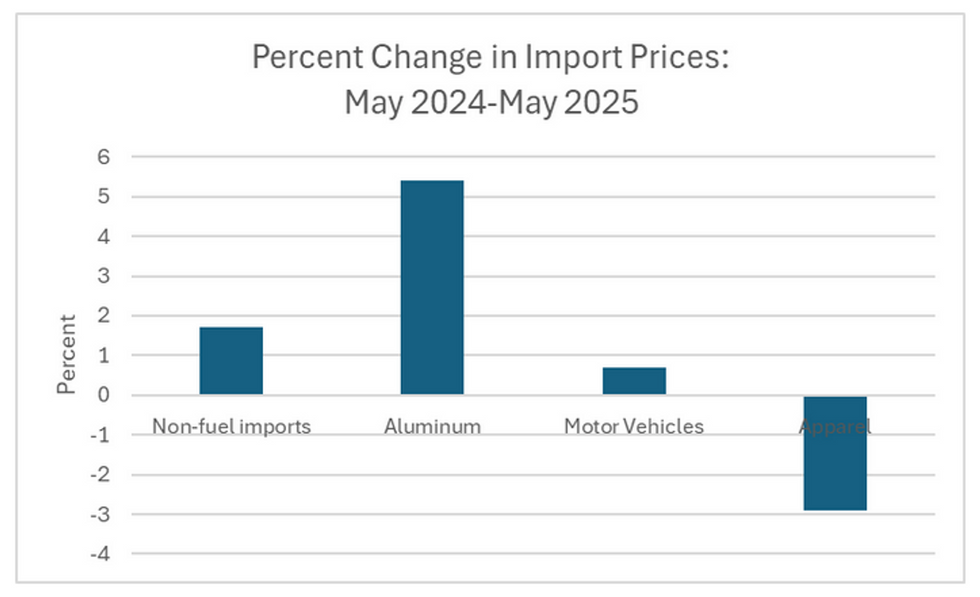
This is not hard to demonstrate. We have data on import prices through May of this year. This is before many of Trump’s tariffs hit, but items for most countries already faced a Trump tax of at least 10 percent, with much higher taxes on goods from China, as well as aluminum and cars and parts.

If other countries were paying the tariffs, then the prices of the goods we import, which do not include the tariff, would be falling. They aren’t.

To start with the big picture, the price of all non-fuel imports was 1.7 percent higher in May of 2025 than it had been in May of 2024. That doesn’t look like exporters are eating the tariffs. If we want a base of comparison, non-fuel import prices rose by just 0.5 percent from May of 2023 to May of 2024. If we want to tell a story of exporters eating the tariffs, we’re going in the wrong direction.

If we look to motor vehicles and parts, the numbers again go in the wrong direction. Import prices are 0.7 percent higher than they were in May of 2024. If we turn to aluminum the story is even worse. The price of aluminum imports was 5.4 percent higher in May of this year than a year ago.

There is a small bit of good news on apparel prices. This index for import prices was 2.9 percent lower in May of 2025 than the prior. But before celebrating too much, it’s worth noting that the price of imported apparel goods had already been dropping before Trump’s tariffs. It fell 0.3 percent from May of 2023 to May of 2024.

It’s also worth noting that much of this apparel comes from China, where items now face a 54 percent tariff. Insofar as our imported apparel comes from China, this 2.9 percent price decline would mean exporters are eating just over 5 percent of the tariff. That would mean that if Trump imposed import taxes of $2 trillion over the next decade, we will pay $1.9 trillion of these tariffs.

In short, whatever Trump may say or think, people in the United States will be paying his tariffs. They amount to a very big and not beautiful tax increase on ordinary workers.

NOW READ: There's only one way to stop Trump

Trump set to whack workers with historic $2,000 tax hike

The waiting is almost over, Donald Trump is about to hit America’s workers with the largest tax increase they have ever seen. Trump’s taxes on imports (tariffs) from Canada, Mexico, and China will cost people in the United States somewhere around $260 billion a year or around $2,000 a household.

This is far larger than any tax increase we’ve seen in the last half-century, and unlike tax increases put in place by Clinton and Obama, it will primarily hit low and middle-income households. Their tax increases primarily hit the top 1% percent, which is probably why they got so much more attention from the media.

It is not clear what our reality TV show president hopes to accomplish with these tax hikes. His stated reasons don’t make much sense. Canada, Mexico, and China are already cooperating with the U.S. on the issues he is complaining about. There is a minimal flow of fentanyl and undocumented immigrants from Canada.

If Trump can’t find major savings in the budget, then he will have to raise other taxes if he doesn’t want to hugely increase the deficit with his tax cuts for the Elon Musk crowd. This is the most obvious explanation for Trump hitting us with his huge import taxes.

Mexico sharply curtailed the flow of undocumented immigrants following a deal with Biden last summer. We can look to reduce the flow further, but that could probably be accomplished by negotiations rather than imposing a big tax on U.S. households.

China has also cooperated in reducing the flow of precursor substances for making fentanyl. Here also there were probably better prospects for further reductions through a path of negotiations rather than Donald Trump’s big tax increases.

Also, unlike Canada and Mexico, China’s economy is not that dependent on its trade with the U.S. China’s exports to the U.S. come to less than 2.5 percent of its GDP. If Donald Trump’s taxes reduce that by half, it could look to export to other countries (like Canada or Mexico) or increase domestic demand.

It seems implausible that Donald Trump’s stated reasons for his tax increase are his actual reasons. In principle, taxes on imports can be used as part of an industrial strategy to build up key industries, as was explicitly the case under Biden. His tariffs were intended to promote the advanced semi-conductor industry, as well as solar and wind energy and electric cars.

However, it would be difficult to find any evidence of an industrial strategy in Trump’s plans. He actually is deliberately sabotaging the industries Biden sought to foster.

There is an old saying in Washington that if you want to understand politicians, look at what they do, not what they say. On that front there is no ambiguity. Donald Trump is imposing big new taxes, and he is doing it in a way that does not require congressional approval.

He has made no secret of his intention to cut taxes on the wealthy. While Elon Musk and DOGE boys have put on a good show with the chain saw and breaking into various government agencies, the savings they can actually identify don’t amount to much.

If Trump can’t find major savings in the budget, then he will have to raise other taxes if he doesn’t want to hugely increase the deficit with his tax cuts for the Elon Musk crowd. This is the most obvious explanation for Trump hitting us with his huge import taxes. It sounds much better to pretend he’s cracking down on fentanyl and illegal immigration than to say he’s whacking ordinary workers with a big tax increase. But that is what Donald Trump is doing.

Correction/Update: This post has been updated from its original to better reflect estimates based on what the Trump administration clarified exactly what tariffs would be put into place.

The speed of economic recovery depends on how soon we control the virus

There have been a number of pieces in major news outlets telling us what the recovery will look like from this recession. Most have been pretty negative. The important thing to know about these forecasts is that the people making these forecasts don’t have a clue what they are talking about.

Keep reading...Show less

A bold plan to strengthen and improve Social Security is what America needs

The Social Security 2100 Act proposed by Connecticut Representative John Larson is getting closer to being passed by the House of Representatives. It now has more than 200 co-sponsors. If it were to be approved and become law, it would both improve the program’s benefit structure and its financial picture.

Keep reading...Show less

The corporate media is boosting Trump's myths about trade. Here's the truth.

The New York Times (8/10/19) ran an article this month with a headline saying that the 2020 Democratic presidential contenders faced a major problem: “How to Be Tougher on Trade Than Trump.” Serious readers might have struggled with the idea of getting “tough on trade.” After all, trade is a tool, like a shovel.  How is it possible to get tough on a shovel?

Keep reading...Show less

Why aren’t Democrats talking about ending patent-financed drug research?

Many of the leading Democratic candidates, especially Bernie Sanders and Elizabeth Warren, have been putting forward bold progressive plans in a wide variety of areas. Sanders and Warren have both supported a quick transition to a universal Medicare program, with no premiums, co-pays, or deductibles. Several candidates have supported a Green New Deal, which in some versions would guarantee every worker in the country a decent paying job.

Keep reading...Show less

This is what's really happening in US-China negotiations

Readers of this NYT piece on Robert Lighthizer, United States trade representative, and his negotiations with China may have missed this point. The piece said that one of Lighthizer’s main goals was to stop China’s practice of requiring that companies like Boeing and GE, who set up operations in China, take Chinese companies as business partners.

Keep reading...Show less

Billionaire Jeff Bezos’ Washington Post Tells You Not to Worry About Those Billionaires

Just when you thought economic commentary in the Washington Post couldn’t get any more insipid, Roger Lowenstein proves otherwise. In a business section “perspective” (7/20/18), he tells readers:

Keep reading...Show less

Amazon's Jeff Bezos Is on a Quest to Find America's Stupidest Mayor

With the Super Bowl now behind us, America eagerly awaits the next big event: the announcement of the winner in Jeff Bezos’ contest to determine which combination of state and local governments is prepared to give him the most money to be home to Amazon’s new headquarters.

Keep reading...Show less

Early Reviews of Trump Tax Cut Are Not Good: Capital Goods Orders Fall in December

The centerpiece of the Republican tax cut was a big reduction in the corporate tax rate, lowering it from 35 percent to 21 percent. While critics argued this was just a handout to shareholders, who are overwhelmingly wealthy, the counter was the tax cut would lead to a surge in growth, which would benefit everyone.

Keep reading...Show less

Are We in the Midst of Another Housing Bubble?

There has been much greater concern about the danger of asset bubbles ever since the collapse of the housing bubble sank the economy. While it is good that people in policy positions now recognize that bubbles can pose a real danger, it is unfortunate that there still seems very little understanding of the nature of the problem.

Keep reading...Show less

The Democratic Party Must Part Ways with Wall St

Doug Schoen, a former consultant to Bill Clinton, argued the case that the Democrats should keep their ties to Wall Street in a NYT column this morning. While he does advance his argument with some red-baiting and bad logic, he uses tradition as a starting point.

Keep reading...Show less

Welfare For Wall Street: Fees On Retirement Accounts

Most of us are willing to help out those who are less well off. Whether it comes from religious belief or a sense of basic decency we feel are an obligation to provide the basic necessities of life for the poor. But how would we feel about being taxed $1,000 a year to provide six figure salaries to people in the financial sector? Although no candidate to my knowledge has ever run on this platform, this is the nature of the retirement system the federal government has constructed for us.

Keep reading...Show less

Trump Team Resurrects Voodoo Economics Pushing Tax Cuts and Ludicrous Growth Projections

Office of Management and Budget Director Mick Mulvaney had a Wall Street Journal column highlighting the benefits of "MAGAnomics." The piece can best be described as a combination of Groundhog Day and outright lies.

Keep reading...Show less

Why Does the Washington Post Want Disabled People to Suffer More?

At a time when an ever-larger share of national income is going to the richest 1 percent, and large segments of the working class population are seeing rising mortality rates, the Washington Post naturally turns to the country’s most pressing problem: the number of people receiving disability payments from the government.

Keep reading...Show less

Trump and Paul Ryan Are Engaged in a Footrace to Destroy Our Federal Government

The budget proposal put forward by the Trump administration has been widely attacked on a variety of grounds. It is clearly making ridiculous assumptions on tax revenue, which don't make sense even with its implausible assumptions on economic growth. It also calls for large cuts to a variety of programs on which low and moderate income families depend like food stamps and Medicaid.

Keep reading...Show less

Blaming the Boomers for Growing Poverty in America Is Just a Media Distraction in Service of the 1%

The main economic story of the last four decades is the massive upward redistribution of income that has taken place. The top 1 percent’s share of national income has more than doubled over this period, from roughly 10 percent in the late 1970s to over 20 percent today. And this is primarily a before-tax income story: The rich have used their control over the levers of economic power to ensure that an ever-larger share of the country’s wealth goes into their pockets. (Yes, this is the topic of my book, Rigged.) (It’s free.)

Keep reading...Show less

Why the NY Times Is Chiefly Responsible for the Mass Ignorance About the U.S. Budget

Paul Krugman criticized the Trump administration for its budget, which would cut or eliminate many programs that benefit low and moderate income people. In his piece, Krugman points out that the public is incredibly ignorant on the budget, with most people having virtually no idea of where most spending goes.

Keep reading...Show less
BRAND NEW STORIES
@2026 - AlterNet Media Inc. All Rights Reserved. - "Poynter" fonts provided by fontsempire.com.