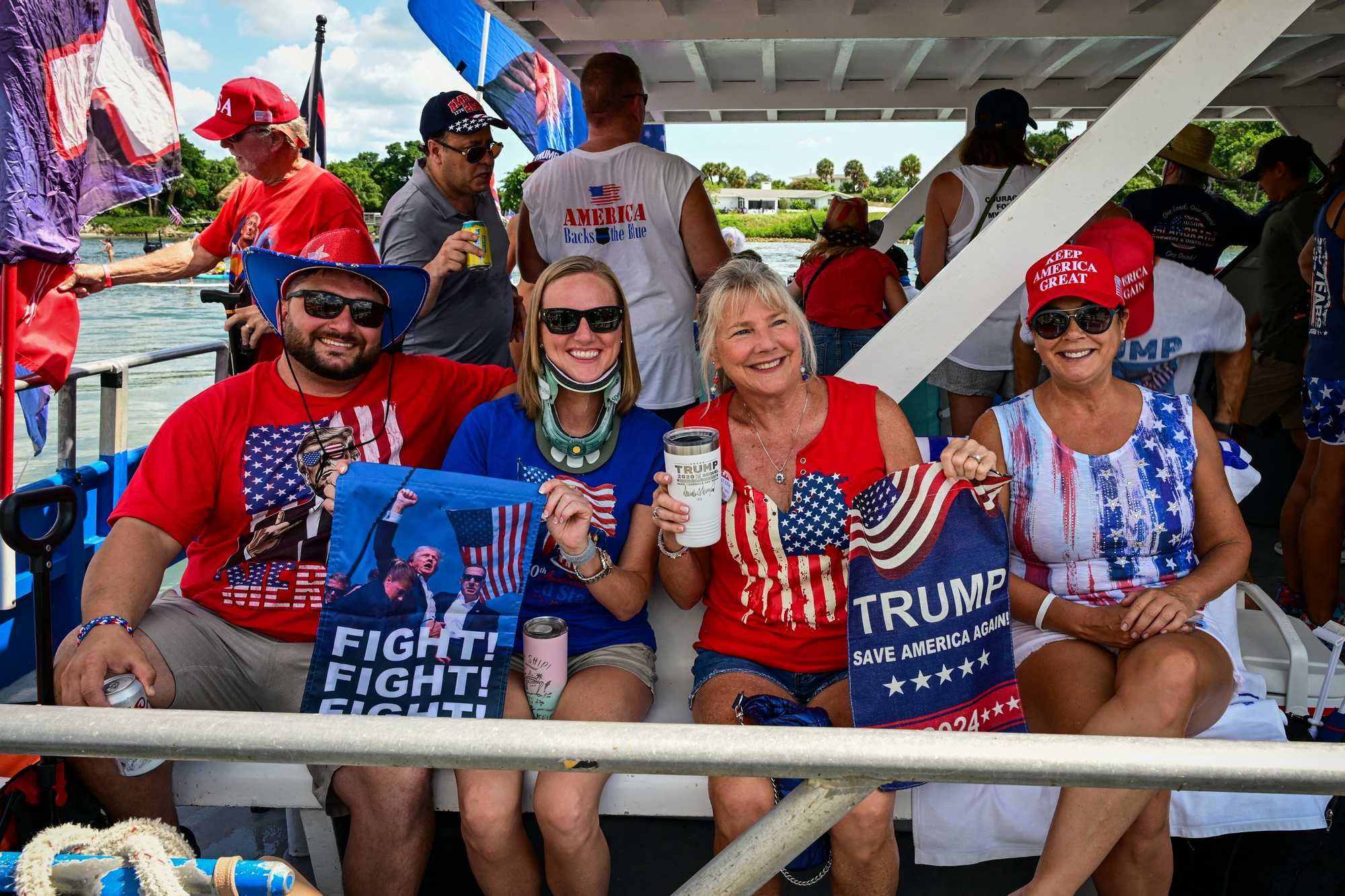
Supporters of U.S. President Donald Trump pose for a photo before the start of a boat parade celebrating his birthday, which coincides with Flag Day, in West Palm Beach, Florida, United States, June 14, 2026.
Supporters of President Donald Trump have made it clear that, for the most part, they will not turn on their champion even when he raises their prices, sends their soldiers to die in unprovoked wars and profits from his office to the tune of $2 billion. Instead they direct their hate toward groups that have never systematically harmed them — racial minorities, immigrants, women, gay people, transgender people, Muslims, Jews, leftists, Democrats, academics, scientists and the media.
To understand why, I turned to Dr. Stephan Lewandowsky, a cognitive scientist and professor of cognitive science at the University of Bristol who has writtenextensively about thepsychology behind Trump's movement. The following transcript has been lightly edited for clarity and length.
MATTHEW ROZSA: I've noticed with a lot of Trump supporters that they seem to take joy in causing pain to their perceived adversaries. For instance — and I'm going to get personal for a moment — as a liberal journalist, I get a sense that there are a lot of people who want to, quote, "own" me. "Own the libs" is a common expression. Why? And where does this — for lack of a better word — sadism come from?
DR. STEPHAN LEWANDOWSKY: Well, um, I can — that's a very good question. I have partial answers, but only partial. This is, you know, something we don't fully understand. First of all, if you look at internet trolls and their personality profiles, you find that they score very high on what's called the dark triad of personality: psychopathy, Machiavellianism, and — I forget the third one.
ROZSA: Narcissism?
LEWANDOWSKY: Yeah, probably. The dark triad — that's what it's called. So we know that trolls take pleasure in trolling, which means getting other people upset. And I think that's what we're observing here — this is basically trolling behavior. So would these people score high on the dark triad? I would think yes, but I don't know of any data that's done a personality profile specifically of MAGA voters. We do have it for trolls, though — I have data on that. People have published research on it, and the similarities are just overwhelming. So I'd be very surprised if these were well-adjusted, nice people.
ROZSA: The question then is, why do these same people demand sympathy when they are suffering?
LEWANDOWSKY: Well, why are people the way they are? Why would anybody be a sadist? I can't fully explain that, other than to say: of course they want sympathy when they're in pain — it's just that they have no empathy to extend to other people.
ROZSA: To give you an example — and this is a British citizen, I'm sure you know who Andrew Tate is —
LEWANDOWSKY: Oh yeah, yeah, yeah.
ROZSA: Andrew Tate and his supporters are whining that he's in jail, but he literally bragged about sex trafficking women. How do you think those women felt? They probably felt like prisoners too. It just galls and astonishes me that they demand sympathy for Tate being in prison but withhold that empathy for his victims, who were also imprisoned. How do you, as a cognitive scientist, explain this disconnect?
LEWANDOWSKY: Well, in the same way I'd explain why the Nazis on trial at Nuremberg felt incredibly sorry for themselves but never, in 12 years, had any empathy for their victims. These are pretty special people — not like the rest of us, I would argue. Certainly in a case like Tate's — I can't diagnose a person from a distance, but it certainly has all the hallmarks of sociopathic behavior, just looking at what the guy's doing. So, (laughs) you're talking about some pretty special people here.
ROZSA: I agree, but — and now I'm going to push further — while Tate has a relatively small following, Trump has a very large one, and the same behavior exists with them. They complain about being censored, and to an extent I agree — they complain about cancel culture — but then they're literally throwing Jimmy Kimmel and Stephen Colbert off the air for making jokes about the president. Or take farmers, for example: farmers are among the most pro-Trump groups, and they're very angry when anyone else gets welfare, but they want subsidies for their own economic suffering. There's a clear hypocrisy at play. And even though you say they're "special people," there are millions of them — there are entire states where this is a majority, in some cases an overwhelming majority of voters. How do you explain that?
LEWANDOWSKY: I used to live in Oklahoma for five years, so you can imagine — I'm familiar with farmers and that mindset, though that was a long time ago (laughs). Look, human beings do all sorts of things, and sometimes you just look at it and think, "What on earth?" Being hypocritical — feeling pain for yourself but not making the connection that maybe this other person is also in pain, and maybe we should support each other rather than throwing welfare recipients under the bus so I can have my subsidy — different people come to different conclusions about that.
There's so much tied up in this. There's latent racism. There's religion. There's the general conservative idea that poor people are — it's their fault, they're just lazy, everybody is responsible for what happens to them… except me, because I'm a farmer, and therefore I'm not lazy, and I've tried everything, and I deserve a subsidy.
There's a lot of attitudes and underlying currents tied up in this that are difficult to disentangle. But, as you said before, there is an angle of racism that I think is underlying pretty much all of this misogyny. If you sort of give an instrument to people that measures their racism and misogyny, well, it tells you about who they're gonna vote for and all that kind of stuff pretty well.