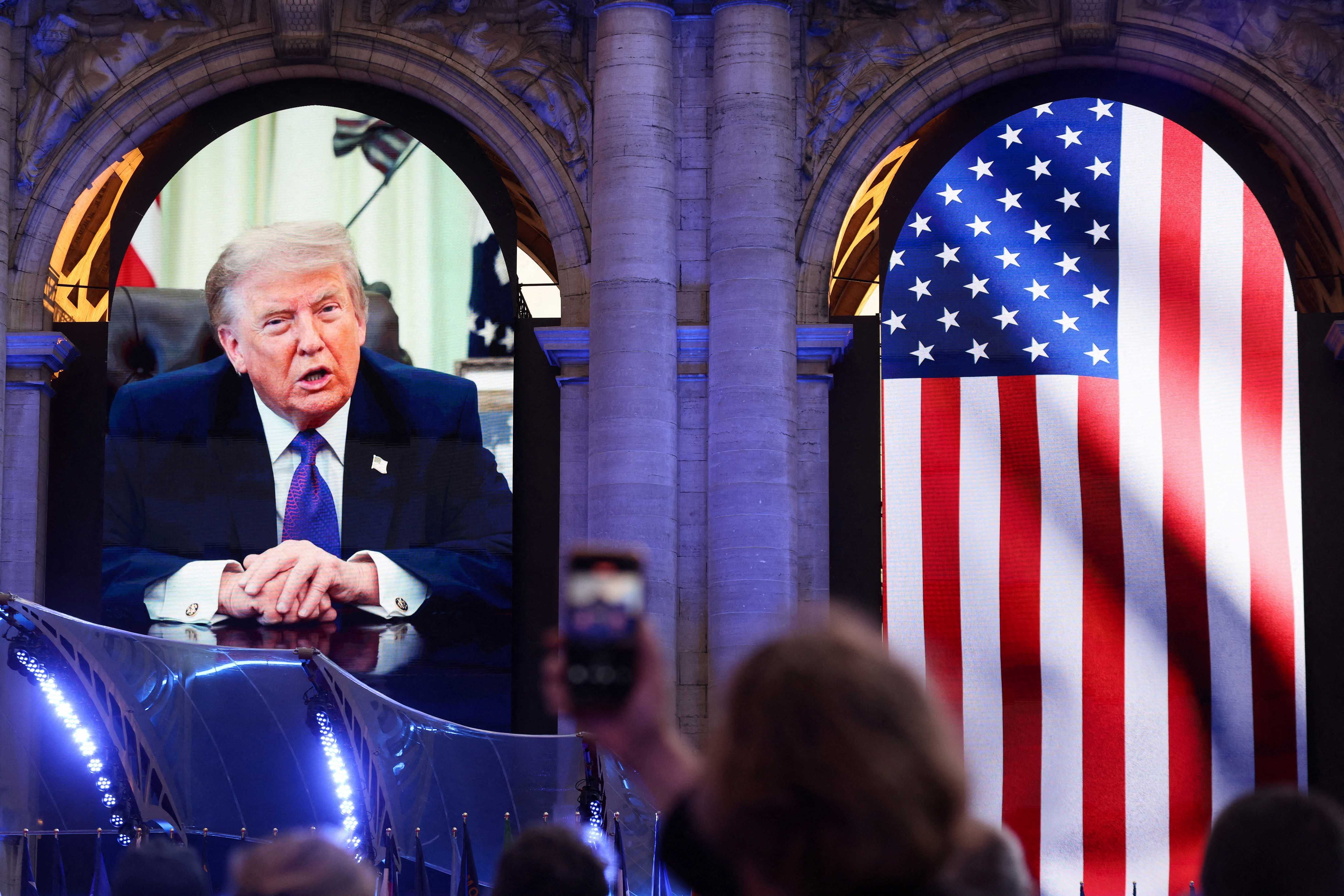
U.S. President Donald Trump appears on a screen in Brussels, Belgium, June 28, 2026.
Last week, the unlikely duo of Bernie Sanders and Steve Bannon keynoted a Washington conference to demand a stop to AI, its data centers, and the risks AI poses to jobs and even to the human species.
Notably, both lambasted the corporate oligarchs behind AI.
The most potent force in American politics is anti-establishment fury at a system seen as rigged against average working people. AI has become Exhibit A.
Until recently both parties largely avoided criticizing the wealthy corporate elites that funded their campaigns. In nature as in politics, one does not bite the hands that feed.
Trump Republicans have instead aimed populist fury at immigrants, LGBTQ+ people, Black and Latino people, “communists,” Muslims, so-called “woke” leaders, “coastal elites,” “childless cat ladies,” and other scapegoats.
Democrats — with the exceptions of Bernie Sanders, AOC, and a few others — have also avoided criticizing wealthy corporate elites, aiming populist fury at Trump.
This may be changing.
It’s becoming obvious to much of America that giant corporations have been raking it in while workers have been taking it on the chin.
As of mid-2026, according to the Bureau of Labor Statistics, the percentage of the total economy going to workers as wages fell to a record low of 52.9 percent (down from above 65 percent when tracking began in 1947) — leaving the rest to investors, business owners, and corporate profits.
AI is on the way to causing far more inequality — generating billions for its backers while reducing jobs and wages.
Trump and his regime, meanwhile, have exposed the greed, venality, cupidity, and corruption of America’s wealthy corporate elites by allowing them to do anything they want — including energy-guzzling, water-depleting AI data centers — as long as they kiss his assets by funding his PAC, paying for his ballroom, and singing his praises.
Trump has thereby unveiled the truth about corporate America that for years had been hidden behind corporate PR about “corporate social responsibility,” corporate charity, and “trickle-down” economics: The captains of corporate America are willing to throw average working Americans under the bus to make billions more.
Corporate avarice under Trump has become so blatant and corporate America’s contempt for the needs of average Americans so flagrant that most Americans are now catching on. In a recent NBC poll, 54 percent of Americans agreed that “When it comes to politics and society, nothing really matters because powerful people will always do whatever they want.”
AI may well be the final tipping point.
Data centers are unpopular — some 70 percent of the public opposes them. And Americans harbor deep suspicions of AI. Over 60 percent believe AI could destroy humanity (this includes 60 percent of Trump supporters).
Fears about AI are provoking larger concerns about wealthy corporate elites bribing politicians — not just to get generous subsidies for AI but also to reduce the corporate elite’s tax bills, kill off unions, slash social safety nets, deregulate Wall Street, attain no-bid government contracts, receive exclusive licenses, open tax loopholes, get tariff exemptions, use public lands, and become even bigger monopolies.
Because of Trump, Americans are coming to view those wealthy corporate elites as more aligned with Republicans than with Democrats. According to last week’s Times-Siena poll, when likely voters were asked which party the word “elitist” describes, 43 percentsaid Republicans while 33 percent said Democrats.
This is something of a return to how America’s two major political parties used to be viewed. Before World War II, Democrats were assumed to be on the side of working people against wealthy corporate elites. On the eve of his 1936 reelection, FDR told the American people they were fighting “business and financial monopoly, speculation, reckless banking, class antagonism, war profiteering …. We now know that Government by organized money is just as dangerous as Government organized by the mob.”
Will Democrats seize the moment and embrace the new AI-fueled economic populism? Or will they continue to succumb to the siren song of big money?
According to Politico, some Democratic political consultants are quietly urging candidates in the toughest battleground races to stay mum on AI “over fears that powerful and well-resourced pro-AI interest groups could spend money pummeling them in the final weeks of the midterms.”
It’s not just the future of the Democratic Party that’s at stake; it’s the future of America.
Robert Reich is a professor of public policy at Berkeley and former secretary of labor. His writings can be found at https://robertreich.substack.com/