Conservative studio accidentally releases action flick criticizing Trumpism
09 September
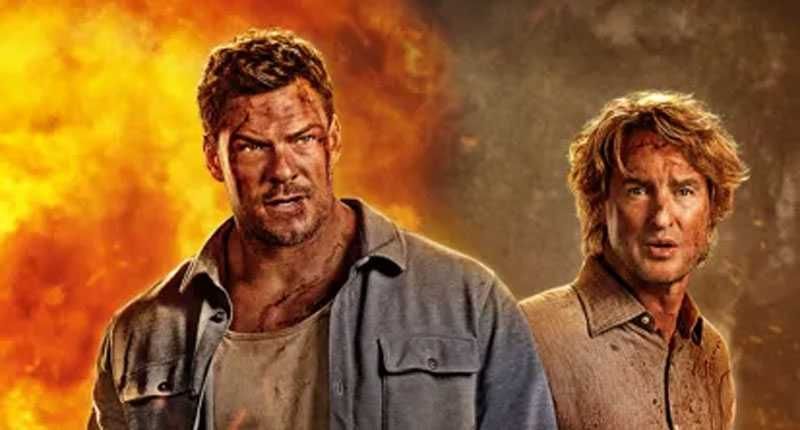
Crop from the movie poster for "Runner"
As I watched the new action movie "Runner," I kept thinking of two very different examples of American media — the 2009 movie "Saw VI" and the 2008-2013 TV show "Breaking Bad." Both the horror film and the drama series have premises that only work because America is inherently unjust in a very, very big way. In the case of "Saw VI," audiences see a slasher villain torture health insurance executives because they systematically deny patients the right to fight for their lives; as for "Breaking Bad," the story's antihero initially becomes a drug dealer to pay for cancer therapy he otherwise could not afford.
And "Runner"? While set in Australia and not the United States, its premise depends on the reality that America has severely curtailed stem cell research, and under President Donald Trump continues to slash funding for science and make it harder for people to afford health care. The premise is that a man with a dark past, Alan Ritchson (Hank Malone), must deliver a liver for transplantation to a dying little girl with the help of courier Ben Bishop (Owen Wilson) despite the violent efforts of cartel leader Damian Zaldívar (Rodrigo Santoro) to steal it for his ailing mother Donna (Adriana Barraza). Directed by Scott Waugh and written by Miles Hubley and Tommy White, "Runner" is highly competent in achieving what one hopes from the action genre. The key set pieces are thrilling and cleverly choreographed; the stakes are high enough that audiences are emotionally invested in the outcome; and it is briskly paced, avoiding the bloat that so often bogs down blockbuster fare.
Yet as I watched "Runner," I couldn't help but think of the political elephant in the room. Because Christian right-wingers in America and other conservatives throughout the world insist on treating stem cells as if they are actually alive, we lack the ability to fully realize the potential that exists in our body of biotechnological knowledge. If that wasn't the case — which is to say, if the capacity to develop stem cells to their utmost was being fully utilized, and we had universal health care — the rare liver for which our heroes fight to the death against our villains wouldn't provoke such bloodshed. People could simply have their own personalized livers and other essential organs developed if and as necessary.
After watching a screener for "Runner," I asked Santoro for his thoughts on this subject.
"I think you have a great question, and what I can say about that is, 'Look, the world we're living in right now with all the technology and AI and everything else, we will have to use that in our favor, and hopefully your question will be answered in a practical way,''" Santoro told me. "I think that we probably have everything to solve that."
I also reached out to director Kevin Greutert, who helmed "Saw VI," whose movie actually has the insight and courage to directly tackle the socioeconomic injustice behind its story's concept.
"You have to take the gloves off as much as corporate media will allow you to and tell as much truth about what a gnarly business it is," Greutert explained. "And as mega-corporations all start to intertwine more and more and get in bed with politicians, it becomes really hard to tell these sorts of courageous stories. So if the story itself doesn't step on any corporate toes, then they're probably all right just focusing on the human drama. But I think, for example, a movie about Luigi [Mangione], they can go ahead and present as much of his point of view as they'd like, and it will only make the movie more successful, barring getting canceled by the studio and/or the Republican administration."
This observation is not intended to diminish the positives about "Runner." Ritchson and Wilson are likable as the protagonists, and Santoro has a welcome opportunity to flex the villain chops he memorably exhibited in the classic 2007 sword-and-sandals motion picture "300" (as well as its underrated prequel, 2014's "300: Rise of an Empire").
"'300' is an action film, but my character, Xerxes, was not involved in the action," Santoro said. "I think this movie, 'Runner,' is the first time that I really got involved doing stunts and fights and all that good stuff. A lot of work, a lot of teamwork with the stunt team. They did an amazing job. I think you watched the movie, we had that final amazing sequence that took us a lot of time to accomplish. We rehearsed a lot. So it was very technical for me. In that way, it's very different than Xerxes, who was the king of the world; believed he was the king, and was up there from his throne, just shouting orders."
At the same time, I was disappointed that "Runner" didn't "take the gloves off" in confronting the delicate social subject matter coiling beneath the surface of its plot. If it had done so, "Runner" could have been more than simply a good movie, but instead a great one.