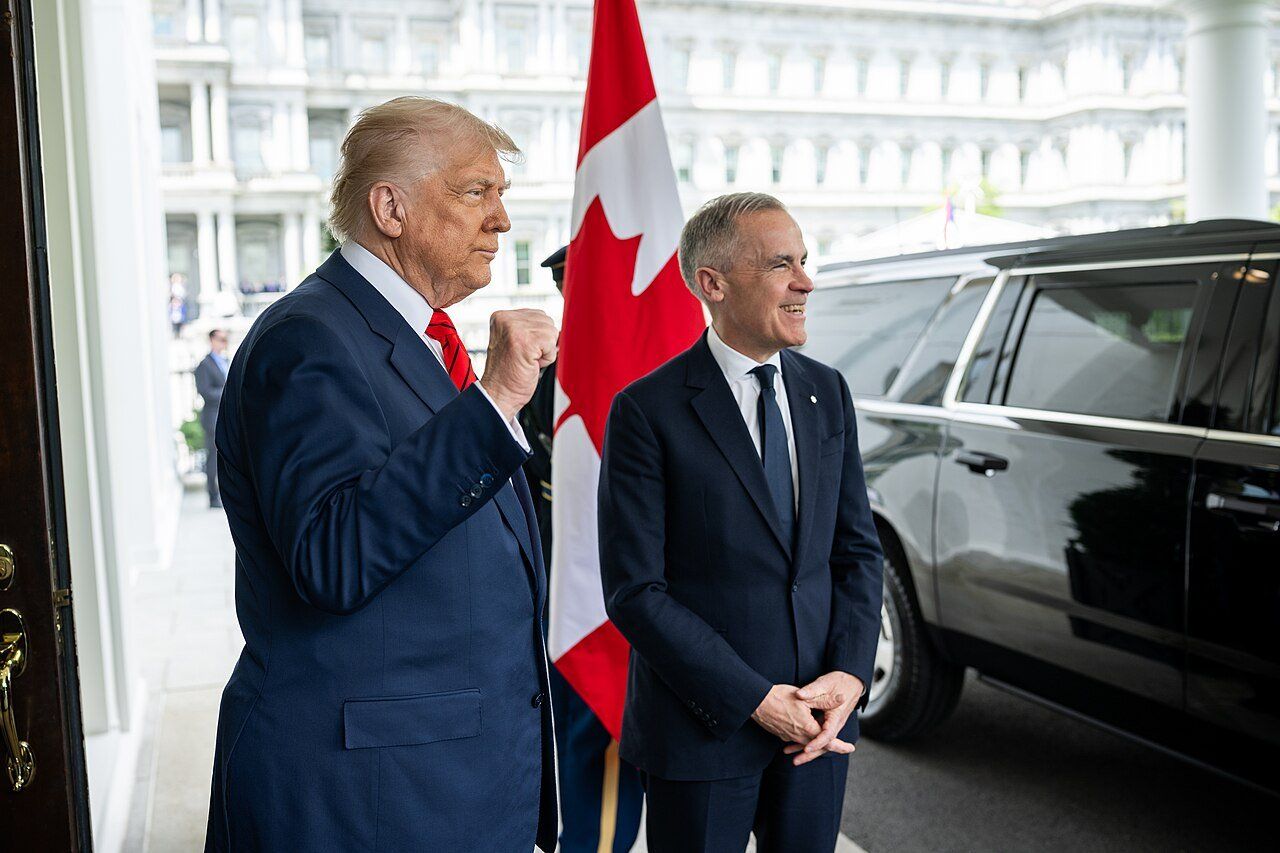
U.S. President Donald Trump with Canadian Prime Minister Mark Carney on May 6, 2025
President Donald Trump's ongoing trade war with Canada has done more than raise prices in both that country and the United States. According to one Canadian expert on US-Canada relations, it has supplied Canadians with a direct incentive to want to economically hurt Americans.
Before Trump rose to power, according to the Progressive Policy Institute trade expert Dr. Ed Gresser, it never occurred to American policymakers to be hostile toward Canadians. Trump "seems to have some real animus against Canada for reasons I don't understand. And that goes well beyond tariffs, although tariffs are kind of the main policy thing, but he's always sort of belittling Canada and calling it the 51st state and things like that. And it's just very — there must be — there seems to be something really personal involved in this, which I don't feel I have any insight into."
He concluded, "It's just, it's weird."
On the other side of the border, Dr. Don Abelson, a professor of political Science at McMaster University, offers insights into how Canadians are processing the "weird" behavior of America's president — and, specifically, how they are taking it out on American consumers.
The following interview has been lightly edited for clarity, context and length.
Rozsa: How do Canada’s retaliatory tariffs hurt ordinary American consumers?
Abelson: Unfortunately, that’s really the intent of applying tariffs: to make American consumers aware of how problematic their government’s position is on imposing tariffs on Canada in the first place. American consumers will be paying more for the softwood lumber they need to build their homes. They’ll be paying more for energy products exported from Canada. They will pay more for auto parts produced in Canada, and for aluminum and steel: all the things the American market and American consumers have come to depend on for many, many years.
Rozsa: For American consumers who are dealing with the fallout of these tariffs directly and indirectly, what can they do to ameliorate their suffering, at least when it comes to high prices?
Abelson: The best thing they can do is express their ongoing concerns to their members of Congress and to the administration. American consumers are paying more for gas, more for food, more for energy, more for lumber, all those things I’ve listed. There has to be an active campaign across the United States to voice concerns about the direction the Trump administration has moved in with respect to Canada-U.S. relations, and the relationship between the United States and some of its other traditional allies.
Rozsa: To what extent do Canadians understand that Trump supporters are only semi-sincere in their hostility, and that they are really in a cult of personality that views the anti-Canada rhetoric as something of a troll?
Abelson: I think that’s a great question. When you look at the 2024 results, and now going into the midterms on November 3rd, the majority of Canadians distinguish between the policies of the Trump administration and the attitudes of average Americans. We tend to have a fairly thick skin, and we understand some of the causes and consequences of increased polarization and hyperpartisanship in the United States. Having said that, 75 million Americans or more voted for Trump in 2024. We’ll have to see how much ground, how much support, he has lost in the coming month among Republicans who voted for him and some independents. I don’t know what his base would be among Democrats. But we’re aware that there’s a huge difference between the policies of your government and the attitudes of the American people.
Canada and the United States have enjoyed a very long, prosperous, and historic bilateral relationship, which is among the most important in the world. The concern the majority of Canadians have now is: What do Canada-U.S. relations look like once Donald Trump leaves office? Is it a return to the way things were under Joe Biden? Probably not. Is this going to be our new reality? Possibly, in some respects. What most Canadians are hoping for is a return to a very civil relationship between two sovereign countries that have come to depend on each other in many important ways. We don’t expect that things will return to normal, but we do expect and hope that the new reality will result in more cordial and collegial relations between our two countries.
Rozsa: I guess what you’re saying is that Canadians cannot stake their economic future on the whims of voters in purple states.
Abelson: You got it. And I’d make two additional points. Up to a third or more of U.S. states have Canada as their major export market. You asked a few minutes ago what Americans can do and what Canadians can do. One thing is appealing to state governors to try to restore the strength of this relationship.
The other issue is that for many years, and this is our own fault, not America’s fault, I think we’ve allowed ourselves to be lulled into a false sense of security. We’ve looked to the United States to absorb a disproportionate amount of the funding for continental defense and for other things we’ve come to rely on.
If there’s any silver lining in all the tensions that have arisen since 2016, when Trump entered the Republican presidential primaries, it’s that the Trump administration has given Canada the wake-up call it needed. For decades, there have been ongoing discussions in Canada about reducing our economic dependence on the United States and having more diverse markets for our exports. What you’ve seen since Mark Carney, our prime minister, came to office is a concerted effort to work more closely with our European, Asian, and Latin American allies in order to more effectively insulate our country against the vicissitudes of American politics. So if there is something positive to take away from this, it’s Canada’s realization that we need to be less dependent on the United States, and therefore more insulated from the politics south of our border. We also have to engage in what’s referred to as strategic sovereignty: we have to look at all the sectors in which our country is engaged and determine which ones we’re going to pursue agreements on with other states, again so that we are less exposed and less vulnerable to political trends in the United States.
So if anything, I think what Donald Trump has done is force our hand and make us wake up to the fact that we need to diversify our markets.
Rozsa: I’m wondering about the history of U.S.-Canada relations. In the 19th century, with the slogan “Fifty-four forty or fight,” James Polk, the Democratic nominee for president and later the president, threatened to invade Canada and take land [the United States] argued was its own. At that point, Canada was part of the British Empire, but this was still a threat against Canada. Clearly, between the 1840s and the 2020s, relations between the United States and Canada significantly improved. What caused that initial improvement, and could it occur again for similar reasons?
Abelson: As I often tell my students, Canada and the United States are two sovereign countries that represent interests that at times will align and at other times will conflict. When we look at the history of the Canada-U.S. relationship, there have been periods of very close cooperation, and periods when important bilateral and international agreements were signed. I had an opportunity for five years to work very closely with our 18th prime minister, Brian Mulroney. The period when Brian Mulroney worked very closely with Ronald Reagan, then President George H.W. Bush, and for a very brief time Bill Clinton, has been held up as the gold standard of how to engage in bilateral diplomacy. What facilitated that cooperation was mutual respect among the leaders of both countries.
To get back to where we were, or at least to a place where we’re not engaging so much in political rhetoric and we’re recognizing the benefits of cooperation, I think it’s going to take very effective, measured, and dedicated leadership in the United States, but in Canada as well. Our relationship with the United States has gone through ebbs and flows. We could go through every prime minister and U.S. president and focus on periods that seemed to work and others that caused friction. But something different has happened over the last decade, particularly with the Trump administration, but also with the Biden administration, which on its first day followed up with its own kind of “America First” or “Buy American” doctrine. They were obviously entitled to that, but it didn’t sit well with Ottawa.
We have to get used to the fact that when the United States historically talked about its special relationship, it wasn’t talking about us. It was talking about Great Britain. In many ways we have to mature as a country, and not take for granted that American interests will always coincide with ours. You are a superpower; we are not. We are a middle power. You have 10 times our population and a GDP we can only dream of having. But what doesn’t help is the ongoing rhetoric, insults, and offensive comments made by the American leadership toward our country. There’s no need for that. For the most part, we’ve had very cooperative relations. But both Justin Trudeau and Mark Carney have had to deal, and still have to deal, with a president who has a very different management style, one that millions of Americans support and millions do not. We need to adjust our strategy, because we can ill afford to lose or compromise what has been the most important bilateral relationship for us.
Rozsa: That was my last question. Is there anything else you’d like to say that you haven’t had a chance to with the questions I’ve broached so far?
Abelson: The only comment I would add concerns your question about how Canadian and American leaders try to keep the relationship intact. About a week or two ago, one of Trump’s economic advisors, Peter Navarro, made a comment criticizing Canadian lobbyists. That’s part of the political game. But Canada would not have to spend as much time, money, and effort getting on the radar inside the Beltway if not for the animosity and pushback that has been generated over the last several years. Having spent a lot of my career focusing on the role and impact of NGOs, I think they can play a very active and important role in bringing to the surface issues that concern both countries. As you pointed out very early in the interview, those issues have an impact across sectors on millions of Americans at the same time.
So that’s the only thing I would add: the importance of civil society, and of being actively engaged in these critically important discussions.