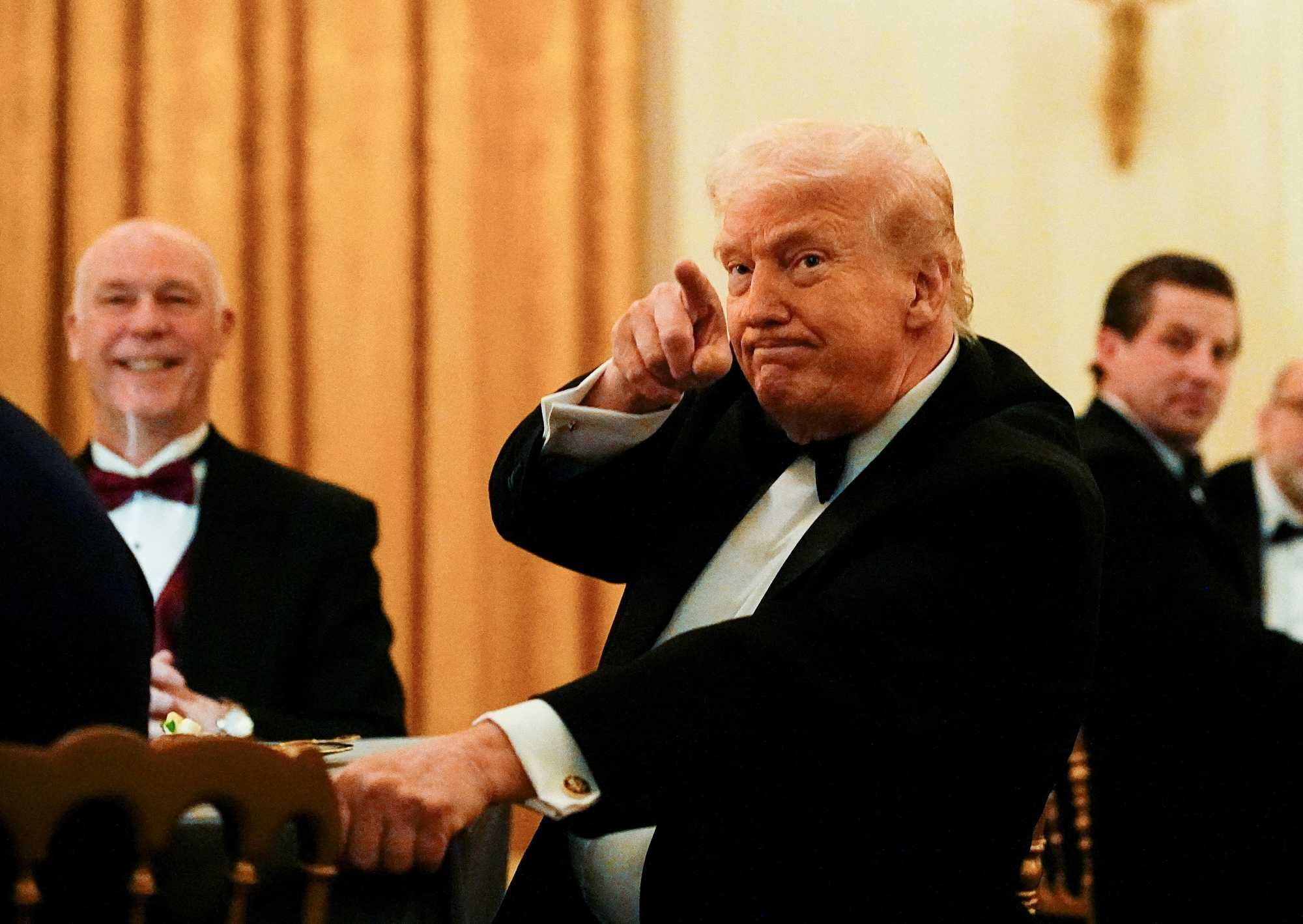
President Donald Trump attends a Governors Dinner at the White House in Washington, D.C., U.S., February 21, 2026. REUTERS/Aaron Schwartz
Whether you agree or disagree with President Donald Trump, he has definitely been impactful — especially when it comes to transforming the American economy.
He has raised tariffs, cut taxes for the rich and removed business regulations. On a personal level, he has enriched himself through the presidency to the tune of roughly $2 billion, far more than any president before him.
His critics claim that he is gutting American industry, worsening income inequality, allowing businesses to exploit people and poisoning our natural environment. Trump supporters, by contrast, claim these measures will cultivate domestic industry, create jobs and spread economic freedom.
To better understand these issues, I spoke with Dr. Justin Wolfers, a non-resident senior fellow at Brookings and the Peterson Institute and a University of Michigan professor of economics and public policy. He has contributed to The New York Times, helped write economics textbooks and co-hosts the Think Like an Economist podcast with President Barack Obama's former Labor Department chief economist and a Ford School of Public Policy at the University of Michigan economist, Betsey Stevenson.
The following interview has been lightly edited for clarity, context and length.
How Trump is destroying the US economy.
ROZSA: You once said that the key question economists need to examine is what makes some countries rich and others poor. Which specific Trump policies do you think do the most damage to long-run growth in America as opposed to short-term policies?
WOLFERS: Right. I was just gonna say I think that's exactly the right question. Too much of our commentary focuses on what GDP will be next month, next quarter, next year. But I think for most folks, what we care about is the sets of opportunities that will be offered over our lives and the opportunities that we'll leave for our kids, grandkids, and future generations. A lot of partisans have been somewhat disappointed that they see what looks like very bad policy from the administration, but they don't see it showing up as terrible economic statistics. And that's right. It isn't showing up as terrible economic statistics. There are weaknesses, to be sure.
But overwhelmingly, those who are saying gloom and doom aren't finding a ton of support. And that's because the overall thrust of Trumpism really has been about undermining the institutions that are foundational to American prosperity.
And so I think the real damage will be seen over decades, not quarters and not years. So you asked a more specific question: What have been the specific policies that have been most damaging? Let me give a general answer, and then I'll actually do the gracious thing and give you a specific one. The foundations of American prosperity reflect things like democracy, the rule of law, that we compete in the market rather than at Mar-a-Lago, that we engage with the rest of the world, that we respect the law, on and on, a list of things like that. Almost all of those things have come under some degree of attack from the administration. And in fact, this is a revolutionary, not a conservative, political moment. Trump and Trumpism are revolutionary, not evolutionary. And they're revolutionary in a tear-it-all-down sense.
Tear it all down makes a lot of sense if you think the current world isn't working at all well for you. So it might be a reasonable response to a failing economy, but the United States is one of the richest economies in the world. Tearing it down means tearing down the foundations that have created that immense prosperity. Let me come back, then — you asked for a specific example. I think the single worst day in recent American history was January 6th. I think democracy is foundational to American prosperity. Democracy's how we choose to put the right people in charge of our economy, and it's how we kick the bums out when they don't deliver. And if we walk away from democracy, then the bums who don't deliver will stay in power. And that means not just that we have bad policy for the next four years, but potentially for much longer.
So I really do believe a functioning democracy is so central. You know, there's questions of democratic theory, and they're important. I don't wanna diminish them, but lots of other people can make that argument. I wanna make the extra argument that I also think democracy is fundamental to our prosperity.
ROZSA: Would you say that Trump is keeping Americans poor long-term?
WOLFERS: I would say that he has tilted the balance in favor of fewer opportunities in the future than we would otherwise have.
ROZSA: In other words, keeping Americans poor long-term.
WOLFERS: No. "Keep Americans poor" — what does poor mean? The country of my birth, Papua New Guinea. Papua New Guinea is poor. America's rich. If we handled the economy well, the economy my kids inherit would be unbelievably rich. And if we handle it poorly, it won't grow, in which case we'd still have our reasonably high standards of material well-being. So I don't wanna use an absolute term like poor. What I fear is my kids are gonna grow up in a world where they're not going to notice that there was an invention that could have been invented here, that there are jobs that could have existed here, and there were forms of prosperity that could have existed that they won't see.
ROZSA: I think that is a valid point. You essentially reminded me to check my privilege as an American when comparing Americans' plight to those of other people.
WOLFERS: I didn't mean to hector you at all. We economists like to be somewhat precise about our language.
ROZSA: I didn't think you were hectoring me. You raised a valid point. I'd rather live in America's economy than Papua New Guinea's economy.
WOLFERS: Right. Right.
How we should understand Trump's key economic legislation.
ROZSA: You called the One Big Beautiful Bill the largest redistribution of money from poor to rich in a single bill in American history. How do you measure that, and how do you respond to Trump supporters who say lower business taxes raise investment and eventually wages?
WOLFERS: Right. So, first of all, I wanna give credit for the claim to my friend Brendan Duke, who first came up with an analysis. And the question of how do you measure how much redistribution there is in a bill is actually not that hard. You look at who's gonna get all the tax cuts, and you look at where all the spending cuts will hit. And what we saw in the One Big Beautiful Bill was a series of tax cuts primarily targeted to the wealthy, almost like they couldn't figure out where middle-class Americans were, except when it came to spending cuts, and the spending cuts on things like Medicare or SNAP — those cuts were very large. So this was really an anti-Robin Hood bill. And then the question is, if you go back and look at other individual bills, some of them have involved tax cuts for the rich; that's what the Reagan bills did. Some of them have involved spending cuts for the poor. None have involved both at this scale. I don't think it's even remotely debatable that this was the largest single redistribution from poor to rich.
Look, if it wasn't the largest redistribution from poor to rich in American history in a single bill, someone would've called me by now and told me a bill that had bigger effects, and no one has. No one in public discourse has said that that claim is false. It stands literally uncontested.
ROZSA: Does Trump and his family personally profiting from being in office have trickle-down effects that harm ordinary Americans?
WOLFERS: Yes, but not in the way you think. So let me make an observation. If Trump gets a billion dollars richer in a country with 340 million people, even if he took it directly out of the treasury, that's $3 per person. That's not very much. That's simply the claim that one man's profits are small relative to an enormous economy. But still, actually, I think the problems are far deeper than that. So the basic idea of a market economy is that you and I compete with each other. If I can bring goods to market at a lower price than you, then people will buy them from me rather than you. If I can create higher-quality goods than you, people will buy from me rather than you. The problem with the Trump family corruption — and not all of it's the legal definition of corruption, by the way; some of it meets the standard English-language definition, if not a legal definition — is what you do is you change the nexus of competition.
If the best way for me to get ahead is to go to the White House bearing gifts, and then they pass a rule and they ban you from competing against me, then that means the basic dynamics of competition and markets delivering good outcomes for regular folks just gets broken. That in turn means that if I'm the CEO of a company, I spend less time trying to create products at lower prices, trying to outcompete, or less time creating new or better products. And I spend more time and energy at Mar-a-Lago trying to win over the favor of the president. That means bad products will win. That means expensive products will win. And the way I tell the story, compare Tim Cook's job at Apple to Steve Jobs' job at Apple.
Steve Jobs was CEO at Apple before the Trump administration. Jobs was deeply involved in product innovation, and Apple was one of the most innovative companies in the world. Then Trump comes to power and Tim Cook takes over as the CEO of Apple. And now when you see Tim Cook, you don't see him huddled with engineers or designers trying to create the perfect phone; you see him at Mar-a-Lago or the White House trying to flatter the president. Tim Cook's job description no longer has been "create better and cheaper products for consumers." It's been "appease the White House so that they will allow us to import goods that we need from trading partners abroad, so that they won't regulate against us," and so on. And I tell the Tim Cook story not because Tim Cook is the only one, but rather to give a sense of the problem when you shift from a form of capitalism centered on market competition to a form of capitalism centered on relationships and crony relationships.
This is what we often call crony capitalism. I have a sense that many of your readers are somewhat to the left and not enamored of markets, and that's okay, because whether you like or dislike capitalism, crony capitalism is worse. And so you see this everywhere. One of the reasons the president uses tariffs is it's a presidential power. And now when you visit the White House, he might carve out an exception for your company or your industry or your country. And as he does so, and he's not doing it in the best interest of the American people, he's designing an economy that is both less competitive and that serves the American people less well.
ROZSA: It reminds me of a quote by President Grover Cleveland. In 1894, he argued that protectionist tariffs create a "communism of pelf," pelf being an archaic term for immoral money. Would you say that that observation holds up 132 years later and applies to Trump?
WOLFERS: I use different language, but I endorse the sentiment, which is: If a president holds the ability to make or break a company or an industry in his back pocket, and he does so in ways that are unpredictable, idiosyncratic, responsive to flattery and responsive to favors, and he does so in ways that further his narrow political self-interest or his personal interest rather than the interest of the American people, that is an enormous distortion that hurts regular people.
How Trump has destroyed the Republican Party.
ROZSA: Would you say that the Republican Party has forfeited its ostensible role as an advocate for free markets by allowing the Trump administration to behave this way?
WOLFERS: I have lots of friends who are Republicans. My friends who are Never Trump Republicans still believe in the party of Reagan or Bush or Romney, which was a party committed to capitalism, to markets, to trade, in many cases to immigration. And they grieve for their party, and they're trying to fight for their party, but they're also currently losing. You threw more of a red-meat statement at me. I love red meat, but I do think the party of Trump, the MAGA party, is not your father's Republican Party. It is not on any level committed to what my libertarian friends are in favor of, which is freedoms, or what many economists are committed to, which is the sense that markets often yield efficient outcomes. It's the most interventionist party of my lifetime. So the old critique of Democrats was that when you meddle with the economy, you make it inefficient.
This president has meddled in the economy to a greater degree, more frequently and more idiosyncratically than any other president in my lifetime.
ROZSA: I'm glad you talked about your lifetime, because that brings me to my final question. When you compare Trump's administration and his economic policies to those of his immediate 21st-century predecessors — George W. Bush, Barack Obama, and Joe Biden — what would you say are the strengths, and what would you say are the weaknesses?
WOLFERS: I'm gonna start with the strength. There is clearly something that led to the current moment, a sense among some that the economy wasn't working for them. And anger, and that anger led to this tear-it-down MAGA movement. I don't agree with them on tearing everything down, and I don't agree with their economic policy approaches, but I think understanding the primal scream of pain from folks who felt that economics and politics was divorced from an understanding of them in their everyday lives — I think that's something we should all think really, really hard about. And the president was able to understand and hear and tap into that sentiment. I think one of the greatest weaknesses: The president has deeply idiosyncratic views, and I tend to think that the average of a bunch of experts is usually a better guide than one old man's instincts.
I think many of the president's instincts have actually been spoiled even more by very, very weak implementation. So we could have a reasonable argument about whether tariffs are a good or a bad idea. I happen not to like them, but I have people I respect who think that in specific times and places they can be used in ways that could be productive. What I'm absolutely certain of is an incoherent tariff regime that changes from day to day and week to week and appears to move up and down and in and out with the president's mood is a terrible idea. That's a statement about the competence of the execution of economic policy rather than about the underlying ideas. And I think that competence question is actually very, very profound. You frequently see announcements of new economic policies where it appears that the administration has done less homework than I would do before preparing to deliver a lecture to my Economics 101 class at Michigan.
So that sheer competence or incompetence, I think, is problematic. I think that many of the economic ideas are just plain wrongheaded. They show a failure to understand the key ideas and lessons of economics and of history, and they refuse to engage with them coherently. And I think part of that is the president surrounded himself with an incredibly weak staff. And so often you have an idiosyncratic president who can appoint a strong staff and is willing to listen and be persuaded by good evidence where it exists, but I just don't see that at the moment.
ROZSA: Okay. If you had to ultimately compare him, though, to Bush, Obama, and Biden, which was my original question, how would you do so? I guess I'm asking you to rank them, although I'll understand if you don't want to give a one, two, three, four structure.
WOLFERS: Oh, no, no, that's easy. This one's easy. He's the worst president of my lifetime.
ROZSA: How would you compare Bush, Obama, and Biden to him? I do want that contrast.
WOLFERS: Yeah. I think that's a lot harder, because they each faced very different challenges. So, you know, my partner served in the Obama administration, so of course I'm gonna be pro-Obama. Those people were my friends. But, you know, Obama came to office during a global financial crisis. Biden came to office during a global pandemic. Bush had to deal with 9/11. What history doesn't give us is: How would Obama and Biden have dealt with 9/11? How would Bush and Biden have dealt with the financial crisis? How would Bush and Obama have dealt with the pandemic? That's probably the most important question in each of those presidencies. I do know how the Trump administration dealt with the COVID pandemic, and I thought it was an immense failure.