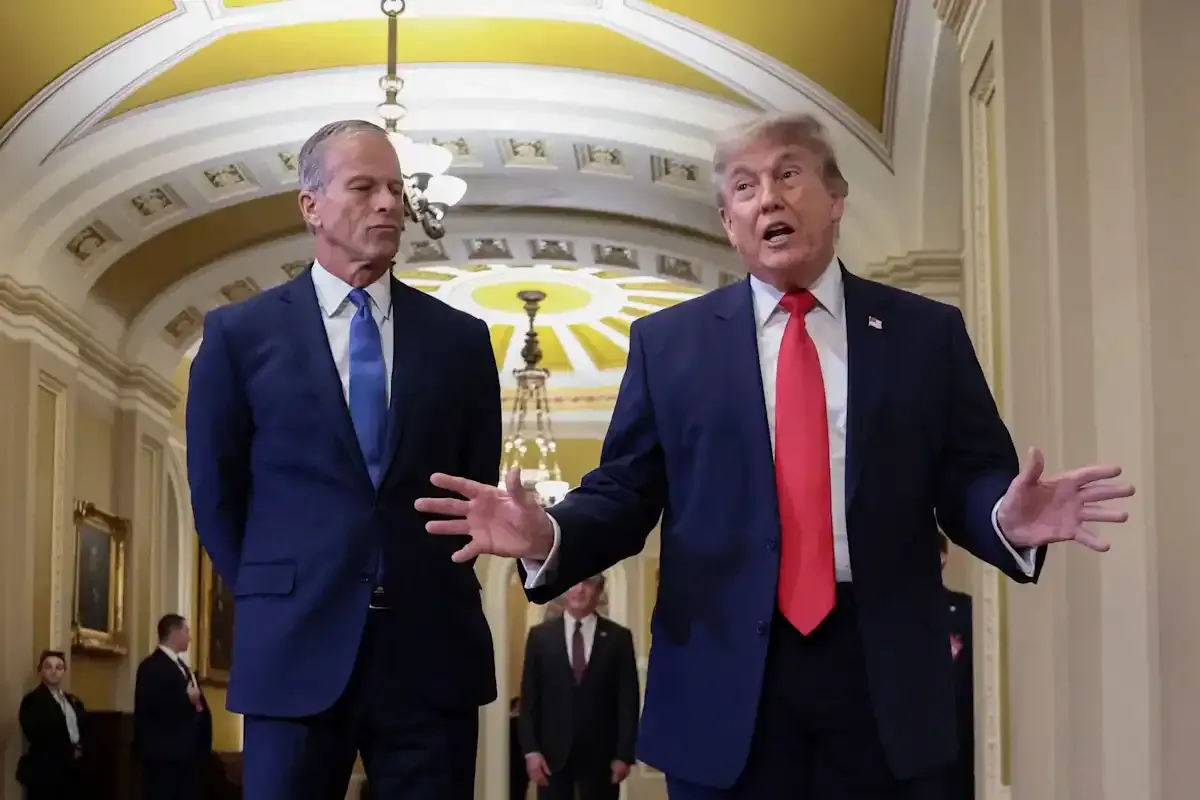
President Donald Trump speaks with the media while walking with Senate Majority Leader John Thune (R-SD), to the Senate Republican Steering Committee lunch at the U.S. Capitol, in Washington, D.C., U.S., June 24, 2026.
On Tuesday, Senate Majority Leader John Thune (R-SD) doubled down on President Donald Trump’s “mega-MAGA” campaign schedule that will bring the latter through some of the country’s reddest voting regions in an attempt to rally his base for the midterms. According to analysts, however, this “dubious strategy” will fail to bolster support where the GOP needs it most – swing states full of voters disappointed by the president’s “second-term failures.”
“I think that the president and his team, as they look at the electoral map, are figuring out where they think he can make the biggest difference,” said Thune when asked by reporters why Trump’s schedule focuses on Republican strongholds rather than battlegrounds. “Obviously all across the country, we need the president to turn out voters that are his voters. In a non-presidential year, in a midterm election, the challenge is always voter turnout, and in this case you have a lot of voters out there who might not be inclined to get out and vote. The president going out there and telling them how important it is will help turn those voters out, whether it’s in a red state, a swing state, or a blue state.”
According to longtime political commentator Ed Kilgore, “This dubious strategy might have made some sense if the president was hyperfocused on producing an (improbable) mega-MAGA turnout in the highly competitive states where a backlash to his second-term failures has made a Democratic Congress all but certain. Instead, his travel schedule has him flying around to campaign for the GOP in deep-red territory.”
“Those are all scheduling decisions the White House is making,” said Thune, “but I think they intend to deploy the president in ways that will help us achieve the best possible outcome in this election, and that is to preserve and protect our majority in the United States Senate and the majority in the House.” Thune’s statement adds weight to reports that the GOP is increasingly concerned about its vulnerability in the Senate.
“This very week,” notes Kilgore, “Trump is campaigning in Alabama, Oklahoma, and Ohio — states he carried by 30 percent, 34 percent and 11 percent just two years ago.” The fact that there are vulnerable House seats in Alabama and Oklahoma, he argues, is “a sign of how deep a hole the GOP has dug for itself. A trip to Ohio is arguably more justifiable; there are highly endangered but still winnable Senate and House races along with a close gubernatorial contest.” But by focusing on red states – “including Iowa and Texas, where there are an extraordinary number of ‘fires’ scorching Republican candidates – Trump reduces efforts in purple states like Arizona, Georgia, Michigan, Nevada, North Carolina, Pennsylvania, and Wisconsin.
“The 2026 midterms are to a very dangerous extent being fought on the home turf of the president’s party, leaving too much highly contested ground uncovered,” concludes Kilgore. “And it’s beginning to look like Trump in particular may be simply trying to mitigate losses rather than to win, which for a politician obsessed with ‘winning’ is a terrible sign.”