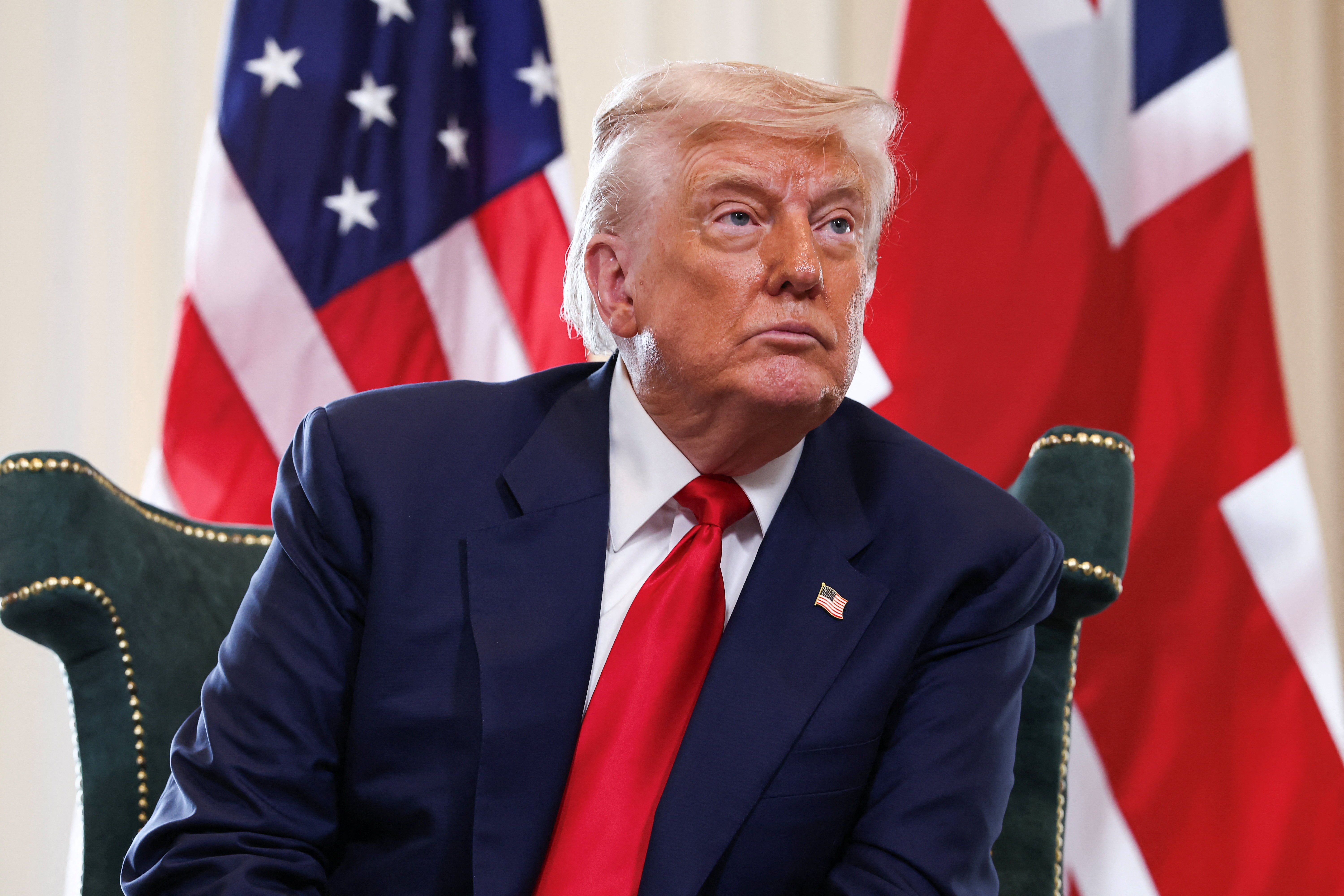
U.S. President Donald Trump and British Prime Minister Keir Starmer (not pictured) hold a bilateral meeting at Trump Turnberry golf course in Turnberry, Scotland, Britain, July 28, 2025.
President Donald Trump likes to consider himself America's greatest president, even picking a posthumous fight with former President Abraham Lincoln over the latter's conventional status as greatest president. Yet according to a conservative commentator, Trump may actually be the "worst president," at least based on how war against Iran is impacting the American economy.
"From the trough of February 2012, prices have been on a crazy upward march," reported The Bulwark's Jonathan V. Last on Tuesday. "This has been hard on buyers, but good news for homeowners."
He added, "That’s all changed in the last two months. The number of pending home sales dropped by a crazy 4 percent from August to September, bringing them to their lowest level since 2014 (excluding the pandemic)."
Last continued, "What happened is Fed rate hikes. In late August you could get a 30-year fixed mortgage for an average of 6.6 percent. Today you’d do well to get one for 7.4 percent. This shocked the market by pushing buyers out of the game, creating a huge oversupply."
The pundit went on, "So if you own a home, Donald Trump’s economic policies are eating away at your investment. But here’s where Trump’s special magic comes in: If you’re trying to buy a home, you’re worse off, too!" To prove the latter point, he observed that monthly payments are increasing even as market losses reduce immediate mortgage rates.
"So how did Trump break the laws of supply and demand?" Last asked. "Because interest rates inflict costs on nearly everything. Kind of like energy prices. If you do something to the economy that raises energy costs—like starting a war with Iran and then losing—it’s the equivalent of instituting a giant new tax. It’s not the case that one party’s loss is another party’s gain. It’s just losses all around."
He concluded that Trump chose this for America by "waging trade wars."
Speaking to AlterNet in September, University of Massachusetts — Amherst economist emeritus Dr. Richard Wolff agreed that Trump's belligerent rhetoric toward longtime trade allies such as Canada.
"I am not surprised that our government is surprised," Wolff told AlterNet about Trump's reported shock at Canada's defiance toward him. "Our government is busy strong-arming people around the world in every way that it can, militarily, economically, politically, and discovering time after time to their amazement, if you take them seriously, that the folks are going to resist. And that's what's going to happen."
He also said the Iran war is making matters worse.
"Israel and the United States thought they could bomb Iran June 2025, and that was a 12-day war because they couldn't get them to bend over and surrender," Wolff told AlterNet. "So they went to work, tried it again February 28th of this year. And they're not doing it. And so now you discover, gee, the people of Canada being threatened in this way and that way by the tariffs are not bending and are putting pressure on their leaders to find a way other than capitulation."
Speaking to AlterNet in April, a former presidential adviser told AlterNet that Trump's war against Iran is causing long-term damage to the economy.
“Even if hostilities do not restart, the price of oil will not return to pre-Trump levels because there’s a new risk premium that they could restart at any time, increasing tanker insurance costs for example, and because oil infrastructure has been degraded, reducing supply for some time,” President Bill Clinton's economics adviser Dr. Robert J. Shapiro told AlterNet at the time. “An Iran-controlled toll to use the Strait will produce big bucks for Iran, but its impact on world prices for oil, natural gas, helium, etc. should be minimal. Another source of economic friction will be the now-intense uncertainty about what the Trump administration will do next—in the Mideast and in scores of policies at home; and uncertainty dampens investment.”
He continued, “As it is, the economy was weakening before this crisis began, and these and other factors will exacerbate those downward pressures. A resolution over the next two weeks will not stop the deterioration in economic conditions.”