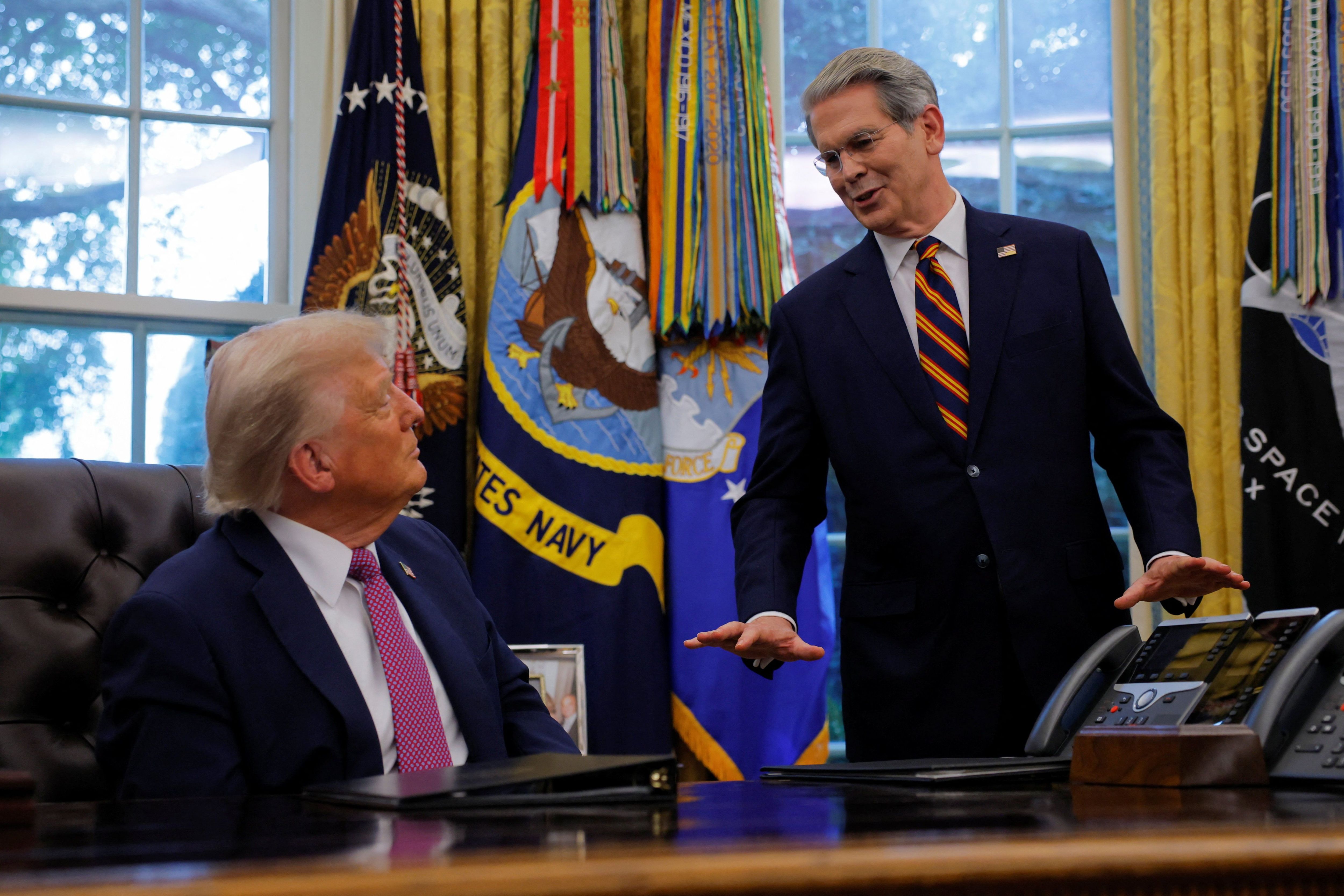
U.S. President Donald Trump speaks with U.S. Secretary of the Treasury Scott Bessent, in the Oval Office, at the White House in Washington, D.C., U.S., September 5, 2025. REUTERS/Brian Snyder
A very wealthy donor to President Donald Trump scored a deal with a Russian state-owned bank that would normally be off-limits due to sanctions, the International Consortium of Independent Journalists reported.
Konstantin Sokolov is a Russian-American businessman and a major donor to Trump's political groups. In 2025, he gave $11 million to MAGA Inc., the president's super PAC, and also contributed to Trump’s White House ballroom project.
Trump signed off on new sanctions last week. The new sanctions would target Russian officials, financial institutions, energy and defense sectors and oil-shipping networks. It also authorizes tariffs of up to 100 percent on major purchasers of Russian oil and gas, one explainer outlined.
But already, Trump's funder is exempt, according to a Treasury Department decision. Sokolov will be able to buy a major copper mine in Armenia from the Russian state-owned bank.
"The Treasury Department’s Office of Foreign Assets Control, known as OFAC, can grant a license to individuals or companies to complete transactions that would otherwise be prohibited by sanctions," the ICIJ explained. "OFAC states on its website that it may grant a license to do business with sanctioned Russian entities when it is in the interest of the applicant and the U.S. government."
Sokolov's spokesperson confirmed that such approval was given.
Sokolov was also appointed chairman of a new $200 million State Department enterprise fund that will invest in Central Asia and the South Caucasus, which is a strategic geographic region at the border of Eastern Europe and Western Asia. Armenia is expected to benefit. That means Sokolov has two overlapping roles: first, he owns or manages private businesses in Armenia, including the copper mine. Second, Sokolov helps oversee a U.S. government-backed investment fund that may invest in Armenia.
Armenian lawmakers and critics are concerned that the relationship creates a potential conflict of interest by essentially granting Sokolov public or government-supported investment and decision-making in a country where he also has large private financial interests.
Armenia’s National Assemblymember Mesrop Manukyan said when speaking to the ICIJ that Sokolov’s position “create[s] legitimate questions about … the separation between private commercial interest and decisions involving public or government-backed funds.”
Sokolov's spokesperson also claimed there was “no evidential basis” to link Sokolov's donations to Trump and approval by Trump's government. Suggesting otherwise “would be incorrect and wholly misplaced," they added.
While the administration and Sokolov deny any corruption, the report raises legitimate questions about transparency, favoritism and whether private business interests could overlap with Trump's government power.